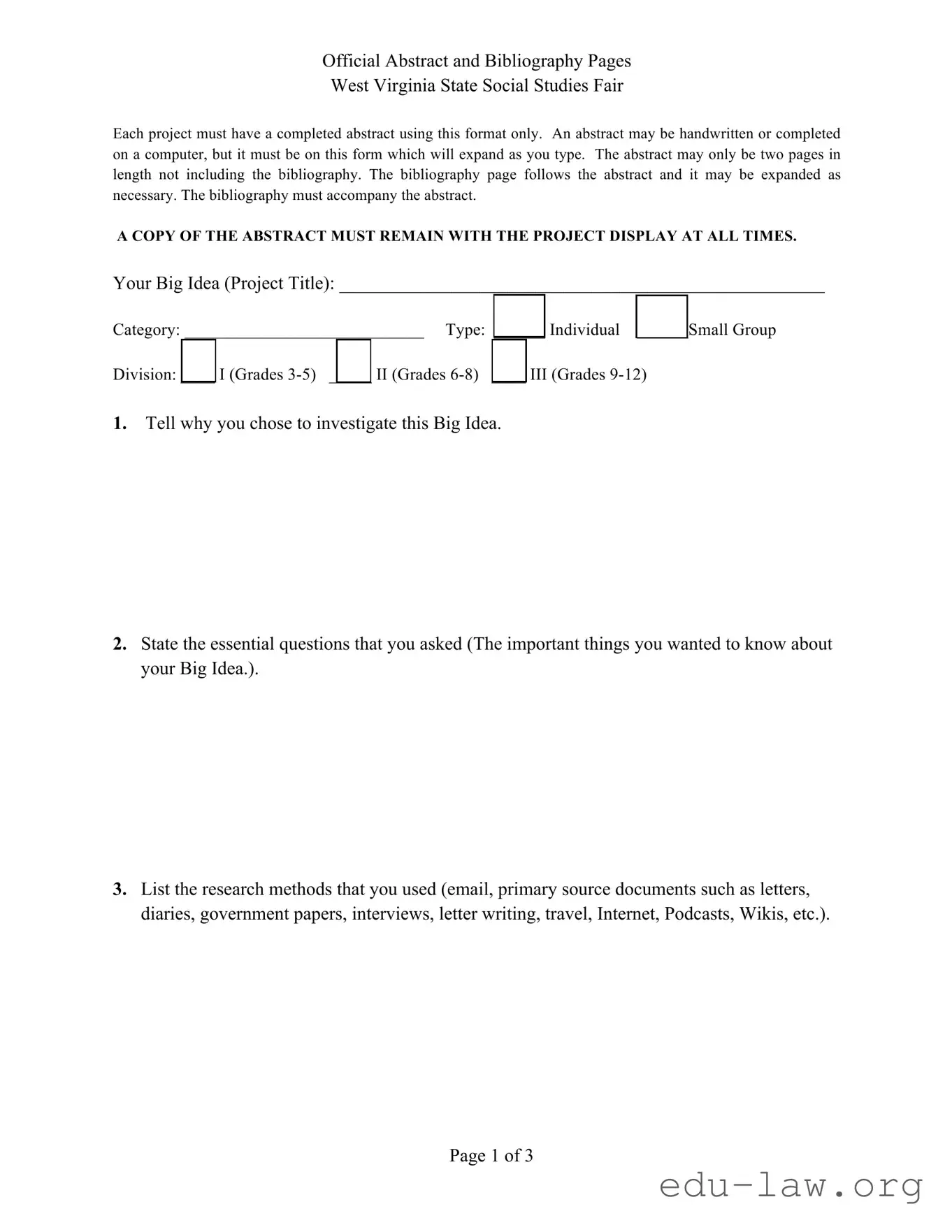
The West Virginia Abstract Social Studies Fair form serves as a vital tool for students participating in this educational event, guiding them through the process of presenting their research in a structured manner. This form is designed to capture the essence of each project, allowing students to articulate their "Big Idea" or project title clearly. Participants must categorize their projects and specify whether they are working individually or in small groups, alongside identifying their division based on grade levels. The abstract itself, limited to two pages, encourages students to reflect on their motivations for choosing their topics, formulate essential questions, and outline the research methods employed throughout their investigation. In addition, students are prompted to validate their sources, summarize their findings, and draw conclusions that suggest potential improvements or future predictions based on their learnings. Accompanying the abstract, a bibliography page is required to document the sources used, ensuring proper attribution and adherence to academic standards. This combination of elements not only fosters critical thinking and research skills but also prepares students for future academic endeavors.

Official Abstract and Bibliography Pages
West Virginia State Social Studies Fair
Each project must have a completed abstract using this format only. An abstract may be handwritten or completed on a computer, but it must be on this form which will expand as you type. The abstract may only be two pages in length not including the bibliography. The bibliography page follows the abstract and it may be expanded as necessary. The bibliography must accompany the abstract.
A COPY OF THE ABSTRACT MUST REMAIN WITH THE PROJECT DISPLAY AT ALL TIMES.
Your Big Idea (Project Title): ____________________________________________________
Category: ____________________________ Type: ______ Individual ______Small Group
Division: ____ I (Grades
1.Tell why you chose to investigate this Big Idea.
2.State the essential questions that you asked (The important things you wanted to know about your Big Idea.).
3.List the research methods that you used (email, primary source documents such as letters, diaries, government papers, interviews, letter writing, travel, Internet, Podcasts, Wikis, etc.).
Page 1 of 3
4.How did you validate your sources of information?
5.Write a brief summary of your project.
6.State your conclusion.
7.Suggest a way to change or improve the outcome, or make a future prediction about what you anticipate based on what you have learned.
Complete Your Bibliography on the Following Page
Page 2 of 3
Bibliography Page
You must use a bibliographic format which includes the author, title, place of publication,
publisher, and publication date.
Here is one of many sites for bibliography formats that include audiovisuals, Internet,
newspapers,
http://www.fcps.edu/KeyMS/library/bibliography.html
Page 3 of 3
| Fact Name | Details |
|---|---|
| Form Purpose | This form is used for submitting abstracts for projects at the West Virginia State Social Studies Fair. |
| Abstract Requirements | The abstract must be completed using the specified format and can be handwritten or typed. |
| Length Limit | The abstract is limited to two pages, not including the bibliography. |
| Bibliography Inclusion | A bibliography must accompany the abstract and can be expanded as necessary. |
| Project Display Copy | A copy of the abstract must remain with the project display at all times. |
| Big Idea Section | The form requires a section for the project title and category, along with the division based on grade level. |
| Research Methods | Participants must list the research methods used, including various sources like interviews and internet resources. |
| Source Validation | Participants are required to describe how they validated their sources of information. |
| Bibliography Format | The bibliography must follow a specific format, including author, title, place of publication, publisher, and publication date. |
Filling out the West Virginia Abstract Social Studies Fair form requires attention to detail and adherence to specific guidelines. This form captures essential information about your project, including your research methods, conclusions, and bibliography. Properly completing this form is crucial for showcasing your work effectively.
What is the purpose of the West Virginia Abstract Social Studies Fair form?
The form is designed to help students present their research in a structured manner. It ensures that each project includes essential components such as an abstract and bibliography, which are crucial for understanding the scope and sources of the research conducted.
How should I complete the abstract section of the form?
You can complete the abstract by either handwriting it or typing it on a computer. The form is designed to expand as you type, allowing you to fit your content appropriately. Remember, the abstract should not exceed two pages in length, excluding the bibliography.
What information is required in the bibliography?
The bibliography must include the author, title, place of publication, publisher, and publication date for each source you used in your research. This ensures that your work is credible and allows others to locate the sources you referenced.
Is it necessary to keep a copy of the abstract with the project display?
Yes, a copy of the abstract must remain with the project display at all times. This is important for judges and viewers to understand your project and the research behind it.
What are the categories and divisions for the projects?
Projects are categorized based on the grade level of the participants. The divisions are as follows: Division I for grades 3-5, Division II for grades 6-8, and Division III for grades 9-12. Additionally, projects can be classified as either individual or small group efforts.
What types of research methods can I include in my abstract?
You can list various research methods, including but not limited to email correspondence, primary source documents, interviews, travel, and online resources like podcasts and wikis. This diversity showcases the depth of your research approach.
How can I validate the sources of information I use?
Validating your sources involves checking their credibility and reliability. You can do this by considering the author's qualifications, the publication's reputation, and cross-referencing information with other reputable sources. This step is crucial for ensuring the integrity of your project.
Neglecting to use the correct form: Many participants overlook the requirement to use the official form provided for the abstract. This can lead to disqualification.
Exceeding the page limit: The abstract must be two pages long, not including the bibliography. Some students mistakenly include additional pages, which can result in penalties.
Forgetting the bibliography: A completed bibliography must accompany the abstract. Some forget to include it, which is a critical mistake.
Inadequate explanation of the Big Idea: Participants often fail to clearly articulate their project title or Big Idea, which is essential for understanding the focus of their research.
Vague essential questions: Essential questions should be specific and focused. Many students provide overly broad or unclear questions that do not guide their research effectively.
Not listing research methods: Some forget to include the various research methods they used. This information is crucial to demonstrate the depth of their investigation.
Failing to validate sources: Participants sometimes neglect to explain how they verified their sources. This step is important for establishing credibility.
Weak project summary: A brief summary should encapsulate the project's essence. Some summaries are too brief or lack essential details, making it hard to grasp the project's significance.
Ignoring future implications: The conclusion should suggest improvements or future predictions. Many students miss this opportunity to reflect on their findings and their potential impact.
The West Virginia Abstract Social Studies Fair form is an essential document for students participating in the fair. However, several other forms and documents complement this main form to ensure a comprehensive and well-organized presentation of a student's project. Below are some of the key documents often used alongside the Abstract Social Studies Fair form.
Each of these documents plays a vital role in the preparation and presentation of a project at the West Virginia Social Studies Fair. Together, they help students effectively convey their research and findings, fostering a richer educational experience.
The West Virginia Abstract Social Studies Fair form shares similarities with the research paper outline. Both documents serve as structured frameworks that guide students in organizing their thoughts and findings. A research paper outline typically includes sections for the introduction, body, and conclusion, similar to how the Abstract form asks for a summary, essential questions, and conclusions. Each element helps to clarify the research process and ensures that students present their work in a coherent manner. This organizational aspect is crucial for both assignments, as it allows students to articulate their ideas clearly and effectively.
Another document that resembles the West Virginia Abstract Social Studies Fair form is the project proposal template. Like the Abstract form, a project proposal outlines the main objectives and methodologies of a research project. It often requires students to state their research question, describe their intended methods, and explain the significance of their study. Both documents emphasize the importance of having a clear focus and a plan for how to approach the research, making them essential tools for students embarking on academic projects.
The science fair project report is also quite similar to the West Virginia Abstract Social Studies Fair form. Both require students to summarize their findings and present their research in a structured format. The science fair report typically includes sections such as hypothesis, methods, results, and conclusion, paralleling the Abstract's request for a brief summary and conclusion. This similarity highlights the necessity for students to communicate their research effectively, regardless of the subject matter.
Additionally, the thesis statement worksheet bears a resemblance to the Abstract form. Both documents guide students in articulating their main ideas and supporting arguments. A thesis statement worksheet helps students clarify their position on a topic, while the Abstract form requires students to summarize their project and its significance. This focus on clarity and precision in expressing ideas is vital for academic success in both instances.
Lastly, the reflective journal template shares common ground with the West Virginia Abstract Social Studies Fair form. Reflective journals encourage students to think critically about their learning experiences and document their thought processes. Similar to the Abstract, which prompts students to reflect on their research methods and conclusions, a reflective journal asks for insights and personal growth throughout the project. Both documents foster a deeper understanding of the learning journey and the importance of self-assessment in academic work.
When filling out the West Virginia Abstract Social Studies Fair form, there are some important dos and don'ts to keep in mind. Following these guidelines will help ensure that your project is well-presented and meets the requirements.
Misconceptions about the West Virginia Abstract Social Studies Fair form can lead to confusion and errors in project submissions. Here are ten common misconceptions, along with clarifications for each:
When filling out the West Virginia Abstract Social Studies Fair form, keep these key takeaways in mind: