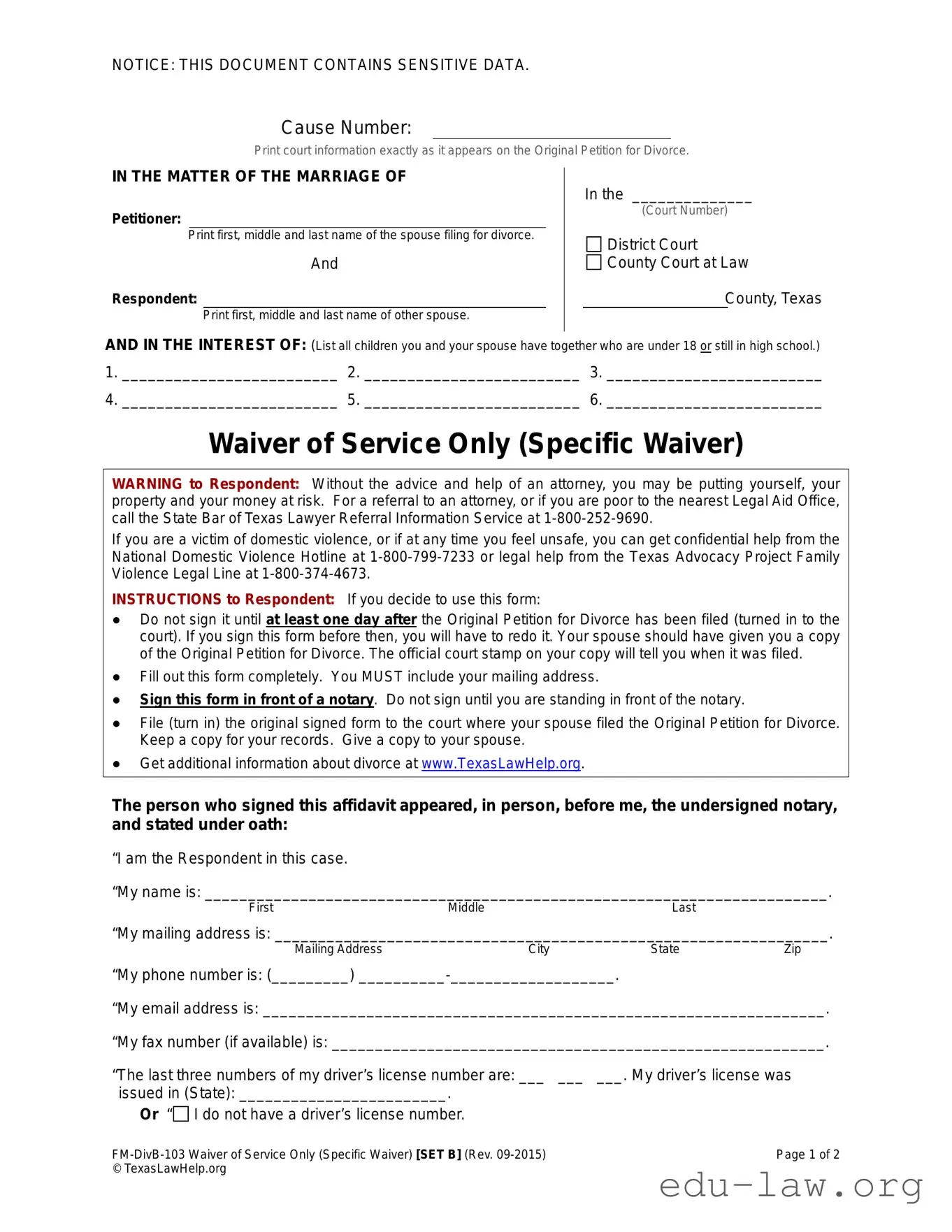
The Waiver Service form plays a crucial role in the divorce process, particularly for those seeking a smoother transition through legal proceedings. This document allows one spouse, known as the Respondent, to waive their right to be formally served with divorce papers, streamlining the process significantly. It requires specific information, including the cause number, names of both spouses, and details about any children under 18 or still in high school. The form also contains important warnings and instructions, emphasizing the need for legal advice and the potential risks of proceeding without it. Respondents must fill out the form completely, including their mailing address and contact information, and sign it in front of a notary. Notably, the form includes provisions regarding the Respondent's rights, such as the ability to contest any changes to the divorce petition and the necessity of receiving notice for court hearings. Additionally, it addresses military status and name change requests, ensuring that all relevant aspects are covered. By understanding the Waiver Service form and its implications, individuals can navigate their divorce proceedings with greater clarity and confidence.

NOTICE: THIS DOCUMENT CONTAINS SENSITIVE DATA.
Cause Number:
Print court information exactly as it appears on the Original Petition for Divorce.
IN THE MATTER OF THE MARRIAGE OF |
In the ______________ |
|
|
|
|
Petitioner: |
(Court Number) |
|
|
||
|
Print first, middle and last name of the spouse filing for divorce. |
□ District Court |
|
|
|
|
And |
□ County Court at Law |
Respondent: |
County, Texas |
|
Print first, middle and last name of other spouse.
AND IN THE INTEREST OF: (List all children you and your spouse have together who are under 18 or still in high school.)
1._________________________ 2. _________________________ 3. _________________________
4._________________________ 5. _________________________ 6. _________________________
Waiver of Service Only (Specific Waiver)
WARNING to Respondent: Without the advice and help of an attorney, you may be putting yourself, your property and your money at risk. For a referral to an attorney, or if you are poor to the nearest Legal Aid Office, call the State Bar of Texas Lawyer Referral Information Service at
If you are a victim of domestic violence, or if at any time you feel unsafe, you can get confidential help from the National Domestic Violence Hotline at
INSTRUCTIONS to Respondent: If you decide to use this form:
●Do not sign it until at least one day after the Original Petition for Divorce has been filed (turned in to the court). If you sign this form before then, you will have to redo it. Your spouse should have given you a copy of the Original Petition for Divorce. The official court stamp on your copy will tell you when it was filed.
●Fill out this form completely. You MUST include your mailing address.
●Sign this form in front of a notary. Do not sign until you are standing in front of the notary.
●File (turn in) the original signed form to the court where your spouse filed the Original Petition for Divorce. Keep a copy for your records. Give a copy to your spouse.
●Get additional information about divorce at www.TexasLawHelp.org.
The person who signed this affidavit appeared, in person, before me, the undersigned notary, and stated under oath:
“I am the Respondent in this case.
“My name is: ________________________________________________________________________.
FirstMiddleLast
“My mailing address is: ________________________________________________________________.
Mailing AddressCityStateZip
“My phone number is: (_________)
“My email address is: _________________________________________________________________.
“My fax number (if available) is: _________________________________________________________.
“The last three numbers of my driver’s license number are: ___ ___ |
___. My driver’s license was |
issued in (State): ________________________. |
|
Or “□ I do not have a driver’s license number. |
|
Page 1 of 2 |
|
© TexasLawHelp.org |
|

“The last three numbers of my social security number are: ___ ___ ___. Or “□ I do not have a social security number.
“I have been given a copy of the Original Petition for Divorce filed in this case. I have read the Original Petition for Divorce and understand what it says. I do not give up my right to review a different Petition for Divorce if it gets changed (amended).
“I understand that I have the right to be given a copy of the Original Petition for Divorce by a constable, sheriff or other official process server (legal notice). I do not want to be given legal notice. I give up my right to legal notice.
“I ask that the Court not enter any orders in this case unless the order is signed by me or unless I have received prior written notice of the date, time, and place of hearing.
“If I reach an agreement and sign a Final Decree of Divorce, the court can enter the Decree without me being present and without giving me notice. If I sign an agreed Final Decree of Divorce, I do not want a court reporter to make a record of the testimony.
“I understand that by signing this form I am entering an appearance in this case. I agree that a Judge or Associate Judge in the county and state where this case is filed may make decisions about my divorce, even if the divorce should have been filed in another county.
“I understand that I must let the Court and my spouse’s attorney (or my spouse if s/he is not represented by an attorney) know in writing if my mailing address or email address changes during this case. If I don’t, then I understand that any notices about this case will be sent to me at the mailing address or email address on this form.
Military Status (Check one box.)
“□ I am not in the military.
“□ I am in the military. I agree to the provisions stated above and I waive only the rights, privileges, and exemptions I have under the Servicemember’s Civil Relief Act that are contrary to those provisions.
Name Change (Check one box.)
“□ I am NOT asking the court to change my name.
“□ I ask the Court to change my name back to a name I used before my marriage. I am not asking the court to change my name to avoid criminal prosecution or creditors.”
_________________________________________________________________________________________
First |
Middle |
Last |
►
Signature of Respondent (Do NOT sign until you are in front of a notary.)
Notary fills out below.
State of
(Print name of state where this Affidavit is notarized)
County of
(Print the name of the county where this Affidavit is notarized)
Date
Sworn to and subscribed before me, the undersigned notary, on this date: |
|
/ |
/ |
|||
at |
|
a.m./p.m. |
Month |
day |
year |
|
|
|
|
|
|||
|
time |
|
circle one |
|
|
|
by
(Print name of person who is signing this Affidavit. NOT the notary’s name.)
[Notary Stamps Here ] |
|
|
|
|
|||
|
Page 2 of 2 |
||
© TexasLawHelp.org |
|
|
|
| Fact Name | Details |
|---|---|
| Document Purpose | The Waiver Service form allows the respondent in a divorce case to waive their right to be formally served with divorce papers. |
| Governing Law | This form is governed by the Texas Family Code, particularly sections related to divorce proceedings. |
| Signature Requirement | The respondent must sign the form in front of a notary public to validate it. |
| Filing Instructions | The completed form must be filed with the court where the Original Petition for Divorce was submitted. |
| Children's Information | The form requires the listing of all children under 18 or still in high school from the marriage. |
| Advice Warning | A warning is included, advising the respondent to seek legal counsel to avoid potential risks. |
| Legal Notice Waiver | By signing, the respondent waives their right to receive legal notice of court proceedings. |
| Military Status | The form includes a section where the respondent must declare their military status, which can affect their rights. |
| Name Change Request | The respondent can request a name change back to a name used before marriage, if desired. |
After completing the Waiver Service form, the next steps involve ensuring that the document is properly signed and filed with the court. This process is crucial for your divorce proceedings. Follow the steps below to fill out the form accurately.
What is the purpose of the Waiver Service form?
The Waiver Service form allows a respondent in a divorce case to waive their right to be formally served with legal notice of the divorce proceedings. By signing this form, the respondent acknowledges that they have received a copy of the Original Petition for Divorce and agree to the court proceeding without being present for formal service of process.
Who should fill out the Waiver Service form?
The Waiver Service form should be filled out by the respondent, which is the spouse who did not file the Original Petition for Divorce. It is important that the respondent understands the implications of signing this form and that they have received the necessary documentation from the petitioner.
When should the respondent sign the Waiver Service form?
The respondent should not sign the Waiver Service form until at least one day after the Original Petition for Divorce has been filed with the court. Signing the form before this time will necessitate completing a new form, as it will be considered invalid.
What information is required on the Waiver Service form?
The form requires the respondent to provide their full name, mailing address, phone number, email address, and the last three digits of their driver’s license and social security numbers, if applicable. This information is essential for the court to maintain accurate records and for communication purposes throughout the divorce process.
What happens after the Waiver Service form is signed?
Once the Waiver Service form is signed in front of a notary, the original signed form must be filed with the court where the Original Petition for Divorce was submitted. The respondent should keep a copy for their records and provide a copy to the petitioner. This ensures that all parties are aware of the waiver and the respondent’s agreement to the proceedings.
What are the potential risks of signing the Waiver Service form?
By signing the Waiver Service form, the respondent may be waiving important rights, including the right to receive formal legal notice of court proceedings. It is strongly advised that the respondent consult with an attorney before signing the form to understand the potential consequences fully. If there are concerns about safety or domestic violence, confidential resources are available for support.
Can the respondent change their mind after signing the Waiver Service form?
Once the Waiver Service form is signed and submitted, it may be challenging for the respondent to retract their waiver. They should carefully consider their decision before signing. If circumstances change or if the respondent feels they need to contest the divorce, they may need to seek legal advice to understand their options moving forward.
Incomplete Information: Many individuals fail to provide all necessary details, such as the complete names of both spouses or the required mailing address. Omitting this information can lead to delays or complications in the process.
Signing Before Notarization: Some people mistakenly sign the Waiver Service form before they are in front of a notary. This can invalidate the document, requiring them to repeat the process.
Not Following Filing Instructions: It is essential to file the original signed form at the correct court where the Original Petition for Divorce was filed. Failing to do so may result in the form not being recognized by the court.
Ignoring Legal Advice: Individuals often overlook the warning regarding the importance of seeking legal counsel. Without proper legal guidance, they may unknowingly jeopardize their rights and interests.
The Waiver Service form is an important document in divorce proceedings, particularly in Texas. It allows one spouse to waive formal service of the divorce petition, thereby streamlining the process. However, it is often accompanied by other forms and documents that are essential for a complete and legally sound divorce filing. Below is a list of these commonly used documents.
Each of these documents plays a crucial role in the divorce process. Understanding their purpose can help individuals navigate the complexities of family law more effectively. It is advisable to seek legal guidance when preparing these forms to ensure compliance with all legal requirements.
The Waiver of Service form shares similarities with the Affidavit of Service. Both documents serve to confirm that one party has received notice of a legal proceeding without the need for formal service by a process server. In the Affidavit of Service, the individual acknowledges receipt of the petition and waives the right to formal notification. This streamlines the process and can help expedite court proceedings, just as the Waiver of Service does in divorce cases.
Another document comparable to the Waiver of Service form is the Petition for Divorce itself. While the Waiver of Service indicates that one spouse is aware of the divorce action and does not require formal service, the Petition for Divorce outlines the reasons for the divorce and the relief sought. Both documents are essential in the divorce process, ensuring that both parties are informed and can proceed with the case efficiently.
The Consent to Modify form is also similar to the Waiver of Service. This document is used when parties agree to changes in existing court orders, such as custody arrangements or support payments. Just as the Waiver of Service indicates an agreement to proceed without formal service, the Consent to Modify shows mutual agreement on changes, which can simplify court procedures and reduce the need for additional hearings.
The Answer to Petition for Divorce serves a similar purpose as the Waiver of Service form. In this document, the respondent formally acknowledges the divorce petition and provides their response. While the Waiver indicates a lack of objection to the proceedings, the Answer allows the respondent to express their position. Both documents are crucial for moving forward in the divorce process, ensuring that the court has the necessary information to make decisions.
The Motion for Default Judgment is another document that relates closely to the Waiver of Service. This motion is filed when one party does not respond to the divorce petition, allowing the court to proceed without their input. In contrast, the Waiver of Service shows that the respondent is aware of the proceedings and is choosing not to contest them. Both documents impact how the court can handle the case, either by moving forward with or without the respondent's participation.
The Settlement Agreement is similar in that it outlines the terms agreed upon by both parties regarding the divorce. Like the Waiver of Service, which indicates that the respondent is aware of the proceedings and consents to them, a Settlement Agreement reflects mutual consent on various issues such as property division and child custody. Both documents help facilitate a smoother resolution to the divorce process.
Finally, the Certificate of Service is akin to the Waiver of Service in that it provides proof of communication between parties. This document confirms that one party has sent the necessary legal documents to the other party. While the Waiver of Service eliminates the need for formal service, the Certificate of Service ensures that all parties are kept informed about the proceedings, promoting transparency and accountability in the legal process.
When filling out the Waiver Service form, it is important to follow specific guidelines to ensure accuracy and compliance. Here are six things you should and shouldn't do:
Following these steps can help prevent delays and complications in your divorce process.
Misconceptions about the Waiver Service form can lead to confusion and potential issues during the divorce process. Here are six common misconceptions:
Filling out and using the Waiver Service form is a crucial step in the divorce process. Here are key takeaways to ensure you navigate this correctly: