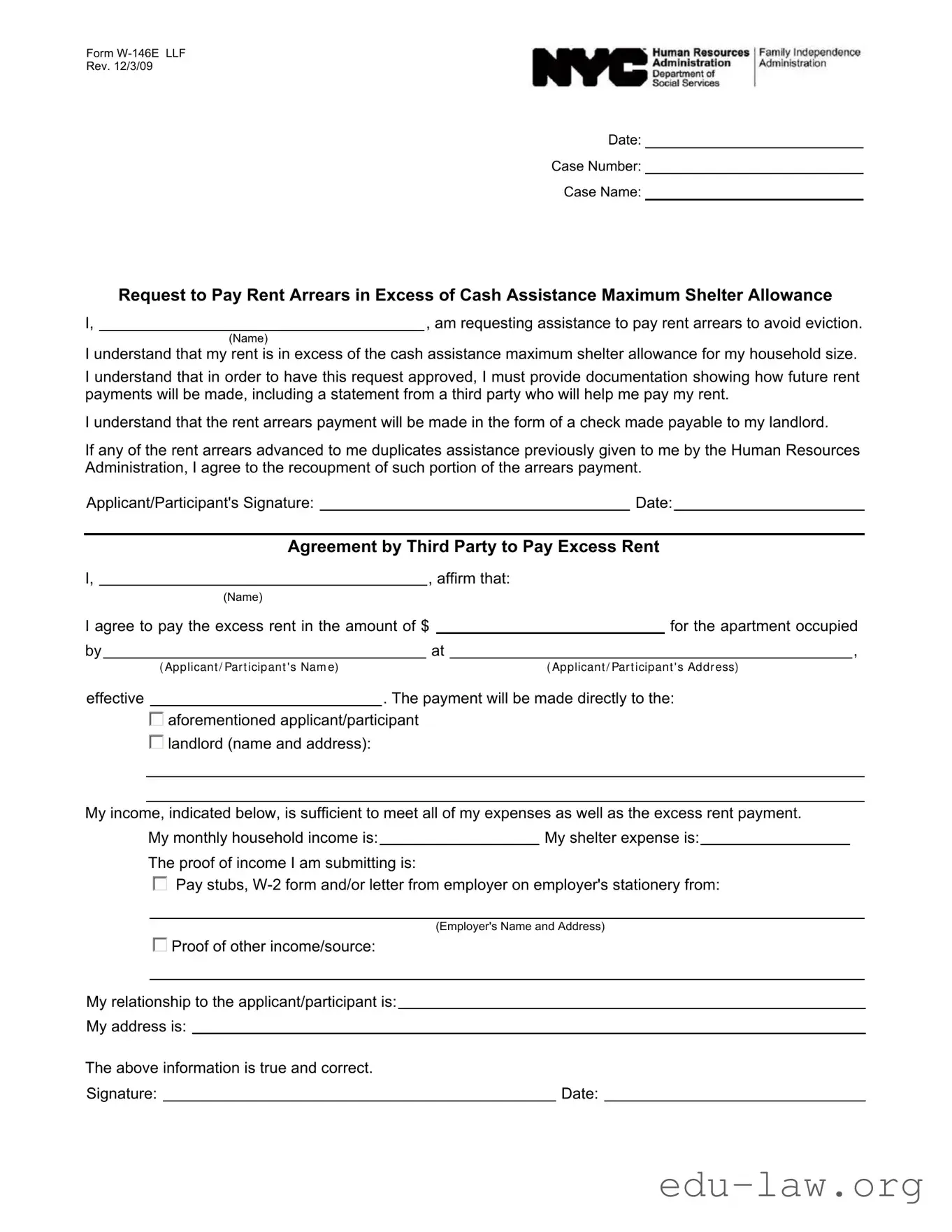
The W-146E form serves as a crucial tool for individuals facing financial hardship, specifically those who are at risk of eviction due to unpaid rent. This form is designed for applicants seeking assistance to cover rent arrears that exceed the maximum shelter allowance provided by cash assistance programs. To successfully complete the form, applicants must provide detailed information about their current living situation, including their case number and personal details. Additionally, it requires documentation that demonstrates how future rent payments will be managed, which may involve a commitment from a third party willing to assist with these payments. The form also outlines the process for payment, indicating that any assistance provided will be issued directly to the landlord in the form of a check. Importantly, applicants must acknowledge that if they have previously received assistance for the same rent arrears, they agree to the recoupment of those funds. This structured approach not only aids in managing immediate financial crises but also emphasizes the importance of accountability and future planning for sustainable housing stability.

Form
Rev. 12/3/09
Date:
Case Number:
Case Name:
|
Request to Pay Rent Arrears in Excess of Cash Assistance Maximum Shelter Allowance |
|
I, |
|
, am requesting assistance to pay rent arrears to avoid eviction. |
|
(Name) |
|
I understand that my rent is in excess of the cash assistance maximum shelter allowance for my household size.
I understand that in order to have this request approved, I must provide documentation showing how future rent payments will be made, including a statement from a third party who will help me pay my rent.
I understand that the rent arrears payment will be made in the form of a check made payable to my landlord.
If any of the rent arrears advanced to me duplicates assistance previously given to me by the Human Resources Administration, I agree to the recoupment of such portion of the arrears payment.
Applicant/Participant's Signature:Date:
Agreement by Third Party to Pay Excess Rent
I, |
|
, affirm that: |
|
|
|
|||||
|
|
|
(Name) |
|
|
|
|
|
|
|
I agree to pay the excess rent in the amount of $ |
|
|
for the apartment occupied |
|||||||
by |
|
|
at |
|
|
, |
||||
|
|
|
( App lican t / Par t icip an t ' s Nam e) |
|
|
|
|
( Ap plican t / Par t icipan t ' s Ad dr ess) |
||
effective |
|
. The payment will be made directly to the: |
||||||||
cef aforementioned applicant/participant cef landlord (name and address):
My income, indicated below, is sufficient to meet all of my expenses as well as the excess rent payment.
My monthly household income is:My shelter expense is: The proof of income I am submitting is:
cef Pay stubs,
(Employer's Name and Address)
cef Proof of other income/source:
My relationship to the applicant/participant is:
My address is:
The above information is true and correct.
Signature:Date:
| Fact Name | Details |
|---|---|
| Form Title | W-146E LLF Rev. 12/3/09 |
| Purpose | This form is used to request assistance for paying rent arrears that exceed the cash assistance maximum shelter allowance. |
| Eligibility | Applicants must demonstrate that their rent exceeds the cash assistance maximum for their household size. |
| Documentation Requirement | Applicants must provide documentation on future rent payments, including a statement from a third party who will assist in payment. |
| Payment Method | Payments are issued in the form of a check made payable to the landlord. |
| Recoupment Agreement | If rent arrears payments duplicate prior assistance, applicants agree to allow recoupment of that amount. |
| Third Party Agreement | A third party can agree to pay excess rent, requiring their signature and confirmation of income. |
| Income Verification | Applicants must provide proof of income, such as pay stubs or W-2 forms, to demonstrate financial capability. |
| Governing Law | This form is governed by state-specific regulations related to housing assistance and eviction prevention. |
Completing the W-146E form involves providing necessary information to request assistance for rent arrears. This form must be filled out accurately to ensure that the request is processed efficiently. Follow the steps below to complete the form correctly.
What is Form W-146E used for?
Form W-146E is a request for assistance to pay rent arrears that exceed the maximum shelter allowance for cash assistance. If you are facing eviction and need help covering past due rent, this form is necessary to seek that support. It helps ensure that you can stay in your home while you get back on track financially.
Who can fill out this form?
This form can be filled out by individuals who are receiving cash assistance and have rent arrears. The applicant must provide details about their situation, including their name, case number, and the amount of rent owed. Additionally, a third party who agrees to help pay the excess rent must also sign the form.
What documentation is needed to support my request?
You will need to provide documentation that shows how you plan to make future rent payments. This includes a statement from a third party who will assist you with the rent. Proof of income, such as pay stubs, W-2 forms, or letters from your employer, should also be included. This information helps verify that you can cover your expenses moving forward.
How will the payment for rent arrears be made?
If your request is approved, the payment will be issued in the form of a check made payable directly to your landlord. It is important to note that if any portion of the rent arrears payment duplicates assistance you have already received from the Human Resources Administration, that amount will be recouped.
What happens if my request is denied?
If your request for assistance is denied, you will receive a notification explaining the reasons for the denial. You may have the option to appeal the decision or seek other forms of assistance. It’s advisable to explore all available resources to help you manage your rent situation.
Failing to provide the applicant's name in the designated section. This is crucial for identifying the request.
Not including the case number. This number links the request to the applicant's file and is essential for processing.
Leaving the amount of excess rent blank. This information is necessary to determine the financial assistance required.
Omitting the third party's agreement to pay excess rent. This statement is vital for verifying that future payments are secured.
Neglecting to attach proof of income. Documentation such as pay stubs or W-2 forms must be included to validate financial capability.
Not signing the form. An unsigned form is incomplete and cannot be processed.
Providing inaccurate or incomplete information about the landlord. This can delay payment and create confusion.
Failing to indicate the effective date for the payment agreement. This date is important for establishing when the rent payment obligation begins.
When submitting the W-146E form, there are several other documents and forms that may be required to support the request for assistance in paying rent arrears. These documents help provide a clearer picture of the financial situation and ensure that all necessary information is available for review. Below is a list of commonly used forms and documents that accompany the W-146E.
Gathering these documents can streamline the application process and improve the chances of receiving the necessary assistance. Each document plays a crucial role in presenting a complete financial picture and demonstrating the need for support in paying rent arrears.
The W-146E form serves as a request for assistance with rent arrears, particularly when the amount exceeds the cash assistance maximum shelter allowance. A document similar to this is the Rental Assistance Application. This application is typically used by individuals seeking financial help to cover their rent. Like the W-146E, it requires detailed information about the applicant’s income, housing situation, and the amount of assistance needed. Both forms aim to prevent homelessness by providing a structured way to request financial aid for housing-related expenses.
Another document comparable to the W-146E is the Eviction Prevention Application. This form is specifically designed for individuals facing eviction and in need of immediate financial assistance. Similar to the W-146E, it necessitates proof of income and details about the applicant’s current living situation. The goal of both documents is to provide a pathway for individuals to secure funds to avoid losing their homes, emphasizing the importance of timely intervention in housing crises.
The Emergency Rental Assistance Program (ERAP) application also shares similarities with the W-146E form. This application is part of a federal initiative aimed at helping renters who have fallen behind on their payments due to unforeseen circumstances. Like the W-146E, the ERAP application requires documentation of income and expenses, along with a clear explanation of the financial need. Both forms are crucial in facilitating access to funds that can help maintain stable housing for families and individuals in distress.
In addition, the Temporary Assistance for Needy Families (TANF) application can be likened to the W-146E form. TANF provides financial assistance to low-income families, and its application process includes an assessment of housing needs. Both forms require applicants to outline their financial circumstances and demonstrate a need for assistance. They serve as vital tools in the broader context of social support systems aimed at alleviating poverty and preventing homelessness.
The Section 8 Housing Choice Voucher Program application is another document that parallels the W-146E form. This application is used by individuals seeking subsidized housing assistance. Similar to the W-146E, it requires comprehensive information about the applicant's income and housing situation. Both forms play a significant role in ensuring that individuals and families can afford stable housing, thereby promoting community welfare and stability.
Furthermore, the Utility Assistance Application can be compared to the W-146E form. This application is designed for individuals seeking help with their utility bills, which can often contribute to housing instability. Both documents require proof of income and detail the financial burdens faced by the applicant. They serve a common purpose: to provide financial relief that helps individuals maintain their homes and avoid potential eviction due to unpaid bills.
Lastly, the Homeless Prevention Program Application shares characteristics with the W-146E form. This application is focused on providing assistance to those at risk of becoming homeless. Like the W-146E, it requires applicants to provide evidence of their financial situation and the specific assistance needed. Both forms are essential in the fight against homelessness, offering a structured approach to securing necessary funds for housing stability.
When filling out the W-146E form, it's essential to approach the task with care. Here’s a guide on what to do and what to avoid to ensure your application is processed smoothly.
By following these guidelines, you can enhance your chances of a successful application for rent arrears assistance. Remember, thoroughness is key!
Here are some common misconceptions about the W-146E form. Understanding these can help ensure that you navigate the process effectively.
Understanding these misconceptions can help you prepare your application accurately and increase your chances of receiving the assistance you need.
When filling out and using the W-146E form, consider the following key takeaways: