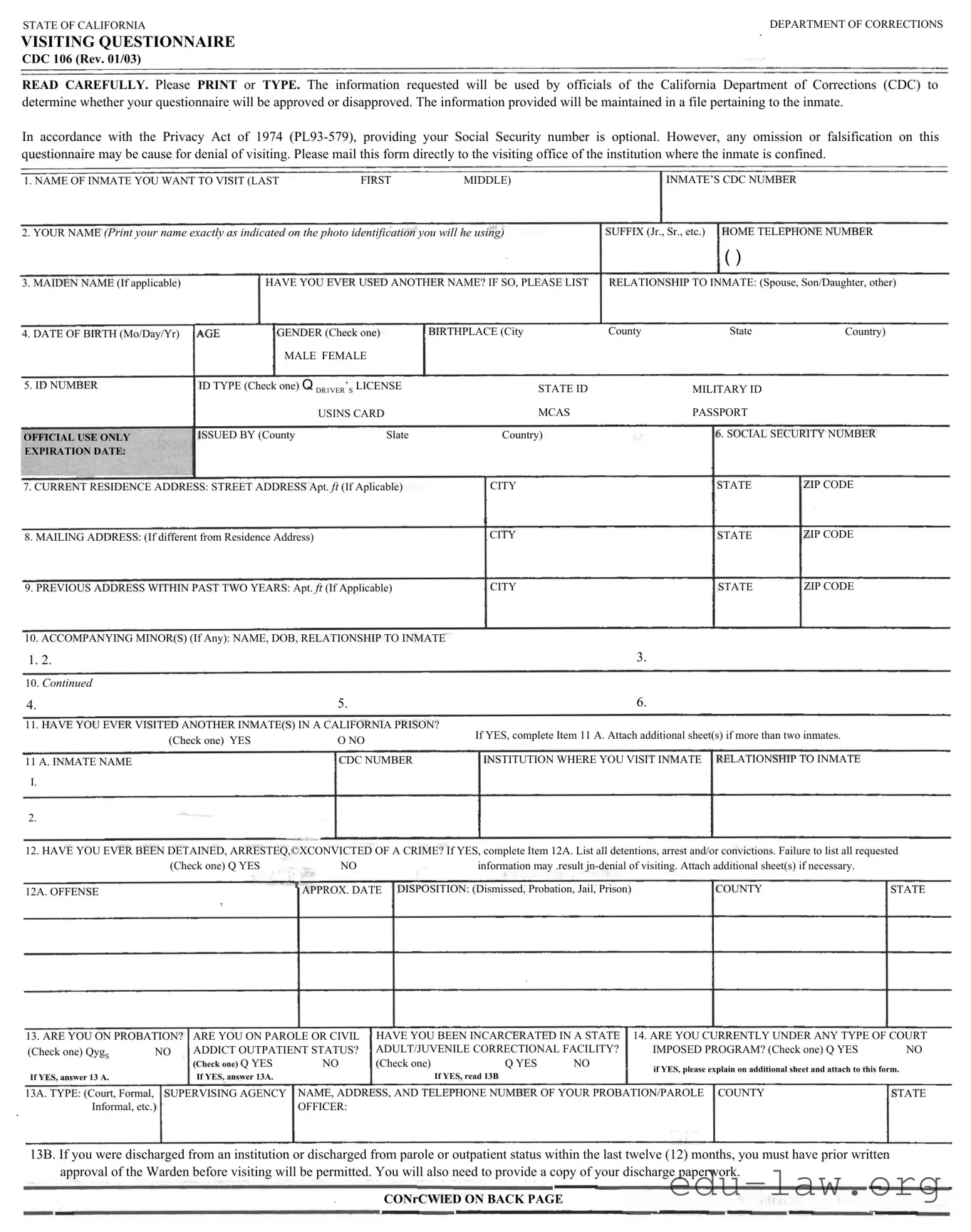
The Visiting Questionnaire form is an essential document for individuals wishing to visit inmates in California correctional facilities. This form, officially designated as CDC 106, is designed to gather necessary information about both the visitor and the inmate. It includes sections for the visitor's personal details, such as name, contact information, and relationship to the inmate, as well as questions regarding any past criminal history. The California Department of Corrections uses the information provided to assess eligibility for visitation, ensuring the safety and security of both the institution and its residents. Importantly, visitors must be aware that providing accurate information is crucial; any omissions or inaccuracies can lead to denial of visitation rights. The form also addresses specific requirements for minors and individuals with disabilities, ensuring that all visitors can comply with institutional policies. Additionally, it outlines the rules surrounding searches and restrictions on items that can be brought into the facility, reinforcing the importance of adhering to legal standards. Completing and submitting the Visiting Questionnaire correctly is the first step toward maintaining connections with loved ones who are incarcerated.
STATE OF CALIFORNIA |
DEPARTMENT OF CORRECTIONS |
VISITING QUESTIONNAIRE
CDC 106 (Rev. 01/03)
READ CAREFULLY. Please PRINT or TYPE. The information requested will be used by officials of the California Department of Corrections (CDC) to determine whether your questionnaire will be approved or disapproved. The information provided will be maintained in a file pertaining to the inmate.
In accordance with the Privacy Act of 1974
1. NAME OF INMATE YOU WANT TO VISIT (LASTFIRSTMIDDLE)INMATE’S CDC NUMBER
2. YOUR NAME (Print your name exactly as indicated on the photo identification you will he using) |
SUFFIX (Jr., Sr., etc.) |
HOME TELEPHONE NUMBER |
|||||||
|
|
|
|
|
|
|
|
( ) |
|
3. MAIDEN NAME (If applicable) |
HAVE YOU EVER USED ANOTHER NAME? IF SO, PLEASE LIST |
RELATIONSHIP TO INMATE: (Spouse, Son/Daughter, other) |
|||||||
4. DATE OF BIRTH (Mo/Day/Yr) |
GENDER (Check one) |
BIRTHPLACE (City |
County |
State |
Country) |
||||
|
MALE FEMALE |
|
|
|
|
|
|
||
5. ID NUMBER |
ID TYPE (Check one) q DR1VER’S LICENSE |
|
|
STATE ID |
MILITARY ID |
|
|||
|
|
USINS CARD |
|
|
MCAS |
PASSPORT |
|
||
OFFICIAL USE ONLY |
ISSUED BY (County |
|
Slate |
|
|
Country) |
|
6. SOCIAL SECURITY NUMBER |
|
EXPIRATION DATE. |
|
|
|
|
|
|
|
|
|
|
|
|
|
|
|
|
|
|
|
7. CURRENT RESIDENCE ADDRESS: STREET ADDRESS Apt. ft (If Aplicable) |
|
|
CITY |
|
STATE |
ZIP CODE |
|||
|
|
|
|
|
|
|
|
|
|
8. MAILING ADDRESS: (If different from Residence Address) |
|
|
|
|
CITY |
|
STATE |
ZIP CODE |
|
|
|
|
|
|
|
|
|
||
9. PREVIOUS ADDRESS WITHIN PAST TWO YEARS: Apt. ft (If Applicable) |
|
|
CITY |
|
STATE |
ZIP CODE |
|||
|
|
|
|
|
|
|
|||
10. ACCOMPANYING MINOR(S) (If Any): NAME, DOB, RELATIONSHIP TO INMATE |
|
|
|
|
|||||
1. 2. |
|
|
|
|
|
|
3. |
|
|
10. Continued |
|
|
|
|
|
|
|
|
|
4. |
|
5. |
|
|
|
6. |
|
|
|
11. HAVE YOU EVER VISITED ANOTHER INMATE(S) IN A CALIFORNIA PRISON? |
|
|
|
||||||
(Check one) YES |
|
O NO |
If YES, complete Item 11 A. Attach additional sheet(s) if more than two inmates. |
||||||
|
|
|
|
|
|
|
|||
11 A. INMATE NAME |
|
|
CDC NUMBER |
|
INSTITUTION WHERE YOU VISIT INMATE |
RELATIONSHIP TO INMATE |
|||
I. |
|
|
|
|
|
|
|
|
|
|
|
|
|
|
|
|
|
|
|
2. |
|
|
|
|
|
|
|
|
|
|
|
|
|
|
|
|
|
|
|
12. HAVE YOU EVER BEEN DETAINED, ARRESTEQ,©XCONVICTED OF A CRIME? If YES, complete Item 12A. List all detentions, arrest and/or convictions. Failure to list all requested
|
|
(Check one) Q YES |
NO |
|
|
information may .result |
|
|||||
|
|
|
|
|
|
|
|
|
|
|
||
12A. OFFENSE |
|
|
|
APPROX. DATE |
DISPOSITION: (Dismissed, Probation, Jail, Prison) |
|
COUNTY |
STATE |
||||
|
|
|
|
|
|
|
|
|
||||
|
|
|
|
|
|
|
|
|
|
|
|
|
|
|
|
|
|
|
|
|
|
|
|
|
|
|
|
|
|
|
|
|
|
|
|
|
|
|
13. ARE YOU ON PROBATION? |
ARE YOU ON PAROLE OR CIVIL |
HAVE YOU BEEN INCARCERATED IN A STATE |
|
14. ARE YOU CURRENTLY UNDER ANY TYPE OF COURT |
||||||||
(Check one) QygS |
NO |
ADDICT OUTPATIENT STATUS? |
ADULT/JUVENILE CORRECTIONAL FACILITY? |
|
IMPOSED PROGRAM? (Check one) Q YES |
NO |
||||||
|
|
|
(Check one) Q YES |
NO |
(Check one) |
Q YES |
NO |
|
if YES, please explain on additional sheet and attach to this form. |
|||
If YES, answer 13 A. |
|
|
If YES, answer 13A. |
|
|
|
If YES, read 13B |
|
|
|||
|
|
|
|
|
|
|
|
|
|
|||
13A. TYPE: (Court, Formal, |
|
SUPERVISING AGENCY |
NAME, ADDRESS, AND TELEPHONE NUMBER OF YOUR PROBATION/PAROLE |
COUNTY |
STATE |
|||||||
Informal, etc.) |
|
|
OFFICER: |
|
|
|
|
|
|
|
|
|
|
|
|
|
|
|
|
|
|
|
|
|
|
13B. If you were discharged from an institution or discharged from parole or outpatient status within the last twelve (12) months, you must have prior written approval of the Warden before visiting will be permitted. You will also need to provide a copy of your discharge paperwork.
CONrCWlED ON BACK PAGE
15.If you are under 18 years of age and are not an emancipated minor or the inmate’s legal spouse, you must have the written notarized consent of a parent or legal guardian and be accompanied by a responsible adult who is also approved to visit. The notarized written consent must be presented each time a minor visits unless prior approval has been attained form the Warden for an inmate to visit with his or her unchaperoned children.
16.VISITORS WITH DISABILITIES: If you have special requirements related to your disability (medical implants, prosthetic devices or requiring
mobility assistive devices, i.e.,. crutches, walkers, braces, wheelchairs, battery operated or custom prescribed wheelchairs, guide dog for the visually or hearing impaired, insulin kit with syringes, etc.) you will need to attach a verifying statement from your physician. Visitors with guide dogs will need to provide the dog’s certification paperwork upon visit
17.The following laws relate to prison visitation:
SUBJECT TO SEARCH: Visitors entering the correctional institution, camp or facility grounds are subject to a search of their person, vehicle and property. Except as described below, visitors may leave the institution, camp, or facility grounds rather than submit to a search of their person, vehicle or property. Refusal to submit to the search will result in denial of visiting for that day.
Visitors may not elect to leave the correctional institution, camp or facility grounds rather than submit to a search when institution officials possess a court issued search warrant or cause for a search arises while the visitor is on the institution grounds and the cause for the search is believed by institutional officials to be a criminal offense.
FIREARMS AND DRUGS ON INSTITUTIONAL GROUNDS /ASSISTING INMATES TO ESCAPE: It is a felony for anyone to assist inmates to escape. Bringing firearms, deadly weapons, explosives, tear gas, drugs, drug paraphernalia, or selling drugs on prison grounds, or giving/selling inmates firearms, weapons, explosives, liquor, cocaine, or other narcotics or any kind of drugs, including marijuana, is a crime (Sections 2772, 2790,4534, 4535, 4550, 4573, 4573.5, 4573.6, 4573.8, 4573.9, 4574, 4600, California Penal Code).
GIVING LETTERS TO INMATES OR TAKING LETTERS OUT FOR INMATES BY ANYONE IS A MISDEMEANOR: (Section 4570, 4570.1, California Penal Code).
FALSE IDENTIFICATION: Anyone who falsely identifies himself/herself to gain admittance to a prison is guilty of a misdemeanor. Persons previously convicted of a felony in the State who come upon the grounds of a prison without permission of the official in charge are guilty of a felony (Section 4570.5, 4571 California Penal Code).
TRESPASSING: Entry on institution property for unauthorized purposes will be considered trespassing as provided in Section 602(j) of the California Penal Code. Refusal or failure to leave the property when requested to do so by an official will be considered trespassing as provided in Section 602(p) of the California Penal Code.
PERIOD OF EMERGENCY: In the event of an emergency situation that affects a significant portion of the inmate population at an institution, the visiting program and other program activities may be suspended during the period of emergency (Section 2601(d), California Penal Code).
GIVING OR RECEIVING GIFTS: Giving or receiving gifts to or from inmates is a misdemeanor (Section 2540, 2541, California Penal Code).
HOSTAGES: Hostages will not be recognized for bargaining purposes during attempted escapes by inmates (Section 3304, California Code of Regulations, Title 15, Division 3, Chaper 1).
18. If you are APPROVED to visit, the inmate will be notified and it is his/her responsibility to notify you.
If you are DISAPPROVED to visit, the institution will notify you by mail. You will not be allowed to visit until your application is approved.
I have read and understand the above information and agree to follow all
Federal, State and CDC rules and regulations.
VERIFICATION OF MAILING
I have mailed this Visiting Questionnaire to the visitor applicant.
VISITOR SIGNATURE |
DATE |
inmate;/£i6nature / cdc # |
date |
| |
OFFICIAL USE |
|
|||
APPROVED |
O NO O YES CII/FBI # |
— |
. |
||
|
|
|
|||
DISAPPROVED, for the following reason(s): |
|
(If DISAPPROVED, the applicant and inmate are to be informed in writing of the disapproval.) |
|||
Omissions and/or falsifications Section(s): |
|
|
Need copy of Declaration of Discharge |
||
|
|
Need |
|
disposition(s) |
for: |
Applicant is under: |
parole |
formal probation |
Civil Addict Outpatient supervision |
||
Arrest record received via DOJ indicates applicant has an extensive and /or recent history of criminal activity for offenses that are particulary sensitive to the institutional security. May reapply after: (DATE:)
Applicant’s privileges to visit will be reconsidered: |
|
|
|
|
||
|
upon receipt of the above requested information |
and/or |
after (DATE: |
) |
|
|
|
|
|
|
|
|
|
PRINT NAME |
|
SIGNATURE |
|
TITLE |
INSTITUTION |
DATE |
|
|
|
|
|
|
|
INMATE/V1S1TOR NOTIFIED ON (DATE) |
BY WHOM |
| Fact Name | Details |
|---|---|
| Form Title | Visiting Questionnaire CDC 106 |
| State | California |
| Governing Law | Privacy Act of 1974 (PL93-579) |
| Purpose of Form | To determine approval or disapproval for visiting an inmate. |
| Information Maintenance | Details are kept in a file related to the inmate. |
| Social Security Number | Providing it is optional but may affect approval. |
| Visitor Requirements | Must have a valid photo ID and be accompanied by an approved adult if under 18. |
| Search Policy | Visitors are subject to search upon entering the facility. |
| Disapproval Notification | Applicants will be informed by mail if their visit is disapproved. |
Filling out the Visiting Questionnaire form is a crucial step in the process of visiting an inmate. By providing accurate information, you can help ensure that your application is processed smoothly. Once you complete the form, it will be sent directly to the visiting office of the institution where the inmate is located.
Once you have completed the form, ensure that it is sent directly to the appropriate visiting office. Keep a copy for your records if possible. After your application is reviewed, you will be notified of the approval or disapproval of your visiting request.
What is the purpose of the Visiting Questionnaire form?
The Visiting Questionnaire form is designed to collect essential information about individuals who wish to visit an inmate in a California correctional facility. Officials from the California Department of Corrections use this information to determine whether a visitor's application will be approved or denied. The details provided will be maintained in a file associated with the inmate, ensuring that all visits adhere to security and safety protocols.
How should I fill out the Visiting Questionnaire form?
When completing the Visiting Questionnaire, it is crucial to print or type your responses clearly. Make sure to provide accurate information, especially your name as it appears on your photo identification. Include details such as your relationship to the inmate, any previous names used, and your current and previous addresses. Remember, any omission or falsification may lead to a denial of your visiting request. If you have accompanying minors, their details should also be included in the form.
What happens after I submit the Visiting Questionnaire form?
Once you submit the Visiting Questionnaire form, it will be reviewed by the institution's officials. If your application is approved, the inmate will be notified, and it will be their responsibility to inform you of the approval. Conversely, if your application is disapproved, you will receive a notification by mail outlining the reasons for the denial. Until your application receives approval, you will not be permitted to visit the inmate.
Are there any special requirements for visitors with disabilities?
Yes, visitors with disabilities may have special requirements that need to be addressed. If you use medical implants, prosthetic devices, or mobility assistive devices, it’s important to attach a verifying statement from your physician to the Visiting Questionnaire. Additionally, if you have a guide dog, you must provide the dog’s certification paperwork during the visit check-in. The California Department of Corrections strives to accommodate visitors with disabilities while maintaining the institution's safety and security.
Incomplete Information: Failing to fill out all required fields can lead to delays or denial. Every section must be completed accurately.
Incorrect Name Format: Not following the specified format for the inmate's name (Last, First, Middle) can cause confusion. Ensure you write it exactly as required.
Using Nicknames: Submitting a name that is not the legal name as shown on identification can result in disapproval. Always use the name on your ID.
Missing Social Security Number: While optional, omitting this number may hinder the processing of your application. Consider including it if possible.
Incorrect Relationship Declaration: Not accurately stating your relationship to the inmate can lead to misunderstandings. Be clear and honest about your connection.
Failure to Disclose Criminal History: Not listing all arrests or convictions, even if they seem minor, can result in automatic denial. Be thorough and truthful.
Ignoring Additional Requirements: If you are under 18 or have special needs, failing to provide necessary documentation can lead to denial. Always check for additional requirements.
Not Following Submission Guidelines: Sending the form to the wrong address or not mailing it directly to the institution can delay the process. Double-check the mailing instructions.
When preparing to visit an inmate, several forms and documents may be needed alongside the Visiting Questionnaire form. Each of these documents serves a specific purpose in the visitation process. Below is a list of commonly required forms and documents.
Having these documents ready can streamline the visitation process and help ensure a successful visit. Always check with the specific institution for any additional requirements or changes in the visitation policy.
The Visiting Questionnaire form is similar to the Visitor Application form used in many correctional facilities across the United States. Both documents require personal information about the visitor, including their name, address, and relationship to the inmate. They also ask for identification details, ensuring that the facility can verify the identity of the individual wishing to visit. The primary purpose is to assess the eligibility of visitors based on their background and connection to the inmate.
Another comparable document is the Inmate Visitation Request form. This form is typically filled out by the inmate to request visits from specific individuals. Similar to the Visiting Questionnaire, it collects information about the visitor, including their full name and relationship to the inmate. This process helps institutions manage visitor lists and maintain security protocols during visits.
The Background Check Authorization form is also akin to the Visiting Questionnaire. This document is used to obtain consent from visitors for a background check. Both forms require personal details such as Social Security numbers and addresses. They serve to ensure that individuals with a criminal history that may pose a risk to the institution are appropriately screened before being allowed to visit.
The Visitor Consent form is another similar document. This form is often required for minors who wish to visit an inmate. It includes information about the minor, their guardian, and the specific consent for the visit. Like the Visiting Questionnaire, it emphasizes the importance of relationship verification and legal guardianship to ensure the minor's safety during the visit.
The Inmate Release Notification form bears resemblance to the Visiting Questionnaire as well. This document is used to inform visitors about the release of an inmate. It may require similar personal information from the visitor to ensure that they are aware of the inmate's status. Both forms help maintain clear communication between the institution and the visitors regarding the inmate's situation.
The Visitor Rules and Regulations form is another document that aligns with the Visiting Questionnaire. This form outlines the rules visitors must follow while at the facility. It often includes similar personal information requirements and emphasizes the importance of compliance with institutional policies. Both forms aim to prepare visitors for what to expect and ensure a safe environment for all involved.
The Inmate Visitation Policy document shares similarities with the Visiting Questionnaire as well. This document outlines the guidelines for visitation, including eligibility criteria and restrictions. It often requires visitors to provide personal information to confirm their understanding of the policies. Both documents work together to ensure that visitors are informed and compliant with institutional regulations.
The Visitor Identification Verification form is also comparable to the Visiting Questionnaire. This document is used to confirm the identity of visitors upon arrival at the facility. It requires similar personal details and may include a request for photo identification. Both forms serve to enhance security measures and ensure that only authorized individuals are permitted to visit inmates.
The Inmate Visitation Log is another related document. This log records details of all visitors who come to see an inmate, including their names and relationships. Similar to the Visiting Questionnaire, it helps the facility keep track of who is visiting and when. This information is crucial for maintaining security and ensuring that visitation policies are followed.
Lastly, the Visitor Screening form is akin to the Visiting Questionnaire. This form is used to assess the eligibility of visitors based on their background and criminal history. It collects similar personal information and aims to identify any potential risks associated with allowing a visitor into the facility. Both documents are essential for maintaining safety and security within correctional institutions.
When filling out the Visiting Questionnaire form, it's important to be thorough and accurate. Here are ten things to keep in mind:
Understanding the Visiting Questionnaire form is essential for those looking to visit inmates in California's correctional facilities. However, several misconceptions often arise regarding this form. Below is a list of common misunderstandings, along with clarifications for each.
By addressing these misconceptions, individuals can better navigate the Visiting Questionnaire process and ensure a smoother experience when visiting inmates.
Filling out the Visiting Questionnaire form is an important step for anyone wishing to visit an inmate in a California correctional facility. Here are some key takeaways to keep in mind:
By following these guidelines, you can help ensure a smoother process for your visit. Always remember to stay informed about the rules and regulations to avoid any complications.