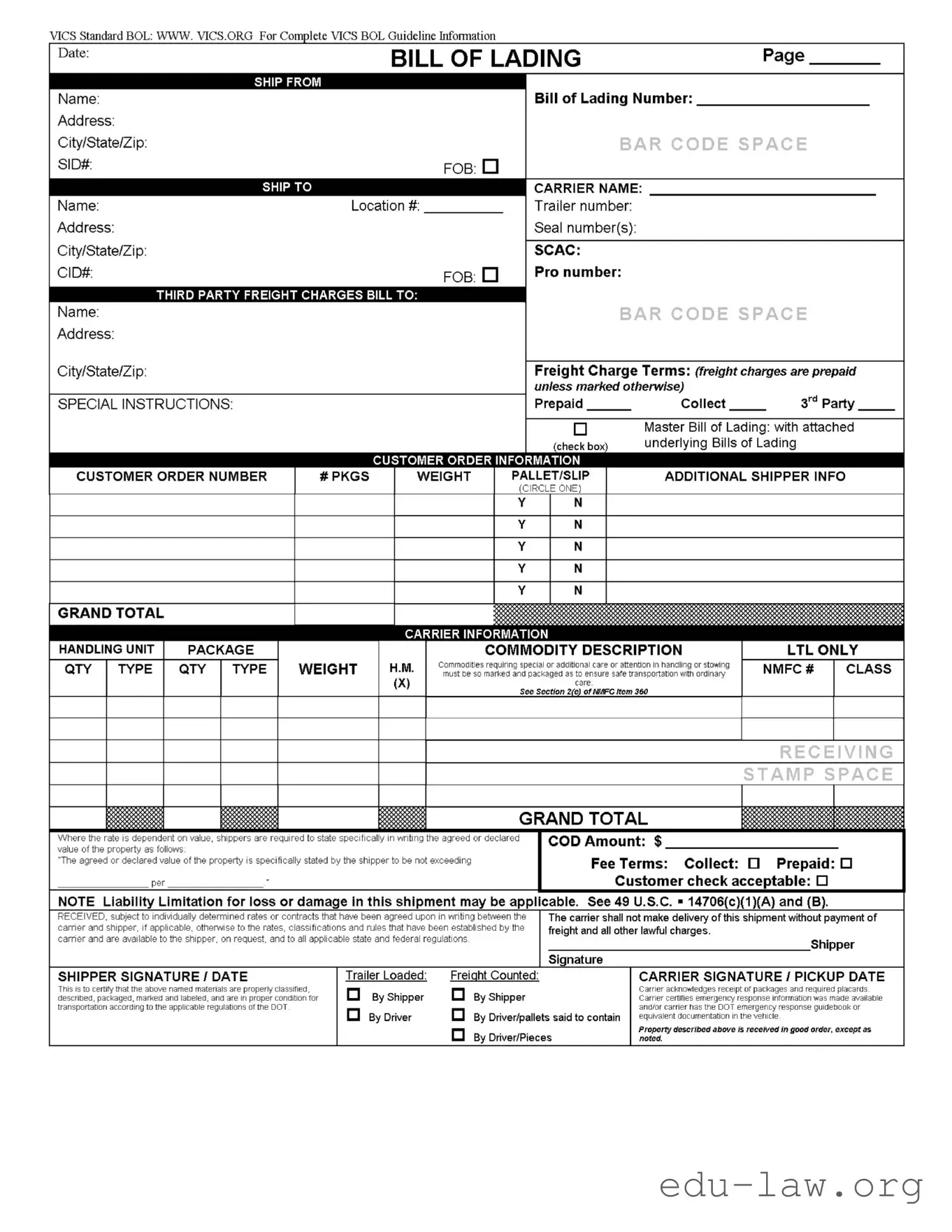
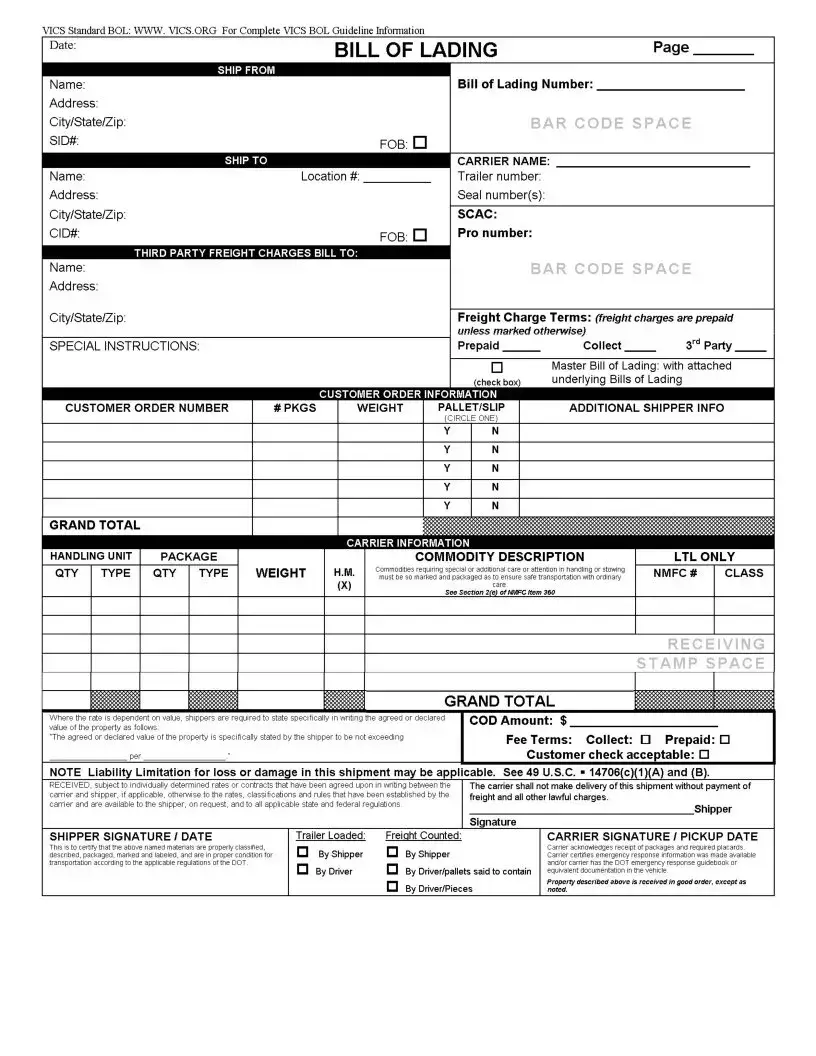
The VICS Bol form is an essential document in the shipping and logistics industry, serving as a comprehensive Bill of Lading (BOL) that facilitates the movement of goods. It includes critical information about the shipment, such as the shipper's and carrier's details, freight charge terms, and special instructions for handling the cargo. The form requires specific customer order information, including the order number, package count, and weight, ensuring that all parties have a clear understanding of what is being shipped. Additionally, the VICS Bol form highlights the importance of proper packaging and labeling, especially for commodities that need special care. Shippers must declare the value of the property being transported, which is crucial for determining liability in case of loss or damage. The form also emphasizes compliance with federal regulations and the necessity for payment of freight charges before delivery. By encapsulating all these elements, the VICS Bol form plays a vital role in streamlining shipping processes and ensuring accountability throughout the transportation chain.
VICS Standard BQL: WWW. VICS.QRG For Complete VICS BQL Guideline Information
I Date: |
|
BILL OF LADING |
|
Page |
|
|
|
|
|||
Name: |
|
|
Bill of Lading Number: |
|
|
Address: |
|
|
|
|
|
City/State/Zip: |
|
|
BAR CODE SPACE |
||
SID#: |
|
FOB: |
|
|
|
|
|
|
CARRIER NAME: |
|
|
|
|
|
Trailer number: |
|
|
|
|
|
Seal number(s): |
|
|
|
|
|
SCAC: |
|
|
|
|
|
Pro number: |
|
|
|
|
|
BAR CODE SPACE |
||
|
|
|
Freight Charge Terms: (freight charges are prepaid |
||
|
|
|
unless marked otherwise) |
3rd Party |
|
SPECIAL INSTRUCTIONS: |
|
|
Prepaid |
Collect |
|
|
|
|
|
Master Bill of Lading: with attached |
|
|
|
|
(check box) |
underlying Bills of Lading |
|
CUSTOMER ORDER NUMBER |
# PKGS |
WEIGHT |
PALLET/SLIP |
ADDITIONAL SHIPPER INFO |
|
|
|
|
(CIRCLE ONE) |
|
|
GRAND TOTAL
HANDLING UNIT |
PACKAGE |
WEIGHT |
COMMODITY DESCRIPTION |
LTL ONLY |
|
QTY TYPE |
QTY TYPE |
Commodities requiring special or additional care or attention in handling or stowing |
NMFC# |
CLASS |
|
must be so marked and packaged as to ensure safe transportation with ordinary |
|||||
care.
See Section 2(e) ofNMFC Item 360
RECEIVING
STAMP SPACE
GRAND TOTAL
Where the rate is dependent on value, shippers are required to state specifically in writing the agreed or declared value of the property as follows:
COD Amount: $
"The agreed or declared value of the property is specifically stated by the shipper to be not exceeding |
Fee Terms: Collect: |
Prepaid: |
|
||
per |
Customer check acceptable: |
|
NOTE Liability Limitation for loss or damage in this shipment may be applicable. See 49 U.S.C. ■ 14706(c)(1)(A) and (B).
RECEIVED, subject to individually determined rates or contracts that have been agreed upon in writing between the |
The carrier shall not make delivery of this shipment without payment of |
carrier and shipper, if applicable, otherwise to the rates, classifications and rules that have been established by the |
freight and all other lawful charges. |
carrier and are available to the shipper, on request, and to all applicable state and federal regulations. |
Shipper |
|
|
|
Signature |
SHIPPER SIGNATURE / DATE |
Trailer Loaded: |
Freight Counted: |
|
This is to certify that the above named materials are properly classified, |
О |
By Shipper |
О By Shipper |
described, packaged, marked and labeled, and are in proper condition for |
|||
transportation according to the applicable regulations of the DOT. |
Q |
By Driver |
О By Driver/pallets said to contain |
|
|||
CARRIER SIGNATURE / PICKUP DATE
Carrier acknowledges receipt of packages and required placards. Carrier certifies emergency response information was made available and/or carrier has the DOT emergency response guidebook or equivalent documentation in the vehicle.
О By Driver/Pieces |
Property described above is received in good order, except as |
|
noted. |
||
|
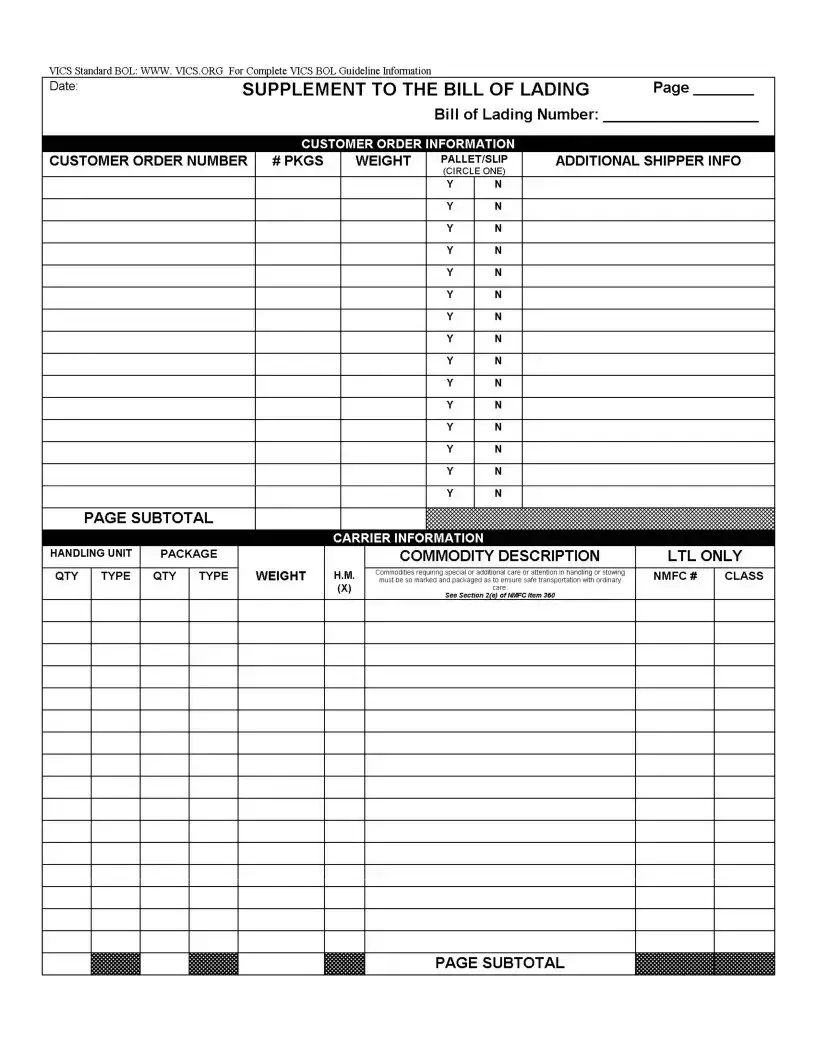
VICS Standard BQL: WWW.VICS.ORG For Complete VICS BQL Guideline Information__________________________________________________________________
Date |
SUPPLEMENT TO THE BILL OF LADING |
Page |
|
Bill of Lading Number: |
|
| Fact Name | Fact Description |
|---|---|
| Purpose | The VICS Bol form serves as a Bill of Lading for shipping and transportation documentation. |
| Governing Laws | This form is governed by federal regulations, including 49 U.S.C. § 14706, and applicable state laws. |
| Freight Charges | Freight charges are typically prepaid unless indicated otherwise on the form. |
| Special Instructions | Shippers can include special instructions to ensure proper handling of the shipment. |
| Liability Limitation | Liability for loss or damage may be limited; shippers should refer to specific regulations for details. |
| Certification | The shipper certifies that the materials are properly classified and in good condition for transport. |
Filling out the VICS Bill of Lading (BOL) form requires careful attention to detail. Each section must be completed accurately to ensure proper handling and transportation of goods. After completing the form, it should be reviewed for any errors before submission.
What is the VICS BOL form used for?
The VICS Bill of Lading (BOL) form is a document used in the shipping industry to detail the specifics of a shipment. It serves as a receipt for the goods being transported and outlines the terms of the shipment, including the sender, receiver, and carrier information. This form is essential for tracking shipments and ensuring compliance with regulations.
What information is required on the VICS BOL form?
Key information required includes the shipper's name and address, the bill of lading number, carrier name, freight charge terms, customer order information, and a description of the commodities being shipped. Additionally, details about the weight, quantity, and any special instructions should be included to ensure proper handling.
How do I determine the freight charge terms?
Freight charge terms indicate who is responsible for paying the shipping costs. You can select from options such as prepaid, collect, or third-party billing. Prepaid means the shipper pays upfront, collect indicates the receiver will pay upon delivery, and third-party means a different entity will cover the charges. Make sure to check the appropriate box on the form.
What should I do if my shipment requires special handling?
If your shipment requires special care, it is crucial to mark and package it appropriately. You should include any specific instructions on the VICS BOL form under "Special Instructions." This ensures that the carrier is aware and can take the necessary precautions during transportation.
What is the significance of the NMFC number?
The National Motor Freight Classification (NMFC) number is used to classify freight for shipping purposes. It helps determine the shipping rates based on the type of goods being transported. Including the correct NMFC number on the VICS BOL form is important for accurate billing and compliance with regulations.
What does the liability limitation mean?
The liability limitation refers to the maximum amount the carrier may be liable for in case of loss or damage to the shipment. This is governed by federal regulations. It is essential to declare the value of the property being shipped on the form if it exceeds the standard liability limits to ensure proper coverage.
Who needs to sign the VICS BOL form?
The VICS BOL form must be signed by both the shipper and the carrier. The shipper's signature certifies that the materials are properly classified and packaged, while the carrier's signature confirms receipt of the shipment in good order. Both signatures are necessary for legal and compliance purposes.
Where can I find more information about the VICS BOL guidelines?
For complete VICS BOL guideline information, you can visit the VICS website at www.vics.org. This resource provides detailed instructions and best practices for completing the form correctly, ensuring that all parties involved in the shipment process are informed and compliant.
Missing Information: Failing to fill in all required fields can lead to delays or issues with shipment processing. Ensure that every section, such as the shipper's name and address, is complete.
Incorrect Bill of Lading Number: Using an incorrect or previously used Bill of Lading number can cause confusion. Always verify that the number is unique for each shipment.
Improper Freight Charge Terms: Not clearly marking whether freight charges are prepaid or collect can lead to unexpected costs. Double-check the freight charge terms before submitting.
Neglecting Special Instructions: Omitting special instructions can result in mishandling of the shipment. If there are specific handling needs, be sure to include them.
Inaccurate Commodity Descriptions: Providing vague or incorrect descriptions of the commodities can lead to compliance issues. Be precise in describing what is being shipped.
Failure to State Agreed Value: Not stating the agreed or declared value of the property can limit liability. Always include this information if the rate depends on value.
Ignoring Liability Limitations: Overlooking the liability limitations for loss or damage can be costly. Familiarize yourself with the applicable laws and include necessary disclaimers.
Not Signing the Document: Forgetting to sign the Bill of Lading can invalidate the document. Ensure that both the shipper and carrier signatures are present.
Inadequate Package Count: Miscounting the number of packages or pieces can create discrepancies. Always verify the count before finalizing the form.
Failure to Provide Emergency Response Information: Not including or acknowledging emergency response information can lead to safety risks. Ensure this information is available and noted on the form.
The VICS Bill of Lading (BOL) form is an essential document in the shipping and logistics industry. It serves as a receipt for goods, a contract between the shipper and carrier, and a document of title. Alongside the VICS BOL form, several other documents are often utilized to ensure smooth transportation and compliance with regulations. Below is a list of commonly used forms and documents that accompany the VICS BOL.
These documents play a vital role in the shipping process, ensuring that all parties involved have the necessary information to facilitate transportation and compliance. Properly managing and understanding these forms can help prevent delays and misunderstandings in the logistics chain.
The Bill of Lading (BOL) is a crucial document in the shipping industry, serving as a contract between the shipper and the carrier. Similar to the VICS BOL form, the Standard Bill of Lading outlines the specifics of the shipment, including the shipper's and receiver's details, the nature of the goods, and payment terms. This document not only acts as a receipt for the goods but also provides legal evidence of the contract. Just like the VICS version, it ensures that all parties are clear about their responsibilities and the terms of the shipment.
Another document that shares similarities with the VICS BOL is the Master Bill of Lading. This document is typically used in multi-modal transport and consolidates several shipments under one contract. Like the VICS BOL, it includes information about the shipper, consignee, and details about the cargo. The Master Bill of Lading serves to simplify the shipping process by summarizing multiple underlying bills, much like how the VICS BOL addresses various shipments in a single form.
The Freight Bill is also akin to the VICS BOL. This document is issued by the carrier to the shipper after the delivery of goods. It details the charges for the transportation services provided. Similar to the VICS BOL, the Freight Bill outlines payment terms and can be used to resolve disputes regarding charges. Both documents are essential for ensuring that all parties agree on the services rendered and the associated costs.
The Delivery Receipt is another document that parallels the VICS BOL. This document is signed by the recipient upon receiving the goods, confirming that the shipment has been delivered in good condition. Like the VICS BOL, it serves as proof of delivery and can be critical in case of disputes over whether the goods were received as agreed. Both documents ensure accountability throughout the shipping process.
Next, the Shipping Order is similar to the VICS BOL in that it provides instructions for the shipment of goods. This document is typically issued by the shipper to the carrier, detailing what is to be shipped, when, and where. Just as the VICS BOL contains specific instructions for handling and transporting goods, the Shipping Order ensures that the carrier has clear guidance on the shipment's requirements.
The Packing List is another document that complements the VICS BOL. It details the contents of a shipment, including item descriptions, quantities, and weights. While the VICS BOL provides a summary of shipping terms, the Packing List offers a more granular view of what is being shipped. Both documents work together to ensure that all parties are informed about the shipment's contents and condition.
Lastly, the Consignment Note shares characteristics with the VICS BOL as it serves as a contract between the shipper and the carrier for the transportation of goods. This document outlines the details of the shipment, including the sender, recipient, and description of the goods. Similar to the VICS BOL, the Consignment Note is essential for ensuring that all parties understand their obligations and the terms of the shipment, thereby facilitating smooth logistics operations.
When filling out the VICS Bill of Lading (BOL) form, it’s essential to ensure accuracy and clarity. Below is a list of things you should and shouldn’t do.
Following these guidelines will help ensure a smooth shipping process. Always prioritize accuracy and completeness when filling out the VICS BOL form.
Misconceptions about the Vics Bol form can lead to confusion and errors in shipping processes. Here are four common misunderstandings:
When filling out and using the VICS Bill of Lading (BOL) form, there are several important points to keep in mind: