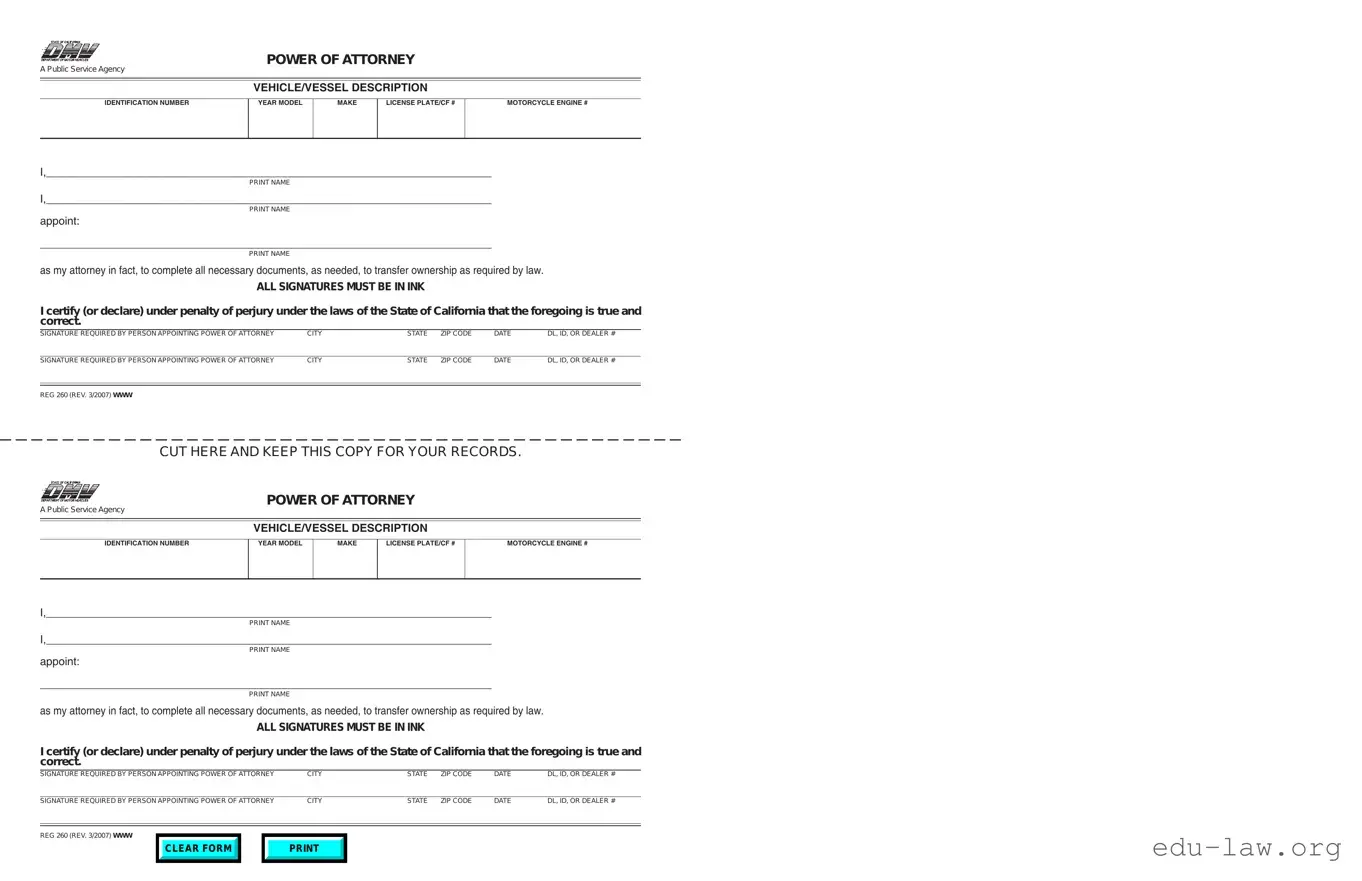
The Vehicle Power of Attorney (POA) REG 260 form serves as an essential document for individuals who need to authorize another person to act on their behalf in matters related to vehicle ownership and registration in the state of California. This form allows the designated agent to perform various tasks, such as signing title transfers, obtaining vehicle registrations, and handling other administrative duties. By using the REG 260, vehicle owners can ensure that their interests are represented even when they are unable to attend to these matters personally. The form requires specific information, including the vehicle's details, the owner's information, and the agent's contact information. Additionally, it must be signed and dated by the vehicle owner to validate the authorization. Understanding the importance and proper use of the Vehicle POA REG 260 form can streamline processes related to vehicle transactions and help avoid potential complications. Proper completion of this form can facilitate smoother interactions with the Department of Motor Vehicles (DMV) and other relevant entities, making it a valuable tool for vehicle owners.
POWER OF ATTORNEY
A Public Service Agency
VEHICLE/VESSEL DESCRIPTION
IDENTIFICATION NUMBER
YEAR MODEL
MAKE
LICENSE PLATE/CF #
MOTORCYCLE ENGINE #
I,________________________________________________________________________
PRINT NAME
I,________________________________________________________________________
PRINT NAME
appoint:
_________________________________________________________________________
PRINT NAME
as my attorney in fact, to complete all necessary documents, as needed, to transfer ownership as required by law.
ALL SIGNATURES MUST BE IN INK
I certify (or declare) under penalty of perjury under the laws of the State of California that the foregoing is true and correct.
SIGNATURE REQUIRED BY PERSON APPOINTING POWER OF ATTORNEY |
CITY |
STATE |
ZIP CODE |
DATE |
DL, ID, OR DEALER # |
|
|
|
|
|
|
SIGNATURE REQUIRED BY PERSON APPOINTING POWER OF ATTORNEY |
CITY |
STATE |
ZIP CODE |
DATE |
DL, ID, OR DEALER # |
|
|
|
|
|
|
|
|
|
|
|
|
REG 260 (REV. 3/2007) WWW |
|
|
|
|
|
CUT HERE AND KEEP THIS COPY FOR YOUR RECORDS.
POWER OF ATTORNEY
A Public Service Agency
VEHICLE/VESSEL DESCRIPTION
IDENTIFICATION NUMBER
YEAR MODEL
MAKE
LICENSE PLATE/CF #
MOTORCYCLE ENGINE #
I,________________________________________________________________________
PRINT NAME
I,________________________________________________________________________
PRINT NAME
appoint:
_________________________________________________________________________
PRINT NAME
as my attorney in fact, to complete all necessary documents, as needed, to transfer ownership as required by law.
ALL SIGNATURES MUST BE IN INK
I certify (or declare) under penalty of perjury under the laws of the State of California that the foregoing is true and correct.
SIGNATURE REQUIRED BY PERSON APPOINTING POWER OF ATTORNEY |
CITY |
STATE |
ZIP CODE |
DATE |
DL, ID, OR DEALER # |
|
|
|
|
|
|
SIGNATURE REQUIRED BY PERSON APPOINTING POWER OF ATTORNEY |
CITY |
STATE |
ZIP CODE |
DATE |
DL, ID, OR DEALER # |
REG 260 (REV. 3/2007) WWW
CLEAR FORM
| Fact Name | Details |
|---|---|
| Purpose | The Vehicle POA REG 260 form allows an individual to authorize another person to act on their behalf regarding vehicle-related matters. |
| Governing Law | This form is governed by the California Vehicle Code, specifically sections relating to powers of attorney. |
| Who Can Use It | Any vehicle owner in California can use this form to delegate authority to another individual. |
| Common Uses | Typical uses include transferring vehicle ownership, registering a vehicle, or obtaining duplicate titles. |
| Signature Requirement | The form must be signed by the vehicle owner to be valid. |
| Expiration | The Vehicle POA does not expire unless revoked by the principal. |
| Submission | Once completed, the form should be submitted to the California Department of Motor Vehicles (DMV) or relevant agency. |
Completing the Vehicle POA REG 260 form is a crucial step in ensuring that your vehicle-related matters are handled correctly. After filling out the form, you will need to submit it to the appropriate authorities to grant power of attorney regarding your vehicle. Follow the steps below to ensure that you fill out the form accurately.
What is the Vehicle POA REG 260 form?
The Vehicle POA REG 260 form is a Power of Attorney document specifically designed for vehicle-related transactions in the state of California. This form allows an individual to authorize another person to act on their behalf in matters concerning the registration, transfer, or sale of a vehicle. It streamlines the process by enabling someone else to handle the necessary paperwork without the vehicle owner's physical presence.
Who can use the Vehicle POA REG 260 form?
Any vehicle owner in California can utilize the Vehicle POA REG 260 form. This includes individuals who may be unable to attend a DMV appointment due to various reasons, such as being out of state, having health issues, or simply needing someone they trust to manage the transaction for them. The form is applicable for both individuals and businesses that own vehicles.
How do I complete the Vehicle POA REG 260 form?
To complete the Vehicle POA REG 260 form, you need to provide specific information. Start by filling in the details of the vehicle, including the make, model, year, and Vehicle Identification Number (VIN). Next, include your name and contact information as the vehicle owner, along with the name and contact information of the person you are designating as your attorney-in-fact. Finally, both parties must sign and date the form to validate it.
Is there a fee associated with the Vehicle POA REG 260 form?
There is no fee specifically for completing the Vehicle POA REG 260 form itself. However, any associated transactions that the designated person carries out, such as vehicle registration or title transfer, may incur standard fees set by the California Department of Motor Vehicles (DMV). It is advisable to check the DMV website or contact them for the most current fee schedule.
How long is the Vehicle POA REG 260 form valid?
The Vehicle POA REG 260 form remains valid until the specific task for which it was created is completed, or until it is revoked by the vehicle owner. If the owner decides to cancel the power of attorney, they should notify the designated person and, if necessary, submit a revocation form to the DMV. Keeping a copy of the completed form and any revocation documents is recommended for personal records.
Where can I obtain the Vehicle POA REG 260 form?
The Vehicle POA REG 260 form can be obtained from the California Department of Motor Vehicles (DMV) website. It is available as a downloadable PDF, allowing you to print it at home. Additionally, you can visit a local DMV office to request a physical copy. Ensure you have the most current version of the form to avoid any issues during processing.
Incomplete Information: Many individuals fail to fill in all required fields on the Vehicle POA REG 260 form. Missing details can lead to delays or rejection of the document.
Incorrect Signatures: Some people forget to sign the form or provide the wrong signature. Each signature must match the name as it appears on the vehicle title.
Not Including the Notary: A common oversight is neglecting to have the form notarized when required. Without a notary's signature, the form may not be considered valid.
Using Outdated Versions: Submitting an outdated version of the form can result in complications. Always ensure you are using the most current version available.
The Vehicle Power of Attorney (POA) REG 260 form is often accompanied by various other documents that facilitate the transfer or management of vehicle ownership. Below is a list of related forms and documents that may be necessary in conjunction with the Vehicle POA REG 260 form.
Having these documents prepared and organized can streamline the process of transferring vehicle ownership. Each form plays a specific role in ensuring that all legal requirements are met and that both parties are protected throughout the transaction.
The Vehicle Power of Attorney (POA) REG 260 form allows individuals to authorize another person to act on their behalf regarding vehicle-related matters. A similar document is the General Power of Attorney. This document grants broad authority to an agent to manage a person’s affairs, including financial and legal matters. While the Vehicle POA is specific to vehicle transactions, the General POA encompasses a wider range of responsibilities, allowing the agent to make decisions that may affect various aspects of the principal's life.
Another comparable document is the Limited Power of Attorney. This form restricts the agent's authority to specific tasks or situations, much like the Vehicle POA. The Limited POA may be used for particular transactions, such as selling a property or managing a bank account, whereas the Vehicle POA is tailored for vehicle registration, title transfers, and other automotive matters.
The Durable Power of Attorney shares similarities with the Vehicle POA in that it remains effective even if the principal becomes incapacitated. This document is often used for healthcare decisions, but it can also cover financial matters. Like the Vehicle POA, it allows someone to act on behalf of another, ensuring that the principal’s interests are protected during times when they cannot act for themselves.
A Vehicle Title Transfer form is another document that resembles the Vehicle POA REG 260. This form is used when ownership of a vehicle changes hands. While the Vehicle POA allows someone to facilitate this transfer on behalf of the owner, the Title Transfer form is the actual document that records the change of ownership with the relevant authorities.
The Bill of Sale is also akin to the Vehicle POA. This document serves as a receipt for the sale of a vehicle, providing proof of the transaction between buyer and seller. The Vehicle POA may accompany a Bill of Sale when someone is acting on behalf of the seller, ensuring that the transaction proceeds smoothly.
In addition, the Registration Application for a Vehicle parallels the Vehicle POA. This form is necessary for registering a vehicle with the state. While the Vehicle POA authorizes someone to complete this registration on behalf of the owner, the Registration Application itself is the document that must be submitted to the state to officially register the vehicle.
The Affidavit of Heirship can be likened to the Vehicle POA in situations involving the transfer of a deceased person's vehicle. This document establishes the rightful heir to the vehicle, allowing them to claim ownership. The Vehicle POA might be necessary if the heir needs to manage the vehicle's registration or transfer on behalf of the estate.
The Consent for Minor to Drive form is another document that bears resemblance to the Vehicle POA. This form allows a parent or guardian to grant permission for a minor to operate a vehicle. While the Vehicle POA focuses on authorizing someone to act on behalf of the vehicle owner, the Consent form is specifically about granting driving privileges to a minor.
Lastly, the Vehicle Release form is similar in that it authorizes the release of a vehicle from impound or other legal hold. This document allows someone to retrieve a vehicle on behalf of the owner. The Vehicle POA may be required in situations where the owner cannot be present to authorize the release, ensuring that their rights are respected.
When filling out the Vehicle POA REG 260 form, it's important to follow certain guidelines to ensure everything is completed correctly. Here are some things you should and shouldn't do:
Following these tips will help ensure your Vehicle POA REG 260 form is processed smoothly.
Understanding the Vehicle Power of Attorney (POA) REG 260 form is essential for vehicle owners. However, several misconceptions can lead to confusion. Below is a list of ten common misconceptions about this form, along with clarifications.
By addressing these misconceptions, vehicle owners can better understand how to effectively utilize the Vehicle POA REG 260 form for their needs.
When filling out and using the Vehicle POA REG 260 form, keep these key points in mind: