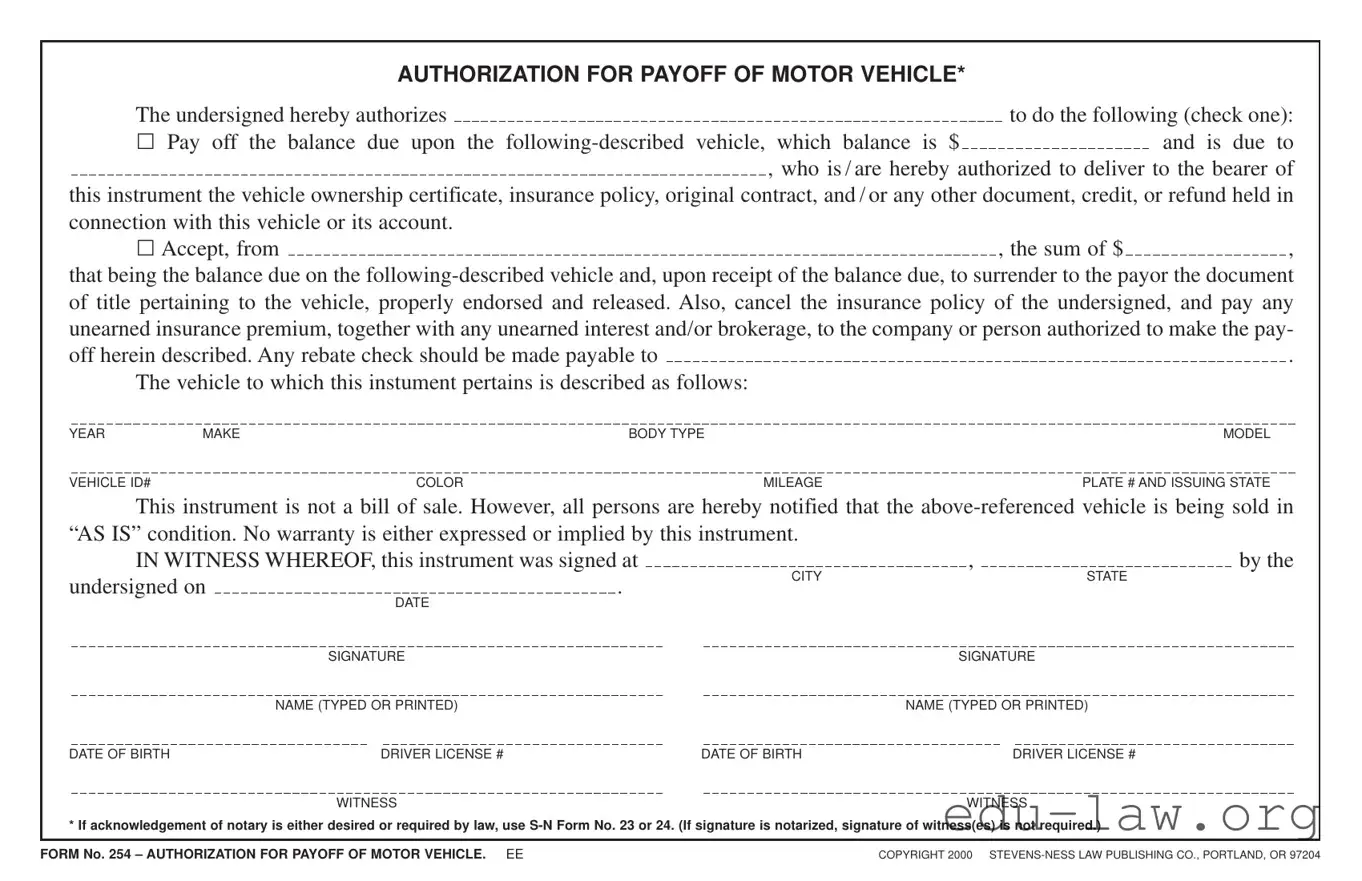
The Vehicle Payoff Authorization form serves as a crucial document in the process of settling the financial obligations associated with a motor vehicle. This form allows the undersigned to authorize specific actions regarding the payoff of the vehicle's balance. Individuals can choose to either pay off the remaining amount owed or accept the balance due from another party. Essential details about the vehicle, such as its year, make, model, and vehicle identification number, must be provided to ensure accurate identification. Additionally, the form outlines the responsibilities of the parties involved, including the delivery of necessary documents like the vehicle ownership certificate and insurance policy. It is important to note that this form does not constitute a bill of sale and specifies that the vehicle is sold in “AS IS” condition, without any warranties. The signatures of all parties involved, along with their identification details, are required to validate the authorization. In some cases, notarization may be necessary to meet legal requirements. Overall, the Vehicle Payoff Authorization form streamlines the process of transferring ownership and settling any outstanding debts related to the vehicle.

|
|
|
|
|
AUTHORIZATION FOR PAYOFF OF MOTOR VEHICLE* |
|
|
|
|
|
|
||||||||||||||||||
|
|
The undersigned hereby authorizes |
|
|
|
|
|
|
|
|
|
|
|
|
|
to do the following (check one): |
|||||||||||||
|
|
A Pay |
off the balance due upon the |
balance is $ |
and is due to |
||||||||||||||||||||||||
|
|
|
|
|
|
|
|
|
|
|
|
, who is / are hereby authorized to deliver to the bearer of |
|||||||||||||||||
|
|
|
|
|
|
|
|
|
|
|
|
||||||||||||||||||
this instrument the vehicle ownership certificate, insurance policy, original contract, and / or any other document, credit, or refund held in |
|||||||||||||||||||||||||||||
connection with this vehicle or its account. |
|
|
|
|
|
|
|
|
|
|
|
|
|
|
|
|
|
|
|
|
|
|
|
|
|||||
|
|
A Accept, from |
|
|
|
|
|
|
|
|
|
|
|
|
, the sum of $ |
|
|
|
|
, |
|||||||||
|
|
|
|
|
|
|
|
|
|
|
|
|
|
|
|
||||||||||||||
that being the balance due on the |
|||||||||||||||||||||||||||||
of title pertaining to the vehicle, properly endorsed and released. Also, cancel the insurance policy of the undersigned, and pay any |
|||||||||||||||||||||||||||||
unearned insurance premium, together with any unearned interest and/or brokerage, to the company or person authorized to make the pay- |
|||||||||||||||||||||||||||||
off herein described. Any rebate check should be made payable to |
|
|
|
|
|
|
|
|
|
|
|
|
|
. |
|||||||||||||||
|
|
The vehicle to which this instument pertains is described as follows: |
|
|
|
|
|
|
|
|
|
|
|
|
|
|
|
|
|
|
|
||||||||
YEAR |
MAKE |
BODY TYPE |
|
|
|
|
|
|
|
|
|
|
|
|
|
MODEL |
|||||||||||||
VEHICLE ID# |
|
|
COLOR |
|
|
|
|
|
MILEAGE |
|
|
|
|
|
|
|
|
PLATE # AND ISSUING STATE |
|||||||||||
|
|
This instrument is not a bill of sale. However, all persons are hereby notified that the |
|||||||||||||||||||||||||||
“AS IS” condition. No warranty is either expressed or implied by this instrument. |
|
|
|
|
|
|
|
|
|
|
|
|
|
|
|
|
|
||||||||||||
|
|
IN WITNESS WHEREOF, this instrument was signed at |
|
|
|
CITY |
|
|
, |
|
|
|
|
|
STATE |
|
|
by the |
|||||||||||
|
|
|
|
|
|
|
|
|
|
|
|||||||||||||||||||
undersigned on |
. |
|
|
|
|
|
|
|
|
|
|
|
|
|
|
|
|
|
|
|
|||||||||
|
|
|
|
|
|
|
|
|
|
|
|
|
|
|
|
|
|
|
|
|
|
|
|||||||
|
|
|
|
|
DATE |
|
|
|
|
|
|
|
|
|
|
|
|
|
|
|
|
|
|
|
|
|
|
|
|
|
|
|
SIGNATURE |
|
|
|
|
|
|
|
SIGNATURE |
|
|
|
|
|
|
||||||||||||
|
|
|
NAME (TYPED OR PRINTED) |
|
|
|
|
|
|
|
NAME (TYPED OR PRINTED) |
|
|
|
|
|
|
||||||||||||
|
|
|
|
|
|
|
|
|
|
|
|
|
|
|
|
|
|
|
|
|
|
|
|
|
|
|
|
|
|
DATE OF BIRTH |
|
|
DRIVER LICENSE # |
|
|
DATE OF BIRTH |
|
|
|
|
|
|
DRIVER LICENSE # |
|
|
|
|
|
|
||||||||||
|
|
|
WITNESS |
|
|
|
|
|
|
|
|
|
WITNESS |
|
|
|
|
|
|
||||||||||
* If acknowledgement of notary is either desired or required by law, use |
|
|
|
|
|
|
|||||||||||||||||||||||
|
|
|
|
|
|||||||||||||||||||||||||
FORM No. 254 – AUTHORIZATION FOR PAYOFF OF MOTOR VEHICLE. |
EE |
|
|
COPYRIGHT 2000 |
|||||||||||||||||||||||||
| Fact Name | Description |
|---|---|
| Purpose | The Vehicle Payoff Authorization form allows a vehicle owner to authorize a third party to pay off the remaining balance on a vehicle loan. |
| Authorization Options | The form provides two options: one to pay off the balance and another to accept the balance due from a specified party. |
| Documents Included | The authorized party is permitted to receive the vehicle ownership certificate, insurance policy, and other related documents upon payoff. |
| Insurance Cancellation | The form allows for the cancellation of the insurance policy associated with the vehicle and directs any unearned premiums to be refunded. |
| Vehicle Description | Specific details about the vehicle, including year, make, model, and vehicle identification number (VIN), must be provided on the form. |
| Legal Status | This form is not a bill of sale and indicates that the vehicle is sold "AS IS," without any warranties. |
| Witness Requirements | The signature of a witness is not required if the signature is notarized, although it is recommended for additional verification. |
| State-Specific Regulations | Each state may have specific laws governing the use of this form, including requirements for notarization or witness signatures. |
| Form Identification | This document is identified as FORM No. 254 and is published by Stevens-Ness Law Publishing Co. |
| Notary Acknowledgment | If a notary acknowledgment is desired or required, the form instructs users to refer to S-N Form No. 23 or 24. |
Once you have the Vehicle Payoff Authorization form in hand, you will need to complete it accurately to ensure a smooth transaction. Follow the steps below to fill out the form correctly.
After completing the form, review it for accuracy. Make sure all information is correct before submitting it to the relevant parties. This will help prevent any delays in the payoff process.
What is the purpose of the Vehicle Payoff Authorization form?
The Vehicle Payoff Authorization form is used to grant permission for a third party to either pay off the remaining balance on a vehicle loan or accept the payoff amount. This form ensures that the necessary documents related to the vehicle, such as the ownership certificate and insurance policy, are properly transferred to the authorized individual or entity. It is important to complete this form accurately to facilitate the smooth transaction of the vehicle's ownership.
What information do I need to provide on the form?
You will need to provide specific details about the vehicle, including the year, make, model, vehicle identification number (VIN), color, mileage, and license plate number. Additionally, you must include the balance due on the vehicle, the name of the lender or finance company, and the name of the individual or entity authorized to handle the payoff. This information is crucial for identifying the vehicle and ensuring the correct payoff process.
What happens after I submit the Vehicle Payoff Authorization form?
Once the form is submitted, the authorized party can proceed with the payoff process. They will either pay off the balance directly to the lender or accept the payoff amount from you. After the payment is made, the lender will release the title and any other related documents to the authorized individual. It is important to keep a copy of the form for your records and to confirm that all documents have been transferred as expected.
Is the Vehicle Payoff Authorization form a bill of sale?
No, the Vehicle Payoff Authorization form is not a bill of sale. It serves solely as an authorization for the payoff of the vehicle. The form indicates that the vehicle is being sold in "AS IS" condition, meaning no warranties are implied or expressed. If you need to create a bill of sale, a separate document will be required to complete that transaction.
Leaving fields blank - One common mistake is failing to fill in all required fields. Each section of the form, from the vehicle details to the signatures, needs to be completed. Omitting information can lead to delays or complications in the payoff process.
Incorrect vehicle identification - Providing inaccurate vehicle details, such as the Vehicle ID number or model, can cause significant issues. Double-check that the information matches what is on the vehicle’s title to avoid any discrepancies.
Not specifying the correct payee - It is crucial to clearly identify who is receiving the payment. Failing to do so can result in the funds being sent to the wrong party, complicating the payoff process.
Forgetting signatures - All necessary signatures must be included. A missing signature can render the form invalid, leading to potential delays in processing the payoff.
Ignoring additional documentation - Sometimes, people forget to include required documents, such as the insurance policy or original contract. Ensure that all necessary paperwork is attached to facilitate a smooth transaction.
The Vehicle Payoff Authorization form is a crucial document when settling the balance on a vehicle. Along with this form, several other documents may be necessary to ensure a smooth transaction. Below is a list of commonly used forms and documents that accompany the Vehicle Payoff Authorization.
Having these documents ready can streamline the vehicle payoff process and help avoid potential complications. Always ensure that each form is filled out accurately and completely to facilitate a successful transaction.
The Vehicle Payoff Authorization form shares similarities with a Power of Attorney document. Both forms grant authority to an individual or entity to act on behalf of another. In the case of the Vehicle Payoff Authorization, the signer allows a third party to handle the payoff of a vehicle loan and manage related documents. Similarly, a Power of Attorney enables someone to make decisions or take actions, such as signing documents or handling financial matters, for another person. This shared aspect of granting authority ensures that the designated party can effectively manage transactions without needing the principal's constant involvement.
Another document that resembles the Vehicle Payoff Authorization is the Bill of Sale. While the Vehicle Payoff Authorization focuses on authorizing the payoff of a vehicle loan, a Bill of Sale serves as a legal record of the transfer of ownership from one party to another. Both documents require detailed information about the vehicle, including make, model, and identification numbers. Additionally, they both serve as proof of the transaction, ensuring that all parties involved have a clear understanding of the terms and conditions related to the vehicle.
The Vehicle Release form is also similar in function to the Vehicle Payoff Authorization. This document is used when a vehicle is being released from a lien or loan obligation. Like the Vehicle Payoff Authorization, it requires the identification of the vehicle and the parties involved. Both documents facilitate the process of transferring ownership and clearing any financial obligations tied to the vehicle. By using these forms, individuals can ensure that all necessary paperwork is completed accurately and efficiently.
A Lien Release form is another document that parallels the Vehicle Payoff Authorization. When a vehicle loan is paid off, a Lien Release confirms that the lender no longer has a claim to the vehicle. This form is essential for the vehicle owner to obtain clear title. Similar to the Vehicle Payoff Authorization, it involves the lender's acknowledgment of the payment and the release of any claims they held. Both documents protect the interests of the vehicle owner and provide proof of the financial transaction.
The Assignment of Title document is akin to the Vehicle Payoff Authorization as well. This document is used to transfer ownership of a vehicle from one party to another. When a vehicle is paid off, the owner must assign the title to the new owner. The Vehicle Payoff Authorization allows for the title to be released upon payment, ensuring a smooth transition of ownership. Both documents require specific vehicle details and signatures from the parties involved, making them crucial for proper vehicle transfer.
Lastly, the Insurance Cancellation form bears similarities to the Vehicle Payoff Authorization. When a vehicle is sold or paid off, the owner often needs to cancel their insurance policy. The Vehicle Payoff Authorization includes provisions for canceling insurance and refunding any unearned premiums. Both documents ensure that the necessary steps are taken to update insurance records and reflect the change in ownership. This helps prevent any future liabilities or complications related to the vehicle's insurance coverage.
When filling out the Vehicle Payoff Authorization form, there are important steps to follow. Here’s a list of what you should and shouldn’t do:
Understanding the Vehicle Payoff Authorization form is crucial for anyone looking to manage their vehicle financing effectively. However, several misconceptions can lead to confusion. Here are ten common misunderstandings about this form:
Being aware of these misconceptions can help individuals navigate the vehicle payoff process more effectively and avoid potential pitfalls.
Here are key takeaways regarding the Vehicle Payoff Authorization form: