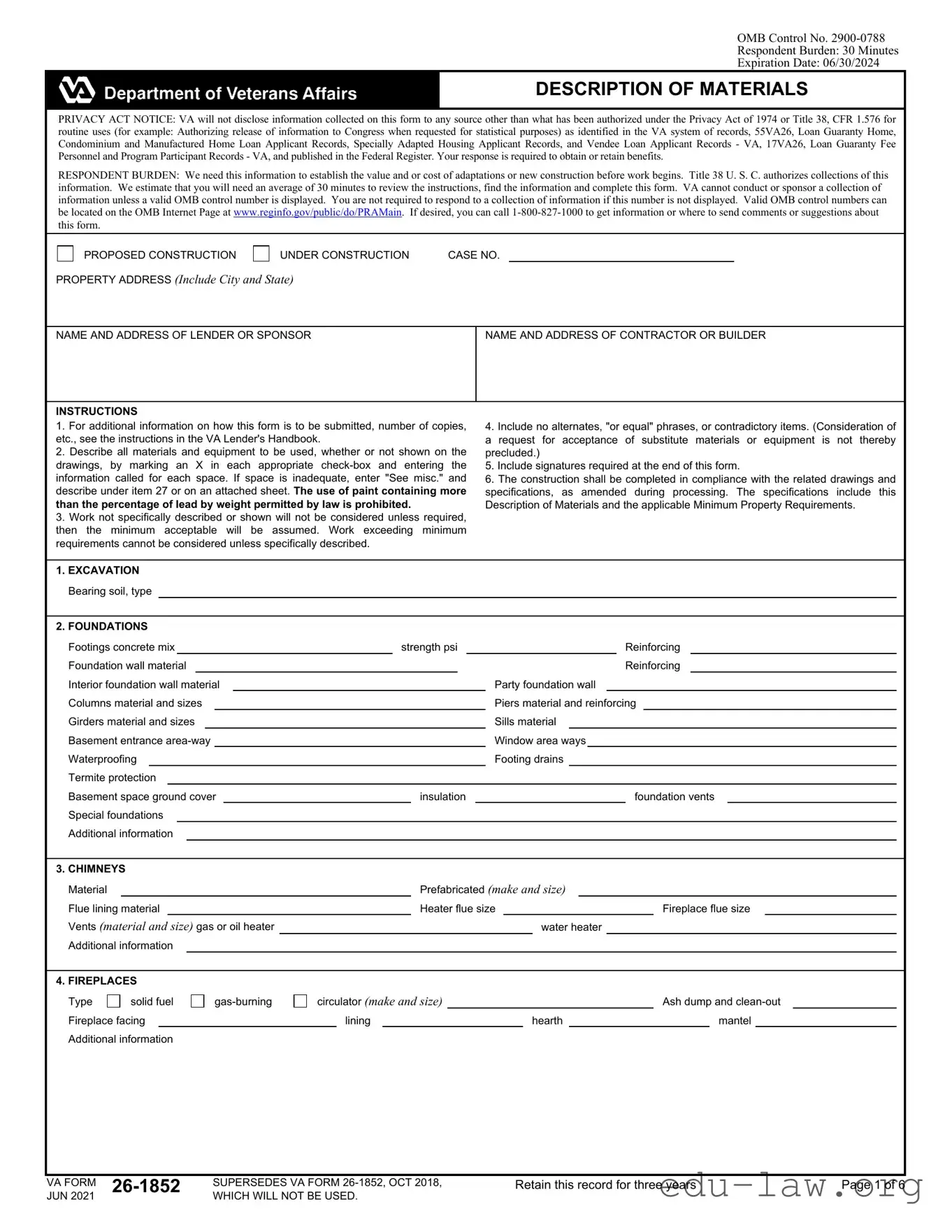
The VA Form 26-1852 is an essential document for those seeking to secure benefits related to housing adaptations, new constructions, or modifications. This form collects detailed information about the materials and equipment planned for use in construction projects. It serves multiple purposes, including establishing the value and cost of the proposed work. The form also complies with the Privacy Act of 1974, ensuring that the information provided is handled with confidentiality and only shared as authorized. Applicants must be aware that completing this form is necessary to obtain or retain benefits, and it is estimated that filling it out will take around 30 minutes. The form requires specifics about various construction elements, from foundations to roofing, plumbing, and electrical systems. Clear instructions guide users on how to accurately describe materials and comply with minimum property requirements. It is important to note that any work not explicitly described may not be considered during the review process. Therefore, thoroughness in completing the form is crucial for a successful application.
OMB Control No.
Respondent Burden: 30 Minutes
Expiration Date: 06/30/2024
DESCRIPTION OF MATERIALS
PRIVACY ACT NOTICE: VA will not disclose information collected on this form to any source other than what has been authorized under the Privacy Act of 1974 or Title 38, CFR 1.576 for
routine uses (for example: Authorizing release of information to Congress when requested for statistical purposes) as identified in the VA system of records, 55VA26, Loan Guaranty Home, Condominium and Manufactured Home Loan Applicant Records, Specially Adapted Housing Applicant Records, and Vendee Loan Applicant Records - VA, 17VA26, Loan Guaranty Fee Personnel and Program Participant Records - VA, and published in the Federal Register. Your response is required to obtain or retain benefits.
RESPONDENT BURDEN: We need this information to establish the value and or cost of adaptations or new construction before work begins. Title 38 U. S. C. authorizes collections of this information. We estimate that you will need an average of 30 minutes to review the instructions, find the information and complete this form. VA cannot conduct or sponsor a collection of information unless a valid OMB control number is displayed. You are not required to respond to a collection of information if this number is not displayed. Valid OMB control numbers can be located on the OMB Internet Page at www.reginfo.gov/public/do/PRAMain. If desired, you can call
PROPOSED CONSTRUCTION
|
UNDER CONSTRUCTION |
CASE NO. |
PROPERTY ADDRESS (Include City and State)
NAME AND ADDRESS OF LENDER OR SPONSOR
NAME AND ADDRESS OF CONTRACTOR OR BUILDER
INSTRUCTIONS |
|
|
|
|
|
|
|
|
|
|
|
|
|
|
|
|
|
|
|
|
|
||||||||||||
1. For additional information on how this form is to be submitted, number of copies, |
4. Include no alternates, "or equal" phrases, or contradictory items. (Consideration of |
||||||||||||||||||||||||||||||||
etc., see the instructions in the VA Lender's Handbook. |
|
|
|
|
a request for acceptance of substitute materials or equipment is not thereby |
||||||||||||||||||||||||||||
2. Describe all materials and equipment to be used, whether or not shown on the |
precluded.) |
|
|
|
|
|
|
|
|
|
|
||||||||||||||||||||||
drawings, by marking an X in each appropriate |
5. Include signatures required at the end of this form. |
||||||||||||||||||||||||||||||||
information called for each space. If space is inadequate, enter "See misc." and |
6. The construction shall be completed in compliance with the related drawings and |
||||||||||||||||||||||||||||||||
describe under item 27 or on an attached sheet. The use of paint containing more |
specifications, as amended during processing. The specifications include this |
||||||||||||||||||||||||||||||||
than the percentage of lead by weight permitted by law is prohibited. |
Description of Materials and the applicable Minimum Property Requirements. |
||||||||||||||||||||||||||||||||
3. Work not specifically described or shown will not be considered unless required, |
|
|
|
|
|
|
|
|
|
|
|
|
|
|
|
|
|
||||||||||||||||
then the minimum acceptable will be assumed. Work exceeding minimum |
|
|
|
|
|
|
|
|
|
|
|
|
|
|
|
|
|
||||||||||||||||
requirements cannot be considered unless specifically described. |
|
|
|
|
|
|
|
|
|
|
|
|
|
|
|
|
|
|
|
|
|
||||||||||||
|
|
|
|
|
|
|
|
|
|
|
|
|
|
|
|
|
|
|
|
|
|
|
|
|
|
|
|
|
|
|
|
|
|
1. EXCAVATION |
|
|
|
|
|
|
|
|
|
|
|
|
|
|
|
|
|
|
|
|
|
||||||||||||
Bearing soil, type |
|
|
|
|
|
|
|
|
|
|
|
|
|
|
|
|
|
|
|
|
|
||||||||||||
|
|
|
|
|
|
|
|
|
|
|
|
|
|
|
|
|
|
|
|
|
|
|
|
|
|
|
|
|
|
|
|
|
|
2. FOUNDATIONS |
|
|
|
|
|
|
|
|
|
|
|
|
|
|
|
|
|
|
|
|
|
||||||||||||
Footings concrete mix |
|
strength psi |
|
|
|
|
|
|
|
|
|
Reinforcing |
|
|
|||||||||||||||||||
Foundation wall material |
|
|
|
|
|
|
|
|
|
|
|
|
|
Reinforcing |
|
|
|||||||||||||||||
Interior foundation wall material |
|
|
|
|
|
|
Party foundation wall |
|
|
|
|
|
|
|
|
|
|
||||||||||||||||
Columns material and sizes |
|
|
|
|
|
|
Piers material and reinforcing |
|
|
||||||||||||||||||||||||
Girders material and sizes |
|
|
|
|
|
|
Sills material |
|
|
|
|
|
|
|
|
|
|
|
|||||||||||||||
Basement entrance |
|
|
|
|
|
|
Window area ways |
|
|
|
|
|
|
|
|
|
|
|
|||||||||||||||
Waterproofing |
|
|
|
|
|
|
Footing drains |
|
|
|
|
|
|
|
|
|
|
|
|||||||||||||||
Termite protection |
|
|
|
|
|
|
|
|
|
|
|
|
|
|
|
|
|
|
|
|
|
|
|||||||||||
Basement space ground cover |
|
|
insulation |
|
|
|
|
|
|
|
|
|
foundation vents |
|
|
||||||||||||||||||
Special foundations |
|
|
|
|
|
|
|
|
|
|
|
|
|
|
|
|
|
|
|
|
|
|
|||||||||||
Additional information |
|
|
|
|
|
|
|
|
|
|
|
|
|
|
|
|
|
|
|
|
|
||||||||||||
|
|
|
|
|
|
|
|
|
|
|
|
|
|
|
|
|
|
|
|
|
|
|
|
|
|
|
|
|
|
|
|
|
|
3. CHIMNEYS |
|
|
|
|
|
|
|
|
|
|
|
|
|
|
|
|
|
|
|
|
|
||||||||||||
Material |
|
|
Prefabricated (make and size) |
|
|
|
|
|
|
|
|
|
|
|
|||||||||||||||||||
Flue lining material |
|
|
Heater flue size |
|
|
|
|
|
Fireplace flue size |
|
|
||||||||||||||||||||||
Vents (material and size) gas or oil heater |
|
|
|
|
|
|
|
|
water heater |
|
|
|
|
|
|
|
|
|
|
||||||||||||||
Additional information |
|
|
|
|
|
|
|
|
|
|
|
|
|
|
|
|
|
|
|
|
|
|
|||||||||||
4.FIREPLACES
Type solid fuel Fireplace facing Additional information
|
circulator (make and size) |
|
|
|
Ash dump and |
|
|||
|
|
|
|||||||
|
lining |
|
hearth |
|
|
mantel |
|
||
JUN 2021 |
WHICH WILL NOT BE USED. |
|
|
|
VA FORM |
SUPERSEDES VA FORM |
Retain this record for three years |
Page 1 of 6 |
|
| Fact Name | Details |
|---|---|
| OMB Control Number | 2900-0788 |
| Respondent Burden | It takes approximately 30 minutes to complete the form. |
| Expiration Date | The form expires on 06/30/2024. |
| Governing Law | Title 38 U.S.C. governs the collection of information for this form. |
| Privacy Act Notice | Information collected will not be disclosed except as authorized under the Privacy Act of 1974. |
| Submission Instructions | Refer to the VA Lender's Handbook for details on submission and required copies. |
| Construction Compliance | All work must comply with related drawings and specifications as amended during processing. |
Completing the VA Form 26-1852 requires careful attention to detail. This form is essential for providing information about proposed construction and the materials to be used. Follow these steps to ensure that the form is filled out correctly.
After filling out the form, it is important to submit it as instructed. Ensure that all necessary copies are included and that the form is sent to the appropriate recipient for processing.
What is the purpose of the VA Form 26-1852?
The VA Form 26-1852 is used to collect information necessary to establish the value and cost of adaptations or new construction for homes financed through VA loans. This information helps ensure that the proposed construction meets the required standards and specifications. It is essential for obtaining or retaining benefits related to housing loans.
How long does it take to complete the VA Form 26-1852?
It is estimated that completing the VA Form 26-1852 will take approximately 30 minutes. This time includes reviewing the instructions, gathering necessary information, and filling out the form. It is important to provide accurate and complete information to avoid delays in processing.
What information is required on the VA Form 26-1852?
The form requires detailed descriptions of materials and equipment to be used in the proposed construction. This includes specifics about foundations, walls, roofing, plumbing, electrical systems, and more. If additional space is needed, you can refer to a separate sheet by indicating "See misc." in the appropriate section of the form.
What should I do if I have questions about the form?
If you have questions or need assistance with the VA Form 26-1852, you can call the VA at 1-800-827-1000. They can provide information on how to complete the form or direct you to resources that can help. It is always best to clarify any uncertainties before submitting the form.
What happens if the OMB control number is not displayed on the form?
The VA cannot conduct or sponsor the collection of information unless a valid OMB control number is displayed on the form. If this number is not present, you are not required to respond to the collection of information. You can verify valid OMB control numbers by visiting the OMB Internet Page.
Inadequate Description of Materials: Many individuals fail to provide a comprehensive description of the materials and equipment to be used. It is essential to mark an X in each appropriate check-box and fill in all requested information. If space is limited, simply writing "See misc." is not sufficient.
Neglecting Required Signatures: A common oversight is not including the necessary signatures at the end of the form. Without these signatures, the submission may be considered incomplete.
Ignoring Compliance with Specifications: Some applicants do not ensure that the construction will comply with the related drawings and specifications. This can lead to delays or rejections during the approval process.
Using "Or Equal" Phrases: Including alternates or "or equal" phrases in the description can confuse reviewers. It is crucial to provide specific details without ambiguity.
Omitting Additional Information: When the form does not have enough space for detailed descriptions, individuals often forget to provide the necessary information on an attached sheet. This can result in incomplete submissions.
Failure to Describe Work: Work that is not specifically described or shown on the form may not be considered. Applicants should ensure that all relevant work is detailed appropriately.
Incorrect Property Address: Providing an inaccurate property address can lead to significant issues in processing the application. Always double-check the address for accuracy.
Missing Contractor Information: Some individuals forget to include the name and address of the contractor or builder. This information is crucial for the processing of the form.
Not Reviewing Instructions: Failing to read and follow the instructions carefully can lead to mistakes. Taking time to understand the requirements is essential for a successful submission.
The VA Form 26-1852 is essential for documenting the materials and construction details of a property when applying for a VA loan. However, several other forms and documents are often used in conjunction with it to ensure a smooth loan process. Below are five important documents that may accompany the VA Form 26-1852.
Using these forms alongside the VA Form 26-1852 helps streamline the loan application process and ensures compliance with VA regulations. Proper documentation is crucial for both applicants and lenders to facilitate a successful transaction.
The VA Form 26-1852 serves as a crucial document for veterans seeking benefits related to housing adaptations and construction. One document that bears similarities is the VA Form 26-1880, which is used to apply for a Certificate of Eligibility for a VA home loan. Like the 26-1852, the 26-1880 collects essential information to establish a veteran's qualifications for benefits. Both forms require detailed personal information and are designed to facilitate the processing of claims, ensuring that veterans receive the support they need for home ownership.
Another related document is the VA Form 26-1817, which is the Application for a VA Guaranteed Home Loan. This form, much like the 26-1852, aims to gather pertinent information about the applicant and the property involved. Both forms play a vital role in the loan process, helping the VA assess eligibility and determine the necessary support for veterans looking to secure housing. They emphasize the importance of providing accurate details to streamline the approval process.
The VA Form 26-1820 is also noteworthy. This document is used to report the loan closing and ensure that the loan meets VA requirements. Similar to the 26-1852, it requires specific information about the property and the loan terms. Both forms serve as checkpoints in the loan process, ensuring compliance with regulations and protecting the interests of veterans seeking assistance.
Furthermore, the VA Form 26-1819 is relevant as it is used to apply for a VA home loan for a manufactured home. This form shares the same goal of facilitating access to housing benefits for veterans, much like the 26-1852. Both documents require detailed descriptions of the property and the intended use, highlighting the importance of clarity in the application process to avoid delays.
Another similar document is the VA Form 26-1853, which is the Application for a Specially Adapted Housing Grant. This form, like the 26-1852, is specifically tailored for veterans with certain service-connected disabilities. Both forms gather information regarding the veteran's needs and the proposed construction or adaptation, ensuring that the VA can provide the necessary support for creating accessible living spaces.
The VA Form 26-1854 is also comparable. It is used for the application for a grant for the construction of a new home. Like the 26-1852, this form collects vital information about the construction project, including specifications and materials. Both documents aim to ensure that the proposed construction meets VA standards and adequately addresses the needs of veterans.
Additionally, the VA Form 26-1855, which is used for the application for a grant for the purchase of a home, shares similarities with the 26-1852. Both forms focus on the financial aspects of housing and require detailed information about the property and the applicant's financial situation. This helps the VA evaluate the veteran's eligibility for various housing benefits.
The VA Form 26-1860 is another related document. This form is used for reporting the status of a loan and is similar in purpose to the 26-1852, as it ensures that all relevant information about the property and loan conditions is accurately reported. Both forms are essential for maintaining transparency and compliance within the VA loan process.
Lastly, the VA Form 26-1870 is relevant as it is used for the application for a VA loan assumption. This document, like the 26-1852, requires specific details about the property and the parties involved. Both forms emphasize the importance of providing comprehensive information to facilitate the smooth transfer of benefits and ensure that veterans receive the assistance they deserve.
When filling out the VA Form 26-1852, it is important to follow specific guidelines to ensure accuracy and compliance. Here are six things to do and avoid:
This form can also be used for adaptations to existing homes. It helps assess the necessary materials and costs for modifications, ensuring compliance with VA requirements.
Submitting the VA Form 26-1852 is mandatory for obtaining benefits related to home loans. The information collected is essential for processing your application.
Every detail matters. Omitting information may lead to delays or denials. The form requires thorough descriptions of materials and construction plans.
Signatures are essential. The form must be signed at the end to validate the information provided and to confirm that it is accurate.
A valid OMB control number is necessary for the collection of information. Submitting the form without it may result in rejection.
The VA Form 26-1852 can also apply to condominiums and manufactured homes. It is designed to accommodate various types of housing structures.
Key Takeaways for Completing VA Form 26-1852: