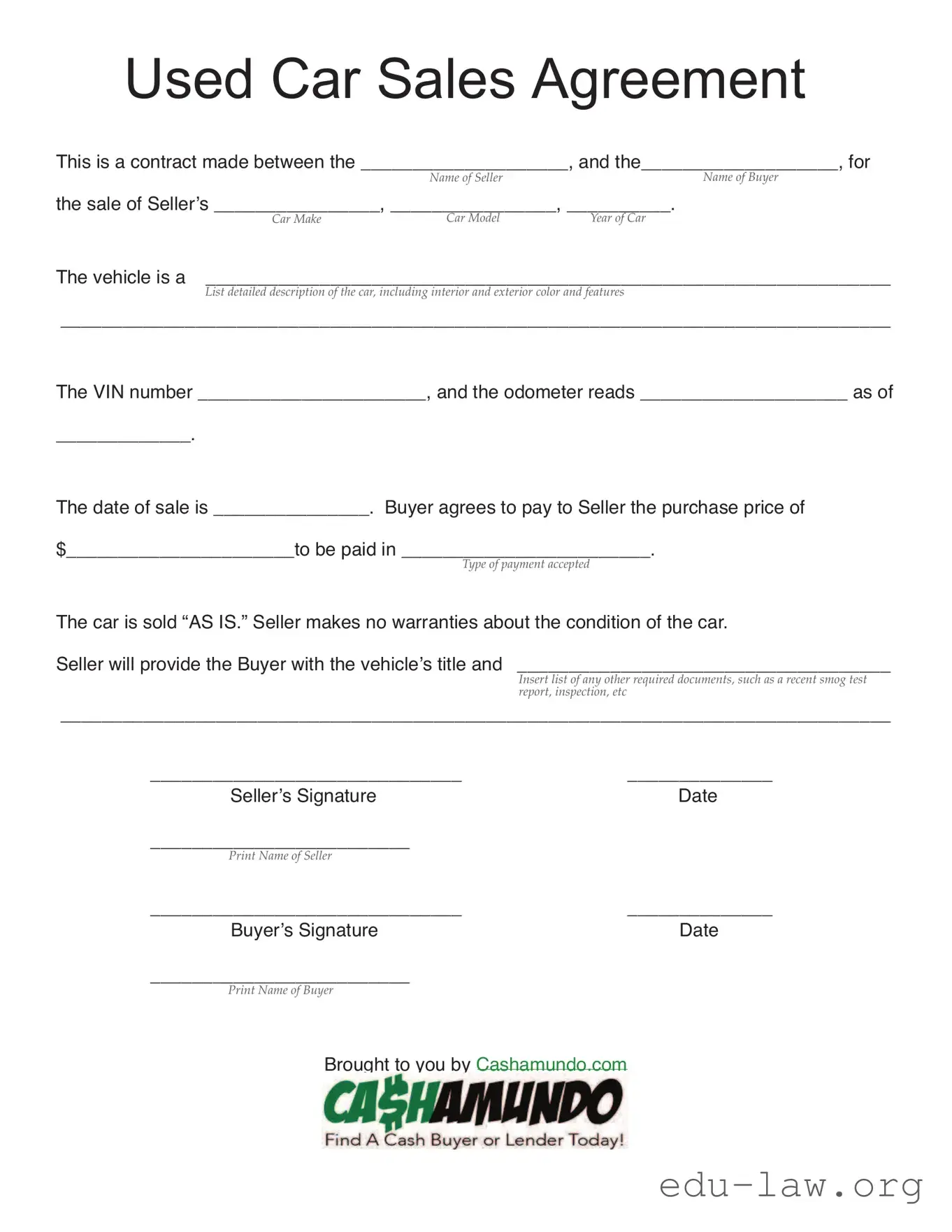
The Used Car Agreement form serves as a crucial document in the transaction between a seller and a buyer, outlining the terms and conditions of the sale of a pre-owned vehicle. This contract includes essential information such as the names of both parties, the make, model, and year of the car, and a detailed description of the vehicle's condition and features. Additionally, it requires the Vehicle Identification Number (VIN) and the current odometer reading, ensuring transparency regarding the car's history. The agreement specifies the purchase price, the payment method, and emphasizes that the vehicle is sold "AS IS," meaning the seller does not provide any warranties regarding its condition. Furthermore, the seller is obligated to provide the buyer with the vehicle's title and any other necessary documents, such as a recent smog test report or inspection records. Both parties must sign and date the agreement, solidifying their understanding and acceptance of the terms laid out in this important transaction document.

Used Car Sales Agreement
This is a contract made between the ____________________, and the___________________, for
the sale of Seller’s ________________, ________________, __________.
Car MakeCar ModelYear of Car
The vehicle is a __________________________________________________________________
List detailed description of the car, including interior and exterior color and features
________________________________________________________________________________
The VIN number ______________________, and the odometer reads ____________________ as of
_____________.
The date of sale is _______________. Buyer agrees to pay to Seller the purchase price of
$______________________to be paid in ________________________.
Type of payment accepted
The car is sold “AS IS.” Seller makes no warranties about the condition of the car.
Seller will provide the Buyer with the vehicle’s title and ____________________________________
Insert list of any other required documents, such as a recent smog test report, inspection, etc
________________________________________________________________________________
______________________________ |
______________ |
Seller’s Signature |
Date |
_________________________ |
|
Print Name of Seller |
|
______________________________ |
______________ |
Buyer’s Signature |
Date |
_________________________ |
|
Print Name of Buyer |
|
Brought to you by Cashamundo.com
| Fact Name | Description |
|---|---|
| Parties Involved | The agreement is made between the seller and the buyer, each of whom must provide their names to complete the contract. |
| Vehicle Information | Details about the car, including make, model, year, and a comprehensive description, must be included to ensure clarity about the vehicle being sold. |
| VIN and Odometer | The vehicle identification number (VIN) and the current odometer reading are required to verify the car's identity and mileage at the time of sale. |
| Payment Terms | The buyer agrees to pay a specified purchase price, and the form must indicate the type of payment accepted, ensuring mutual understanding of the transaction. |
| AS IS Clause | The car is sold "AS IS," meaning the seller does not provide warranties regarding the vehicle's condition, which the buyer must acknowledge. |
Filling out the Used Car Agreement form is a straightforward process that helps both the seller and buyer document the sale of a vehicle. Follow these steps to ensure all necessary information is accurately captured.
What is a Used Car Agreement form?
The Used Car Agreement form is a legal document that outlines the terms and conditions of the sale of a used vehicle between a seller and a buyer. This form includes essential details such as the names of both parties, the make and model of the car, the vehicle identification number (VIN), and the agreed purchase price. It serves as a record of the transaction and protects the interests of both the buyer and the seller.
What does "AS IS" mean in the context of a Used Car Agreement?
When a car is sold "AS IS," it means that the seller is not providing any warranties or guarantees regarding the vehicle's condition. The buyer accepts the car in its current state, including any existing issues or defects. It’s crucial for buyers to thoroughly inspect the vehicle and consider having a mechanic check it before finalizing the purchase, as they are assuming all risks associated with the car's condition.
What information should be included in the detailed description of the car?
The detailed description of the car should encompass various aspects to give the buyer a clear understanding of what they are purchasing. This includes the car's interior and exterior color, any special features such as leather seats or a sunroof, and any modifications that have been made. Providing a comprehensive description helps prevent misunderstandings and ensures that both parties are on the same page regarding the vehicle's condition and features.
What documents should the seller provide to the buyer?
When completing the Used Car Agreement, the seller is responsible for providing the buyer with the vehicle’s title, which proves ownership. Additionally, any other required documents should be listed in the agreement. This may include a recent smog test report, inspection reports, or maintenance records. Ensuring that all necessary documents are provided helps facilitate a smooth transfer of ownership and can protect the buyer from future liabilities.
How can payment be structured in the Used Car Agreement?
The payment structure can be flexible, depending on what both parties agree upon. The agreement should clearly state the total purchase price and the type of payment accepted, such as cash, certified check, or bank transfer. If the buyer plans to make payments over time, the agreement should outline the payment schedule, including the amount and due dates. Clear terms help avoid confusion and ensure that both parties understand their financial obligations.
Incomplete Information: One common mistake occurs when individuals fail to fill in all required fields on the Used Car Agreement form. This includes crucial details such as the names of both the seller and the buyer, the car's make and model, and the VIN number. Leaving these sections blank can lead to confusion or disputes later on.
Ignoring Payment Details: Another frequent error involves neglecting to specify the purchase price and the method of payment. Buyers and sellers should clearly outline how much money is being exchanged and the form that payment will take, whether it be cash, check, or another method. Failing to do so may create misunderstandings regarding the transaction.
Misunderstanding the “AS IS” Clause: Many individuals do not fully grasp the implications of the “AS IS” clause. This phrase indicates that the seller is not providing any warranties about the car's condition. Buyers should be aware that once the agreement is signed, they accept the vehicle in its current state, which may include undisclosed issues.
Omitting Required Documents: Lastly, sellers often forget to list all necessary documents that need to accompany the sale. This may include the vehicle title, smog test reports, or inspection certificates. Not including these documents can complicate the transfer of ownership and delay the sale process.
When engaging in the sale of a used car, several important documents may accompany the Used Car Agreement form. Each of these documents serves a specific purpose and helps ensure that both the buyer and seller are protected during the transaction. Below is a list of common forms and documents that are often used in conjunction with the Used Car Agreement.
Having these documents ready can facilitate a smoother transaction and provide clarity for both parties involved. It is advisable to review each document carefully to ensure all information is accurate and complete before finalizing the sale.
The Bill of Sale is a document that serves as proof of the transfer of ownership of a vehicle from the seller to the buyer. Like the Used Car Agreement, it includes essential details such as the names of both parties, a description of the vehicle, and the sale price. This document typically does not contain warranties, similar to the “AS IS” clause in the Used Car Agreement, indicating that the buyer accepts the vehicle in its current condition without guarantees from the seller.
The Purchase Agreement is another document that outlines the terms of a sale. It is similar to the Used Car Agreement in that it specifies the parties involved, the item being sold, and the payment terms. However, it may also include additional clauses regarding financing, delivery, and contingencies, making it more comprehensive than the typical Used Car Agreement.
The Vehicle Title Transfer form is essential for legally transferring ownership of a vehicle. It shares similarities with the Used Car Agreement, particularly in that both documents require the seller's and buyer's information. The title transfer form must be completed and submitted to the appropriate state agency to ensure the new owner is officially recognized.
The Odometer Disclosure Statement is a document that confirms the mileage on a vehicle at the time of sale. This statement is often required in conjunction with the Used Car Agreement to protect both parties from potential fraud. Just like the odometer reading noted in the Used Car Agreement, this document ensures that the buyer is aware of the vehicle's mileage, which can impact its value.
The Warranty Deed is a document that conveys real property, but it is similar to the Used Car Agreement in that both serve to establish a legal transfer of ownership. While the Warranty Deed includes guarantees about the title, the Used Car Agreement explicitly states that the vehicle is sold “AS IS,” highlighting the difference in liability and warranties between real estate and vehicle sales.
The Lease Agreement is used when a buyer rents a vehicle instead of purchasing it outright. While the Used Car Agreement focuses on the sale of a vehicle, both documents outline the terms of use, payment obligations, and responsibilities of each party. The Lease Agreement may include maintenance responsibilities, which are typically not addressed in a sale agreement.
The Service Agreement outlines the terms for maintenance or repair services for a vehicle. Similar to the Used Car Agreement, it details the parties involved and the scope of services. However, the Service Agreement focuses on ongoing responsibilities rather than the transfer of ownership, emphasizing the relationship between service provider and vehicle owner.
The Financing Agreement is used when a buyer borrows money to purchase a vehicle. This document details the loan amount, interest rate, and payment schedule. Like the Used Car Agreement, it includes both the buyer's and seller's information, but it specifically addresses the financial terms of the purchase rather than the vehicle's condition or warranty.
The Insurance Policy is a contract that provides coverage for a vehicle against various risks. While the Used Car Agreement does not address insurance, both documents are essential in the vehicle ownership process. The Insurance Policy protects the buyer after the sale, whereas the Used Car Agreement focuses on the terms of the sale itself.
The Inspection Report is often generated prior to a vehicle sale to assess its condition. Similar to the Used Car Agreement, it includes details about the vehicle and its current state. This report can serve as an important document for the buyer, providing information about potential issues and supporting the “AS IS” clause in the Used Car Agreement.
When filling out the Used Car Agreement form, it's essential to follow certain guidelines to ensure a smooth transaction. Here are seven important dos and don'ts:
Following these steps will help protect both the buyer and seller throughout the transaction process. Take your time and double-check all entries to avoid potential disputes later on.
Understanding the Used Car Agreement form is crucial for both buyers and sellers. However, several misconceptions often arise regarding this important document. Below are seven common misconceptions and clarifications to help you navigate the used car sales process more effectively.
The agreement states that the car is sold "AS IS," meaning the seller does not provide any warranties regarding the vehicle's condition. Buyers should conduct thorough inspections before finalizing the sale.
Many believe that a warranty is mandatory in a used car sale. However, the "AS IS" clause in the agreement explicitly states that no warranties are offered, placing the onus on the buyer to assess the car's condition.
Some think that the Used Car Agreement is only required for private sales. In reality, it is beneficial for any transaction, including sales at dealerships, as it formalizes the sale and protects both parties.
Once the sale is completed and the agreement is signed, the buyer typically cannot return the vehicle based on dissatisfaction. The "AS IS" clause reinforces that the buyer accepts the car's condition at the time of sale.
While some states require a smog test for used cars, it is not universally mandatory. The seller only needs to provide this document if it is specified in the agreement or required by state law.
Many people mistakenly believe that a Used Car Agreement holds no legal weight. In fact, once signed, it serves as a legally binding contract that outlines the terms of the sale, protecting both parties.
Once the Used Car Agreement is signed, the price is considered final. Buyers should negotiate the price before signing to avoid any misunderstandings later on.
Being aware of these misconceptions can help both buyers and sellers navigate the used car sales process with greater confidence and understanding.
When navigating the Used Car Agreement form, it’s essential to understand its components and implications. Here are key takeaways to ensure a smooth transaction:
By following these takeaways, both buyers and sellers can ensure a clear and effective transaction when using the Used Car Agreement form.