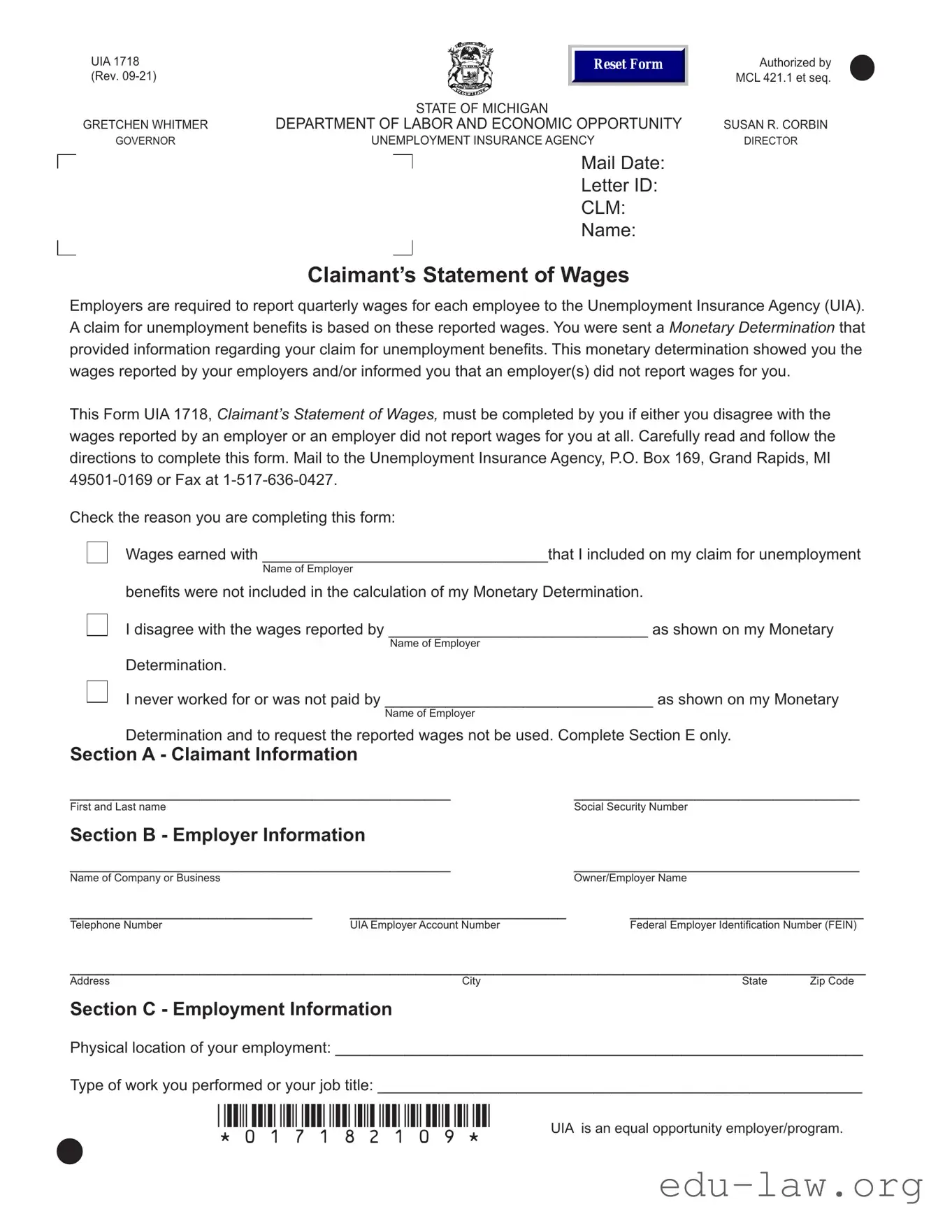
The UIA 1718 form, officially titled the Claimant’s Statement of Wages, plays a crucial role in the unemployment benefits process in Michigan. This form is essential for individuals who have received a Monetary Determination regarding their unemployment claim. It allows claimants to address discrepancies in reported wages, whether due to missing information from employers or disagreements with the reported amounts. The form requires detailed personal information, including the claimant's name and Social Security number, as well as information about the employer, such as the company name and contact details. Additionally, it includes sections for employment specifics, including job title and payment methods. Claimants must report their gross wages for each quarter of the year, ensuring that the information provided is accurate and supported by documentation like pay stubs or W-2 forms. Completing this form correctly is vital, as it directly impacts the calculation of unemployment benefits. Furthermore, the UIA emphasizes the importance of timely updates regarding any changes in personal information to maintain accurate records. Understanding the requirements and processes associated with the UIA 1718 form can significantly aid individuals navigating the unemployment benefits system.
UIA 1718 |
|
|
|
Reset Form |
(Rev. |
|
|
|
|
|
|
|
STATE OF MICHIGAN |
|
GRETCHEN WHITMER |
DEPARTMENT OF LABOR AND ECONOMIC OPPORTUNITY |
|||
GOVERNOR |
UNEMPLOYMENT INSURANCE AGENCY |
|||
|
|
|
|
Mail Date: |
|
|
|
||
|
|
|
||
|
|
|
|
Letter ID: |
|
|
|
|
CLM: |
|
|
|
|
Name: |
Authorized by |
• |
MCL 421.1 et seq. |
|
SUSAN R. CORBIN |
|
DIRECTOR |
|
Claimant’s Statement of Wages
Employers are required to report quarterly wages for each employee to the Unemployment Insurance Agency (UIA). A claim for unemployment benefits is based on these reported wages. You were sent a Monetary Determination that provided information regarding your claim for unemployment benefits. This monetary determination showed you the wages reported by your employers and/or informed you that an employer(s) did not report wages for you.
This Form UIA 1718, Claimant’s Statement of Wages, must be completed by you if either you disagree with the wages reported by an employer or an employer did not report wages for you at all. Carefully read and follow the directions to complete this form. Mail to the Unemployment Insurance Agency, P.O. Box 169, Grand Rapids, MI
Check the reason you are completing this form:
Wages earned with _________________________________that I included on my claim for unemployment
Name of Employer
benefits were not included in the calculation of my Monetary Determination.
I disagree with the wages reported by ______________________________ as shown on my Monetary
Name of Employer
Determination.
I never worked for or was not paid by _______________________________ as shown on my Monetary
Name of Employer
Determination and to request the reported wages not be used. Complete Section E only.
Section A - Claimant Information
____________________________________________ |
_________________________________ |
|
First and Last name |
|
Social Security Number |
Section B - Employer Information |
|
|
____________________________________________ |
_________________________________ |
|
Name of Company or Business |
|
Owner/Employer Name |
____________________________ |
_________________________ |
___________________________ |
Telephone Number |
UIA Employer Account Number |
Federal Employer Identification Number (FEIN) |
____________________________________________________________________________________________
Address |
City |
State |
Zip Code |
Section C - Employment Information |
|
|
|
Physical location of your employment: _____________________________________________________________
Type of work you performed or your job title: ________________________________________________________ |
||
• |
*017182109* |
UIA is an equal opportunity employer/program. |
|
||
UIA 1718 (Rev.
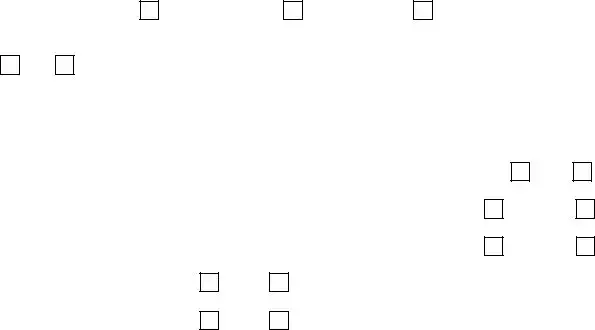
How were you paid?
Cash Check
Direct deposit
Letter ID:
Other - explain: ____________________
Was there other remuneration (e.g. bonuses, commissions, 401K, room and board, etc.) in your wages?
No
Yes - explain:
Were deductions made from your pay (e.g. FICA, income taxes, etc.) in your wages? |
No |
||
Total gross wages during current calendar year: $____________________ |
actual |
||
Total gross wages during preceding calendar year: $__________________ |
actual |
||
Were there other employees? |
No |
Yes - how many? ______________ |
|
Is the employer still operating? |
No |
Yes |
|
Additional comments: |
|
|
|
Yes
estimated
estimated
Section D - Quarterly Wage Information
You must report the quarterly gross wages (before taxes) on the chart on the next page. There are four calendar quarters per year. The quarters are numbered and are the same from year to year. Each quarter contains three calendar months as follows:
1st Quarter |
January 1 |
through |
March 31 |
2nd Quarter |
April 1 |
through |
June 30 |
3rd Quarter |
July 1 |
through |
September 30 |
4th Quarter |
October 1 |
through |
December 31 |
The involved quarters are the same quarters that are shown on your Monetary Determination under the heading “Monetary Determination Calculations”. Label the chart on the next page with the same quarter dates.
•If you are completing this form because wages earned with an employer that you included on your claim were not used in the calculation of your Monetary Determination, complete all quarters that contained wages from that employer.
•If you are completing this form because you disagree with the wages reported by your employer, complete only the quarters that you disagree with.
If your address changes, it is important to update it with the Unemployment Insurance Agency.
If you have questions, you may contact us through your MiWAM account or by calling
UIA 1718 |
Letter ID: |
• |
|
||
(Rev. |
|
These quarterly charts allow you to enter wage information per week to help you determine your quarterly total wages. If you know your gross wages for each quarter, complete only the Total Quarterly Wage box for each involved quarter. Wages are reported in the quarter they are paid to you.
Example: You may have worked during the last week of March (1st quarter), but you were not paid until April (2nd quarter). These wages must be reported in the 2nd quarter (the quarter containing the date you were PAID).
You are required to send in clear, legible proof of wages to support the information you provide on this form. This can include check stubs,
Quarter ___ |
Year ______ |
Quarter ___ |
Year ______ |
Quarter ___ |
Year ______ |
Quarter ___ |
Year ______ |
Quarter ___ |
Year ______ |
|
WEEK PAID |
GROSS WAGES |
WEEK PAID |
GROSS WAGES |
WEEK PAID |
GROSS WAGES |
WEEK PAID |
GROSS WAGES |
WEEK PAID |
GROSS WAGES |
|
PAID |
PAID |
PAID |
PAID |
PAID |
||||||
|
|
|
|
|
||||||
|
|
|
|
|
|
|
|
|
|
|
|
|
|
|
|
|
|
|
|
|
|
|
|
|
|
|
|
|
|
|
|
|
|
|
|
|
|
|
|
|
|
|
|
|
|
|
|
|
|
|
|
|
|
|
|
|
|
|
|
|
|
|
|
|
|
|
|
|
|
|
|
|
|
|
|
|
|
|
|
|
|
|
|
|
|
|
|
|
|
|
|
|
|
|
|
|
|
|
|
|
|
|
|
|
|
|
|
|
|
|
|
|
|
|
|
|
|
|
|
|
|
|
|
|
|
|
|
|
|
|
|
|
|
|
|
|
|
|
|
|
|
|
TOTAL |
|
TOTAL |
|
TOTAL |
|
TOTAL |
|
TOTAL |
|
|
Quarterly |
|
Quarterly |
|
Quarterly |
|
Quarterly |
|
Quarterly |
|
|
Wages |
|
Wages |
|
Wages |
|
Wages |
|
Wages |
|
|
|
|
|
|
|
|
|
|
|
|
Section E - Certification Statement
Certification: I certify that the information I have reported is true and correct. I understand that if I intentionally make a false statement, misrepresent facts or conceal material information, I may be required to pay damages and could be subject to criminal prosecution.
_____________________________________________________ |
_______________________ |
Signature |
Date |
• |
*017182109* UIA is an equal opportunity employer/program. |
|
| Fact Name | Description |
|---|---|
| Purpose of Form | The UIA 1718 form is used by claimants to report discrepancies in wages reported by employers to the Unemployment Insurance Agency (UIA). |
| Governing Law | This form is governed by the Michigan Compiled Laws, specifically MCL 421.1 et seq. |
| Submission Method | Completed forms can be mailed to the Unemployment Insurance Agency at P.O. Box 169, Grand Rapids, MI 49501-0169 or faxed to 1-517-636-0427. |
| Quarterly Wage Reporting | Claimants must report their gross wages for each quarter in which they were employed, as this information is critical for determining eligibility for benefits. |
| Certification Requirement | Claimants must sign a certification statement confirming that the information provided is true and correct, acknowledging potential legal consequences for false statements. |
| Contact Information | For assistance, claimants can contact the UIA at 1-866-500-0017 or through their MiWAM account. |
Completing the UIA 1718 form is essential for ensuring that your unemployment benefits are calculated accurately based on your reported wages. Follow these steps to fill out the form correctly.
What is the UIA 1718 form?
The UIA 1718 form, also known as the Claimant’s Statement of Wages, is used by individuals applying for unemployment benefits in Michigan. This form allows claimants to report discrepancies in their wage information that has been submitted by employers to the Unemployment Insurance Agency (UIA).
When should I complete the UIA 1718 form?
You should complete the UIA 1718 form if you disagree with the wages reported by your employer or if an employer did not report any wages for you. It is essential to address these issues promptly to ensure your claim for unemployment benefits is accurate.
How do I submit the UIA 1718 form?
You can submit the completed UIA 1718 form by mailing it to the Unemployment Insurance Agency at P.O. Box 169, Grand Rapids, MI 49501-0169. Alternatively, you can fax it to 1-517-636-0427. Make sure to keep a copy for your records.
What information do I need to provide on the form?
The form requires your personal information, such as your name and Social Security number, as well as details about your employer, including their name and contact information. You will also need to report your gross wages for each quarter and any discrepancies you are contesting.
What if I never worked for the employer listed?
If you never worked for or were not paid by the employer listed in your Monetary Determination, you should complete Section E of the UIA 1718 form. This section allows you to formally request that the reported wages not be used in your unemployment claim.
What kind of proof do I need to submit?
You must provide clear and legible proof of your wages. Acceptable documentation includes pay stubs, W-2 forms, payroll records, or a letter from your employer detailing your payroll information. This proof is crucial for the UIA to verify the information you provide.
How are wages reported on the form?
You will report your gross wages for each calendar quarter. The quarters are divided into four segments throughout the year. Make sure to enter your wages in the quarter they were paid, not when you worked for them. For example, if you worked in March but were paid in April, those wages should be reported in the second quarter.
What if my address changes after I submit the form?
If your address changes, it is important to update your information with the Unemployment Insurance Agency. This ensures that you receive all necessary correspondence regarding your claim and any benefits you may be entitled to.
Where can I get help if I have questions about the form?
If you have questions about the UIA 1718 form or your unemployment claim, you can contact the UIA through your MiWAM account or by calling 1-866-500-0017. You can also find additional resources and information on the Michigan UIA website.
Incomplete Personal Information: Failing to provide all required details in Section A, such as the full name or Social Security Number, can lead to delays in processing the claim.
Incorrect Employer Information: Listing the wrong employer name or providing an incorrect Employer Identification Number (EIN) in Section B can result in confusion and miscommunication.
Omitting Wage Details: Not reporting gross wages accurately in Section D may lead to discrepancies in the monetary determination, affecting the claim outcome.
Failure to Complete the Quarterly Wage Chart: Neglecting to fill out the quarterly wage information correctly can hinder the assessment of benefits owed.
Not Including Proof of Wages: Submitting the form without clear evidence, such as pay stubs or W-2s, may result in rejection of the claim.
Ignoring Certification Statement: Forgetting to sign and date the certification statement in Section E can invalidate the form.
Providing Inconsistent Information: Discrepancies between the information on the UIA 1718 form and other submitted documents may raise red flags and complicate the review process.
Not Following Submission Guidelines: Failing to mail or fax the form to the correct address as specified can delay processing and potentially jeopardize the claim.
When filing for unemployment benefits in Michigan, the UIA 1718 form is essential for reporting wages. However, several other documents may accompany this form to ensure a complete and accurate claim. Here’s a brief overview of these documents:
These documents work together to create a comprehensive picture of your employment history and earnings, facilitating a smoother claims process. Ensuring you have all necessary documentation can significantly enhance your chances of receiving the benefits you deserve.
The UIA 1718 form is similar to the IRS Form W-2. Both documents are used to report wages earned by employees. The W-2 is issued by employers at the end of the year, summarizing an employee's total earnings and taxes withheld. Similarly, the UIA 1718 form allows claimants to report discrepancies in wages that affect their unemployment benefits. While the W-2 is primarily for tax purposes, the UIA 1718 focuses on ensuring accurate wage reporting for unemployment claims.
Another document similar to the UIA 1718 is the IRS Form 1099-MISC. This form is used to report income earned by independent contractors and freelancers. Like the UIA 1718, it requires detailed information about the earnings received. Both forms serve to clarify wage discrepancies, although the 1099-MISC is for non-employee compensation, whereas the UIA 1718 deals specifically with employment wages impacting unemployment benefits.
The Employment Verification Form is also comparable to the UIA 1718. This document is often used by employers to confirm an employee's job status and earnings. When a claimant disputes reported wages, the UIA 1718 serves a similar purpose by allowing the individual to clarify their employment history and wages. Both documents aim to provide accurate information regarding a person's employment status.
Another related document is the UIA 1710 form, which is the Monetary Determination form. This form informs claimants about the wages reported by their employers and the calculations used to determine eligibility for benefits. The UIA 1718 allows claimants to contest or clarify the information presented in the Monetary Determination, creating a direct connection between the two forms in the process of resolving wage disputes.
The Pay Stub is another document that shares similarities with the UIA 1718. Pay stubs provide a breakdown of earnings for each pay period, including gross wages and deductions. Claimants can use pay stubs as proof of wages when completing the UIA 1718 form to support their claims. Both documents are essential in verifying income and ensuring that reported wages are accurate.
The Social Security Administration's Form SSA-1099 is also relevant. This form reports Social Security benefits received by individuals. While it focuses on government benefits rather than wages from employment, it serves a similar purpose in verifying income. Both forms are used to establish financial information that may impact eligibility for various benefits, including unemployment.
Lastly, the State Unemployment Insurance Application is akin to the UIA 1718. This application is the initial step for individuals seeking unemployment benefits, requiring them to report their employment history and earnings. The UIA 1718 comes into play later in the process when discrepancies arise, allowing claimants to clarify or contest wage information. Both documents are integral to the unemployment benefits process, ensuring that accurate information is used for determining eligibility.
When filling out the UIA 1718 form, it is essential to follow specific guidelines to ensure accuracy and compliance. Here are some important do's and don'ts:
Here are five common misconceptions about the UIA 1718 form, along with clarifications for each:
This form is also for individuals who believe their reported wages are incorrect or who have wages that were not reported at all.
In fact, you must include clear evidence of your wages, such as check stubs or W-2s, to support the information you provide.
Submitting this form does not automatically lead to a change in your benefits; it merely allows you to contest reported wages.
You should also complete the form if you believe wages from an employer were not included in your Monetary Determination.
There are time limits for submitting the UIA 1718 form, so it’s important to act promptly to ensure your claim is processed.
Filling out the UIA 1718 form is an important step in ensuring that your unemployment benefits accurately reflect your work history. Here are some key takeaways to keep in mind: