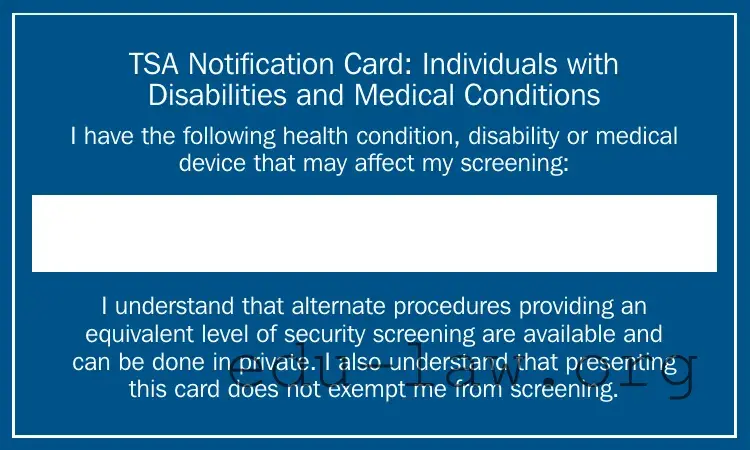
The TSA Notification Card serves as an essential tool for individuals with disabilities and medical conditions who are navigating airport security. This form allows travelers to communicate specific health issues or medical devices that may impact the screening process. By presenting the card, individuals can request alternative screening procedures that maintain a high level of security while ensuring privacy and comfort. It is important to note that the card does not exempt travelers from undergoing screening; rather, it facilitates a more accommodating experience. The TSA encourages travelers to reach out for assistance by contacting TSA Cares, available on weekdays and weekends, ensuring support is accessible in multiple languages. For those who may require additional help, a Passenger Support Specialist can be requested prior to traveling, providing peace of mind during the often-stressful airport experience.

TSA Notification Card: Individuals with Disabilities and Medical Conditions
I have the following health condition, disability or medical
device that may affect my screening:
I understand that alternate procedures providing an equivalent level of security screening are available and can be done in private. I also understand that presenting this card does not exempt me from screening.

Information • Assistance Requests • Compliments • Complaints
TSA Cares
Weekdays: 8 a.m. to 11 p.m. ET
Weekends/Holidays: 9 a.m. to 8 p.m. ET
Hablamos Español
Automated information offered in 12 languages
Call 72 hours prior to traveling to request the assistance of a
Passenger Support Specialist (PSS) at the checkpoint. If a PSS is not available, you may ask for a Supervisory TSA Officer at the checkpoint.
| Fact Name | Fact Details |
|---|---|
| Purpose | The TSA Notification Card is designed for individuals with disabilities and medical conditions to facilitate their screening process at airports. |
| Health Conditions | Cardholders can indicate specific health conditions, disabilities, or medical devices that may impact their screening experience. |
| Alternate Procedures | Individuals are informed that alternate screening procedures, which provide equivalent security, are available and can be conducted in private. |
| No Exemption | Presenting the card does not exempt individuals from the screening process; it simply aids in accommodating their needs. |
| Contact Information | For assistance, individuals can reach TSA Cares at 1-855-787-2227 or via email at [email protected]. |
| Availability | TSA Cares operates weekdays from 8 a.m. to 11 p.m. ET and weekends/holidays from 9 a.m. to 8 p.m. ET. |
| Language Support | Automated information is available in 12 languages, ensuring accessibility for non-English speakers. |
| Requesting Assistance | Travelers are encouraged to call 72 hours before their flight to request the help of a Passenger Support Specialist at the checkpoint. |
| Escalation | If a Passenger Support Specialist is unavailable, individuals can ask for a Supervisory TSA Officer for further assistance. |
Filling out the TSA Notification Card is an important step for individuals with disabilities or medical conditions who may require special accommodations during security screening. This form helps ensure that the necessary arrangements are made to facilitate a smoother experience at the airport. Below are the steps to complete the form effectively.
If you have any questions or need assistance while filling out the form, you can reach out to TSA Cares at 1-855-787-2227 during their operating hours. It’s always a good idea to prepare ahead of time, especially if you plan to travel soon.
What is the TSA Notification Card?
The TSA Notification Card is a tool designed for individuals with disabilities, medical conditions, or those using medical devices that may affect their screening process at airports. It allows travelers to communicate their needs discreetly to TSA officers during security screening.
How do I obtain a TSA Notification Card?
You can obtain the TSA Notification Card by visiting the TSA website or by contacting TSA Cares at 1-855-787-2227. The card is available for download and printing, or you can request a physical card to be mailed to you.
Do I need to present the TSA Notification Card every time I travel?
Will presenting the TSA Notification Card exempt me from screening?
No, presenting the TSA Notification Card does not exempt you from the screening process. However, it does signal to TSA officers that you may require alternate procedures that ensure an equivalent level of security while accommodating your needs.
What should I do if I need assistance at the checkpoint?
If you require assistance at the checkpoint, you can call TSA Cares at least 72 hours before your travel date to request the help of a Passenger Support Specialist (PSS). If a PSS is not available, you can ask for a Supervisory TSA Officer for assistance.
What are the hours of operation for TSA Cares?
TSA Cares operates on weekdays from 8 a.m. to 11 p.m. ET and on weekends and holidays from 9 a.m. to 8 p.m. ET. They provide support and information regarding travel for individuals with disabilities and medical conditions.
Can I receive assistance in languages other than English?
Yes, TSA Cares offers automated information in 12 different languages. If you need assistance in a specific language, it is recommended to mention this when you contact TSA Cares or when you arrive at the checkpoint.
Failing to clearly state the specific health condition or disability. It's essential to provide detailed information about the condition to ensure proper accommodations.
Not understanding that the card does not exempt individuals from screening. Many assume that presenting the card will eliminate the need for any screening procedures.
Ignoring the request for assistance. Individuals often overlook the importance of contacting TSA Cares at least 72 hours before traveling to request a Passenger Support Specialist.
Providing incomplete or inaccurate contact information. This can lead to delays or issues in receiving the necessary assistance during travel.
Neglecting to ask for a Supervisory TSA Officer if a Passenger Support Specialist is unavailable. This step is crucial for ensuring that appropriate measures are taken during the screening process.
When traveling, especially for individuals with disabilities or medical conditions, it is essential to have the right documentation to ensure a smooth experience at security checkpoints. Alongside the TSA Notification Card, several other forms and documents can be beneficial. Below is a list of these documents, each serving a unique purpose in facilitating travel for those who may need additional assistance.
Having these documents readily available can significantly enhance the travel experience for individuals with disabilities or medical conditions. It is always wise to prepare ahead of time, ensuring that all necessary information is at hand for a smoother journey through airport security.
The TSA Notification Card serves a specific purpose for individuals with disabilities and medical conditions, but it shares similarities with the Medical Alert Card. Both documents are designed to communicate important health-related information to security personnel. While the TSA Notification Card focuses on screening at airports, the Medical Alert Card is often used in various public settings to inform first responders about medical conditions, allergies, or devices. This ensures that individuals receive appropriate care in emergencies, similar to how the TSA Notification Card seeks to facilitate a smoother screening process for those with specific needs.
Another document that resembles the TSA Notification Card is the Disability Access Pass. This pass is issued to individuals with disabilities, allowing them to access certain accommodations in public spaces. Like the TSA Notification Card, the Disability Access Pass helps to streamline the experience for individuals who may require additional assistance. Both documents aim to enhance accessibility and ensure that individuals can navigate their environments with greater ease, whether it be at an airport or a public venue.
The Service Animal Identification Card is another similar document. This card provides verification that an individual is accompanied by a service animal, which may be necessary in various settings, including airports. Just as the TSA Notification Card alerts security personnel to potential screening modifications for individuals with disabilities, the Service Animal Identification Card communicates the presence of a service animal, ensuring that the rights of the individual are respected and that the animal is recognized as a legitimate aid.
In addition, the Health Condition Disclosure Form bears resemblance to the TSA Notification Card. This form is often used in educational or workplace settings to inform administrators or employers about an individual's health condition. Both documents facilitate communication regarding health issues, enabling appropriate accommodations to be made. While the TSA Notification Card is specific to travel, the Health Condition Disclosure Form serves a broader range of environments, reflecting the need for understanding and support in various aspects of life.
The Emergency Medical Information Card is also akin to the TSA Notification Card. This card provides critical health information that can be vital in emergencies, such as allergies, medications, or pre-existing conditions. Similar to the TSA Notification Card, which aims to prepare security personnel for specific needs during screening, the Emergency Medical Information Card ensures that first responders are informed about an individual’s health status, potentially saving lives in urgent situations.
Another document that aligns with the TSA Notification Card is the Travel Companion Card. This card is issued to individuals who may need assistance while traveling, particularly those with disabilities. Like the TSA Notification Card, it serves as a means of communication to alert staff about the need for additional support. Both documents are intended to enhance the travel experience by ensuring that individuals receive the necessary help and accommodations during their journey.
Lastly, the Patient Identification Card is similar in purpose to the TSA Notification Card. This card is used to identify patients who have specific medical needs or conditions that may require special attention. Just as the TSA Notification Card informs security personnel of an individual’s health status during screening, the Patient Identification Card communicates essential information to healthcare providers. Both documents emphasize the importance of recognizing and addressing individual needs in various settings.
When filling out the TSA Notification Card form, it's important to keep a few key points in mind. Here’s a list of things you should and shouldn't do to ensure a smooth experience:
Following these guidelines will help ensure that your screening process is as comfortable and efficient as possible. Remember, the TSA is there to assist you, so don’t be afraid to reach out if you need help!
Misconceptions about the TSA Notification Card can lead to confusion for travelers with disabilities or medical conditions. Here are six common misconceptions:
Understanding these misconceptions can help ensure a smoother travel experience for individuals with disabilities or medical conditions.
Filling out and using the TSA Notification Card form can help individuals with disabilities or medical conditions navigate airport security with greater ease. Here are some key takeaways:
Being informed about these aspects can enhance your travel experience and ensure that your needs are met during security screening.