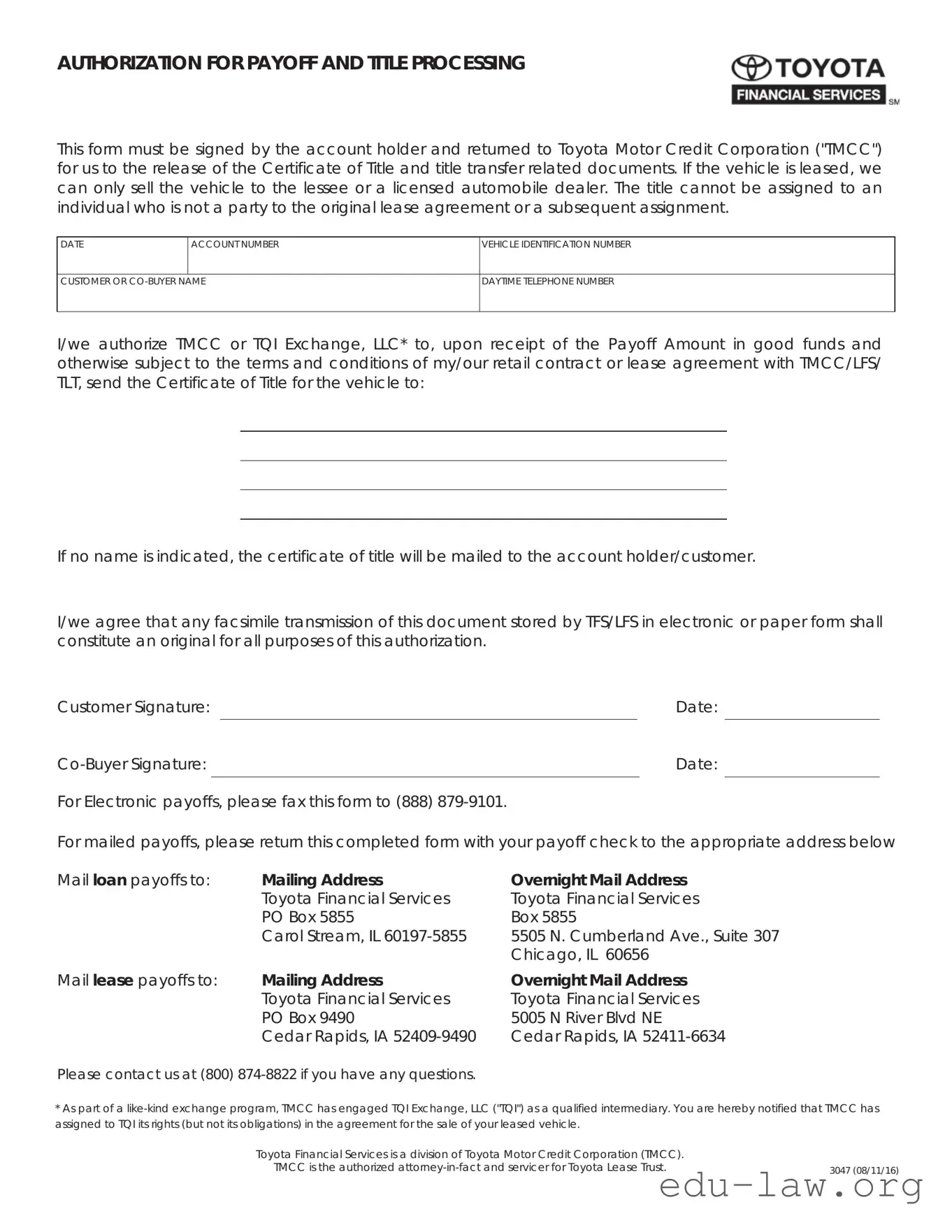
The Toyota Financial Payoff form is an essential document for anyone looking to finalize the payoff of their vehicle through Toyota Motor Credit Corporation (TMCC). This form requires the signature of the account holder to initiate the release of the vehicle's Certificate of Title and any related title transfer documents. For leased vehicles, it's important to note that only the lessee or a licensed automobile dealer can purchase the vehicle, ensuring that the title remains within the original lease agreement. The form captures key details, including the account number, vehicle identification number, and contact information for the customer or co-buyer. By signing the form, you authorize TMCC or TQI Exchange, LLC to process the payoff and send the title to the specified address. If no address is provided, the title will be mailed directly to the account holder. The form also emphasizes that any faxed copy will be treated as an original document. For those opting for electronic payoffs, a dedicated fax number is provided, while specific mailing addresses are listed for both loan and lease payoffs. Should any questions arise during this process, TMCC encourages customers to reach out for assistance, ensuring a smooth and clear payoff experience.
AUTHORIZATION FOR PAYOFF AND TITLE PROCESSING
This form must be signed by the account holder and returned to Toyota Motor Credit Corporation ("TMCC") for us to the release of the Certificate of Title and title transfer related documents. If the vehicle is leased, we can only sell the vehicle to the lessee or a licensed automobile dealer. The title cannot be assigned to an individual who is not a party to the original lease agreement or a subsequent assignment.
DATE
ACCOUNT NUMBER
VEHICLE IDENTIFICATION NUMBER
CUSTOMER OR
DAYTIME TELEPHONE NUMBER
I/we authorize TMCC or TQI Exchange, LLC* to, upon receipt of the Payoff Amount in good funds and otherwise subject to the terms and conditions of my/our retail contract or lease agreement with TMCC/LFS/ TLT, send the Certificate of Title for the vehicle to:
If no name is indicated, the certificate of title will be mailed to the account holder/customer.
I/we agree that any facsimile transmission of this document stored by TFS/LFS in electronic or paper form shall constitute an original for all purposes of this authorization.
Customer Signature: |
|
|
Date: |
|
|
Date: |
|||
|
|
|
|
|
For Electronic payoffs, please fax this form to (888) |
|
|
||
For mailed payoffs, please return this completed form with your payoff check to the appropriate address below
Mail loan payoffs to: |
Mailing Address |
Overnight Mail Address |
|
Toyota Financial Services |
Toyota Financial Services |
|
PO Box 5855 |
Box 5855 |
|
Carol Stream, IL |
5505 N. Cumberland Ave., Suite 307 |
|
|
Chicago, IL 60656 |
Mail lease payoffs to: |
Mailing Address |
Overnight Mail Address |
|
Toyota Financial Services |
Toyota Financial Services |
|
PO Box 9490 |
5005 N River Blvd NE |
|
Cedar Rapids, IA |
Cedar Rapids, IA |
Please contact us at (800)
*As part of a
Toyota Financial Services is a division of Toyota Motor Credit Corporation (TMCC). |
|
TMCC is the authorized |
3047 (08/11/16) |
| Fact Name | Details |
|---|---|
| Form Purpose | This form authorizes the payoff and title processing for a vehicle financed through TMCC. |
| Signature Requirement | The account holder must sign the form for TMCC to release the Certificate of Title. |
| Leased Vehicles | For leased vehicles, sales can only occur to the lessee or a licensed dealer. |
| Title Assignment | The title cannot be assigned to anyone not part of the original lease agreement. |
| Electronic Authorization | Facsimile transmissions of the document are considered original for authorization purposes. |
| Payoff Submission | For electronic payoffs, fax the form to (888) 879-9101. |
| Mailing Addresses | Different addresses are provided for loan and lease payoffs, including overnight options. |
| Contact Information | For questions, contact TMCC at (800) 874-8822. |
| Qualified Intermediary | TQI Exchange, LLC acts as a qualified intermediary for like-kind exchanges. |
| Governing Laws | The form is governed by the laws of the state where the vehicle is registered. |
To complete the Toyota Financial Payoff form, follow the steps outlined below. This process ensures that the necessary information is provided for the release of the Certificate of Title and related documents.
Once the form is completed and submitted, it will be processed by Toyota Motor Credit Corporation. If there are any questions during this process, assistance is available by contacting their customer service.
What is the purpose of the Toyota Financial Payoff form?
The Toyota Financial Payoff form is essential for customers who wish to pay off their vehicle loan or lease. By completing this form, you authorize Toyota Motor Credit Corporation (TMCC) to process the payoff and handle the title transfer related documents. This ensures that once you have paid off your vehicle, the Certificate of Title will be released to the appropriate party, allowing for a smooth transition of ownership.
Who needs to sign the payoff form?
Both the account holder and any co-buyer must sign the payoff form. This requirement ensures that all parties involved in the loan or lease agreement are in agreement with the payoff process. If you are leasing the vehicle, it’s important to note that only the lessee or a licensed automobile dealer can be considered for the sale of the vehicle.
How do I submit the payoff form?
You can submit the Toyota Financial Payoff form in one of two ways. For electronic payoffs, fax the completed form to (888) 879-9101. If you prefer to mail your payoff, include your completed form along with your payoff check and send it to the appropriate address provided for either loan or lease payoffs. Make sure to use the correct mailing address to avoid any delays in processing.
What happens if I do not indicate a name for the title transfer?
If you do not specify a name on the form for the Certificate of Title, it will automatically be mailed to the account holder or customer. This is an important detail to keep in mind, as it ensures that the title is sent to the correct individual unless otherwise directed.
What should I do if I have questions about the payoff process?
If you have any questions regarding the payoff process or need assistance with the form, you can contact Toyota Financial Services at (800) 874-8822. Their representatives are available to help clarify any concerns or provide additional information you may need to complete your transaction smoothly.
Neglecting to Sign the Form: One of the most common mistakes is failing to provide the necessary signatures. Both the account holder and co-buyer must sign the form for it to be valid.
Incorrect Account Information: Providing an incorrect account number or vehicle identification number (VIN) can delay the processing of your payoff. Double-check these numbers for accuracy.
Missing Contact Information: It's essential to include a daytime telephone number. This allows Toyota Financial Services to reach you if there are any questions regarding your submission.
Not Indicating Title Recipient: If you do not specify where to send the Certificate of Title, it will automatically be sent to the account holder. Ensure you indicate the correct recipient if different.
Using Incorrect Mailing Address: Make sure to use the appropriate mailing address based on whether you are paying off a loan or a lease. Using the wrong address can cause significant delays.
Submitting Without Payment: The payoff form must be accompanied by the payoff amount in good funds. Submitting the form without payment will result in processing delays.
Ignoring Electronic Submission Guidelines: If you choose to fax the form for electronic payoffs, ensure you use the correct fax number provided. Failing to do so may result in a lost or unprocessed request.
When dealing with the Toyota Financial Payoff process, several other forms and documents may be necessary to ensure a smooth transaction. Each of these documents serves a specific purpose and can help facilitate the payoff and title transfer process. Here’s a brief overview of some commonly used forms alongside the Toyota Financial Payoff form:
Gathering these documents can help streamline the payoff and title transfer process, making it easier for all parties involved. It's always a good idea to check with Toyota Financial Services or a legal professional to ensure that you have all necessary paperwork in order.
The Authorization for Payoff and Title Processing form is similar to a Loan Payoff Request form. Both documents require the borrower’s consent to process the payoff of a loan. They typically include essential information such as the account number and vehicle identification number. In both cases, the lender must receive the payoff amount before releasing the title or any related documents. The Loan Payoff Request form may also require signatures from all parties involved, ensuring that everyone agrees to the terms outlined.
Another comparable document is the Vehicle Title Transfer form. This form is used when ownership of a vehicle is changing hands, whether through sale or transfer. Like the Toyota Financial Payoff form, it requires the current owner's signature and may necessitate the submission of a payoff amount to clear any existing liens. Both forms serve to protect the interests of the parties involved by ensuring that the title is properly transferred and any financial obligations are settled.
The Release of Lien form also shares similarities with the Toyota Financial Payoff form. This document is used when a lender releases its claim on a vehicle after the loan has been paid off. Both forms require the lender’s acknowledgment of the payoff and the release of any rights to the vehicle. They ensure that the borrower receives clear title to the vehicle once all financial obligations have been fulfilled.
A Bill of Sale is another document that bears resemblance to the Toyota Financial Payoff form. This form is used to document the sale of a vehicle and includes details about the buyer, seller, and the vehicle itself. Similar to the payoff form, it often requires signatures from both parties to validate the transaction. The Bill of Sale serves as proof of ownership transfer, much like the title processing that occurs after a payoff.
The Lease Termination Agreement is akin to the Toyota Financial Payoff form in that it outlines the conditions under which a lease can be concluded. This document requires signatures from both the lessee and the lessor, similar to the authorization needed in the payoff form. Both documents aim to formalize the end of a financial obligation related to a vehicle, ensuring that all parties are clear on their responsibilities and rights.
The Power of Attorney form can also be compared to the Toyota Financial Payoff form. This document allows one person to act on behalf of another in legal matters, including vehicle title processing. In both cases, authorization is required to proceed with actions related to the vehicle. The Power of Attorney can facilitate the transfer of the title without the original owner being present, similar to how the payoff form allows for the title to be processed upon receipt of payment.
A Title Application form is similar in that it is used to apply for a new title for a vehicle. When a loan is paid off, the title must be reissued to reflect the new ownership. Both forms require specific vehicle information and may need to be submitted to a state agency for processing. The Title Application ensures that the vehicle is legally recognized under the new owner's name, just as the payoff form ensures that the lender's interest is removed.
The Credit Application is another document that shares a connection with the Toyota Financial Payoff form. This form is used when someone is seeking financing for a vehicle. While the payoff form deals with closing out a loan, the credit application initiates the borrowing process. Both documents require personal and financial information to assess the individual's eligibility for financing or the clearance of existing debts.
Lastly, the Vehicle Registration form is similar in that it is necessary for legally operating a vehicle on public roads. After the payoff process, the new owner must register the vehicle in their name. Both forms involve submitting specific information about the vehicle and the owner, ensuring that all legal requirements are met for ownership and operation. The registration process solidifies the new owner's claim to the vehicle, much like the payoff form finalizes the financial obligations associated with it.
When filling out the Toyota Financial Payoff form, it’s important to ensure accuracy and completeness. Here’s a list of things you should and shouldn’t do to help you navigate the process smoothly.
By following these guidelines, you can help ensure that your payoff process goes as smoothly as possible.
Only the account holder or co-buyer can sign the form. This ensures that the proper parties authorize the transaction.
The title can only be assigned to the lessee or a licensed automobile dealer. Others are not eligible for the title transfer.
Faxing the form is a valid method for electronic payoffs. Just ensure you send it to the correct fax number.
The form must be signed and returned along with the payoff amount in good funds for processing.
If no name is indicated on the form, the title will be mailed to the account holder. Specify the recipient to avoid delays.
Facsimile transmissions stored by Toyota Financial Services are considered original documents for authorization purposes.
Different addresses exist for loan and lease payoffs. Make sure to send your form to the correct address.
Providing a daytime telephone number is important. It allows Toyota Financial Services to contact you if needed.
If you have questions about the form or the process, calling customer service is encouraged. They can provide assistance.
When it comes to filling out and using the Toyota Financial Payoff form, there are several important points to keep in mind. Here are five key takeaways to ensure a smooth process:
By keeping these points in mind, you can facilitate a quicker and more efficient payoff process with Toyota Financial Services.