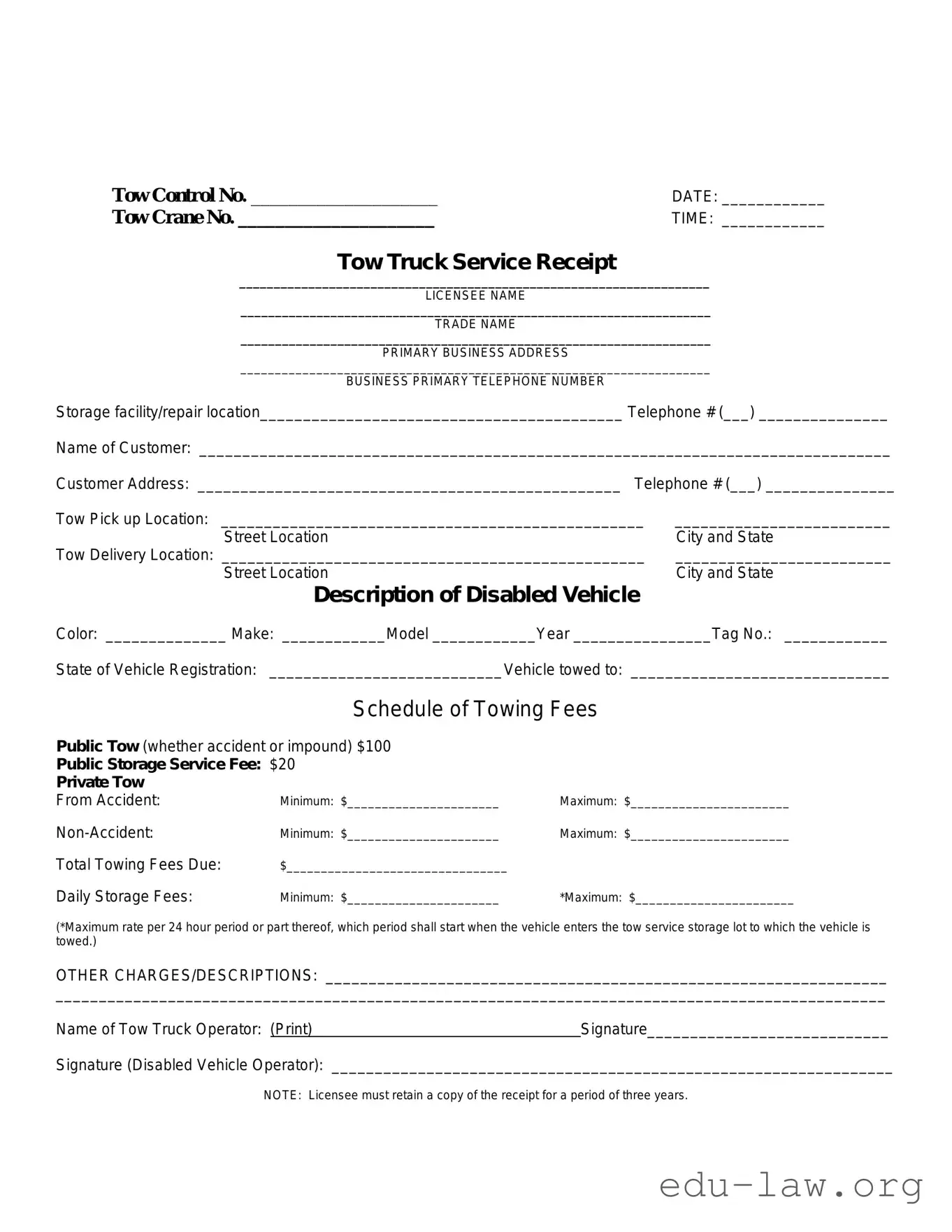
The Tow Truck Receipt form serves as an essential document in the towing industry, providing a clear record of services rendered and fees charged. It captures critical information including the date and time of the tow, the identification of the tow truck and crane used, and the details of the vehicle being towed. Key elements such as the licensee's name, trade name, and contact information are included, ensuring accountability and transparency. Additionally, the form outlines the customer's information, including their address and contact number, which is vital for communication regarding the towing process. The receipt also specifies the locations of both pick-up and delivery, allowing for accurate tracking of the vehicle's journey. A detailed description of the disabled vehicle, including its make, model, color, and registration details, helps to prevent any confusion regarding ownership. Furthermore, the form provides a comprehensive schedule of towing fees, covering various scenarios such as public and private tows, along with daily storage fees. It is important to note that all charges must be clearly itemized, and the signatures of both the tow truck operator and the disabled vehicle operator are required to validate the transaction. Lastly, the form mandates that the licensee retains a copy for three years, ensuring compliance with regulatory requirements and safeguarding the interests of all parties involved.

Tow Control No. ____________________ |
DATE: ____________ |
Tow Crane No. _____________________ |
TIME: ____________ |
Tow Truck Service Receipt
____________________________________________________________________
LICENSEE NAME
____________________________________________________________________
TRADE NAME
____________________________________________________________________
PRIMARY BUSINESS ADDRESS
____________________________________________________________________
BUSINESS PRIMARY TELEPHONE NUMBER
Storage facility/repair location__________________________________________ Telephone # (___) _______________
Name of Customer: ________________________________________________________________________________
Customer Address: _________________________________________________ Telephone # (___) _______________
Tow Pick up Location: _________________________________________________ |
_________________________ |
Street Location |
City and State |
Tow Delivery Location: _________________________________________________ |
_________________________ |
Street Location |
City and State |
Description of Disabled Vehicle |
|
Color: ______________ Make: ____________Model ____________Year ________________Tag No.: ____________
State of Vehicle Registration: ___________________________Vehicle towed to: ______________________________
Schedule of Towing Fees
Public Tow (whether accident or impound) $100
Public Storage Service Fee: $20
Private Tow
From Accident:
Total Towing Fees Due:
Maximum: $_______________________
Maximum: $_______________________
Daily Storage Fees:Minimum: $______________________ *Maximum: $_______________________
(*Maximum rate per 24 hour period or part thereof, which period shall start when the vehicle enters the tow service storage lot to which the vehicle is towed.)
OTHER CHARGES/DESCRIPTIONS: _________________________________________________________________
________________________________________________________________________________________________
Name of Tow Truck Operator: (Print)Signature____________________________
Signature (Disabled Vehicle Operator): _________________________________________________________________
NOTE: Licensee must retain a copy of the receipt for a period of three years.
| Fact Name | Details |
|---|---|
| Minimum Charges | The form requires a minimum charge to be filled in, which varies by state. |
| Tow Control Number | A unique Tow Control Number must be assigned to each towing service. |
| Date and Time | The receipt must include the date and time of the towing service. |
| Licensee Information | The form requires the name, trade name, address, and phone number of the towing company. |
| Customer Details | It is important to include the customer's name, address, and phone number. |
| Vehicle Description | The form asks for detailed information about the disabled vehicle, including color, make, model, year, and registration state. |
| Towing Fees | A schedule of towing fees must be provided, including public and private tow charges. |
| Retention Requirement | Licensees must keep a copy of the receipt for three years as per state regulations. |
After gathering the necessary information, you can proceed to fill out the Tow Truck Receipt form. This form captures essential details about the towing service provided. Make sure all information is accurate to avoid any complications later.
What is the purpose of the Tow Truck Receipt form?
The Tow Truck Receipt form serves as a record of the towing service provided to a customer. It includes important details such as the date and time of the tow, the vehicle's information, and the charges incurred. This receipt is essential for both the towing company and the customer for tracking services rendered and for any potential disputes that may arise.
What information is required on the Tow Truck Receipt?
The form requires several key pieces of information. This includes the date and time of the tow, the licensee's name and contact details, the customer's name and address, and the specifics of the vehicle being towed. Additionally, it outlines the pickup and delivery locations, as well as a detailed breakdown of the fees associated with the towing service.
How are towing fees determined?
Towing fees are typically determined based on several factors, including the type of tow (public or private), the circumstances of the tow (accident or non-accident), and any additional charges for storage or other services. For example, public towing fees may start at $100, while storage fees can vary depending on the duration of storage needed.
What should I do if I have a dispute regarding the charges?
If there is a dispute regarding the charges on the Tow Truck Receipt, it is advisable to first contact the towing company directly. Discuss the issue with them to seek clarification or resolution. If the matter cannot be resolved, it may be necessary to escalate the issue to a local consumer protection agency or seek legal advice.
How long does the towing company need to keep the receipt?
The towing company is required to retain a copy of the receipt for a period of three years. This is important for record-keeping and to ensure that they have documentation in case of any future inquiries or disputes related to the towing service.
Can I request a copy of the receipt?
What details are included in the vehicle description section?
The vehicle description section requires specific details about the towed vehicle. This includes the color, make, model, year, tag number, and the state of vehicle registration. Providing accurate information is crucial for proper identification of the vehicle.
What are the storage fees mentioned in the receipt?
Storage fees are additional charges that may apply if the vehicle remains in the towing company's storage facility for an extended period. The receipt specifies a minimum and maximum rate for daily storage, which typically starts when the vehicle enters the storage lot. It is important to be aware of these fees, as they can accumulate quickly.
Failing to provide accurate minimum and maximum fees. Ensure that both amounts are clearly stated to avoid confusion later.
Omitting the Tow Control Number. This number is crucial for tracking the towing service and should always be included.
Not filling in the date and time of the tow. These details are important for record-keeping and can affect billing.
Leaving out the licensee and trade names. This information is necessary to identify the towing company and its legal status.
Neglecting to include the customer’s contact information. Accurate details help in case of disputes or follow-up communications.
Incorrectly describing the disabled vehicle. Ensure that the color, make, model, year, and tag number are all accurate to prevent potential issues.
Not specifying the storage facility or repair location. This detail is essential for transparency and customer awareness.
Failing to obtain the signature of both the tow truck operator and the disabled vehicle operator. Signatures validate the transaction and confirm agreement.
When dealing with towing services, several forms and documents complement the Tow Truck Receipt form. Each of these documents plays a vital role in ensuring a smooth transaction and clear communication between the towing company and the customer. Here’s a brief overview of some commonly used documents:
Understanding these documents can help ensure that all parties are on the same page and that the towing process is handled efficiently. Proper documentation not only protects the interests of the towing company but also provides peace of mind to the vehicle owner.
The Invoice is a document that outlines the details of a transaction between a seller and a buyer. Like the Tow Truck Receipt, it includes information such as the date of service, the parties involved, and a breakdown of charges. Both documents serve as proof of payment and can be used for record-keeping purposes. In addition, invoices often include terms of payment and may specify penalties for late payment, similar to how towing receipts may detail additional fees for storage or other services.
A Bill of Lading is another document that shares similarities with the Tow Truck Receipt. It serves as a receipt for goods being transported and includes details about the shipment, such as the origin, destination, and description of the cargo. Just as a tow receipt documents the specifics of a vehicle being towed, a Bill of Lading provides a record of the items being shipped. Both documents are critical for tracking the movement of property and can be used in disputes regarding the condition or delivery of the items involved.
A Service Agreement outlines the terms and conditions under which services are provided. Similar to the Tow Truck Receipt, it specifies the services rendered, the parties involved, and the agreed-upon fees. While the receipt serves as proof of payment after the service is completed, the service agreement is often established beforehand. Both documents ensure that all parties understand their rights and obligations, reducing the potential for misunderstandings.
A Repair Order is often used in automotive service contexts and is akin to the Tow Truck Receipt in that it details the work performed on a vehicle. It includes customer information, vehicle details, and a breakdown of costs for services rendered. Both documents serve as a record of transactions and can be used for warranty claims or disputes. The Repair Order is typically generated before service, while the Tow Truck Receipt is issued after the service is completed.
A Receipt for Payment is a straightforward document confirming that a payment has been made. Like the Tow Truck Receipt, it includes the date, amount paid, and details about the service or goods provided. Both documents serve as proof of transaction and can be important for tax purposes. While the Tow Truck Receipt is specific to towing services, a general receipt can apply to various types of transactions.
A Contract for Services is a formal agreement between a service provider and a client. It outlines the services to be provided, payment terms, and other conditions. Similar to the Tow Truck Receipt, it ensures that both parties understand their responsibilities. While the contract is created before services are rendered, the receipt confirms that the agreed-upon services have been completed and payment has been made.
An Estimate is a document that provides a projected cost for services to be rendered. This is similar to the Tow Truck Receipt, which also includes a breakdown of fees associated with towing and storage. Both documents help customers understand potential costs before or after services are provided. While an estimate is given prior to service, the receipt serves as a final accounting of the actual costs incurred.
When filling out the Tow Truck Receipt form, it is essential to follow specific guidelines to ensure accuracy and compliance. Here is a list of what you should and should not do:
Understanding the Tow Truck Receipt form can be confusing, especially with the various details it includes. Here are six common misconceptions about this form, clarified for better understanding:
By understanding these misconceptions, you can better navigate the towing process and ensure that you are fully informed about the charges and requirements associated with the Tow Truck Receipt form.
When filling out and using the Tow Truck Receipt form, there are several important considerations to keep in mind. Below are key takeaways that can help ensure the process is smooth and compliant.
By following these guidelines, individuals and businesses can ensure proper documentation and adherence to regulations in the towing industry.