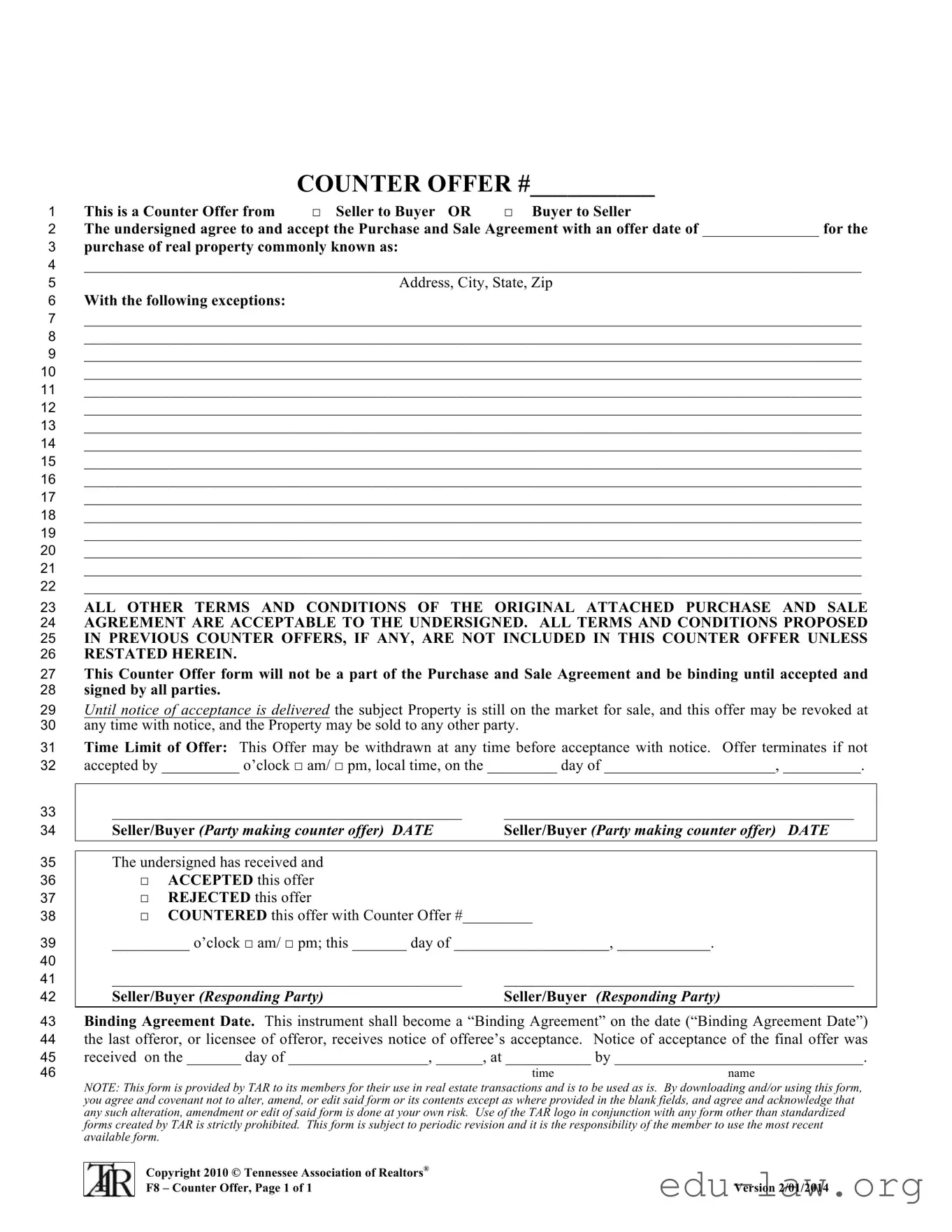
When navigating the complexities of real estate transactions, the Tennessee Counter Offer form plays a crucial role in the negotiation process between buyers and sellers. This document serves as a formal response to an initial offer, allowing either party to propose modifications to the terms of the Purchase and Sale Agreement. It begins with a clear indication of who is making the counter offer—whether it’s the seller responding to a buyer or vice versa. The form includes essential details such as the address of the property in question and any specific exceptions to the original offer. Importantly, it clarifies that all other terms from the original agreement remain acceptable unless explicitly changed in the counter offer. A key aspect of this form is its stipulation that it does not become binding until all parties have signed it, emphasizing the need for mutual agreement before any commitment is made. Additionally, the form outlines a time limit for acceptance, ensuring that the property remains available for sale until the counter offer is formally accepted. Understanding these elements is vital for anyone involved in real estate transactions in Tennessee, as they can significantly impact the negotiation dynamics and final agreement.

1
2
3
4
5
6
7
8
9
10
11
12
13
14
15
16
17
18
19
20
21
22
23
24
25
26
27
28
29
30
31
32
33
34
35
36
37
38
39
40
41
42
43
44
45
46
COUNTER OFFER #__________
This is a Counter Offer from □ Seller to Buyer OR □ Buyer to Seller
The undersigned agree to and accept the Purchase and Sale Agreement with an offer date of _______________ for the
purchase of real property commonly known as:
____________________________________________________________________________________________________
Address, City, State, Zip
With the following exceptions:
____________________________________________________________________________________________________
____________________________________________________________________________________________________
____________________________________________________________________________________________________
____________________________________________________________________________________________________
____________________________________________________________________________________________________
____________________________________________________________________________________________________
____________________________________________________________________________________________________
____________________________________________________________________________________________________
____________________________________________________________________________________________________
____________________________________________________________________________________________________
____________________________________________________________________________________________________
____________________________________________________________________________________________________
____________________________________________________________________________________________________
____________________________________________________________________________________________________
____________________________________________________________________________________________________
____________________________________________________________________________________________________
ALL OTHER TERMS AND CONDITIONS OF THE ORIGINAL ATTACHED PURCHASE AND SALE AGREEMENT ARE ACCEPTABLE TO THE UNDERSIGNED. ALL TERMS AND CONDITIONS PROPOSED IN PREVIOUS COUNTER OFFERS, IF ANY, ARE NOT INCLUDED IN THIS COUNTER OFFER UNLESS RESTATED HEREIN.
This Counter Offer form will not be a part of the Purchase and Sale Agreement and be binding until accepted and signed by all parties.
Until notice of acceptance is delivered the subject Property is still on the market for sale, and this offer may be revoked at any time with notice, and the Property may be sold to any other party.
Time Limit of Offer: This Offer may be withdrawn at any time before acceptance with notice. Offer terminates if not accepted by __________ o’clock □ am/ □ pm, local time, on the _________ day of ______________________, __________.
_____________________________________________ |
_____________________________________________ |
Seller/Buyer (Party making counter offer) DATE |
Seller/Buyer (Party making counter offer) DATE |
The undersigned has received and
□ACCEPTED this offer
□REJECTED this offer
□COUNTERED this offer with Counter Offer #_________
__________ o’clock □ am/ □ pm; this _______ day of ____________________, ____________.
_____________________________________________ |
_____________________________________________ |
Seller/Buyer (Responding Party) |
Seller/Buyer (Responding Party) |
Binding Agreement Date. This instrument shall become a “Binding Agreement” on the date (“Binding Agreement Date”) the last offeror, or licensee of offeror, receives notice of offeree’s acceptance. Notice of acceptance of the final offer was received on the _______ day of __________________, ______, at ___________ by ________________________________.
time |
name |
NOTE: This form is provided by TAR to its members for their use in real estate transactions and is to be used as is. By downloading and/or using this form, you agree and covenant not to alter, amend, or edit said form or its contents except as where provided in the blank fields, and agree and acknowledge that any such alteration, amendment or edit of said form is done at your own risk. Use of the TAR logo in conjunction with any form other than standardized forms created by TAR is strictly prohibited. This form is subject to periodic revision and it is the responsibility of the member to use the most recent available form.
Copyright 2010 © Tennessee Association of Realtors® |
|
F8 – Counter Offer, Page 1 of 1 |
Version 2/01/2014 |
| Fact Name | Fact Description |
|---|---|
| Purpose | The TN Counter Offer form is used to present a counter offer in real estate transactions, allowing either the seller or buyer to propose changes to an original offer. |
| Parties Involved | This form can be filled out by either the seller or the buyer, indicating who is making the counter offer. |
| Original Agreement | The counter offer references an original Purchase and Sale Agreement, ensuring clarity on the terms being modified. |
| Exceptions | Users can specify exceptions to the original agreement, detailing any changes or conditions that differ from the initial offer. |
| Revocation | The counter offer may be revoked at any time before acceptance, keeping the property available for sale until a decision is made. |
| Time Limit | Each counter offer includes a time limit for acceptance, after which the offer becomes void if not accepted. |
| Binding Agreement | A binding agreement is established only when all parties have accepted the counter offer and signed the document. |
| Governing Law | This form is governed by Tennessee real estate laws, ensuring compliance with state regulations. |
| Usage Guidelines | The form is provided by the Tennessee Association of Realtors and should not be altered except in the specified fields. |
To complete the Tn Counter Offer form, follow these steps carefully. Ensure that all necessary information is accurately filled in to avoid any delays in the process.
Once the form is completed, it should be reviewed for accuracy before submission. All parties involved will need to sign the form for it to be valid. Keep a copy for your records after all signatures are obtained.
What is the purpose of the TN Counter Offer form?
The TN Counter Offer form is used in real estate transactions to present a revised offer from either the seller to the buyer or the buyer to the seller. It allows one party to propose changes to the original purchase agreement while keeping the other terms intact, facilitating negotiations between both parties.
Who can use the TN Counter Offer form?
This form can be utilized by either the seller or the buyer involved in a real estate transaction. It is designed for use by members of the Tennessee Association of Realtors (TAR) and should be used as provided without alterations to ensure compliance with legal standards.
What happens if the Counter Offer is accepted?
If the Counter Offer is accepted and signed by all parties, it becomes a binding agreement. The date of acceptance is crucial as it marks the beginning of the binding agreement. The final acceptance must be communicated to the last offeror to ensure that all parties are aware of the agreement's terms.
Can the Counter Offer be revoked?
Yes, the Counter Offer can be revoked at any time before it is accepted. The party making the counter offer must provide notice of the revocation. Until acceptance is communicated, the property remains on the market and can be sold to another party.
What is the time limit for accepting a Counter Offer?
The Counter Offer includes a specified time limit for acceptance, which must be clearly stated in the form. If the Counter Offer is not accepted by the designated time, it automatically terminates, and the original offer may no longer be valid.
What should be included in the exceptions section of the form?
The exceptions section should detail any specific changes or conditions that differ from the original purchase agreement. This may include adjustments to the purchase price, contingencies, or any other terms that the party making the counter offer wishes to modify.
Is the Counter Offer form legally binding?
The Counter Offer itself is not legally binding until it is accepted and signed by all involved parties. Until acceptance is confirmed, the offer remains open to negotiation and can be withdrawn or changed.
What are the implications of previous counter offers?
Any terms proposed in previous counter offers are not included in the current Counter Offer unless they are explicitly restated. This means that only the terms outlined in the current Counter Offer are considered valid, ensuring clarity in the negotiation process.
Can the form be altered or edited?
The TN Counter Offer form should not be altered, amended, or edited beyond filling in the designated blank fields. Any changes made to the form may expose the user to legal risks and potential complications in the transaction.
Not specifying the offer date: Failing to fill in the offer date can lead to confusion about when the agreement was made. This date is crucial for establishing timelines.
Leaving exceptions blank: If there are exceptions to the original agreement, it is important to clearly state them. Omitting this information can result in misunderstandings later on.
Ignoring previous counter offers: If there were previous counter offers, it’s essential to either restate their terms or confirm that they are not included. Neglecting this can lead to disputes over what was agreed upon.
Not including a time limit: Every offer should have a clear expiration time. Leaving this section blank may result in the offer being open indefinitely, which can be problematic for all parties involved.
Failing to sign and date: Both parties must sign and date the counter offer. Without these signatures, the document may not be legally binding, leaving the offer open to challenge.
Using outdated forms: It’s important to use the most recent version of the Counter Offer form. Using an outdated form may lead to compliance issues and misunderstandings regarding the terms.
When dealing with real estate transactions, several documents often accompany the Tennessee Counter Offer form. Each of these forms serves a specific purpose and helps clarify the terms of the agreement between the parties involved. Understanding these documents can enhance the negotiation process and ensure a smoother transaction.
Each of these documents plays a vital role in the real estate transaction process. Being familiar with them can help all parties involved navigate negotiations more effectively and reduce the likelihood of misunderstandings. It is advisable to review these forms carefully and seek guidance if needed to ensure a successful transaction.
The TN Counter Offer form shares similarities with the Purchase Agreement. Both documents serve as essential components in real estate transactions. A Purchase Agreement outlines the initial terms of sale, including price and contingencies, while the Counter Offer modifies these terms based on negotiations between the buyer and seller. Each document requires signatures from the involved parties to be legally binding, ensuring that all terms are agreed upon before the transaction proceeds.
Another document akin to the TN Counter Offer is the Letter of Intent (LOI). An LOI expresses a party's interest in entering into a formal agreement and often outlines preliminary terms. Like the Counter Offer, it signals negotiation and can include specific conditions that must be met. While an LOI is generally non-binding, it lays the groundwork for further discussions, similar to how a Counter Offer refines the details of a Purchase Agreement.
The TN Counter Offer also resembles an Addendum. An Addendum is used to add or modify terms in an existing contract without rewriting the entire document. Just as a Counter Offer highlights changes to the original Purchase Agreement, an Addendum specifies new terms or conditions agreed upon after the initial contract has been signed. Both documents must be signed by all parties to ensure they are enforceable.
Lastly, the TN Counter Offer is similar to a Termination Agreement. While a Counter Offer proposes new terms, a Termination Agreement formally ends a contract. Each document reflects a change in the status of negotiations. A Termination Agreement requires the consent of all parties involved, just like a Counter Offer, ensuring that everyone is on the same page regarding the outcome of the transaction.
When filling out the TN Counter Offer form, it’s important to approach the task with care. Here are some essential dos and don’ts to keep in mind:
Filling out the Tennessee Counter Offer form can be a crucial step in the real estate negotiation process. Here are some key takeaways to keep in mind: