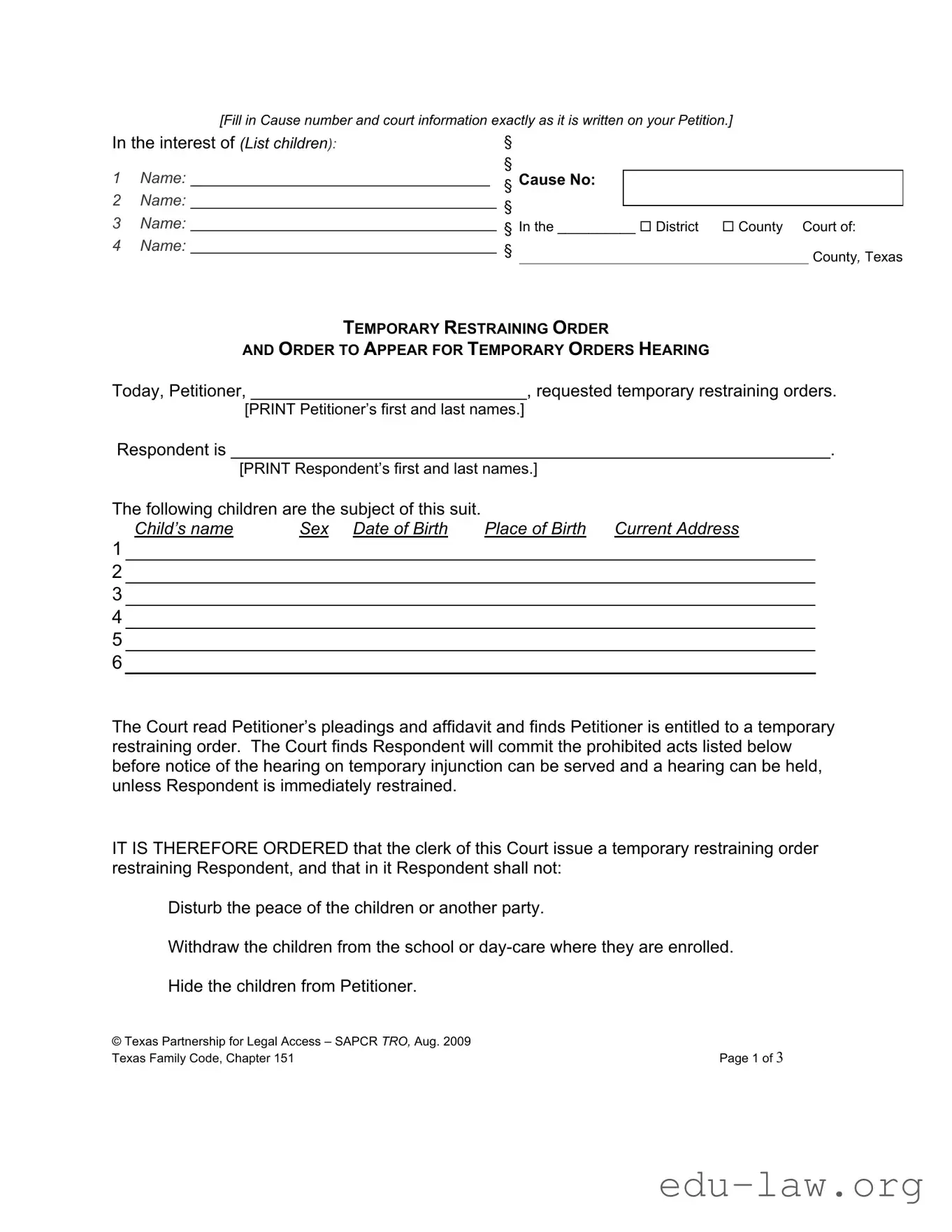
The Texas Temporary Restraining Order (TRO) form serves as a crucial legal instrument designed to provide immediate protection for individuals and children involved in a legal dispute. This document is initiated by a Petitioner who seeks to prevent a Respondent from engaging in specific actions that could harm the children or disrupt their well-being. The form requires the inclusion of essential details such as the cause number, court information, and the names of the children involved. It outlines various prohibitions against the Respondent, including disturbing the peace of the children, withdrawing them from school, or consuming alcohol or drugs during visitation. The order is effective immediately and remains in place until a further court order is issued or it expires by law. Additionally, the TRO mandates the Respondent to appear in court for a hearing, bringing necessary financial documents to discuss potential temporary orders related to custody, child support, and visitation rights. The court’s findings, based on the Petitioner’s affidavit and pleadings, are crucial in determining the necessity of the TRO and any subsequent temporary injunctions that may be issued to safeguard the interests of the children involved.

[Fill in Cause number and court information exactly as it is written on your Petition.]
In the interest of (List children): |
§ |
|
|
|
|||
|
|
|
§ |
|
|
|
|
1 |
Name: |
|
|
§ CAUSE NO: |
|
|
|
|
|
|
|||||
2 |
Name: |
|
§ |
|
|
|
|
|
|
|
|
||||
3 |
Name: |
|
|
|
|
|
|
|
|
§ In the __________ District County Court of: |
|||||
|
|
||||||
4 |
Name: |
|
§ |
|
|
County, Texas |
|
|
|
|
|
|
|
||
|
|
|
|
|
|
|
|
TEMPORARY RESTRAINING ORDER
AND ORDER TO APPEAR FOR TEMPORARY ORDERS HEARING
Today, Petitioner, _____________________________, requested temporary restraining orders.
[PRINT Petitioner’s first and last names.]
Respondent is _______________________________________________________________.
|
[PRINT Respondent’s first and last names.] |
|
|
The following children are the subject of this suit. |
|
|
|
Child’s name |
Sex Date of Birth |
Place of Birth |
Current Address |
1
2
3
4
5
6
The Court read Petitioner’s pleadings and affidavit and finds Petitioner is entitled to a temporary restraining order. The Court finds Respondent will commit the prohibited acts listed below before notice of the hearing on temporary injunction can be served and a hearing can be held, unless Respondent is immediately restrained.
IT IS THEREFORE ORDERED that the clerk of this Court issue a temporary restraining order restraining Respondent, and that in it Respondent shall not:
Disturb the peace of the children or another party.
Withdraw the children from the school or
Hide the children from Petitioner.
© Texas Partnership for Legal Access – SAPCR TRO, Aug. 2009 |
|
Texas Family Code, Chapter 151 |
Page 1 of 3 |
Talk badly about Petitioner or Petitioner’s family to, or around, the children.
Drink alcohol or consume controlled substances within 12 hours before or during a period of possession or access to the children.
Cancel, change, fail to pay premiums, or disturb the present level of health insurance coverage for the children.
This restraining order is effective immediately and shall continue until further order of this Court or until it expires by operation of law. This order binds Respondent, Respondent’s agents, servants, and employees; and those in active concert or participation with them who receive actual notice of this order by personal service or otherwise. No bond is required.
IT IS FURTHER ORDERED that the clerk shall issue notice to Respondent,
__________________________________________, to appear, and Respondent is ORDERED
[PRINT Respondent’s first and last names.]
to appear in person, and to bring the following:
●tax returns for the past two years,
●a written description of his or her monthly income and expenses, and
●pay stubs for the past three months.
Respondent IS ORDERED to appear with those documents before the Court in the courthouse at
________________________________________________________________________.
[PRINT the street address of the courthouse or place for hearing.]
on _____________________________________________ at _______________ __. M.
[PRINT hearing date.] |
[PRINT time.] |
The purpose of the hearing is to decide if the temporary restraining order should be made a temporary injunction while this case is pending, and to make temporary orders in the best interest of the children including but not limited to the following:
Temporary Conservatorship (custody) orders naming Petitioner:
Joint Managing Conservator, with the exclusive right to establish the children’s primary residence,
Joint Managing Conservator, noncustodial parent,
Possessory Conservator,
© Texas Partnership for Legal Access – SAPCR TRO, Aug. 2009 |
|
Texas Family Code, Chapter 151 |
Page 2 of 3 |

and naming Respondent: [CHECK only one.]
Joint Managing Conservator, with the exclusive right to establish the children’s primary residence,
Joint Managing Conservator, noncustodial parent,
Possessory Conservator
Child Support Orders ordering Respondent to:
pay statutory child support, health insurance premiums for the children, and half of the children’s uninsured medical expenses, private school tuition, or
Residency Restrictions, limiting the children’s residence to the following geographic area: __________________________________________________________________
Travel Restrictions, limiting Respondent from taking the children outside a geographical area defined by the Court, acting directly or with others.
Standard Visitation Orders.
Limited Visitation Orders, denying Respondent’s access to the children, or limiting it to only supervised contact with the children.
Other Temporary Orders Requested
_____________________________________________________________________
_____________________________________________________________________
_____________________________________________________________________
_____________________________________________________________________
IT IS FURTHER ORDERED that any authorized person eighteen years of age or older who is not a party to or interested in the outcome of this suit may serve any citation, notice, or process in this case.
SIGNED on _________________________________ at ____________________ __. M.
|
___________________________________ |
|
JUDGE PRESIDING |
© Texas Partnership for Legal Access – SAPCR TRO, Aug. 2009 |
|
Texas Family Code, Chapter 151 |
Page 3 of 3 |
| Fact Name | Description |
|---|---|
| Governing Law | The Texas Temporary Restraining Order is governed by the Texas Family Code, Chapter 151. |
| Purpose | This order aims to prevent the Respondent from committing certain acts that could harm the children or disrupt their well-being. |
| Immediate Effect | The restraining order takes effect immediately upon issuance and remains in place until further court order or expiration by law. |
| Prohibited Actions | Respondent is prohibited from disturbing the peace of the children, withdrawing them from school, hiding them, or consuming alcohol or drugs before visitation. |
| Hearing Requirement | The Respondent must appear in court with specific documents, including tax returns and income statements, to discuss the order. |
| Binding Nature | The order binds not only the Respondent but also their agents and anyone in concert with them who receives notice of the order. |
Once you have gathered the necessary information, you can begin filling out the Texas Temporary Restraining Order form. This process involves entering specific details about the case, the parties involved, and any children affected. Follow the steps below to complete the form accurately.
After completing the form, it will need to be filed with the court. Make sure to keep a copy for your records. The next steps will involve serving the Respondent with the notice of the hearing, so be prepared to follow through with that process as well.
What is a Texas Temporary Restraining Order (TRO)?
A Texas Temporary Restraining Order is a legal order issued by a court to temporarily prohibit an individual, known as the Respondent, from taking certain actions that may harm another individual or their children. It is often sought in family law cases to protect the interests of children or a spouse during legal proceedings.
How do I fill out the Texas Temporary Restraining Order form?
To complete the form, you must provide specific information such as the cause number, court details, and names of the children involved. Ensure that you print the names of both the Petitioner and Respondent clearly. Additionally, list the prohibited actions that the Respondent must avoid and include any relevant details regarding the hearing.
What actions can a TRO prohibit?
The TRO can restrict the Respondent from disturbing the peace of the children, withdrawing them from school or daycare, hiding them from the Petitioner, speaking negatively about the Petitioner in front of the children, consuming alcohol or drugs before or during visitation, and altering health insurance coverage for the children.
How long does a Temporary Restraining Order last?
A Temporary Restraining Order is effective immediately upon issuance and continues until the court issues a further order or until it expires by law. It is crucial to attend the scheduled hearing to determine if the TRO should be extended as a temporary injunction.
What happens at the hearing for a Temporary Restraining Order?
During the hearing, the court will review the circumstances surrounding the TRO and decide whether to convert it into a temporary injunction. The parties may present evidence, and the court will consider what arrangements are in the best interest of the children involved.
What documents must the Respondent bring to the hearing?
The Respondent is required to bring specific documents to the hearing, including tax returns for the past two years, a written description of monthly income and expenses, and pay stubs for the last three months. This information helps the court assess financial responsibilities and arrangements.
Is a bond required for a Temporary Restraining Order?
No bond is required for the issuance of a Temporary Restraining Order in Texas. This means that the Petitioner does not need to pay any fees or post a bond to obtain the order.
Who can serve the Temporary Restraining Order?
Any authorized person who is at least eighteen years old and not involved in the case can serve the TRO. This includes delivering the order to the Respondent to ensure they are aware of the restrictions and the upcoming court date.
What are the potential outcomes of the hearing?
The court may decide to uphold the TRO, convert it into a temporary injunction, or modify the terms based on the evidence presented. Possible outcomes may include establishing temporary conservatorship, child support orders, visitation rights, and residency restrictions.
Can I request additional temporary orders during the hearing?
Yes, you can request additional temporary orders during the hearing. This may include specific arrangements regarding custody, visitation, and financial support, tailored to the needs of the children and the circumstances of the case.
Incorrectly filling in the cause number and court information: It's essential to copy this information exactly as it appears on your petition. Any discrepancies can lead to delays or dismissal of your request.
Failing to list all relevant children: Ensure you include the names of all children involved in the case. Omitting a child can complicate matters and may affect the outcome.
Neglecting to provide complete details about the respondent: Clearly print the respondent’s full name. Incomplete information can hinder the court's ability to enforce the order.
Not specifying prohibited acts: Clearly outline the actions you want the court to restrain the respondent from taking. Vague language can lead to misunderstandings and ineffective orders.
Ignoring the required documents for the hearing: Make sure to list the necessary documents the respondent must bring. This includes tax returns, income descriptions, and pay stubs. Missing documents can delay the hearing.
A Texas Temporary Restraining Order (TRO) is a critical document in family law cases, particularly those involving custody disputes. Alongside the TRO, several other forms and documents are commonly used to ensure that the legal process runs smoothly. Below is a list of these documents, each serving a specific purpose in the context of a TRO.
Understanding these accompanying documents is essential for anyone navigating the complexities of family law in Texas. Each document plays a vital role in protecting the rights and interests of all parties involved, especially the children.
The Texas Temporary Restraining Order (TRO) form shares similarities with a Protective Order. Both documents aim to prevent one party from engaging in harmful behavior toward another. A Protective Order is often used in cases involving domestic violence, while a TRO can be utilized in various situations, including family law disputes. In both cases, the court acts quickly to ensure the safety and well-being of individuals involved, particularly children.
Another document akin to the Texas TRO is the Preliminary Injunction. A Preliminary Injunction is a court order that prohibits a party from taking certain actions while a case is ongoing. Like a TRO, it seeks to maintain the status quo and prevent irreparable harm. However, a Preliminary Injunction typically follows a hearing, whereas a TRO is often issued without notice to the other party to address immediate concerns.
The Texas Family Code also includes a document called a Suit Affecting the Parent-Child Relationship (SAPCR) petition. This petition initiates legal proceedings regarding child custody, visitation, and support. While the TRO focuses on immediate restrictions, the SAPCR outlines the broader issues to be resolved in the case. Both documents emphasize the best interests of the children involved.
Similar to the TRO is the Child Support Order, which mandates financial support from one parent to another for the upbringing of their children. Both documents can be part of the same family law case, with the TRO addressing immediate safety concerns and the Child Support Order focusing on the financial responsibilities of each parent.
The Temporary Custody Order is another document that resembles the Texas TRO. This order grants one parent temporary custody of the children during legal proceedings. Like the TRO, it is designed to protect the children’s welfare. However, a Temporary Custody Order typically requires a hearing, allowing both parties to present their cases, whereas a TRO can be issued more swiftly.
Additionally, a Visitation Order is closely related to the Texas TRO. This document outlines the terms under which one parent can visit their children. While the TRO may restrict a parent’s access to the children, a Visitation Order sets specific guidelines for how and when visitation can occur, ensuring that the children’s best interests remain a priority.
The Affidavit of Support is another document that can accompany a TRO. This sworn statement provides evidence to the court regarding the need for the restraining order. It serves to support the claims made in the TRO application, similar to how the TRO aims to protect individuals from immediate harm.
A Motion for Temporary Orders also shares similarities with the Texas TRO. This motion requests the court to issue temporary orders related to custody, support, or visitation while a case is pending. Both documents seek to address urgent matters, but the Motion for Temporary Orders may cover a broader range of issues compared to the specific restrictions outlined in a TRO.
The Notice of Hearing is another document that can be associated with a TRO. This notice informs the parties involved about the date and time of the hearing related to the TRO. While the TRO provides immediate relief, the Notice of Hearing ensures that both parties have the opportunity to present their case before the court.
Lastly, the Waiver of Service is a document that can be linked to the Texas TRO. This waiver allows a respondent to forgo formal service of the TRO, indicating that they are aware of the proceedings. While the TRO aims to protect individuals from harm, the Waiver of Service streamlines the legal process by allowing parties to acknowledge their involvement without the need for formal notification.
When filling out the Texas Temporary Restraining Order form, it is crucial to follow certain guidelines to ensure your submission is accurate and effective. Here are some important dos and don’ts:
Filling out and using the Texas Temporary Restraining Order (TRO) form can be a crucial step in protecting your rights and the well-being of your children. Here are some key takeaways to consider:
Understanding these key points can help you navigate the process of obtaining a Temporary Restraining Order effectively. Prioritize the safety and well-being of your children throughout this legal journey.