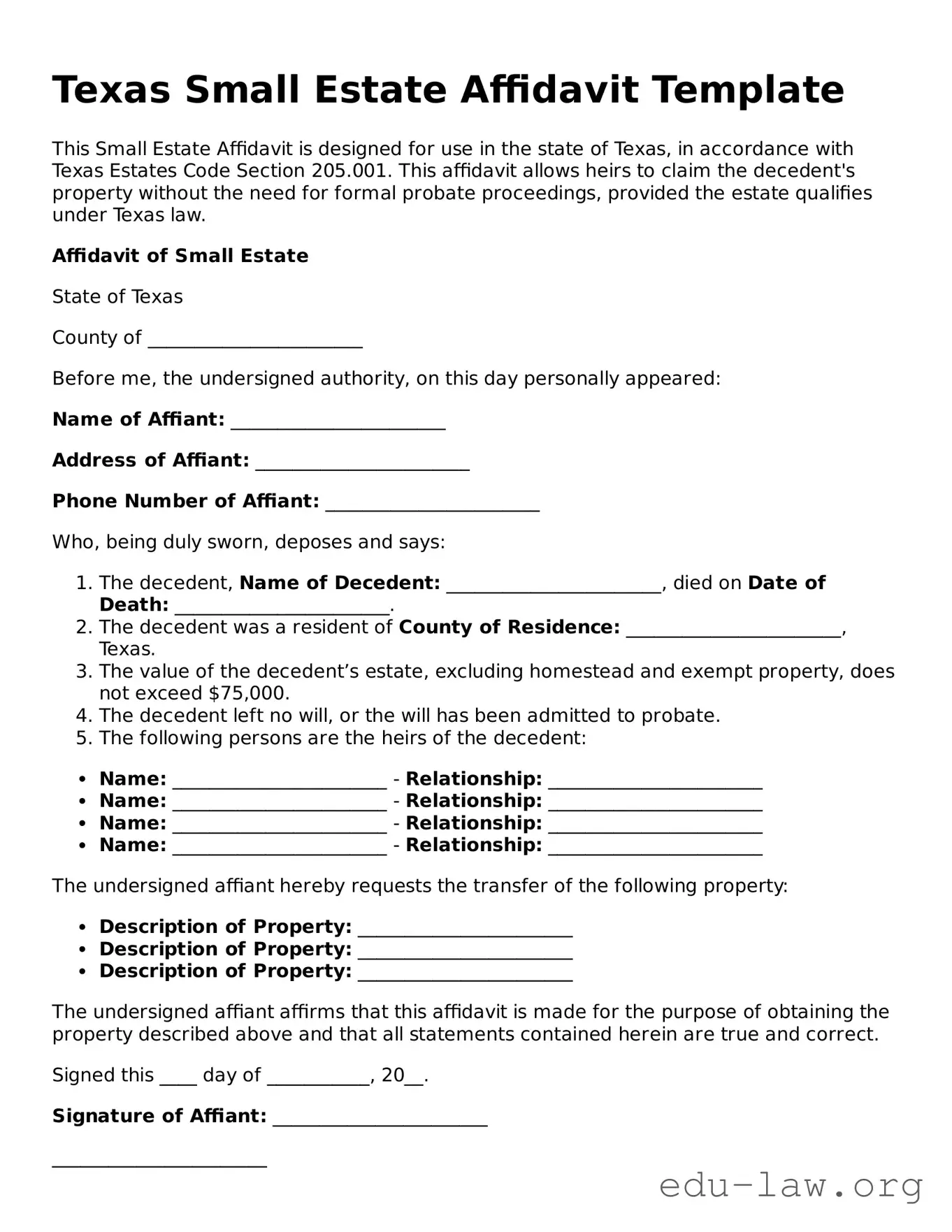
The Texas Small Estate Affidavit is a useful legal tool designed to simplify the process of settling small estates after an individual's passing. This form is applicable when the total value of the estate is below a specified threshold, allowing heirs to bypass the lengthy and often costly probate process. By using this affidavit, individuals can claim their inheritance directly, without the need for a formal court proceeding. The form requires the affiant, typically an heir or beneficiary, to provide essential information about the deceased, including their name, date of death, and the details of the estate's assets and liabilities. Additionally, the affidavit must be signed in front of a notary public, ensuring its validity. It is important to note that specific eligibility criteria must be met, including the value of the estate and the absence of a will or the presence of a will that does not require probate. Understanding the nuances of the Texas Small Estate Affidavit can help streamline the process of estate administration for families during a challenging time.
Texas Small Estate Affidavit Template
This Small Estate Affidavit is designed for use in the state of Texas, in accordance with Texas Estates Code Section 205.001. This affidavit allows heirs to claim the decedent's property without the need for formal probate proceedings, provided the estate qualifies under Texas law.
Affidavit of Small Estate
State of Texas
County of _______________________
Before me, the undersigned authority, on this day personally appeared:
Name of Affiant: _______________________
Address of Affiant: _______________________
Phone Number of Affiant: _______________________
Who, being duly sworn, deposes and says:
The undersigned affiant hereby requests the transfer of the following property:
The undersigned affiant affirms that this affidavit is made for the purpose of obtaining the property described above and that all statements contained herein are true and correct.
Signed this ____ day of ___________, 20__.
Signature of Affiant: _______________________
_______________________
Notary Public in and for the State of Texas
| Fact Name | Details |
|---|---|
| Purpose | The Texas Small Estate Affidavit allows heirs to claim property without going through formal probate, simplifying the transfer process for small estates. |
| Eligibility | To qualify, the total value of the estate must be $75,000 or less, excluding the value of the homestead and certain exempt property. |
| Governing Law | This form is governed by Section 137.001 of the Texas Estates Code. |
| Filing Requirements | The affidavit must be signed by all heirs, and it should be filed with the county clerk in the county where the deceased resided. |
| Timeframe | Heirs can file the affidavit any time after the death of the decedent, but it is advisable to do so promptly to avoid complications. |
| Use of Form | The form can be used to transfer various types of property, including bank accounts, vehicles, and real estate, as long as they fall under the estate's value limit. |
After gathering the necessary information and documents, you can proceed to fill out the Texas Small Estate Affidavit form. This process involves providing details about the deceased, their estate, and the heirs. Ensure you have accurate information to avoid delays or complications.
Once the form is complete, you will need to file it with the appropriate court in the county where the deceased lived. Make copies for your records and for any heirs involved. Following these steps carefully will help ensure a smoother process in settling the estate.
What is a Texas Small Estate Affidavit?
The Texas Small Estate Affidavit is a legal document that allows heirs to claim property of a deceased person without going through a formal probate process. This option is available when the total value of the deceased's estate is below a certain threshold, making it a simpler and more cost-effective alternative for settling smaller estates.
Who can use the Small Estate Affidavit?
Any person who is an heir or a beneficiary of the deceased can use the Small Estate Affidavit. Typically, this includes spouses, children, parents, or siblings. However, the individual must also meet specific requirements, such as being a resident of Texas and having a claim to the estate.
What is the value limit for a small estate in Texas?
As of the latest guidelines, the total value of the estate must not exceed $75,000, excluding any exempt property. This limit is subject to change, so it's essential to verify the current threshold before proceeding with the affidavit.
What property can be claimed using the Small Estate Affidavit?
The Small Estate Affidavit can be used to claim various types of property, including bank accounts, personal belongings, and real estate. However, certain assets, such as life insurance policies or retirement accounts with designated beneficiaries, do not fall under this process.
How do I complete a Small Estate Affidavit?
To complete the Small Estate Affidavit, you must fill out the form with accurate information about the deceased, the heirs, and the assets involved. It's crucial to provide details about the value of the estate and any debts owed by the deceased. After filling out the form, it must be signed in front of a notary public.
Where do I file the Small Estate Affidavit?
The completed Small Estate Affidavit should be filed in the county where the deceased person resided at the time of their death. This filing may require payment of a small fee, and it's advisable to keep copies for personal records.
How long does it take to process a Small Estate Affidavit?
The processing time can vary depending on the county and the specific circumstances of the estate. Generally, once filed, the affidavit can be effective immediately, allowing heirs to claim assets without delay. However, complications may arise that could extend this timeline.
What happens if the estate exceeds the small estate limit?
If the estate's value exceeds the small estate limit, heirs will need to pursue formal probate proceedings. This process is more complex and may require the assistance of an attorney to navigate the legal requirements and ensure that the estate is settled properly.
Can I contest a Small Estate Affidavit?
Yes, interested parties may contest a Small Estate Affidavit if they believe that the information provided is inaccurate or if they have a legitimate claim to the estate. This could involve legal proceedings, and it is advisable to seek legal counsel if you find yourself in this situation.
Is legal assistance necessary to file a Small Estate Affidavit?
While it is possible to file a Small Estate Affidavit without legal assistance, consulting an attorney can be beneficial. An attorney can help ensure that the form is completed correctly and that all necessary steps are followed, potentially avoiding complications later on.
Incomplete Information: Failing to provide all required details can lead to delays or rejections. Ensure that every section is filled out accurately.
Incorrect Signatures: Signatures must be from the appropriate parties. If someone signs on behalf of another without proper authority, it can invalidate the affidavit.
Missing Witnesses: In Texas, the Small Estate Affidavit typically requires the signatures of two disinterested witnesses. Omitting these can cause issues.
Improper Notarization: The affidavit must be notarized. If the notary fails to follow the proper procedures, the document may not be legally binding.
Incorrect Value of Estate: Underestimating or overestimating the value of the estate can lead to complications. Ensure that the total value is accurate and well-documented.
Failure to Attach Required Documents: Certain documents, like death certificates or wills, may need to accompany the affidavit. Missing these can result in delays.
Not Understanding Eligibility Criteria: Some individuals may not qualify to use the Small Estate Affidavit. Familiarize yourself with the requirements to avoid unnecessary complications.
Submitting to the Wrong Court: The affidavit must be filed in the appropriate court. Research the correct venue to ensure proper processing.
When navigating the process of settling a small estate in Texas, several forms and documents may be required in conjunction with the Texas Small Estate Affidavit. Each of these documents serves a specific purpose and can help ensure a smooth transition of assets. Below is a list of commonly used forms that may be beneficial in this process.
Understanding these documents can facilitate the process of settling a small estate in Texas. It is essential to gather the necessary paperwork to ensure that all legal requirements are met and that the wishes of the deceased are honored. Taking the time to prepare these forms can lead to a more efficient and respectful resolution for all involved.
The Texas Small Estate Affidavit is a useful tool for individuals seeking to settle a loved one's estate without going through the lengthy probate process. One document it resembles is the Affidavit of Heirship. This document is often used when someone passes away without a will. It helps establish who the legal heirs are, allowing them to claim property without the need for formal probate proceedings. Both documents aim to simplify the transfer of assets, but the Affidavit of Heirship focuses more on identifying heirs rather than settling an estate's debts.
Another similar document is the Will. While a will outlines how a person wishes their assets to be distributed after death, the Small Estate Affidavit serves as a means to bypass probate for smaller estates. Both documents are essential in estate planning, but the Small Estate Affidavit is particularly beneficial when a loved one has left behind minimal assets, allowing heirs to access those assets more quickly.
The Transfer on Death Deed (TODD) also shares similarities with the Small Estate Affidavit. A TODD allows individuals to transfer real estate directly to beneficiaries upon their death, avoiding probate. While the Small Estate Affidavit deals with the entire estate, including personal property, the TODD is specific to real estate and provides a streamlined way to ensure property goes to the intended recipient without court involvement.
The Affidavit of Domestic Partnership can be compared to the Small Estate Affidavit in that it establishes the legal relationship between partners for various purposes, including inheritance. While the Small Estate Affidavit helps distribute assets after death, the Affidavit of Domestic Partnership can provide rights and responsibilities during a partner’s lifetime, ensuring both parties are recognized in matters of estate and property.
The Petition for Letters of Administration is another document that often comes up in discussions about estate management. This petition is necessary when someone passes away without a will and involves appointing an administrator to manage the estate. Unlike the Small Estate Affidavit, which is a more straightforward and less formal process for smaller estates, the Petition for Letters of Administration initiates a more complex court procedure to handle larger estates.
Similarly, the Small Estate Affidavit is akin to the Small Estate Procedure available in many states. This procedure allows heirs to collect and distribute assets without full probate, similar to the Small Estate Affidavit in Texas. The main difference lies in the specific requirements and limits set by each state, making the Texas version unique in its criteria for qualifying estates.
The Affidavit of Support is another document that bears some resemblance. While it primarily serves immigration purposes, it establishes financial responsibility for a person seeking to immigrate. Both documents require a sworn statement and aim to clarify responsibilities—one for estate management and the other for immigration support—though their contexts differ significantly.
The Durable Power of Attorney is also worth mentioning. This document allows someone to act on behalf of another person in financial matters, even if they become incapacitated. While it does not directly relate to settling an estate, it can play a crucial role in managing assets before death, ensuring that the individual’s wishes are honored. The Small Estate Affidavit comes into play after death, focusing on asset distribution.
Finally, the Living Trust can be compared to the Small Estate Affidavit in that both are used to manage assets. A Living Trust allows individuals to place their assets into a trust during their lifetime, which can then be distributed to beneficiaries without going through probate. The Small Estate Affidavit is a tool for those who may not have set up a trust but still want to avoid the complexities of probate for smaller estates.
Filling out the Texas Small Estate Affidavit form can be a straightforward process when you know what to do and what to avoid. Here is a list of essential actions to take and common mistakes to steer clear of.
By following these guidelines, you can help ensure that the process goes smoothly. Taking the time to prepare properly will minimize complications and delays. Remember, attention to detail is key in legal matters.
The Texas Small Estate Affidavit is a useful legal tool for settling the estates of individuals who have passed away. However, several misconceptions surround its use. Here are nine common misunderstandings:
While it is true that the Texas Small Estate Affidavit is designed for smaller estates, the value limit applies only to personal property. Real estate can be included in the affidavit, provided the total value of personal property does not exceed the threshold.
This is incorrect. The Small Estate Affidavit is primarily for settling debts of the deceased that are related to the estate. Certain debts, such as those secured by real property, may not be addressed through this process.
While it is advisable for heirs to be in agreement, the affidavit can still be filed even if not all heirs consent. However, this may lead to complications or disputes later.
This is a misconception. The Small Estate Affidavit is a process for settling an estate without formal probate. If a valid will exists, it must still be followed, and the affidavit cannot override the terms of the will.
Only certain individuals, typically heirs or those named in the will, can file the affidavit. It is not open to just anyone who claims an interest in the estate.
This is misleading. The Small Estate Affidavit does not need to be filed in court. Instead, it is presented to institutions, such as banks, to access the deceased’s assets.
While the Small Estate Affidavit can simplify the process, it may still take time to gather necessary documents and obtain signatures. It is not an instant solution.
While the Texas Small Estate Affidavit is specific to Texas law, it can be used by individuals who own property in Texas, even if they reside in another state.
This is not entirely accurate. Although the affidavit streamlines the process, it can still be contested by interested parties, particularly if they believe they have a legitimate claim to the estate.
Understanding these misconceptions can help individuals navigate the process of settling a small estate in Texas more effectively.
Filling out and using the Texas Small Estate Affidavit form can simplify the process of settling a deceased person's estate. Here are some key takeaways:
Understanding these points can make navigating the Small Estate Affidavit process much easier.