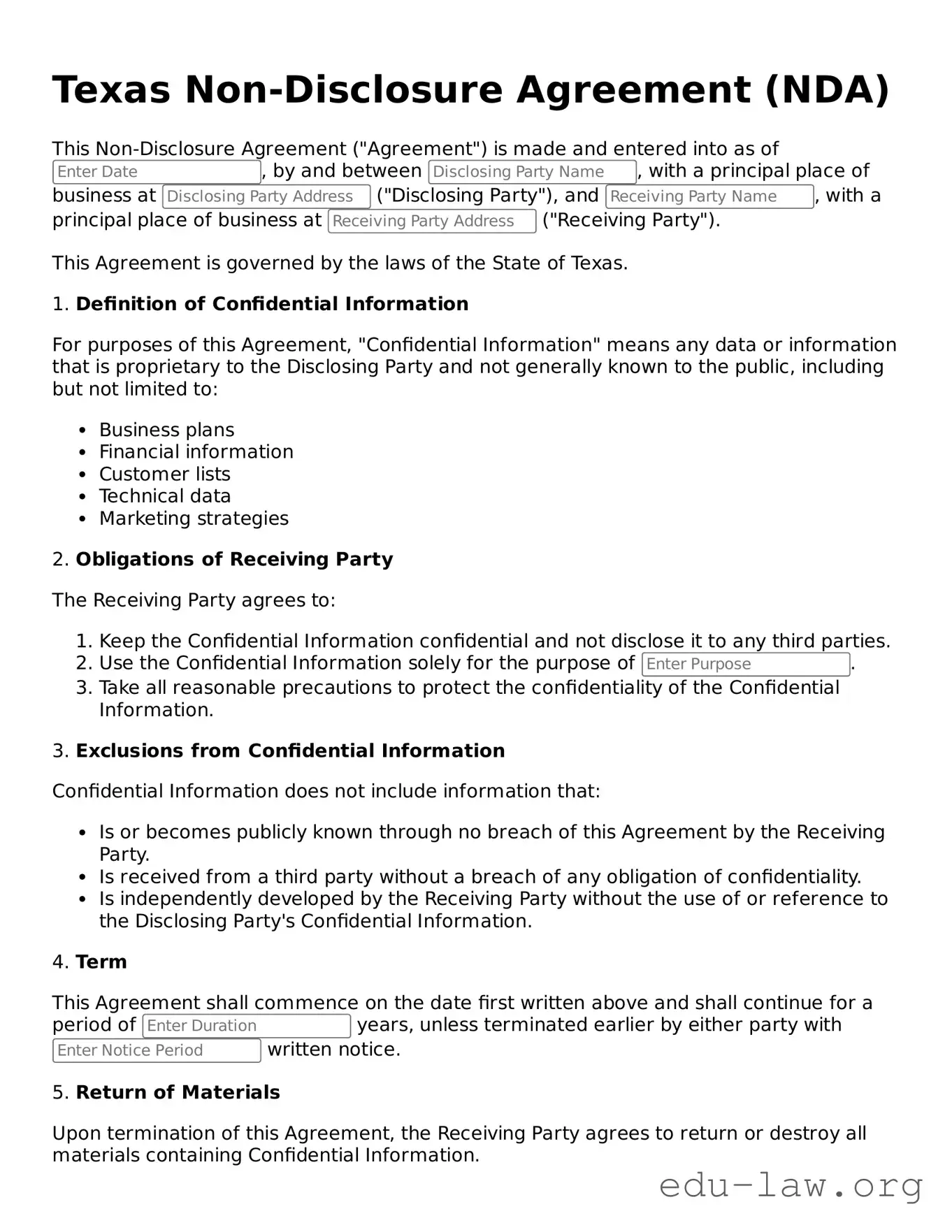
In the competitive landscape of business, protecting sensitive information is crucial. The Texas Non-Disclosure Agreement (NDA) form serves as a vital tool for individuals and companies seeking to safeguard their proprietary data. This legally binding document outlines the terms under which confidential information can be shared between parties, ensuring that trade secrets, business strategies, and other critical information remain secure. Key elements of the NDA include the definition of what constitutes confidential information, the obligations of the receiving party, and the duration of the confidentiality requirement. Additionally, the agreement may specify any exclusions to confidentiality, such as information that becomes public through no fault of the receiving party. By clearly laying out these terms, the Texas NDA helps foster trust and collaboration while minimizing the risk of information leaks that could harm a business's competitive edge.
Texas Non-Disclosure Agreement (NDA)
This Non-Disclosure Agreement ("Agreement") is made and entered into as of , by and between , with a principal place of business at ("Disclosing Party"), and , with a principal place of business at ("Receiving Party").
This Agreement is governed by the laws of the State of Texas.
1. Definition of Confidential Information
For purposes of this Agreement, "Confidential Information" means any data or information that is proprietary to the Disclosing Party and not generally known to the public, including but not limited to:
2. Obligations of Receiving Party
The Receiving Party agrees to:
3. Exclusions from Confidential Information
Confidential Information does not include information that:
4. Term
This Agreement shall commence on the date first written above and shall continue for a period of years, unless terminated earlier by either party with written notice.
5. Return of Materials
Upon termination of this Agreement, the Receiving Party agrees to return or destroy all materials containing Confidential Information.
6. Governing Law
This Agreement shall be governed by and construed in accordance with the laws of the State of Texas.
IN WITNESS WHEREOF, the parties hereto have executed this Non-Disclosure Agreement as of the date first above written.
Disclosing Party: ___________________________
By: , Title:
Receiving Party: ___________________________
By: , Title:
| Fact Name | Description |
|---|---|
| Purpose | The Texas Non-disclosure Agreement (NDA) is designed to protect confidential information shared between parties. |
| Governing Law | This agreement is governed by the laws of the State of Texas. |
| Parties Involved | The NDA typically involves a disclosing party and a receiving party. |
| Duration | The duration of confidentiality obligations can vary but is often specified in the agreement. |
| Enforceability | Texas courts generally enforce NDAs as long as they are reasonable and not overly broad. |
| Exceptions | Information that is public knowledge or independently developed is usually exempt from the NDA. |
| Signature Requirement | For the NDA to be valid, it must be signed by all parties involved. |
Filling out the Texas Non-disclosure Agreement form is a straightforward process. Once you have the form ready, you'll need to provide specific information to ensure it meets legal requirements. Follow the steps below to complete the form accurately.
What is a Texas Non-disclosure Agreement (NDA)?
A Texas Non-disclosure Agreement is a legal contract that establishes a confidential relationship between parties. It is designed to protect sensitive information shared during business transactions, discussions, or negotiations. By signing an NDA, parties agree not to disclose specific information to third parties without consent.
Who should use a Texas NDA?
Businesses, entrepreneurs, and individuals engaging in discussions that involve sensitive information should consider using a Texas NDA. This includes situations where proprietary information, trade secrets, or other confidential data is shared. It is particularly useful when discussing potential partnerships, investments, or employment agreements.
What types of information are typically covered by a Texas NDA?
Typically, a Texas NDA covers various types of confidential information, including but not limited to trade secrets, business plans, financial data, customer lists, and marketing strategies. The specific information to be protected should be clearly outlined in the agreement to ensure both parties understand their obligations.
How long does a Texas NDA last?
The duration of a Texas NDA can vary depending on the terms agreed upon by the parties involved. Generally, NDAs remain in effect for a specified period, which can range from a few years to indefinitely, depending on the nature of the information and the agreement terms. It is essential to define the duration clearly in the document.
What happens if someone violates a Texas NDA?
If a party violates a Texas NDA, the injured party may seek legal remedies. This could include financial compensation for damages caused by the breach or an injunction to prevent further disclosure of the confidential information. The specific consequences and remedies should be outlined in the agreement to provide clarity for all parties involved.
Can a Texas NDA be modified or terminated?
Yes, a Texas NDA can be modified or terminated if both parties agree to the changes in writing. It is advisable to document any amendments or termination to avoid misunderstandings in the future. Clear communication between the parties is essential to ensure all modifications are understood and accepted.
Is a Texas NDA enforceable in court?
Yes, a Texas NDA is generally enforceable in court, provided it meets the legal requirements of a contract. This includes mutual consent, a lawful purpose, and consideration. However, the enforceability may depend on the specific terms of the agreement and the circumstances surrounding its execution.
Not Identifying the Parties Clearly: One common mistake is failing to clearly identify all parties involved. Ensure that the names of individuals or entities are correctly spelled and accurately reflect the legal structure.
Missing a Definition of Confidential Information: It's crucial to specify what constitutes confidential information. Vague descriptions can lead to misunderstandings and potential disputes later on.
Overlooking the Duration of the Agreement: Many people forget to state how long the confidentiality obligation lasts. Clearly define the time frame to avoid confusion.
Failing to Include Permitted Disclosures: Not mentioning situations where disclosures are allowed can create issues. Specify circumstances under which sharing information is acceptable, such as legal requirements.
Ignoring the Consequences of Breach: It's important to outline the repercussions for violating the agreement. This can deter potential breaches and clarify the seriousness of the commitment.
Not Seeking Legal Advice: Some individuals attempt to complete the form without professional guidance. Consulting a legal expert can help ensure that all necessary elements are included and properly worded.
Neglecting to Sign and Date: A signed and dated agreement is essential for enforceability. Forgetting this step can render the entire document ineffective.
Using Outdated Templates: Relying on old or generic templates can lead to problems. Make sure the agreement reflects current laws and practices relevant to Texas.
When engaging in business relationships that require confidentiality, the Texas Non-disclosure Agreement (NDA) is often accompanied by several other important documents. These documents help clarify the terms of the agreement and ensure that all parties are on the same page regarding confidentiality and other obligations.
These documents serve various purposes but collectively enhance the framework of confidentiality and trust necessary for successful business relationships. Utilizing them in conjunction with a Texas Non-disclosure Agreement can help safeguard sensitive information and clarify expectations among all parties involved.
A Non-Disclosure Agreement (NDA) is often compared to a Confidentiality Agreement, as both serve to protect sensitive information shared between parties. While the terms may be used interchangeably, a Confidentiality Agreement may also cover a broader range of information beyond just trade secrets. This document can outline the obligations of each party in keeping the shared information confidential, specifying the duration of confidentiality and the consequences of breach. In essence, both documents aim to prevent unauthorized disclosure, but a Confidentiality Agreement can encompass a wider array of confidential information.
Another document similar to an NDA is a Non-Circumvention Agreement. This type of agreement ensures that one party does not bypass the other to engage directly with a third party. Often used in business dealings where relationships are critical, a Non-Circumvention Agreement protects the interests of the party that initially introduced the other to the business opportunity. While an NDA focuses on confidentiality, a Non-Circumvention Agreement emphasizes the protection of business relationships and opportunities.
A Mutual Non-Disclosure Agreement is also comparable to the Texas NDA. This document is unique because it involves two parties agreeing to share confidential information with each other. In this case, both parties have obligations to protect each other's sensitive information. This type of agreement is particularly useful in joint ventures or partnerships, where both sides need to share proprietary information while ensuring that it remains confidential. The reciprocal nature of this agreement fosters trust and collaboration between the parties.
A Proprietary Information Agreement (PIA) shares similarities with an NDA, as it is designed to protect proprietary information. This document typically identifies specific types of information that are considered proprietary, such as formulas, processes, or methods. While an NDA may cover a broader scope of confidential information, a PIA focuses specifically on proprietary data. Both documents seek to prevent unauthorized use or disclosure, but a PIA may provide more detailed definitions and protections for proprietary information.
In the realm of employment, an Employment Agreement often includes clauses that are similar to those found in an NDA. This document outlines the terms of employment and may include provisions regarding confidentiality and the handling of sensitive company information. Employees are often required to sign such agreements to ensure they understand their obligations regarding company secrets and proprietary data. The inclusion of confidentiality clauses in Employment Agreements serves to protect the employer’s interests while also defining the expectations for the employee.
A Licensing Agreement can also bear similarities to an NDA, particularly when it involves the sharing of proprietary information between a licensor and a licensee. In this context, the Licensing Agreement outlines the terms under which the licensee may use the licensor's intellectual property. To protect the licensor's interests, confidentiality clauses are often included to prevent the licensee from disclosing sensitive information or using it for unauthorized purposes. This ensures that the licensor’s proprietary information remains secure while allowing for the licensed use of their intellectual property.
A Teaming Agreement is another document that often incorporates elements similar to those found in NDAs. Used primarily in the context of collaborative projects, a Teaming Agreement outlines the responsibilities and expectations of each party involved. Confidentiality clauses are typically included to protect any sensitive information shared during the collaboration. This agreement fosters a spirit of cooperation while ensuring that proprietary information is safeguarded throughout the project.
Finally, a Joint Venture Agreement can also resemble an NDA in its intent to protect shared information. When two or more parties come together for a common business purpose, they often need to exchange sensitive information. A Joint Venture Agreement typically includes confidentiality provisions to ensure that any proprietary or sensitive information shared during the collaboration remains protected. This agreement facilitates trust and transparency among the parties while safeguarding their respective interests.
When filling out the Texas Non-disclosure Agreement form, it is important to follow certain guidelines to ensure accuracy and compliance. Here are five things you should and shouldn't do:
Misconceptions about the Texas Non-disclosure Agreement (NDA) can lead to confusion and misinterpretation of its purpose and function. Here are seven common misconceptions:
All NDAs are the same. Many people believe that all non-disclosure agreements are identical in nature. In reality, NDAs can vary significantly in terms of language, scope, and enforceability based on the specific circumstances and the parties involved.
NDAs are only for businesses. While businesses frequently use NDAs to protect trade secrets, individuals can also use them. For instance, freelancers and contractors may require NDAs to safeguard sensitive information when working with clients.
Signing an NDA means you cannot speak to anyone ever. This is a misunderstanding. NDAs generally restrict the sharing of specific confidential information, but they do not prevent all communication. Individuals can still discuss non-confidential matters.
NDAs are unenforceable in Texas. Some people think that NDAs lack legal standing in Texas. However, Texas law does recognize and enforce NDAs, provided they meet certain legal requirements.
Once signed, an NDA lasts forever. This misconception overlooks the fact that NDAs can have specific durations. Many agreements specify a time frame during which the information must remain confidential.
All information shared under an NDA is protected. Not all information is automatically covered by an NDA. For example, information that is already publicly available or independently developed may not be protected.
NDAs can be used to silence whistleblowers. While some may fear that NDAs can be used to prevent reporting illegal activities, whistleblower protections exist. An NDA cannot override laws that protect individuals from retaliation for reporting misconduct.
Understanding these misconceptions can help individuals and businesses navigate the complexities of non-disclosure agreements more effectively.
When working with a Texas Non-disclosure Agreement (NDA), it is essential to understand the key aspects to ensure that the document serves its intended purpose effectively. Here are some important takeaways to consider:
Understanding these key points will help ensure that your Texas Non-disclosure Agreement is comprehensive and effective in protecting your confidential information.