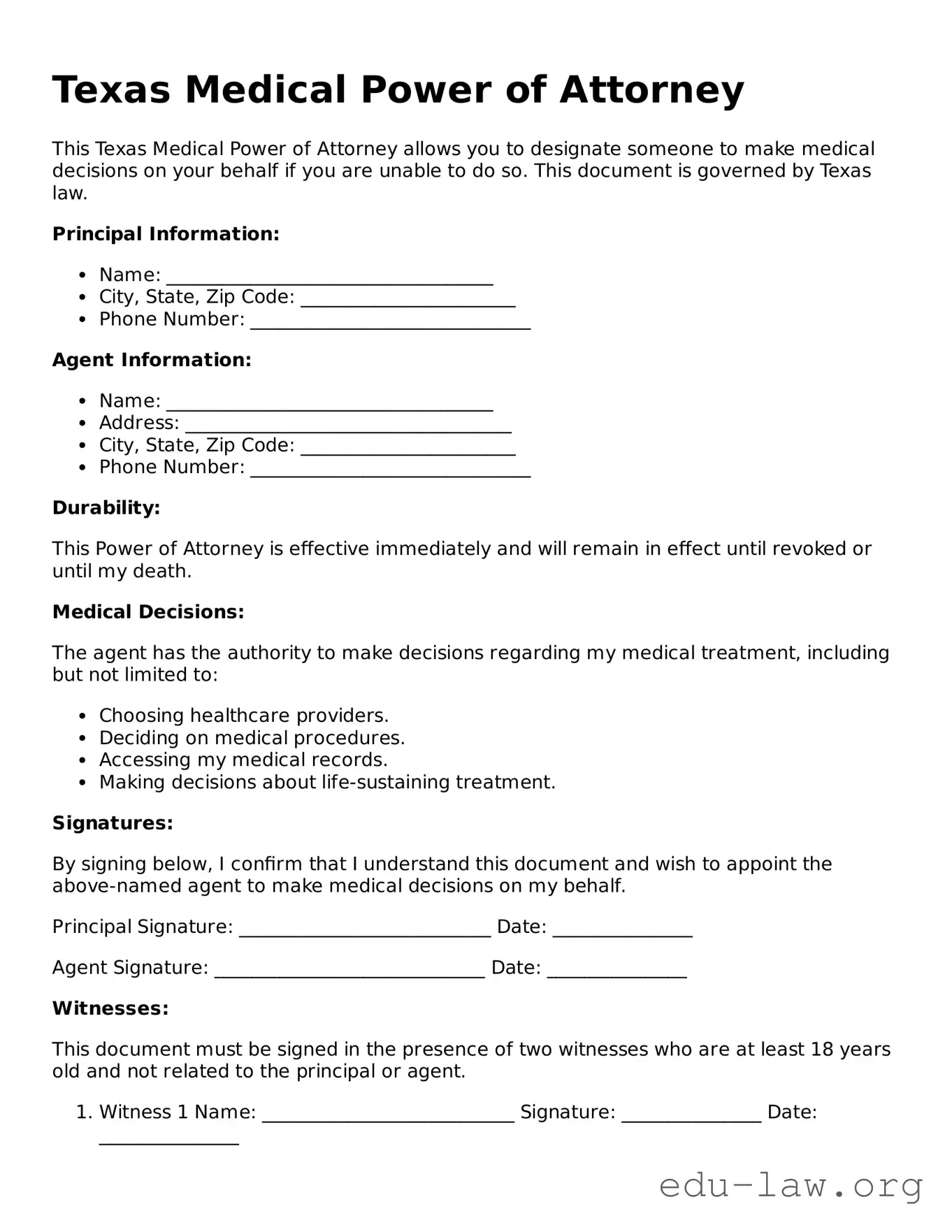
In Texas, a Medical Power of Attorney (MPOA) form is a crucial document that empowers individuals to designate a trusted person to make healthcare decisions on their behalf when they are unable to do so. This form ensures that your medical preferences are honored, even when you cannot communicate them yourself. It allows you to appoint an agent who will have the authority to discuss your medical treatment options with healthcare providers and make decisions based on your wishes. The MPOA can cover a wide range of scenarios, from routine medical care to end-of-life decisions, providing clarity and guidance during challenging times. Completing this form requires careful consideration, as it involves discussing personal values and preferences regarding medical care. Additionally, it is important to ensure that the form is signed and witnessed according to Texas law to ensure its validity. By understanding the key aspects of the Texas Medical Power of Attorney form, individuals can take proactive steps to safeguard their healthcare choices and ensure their voices are heard, even when they cannot speak for themselves.
Texas Medical Power of Attorney
This Texas Medical Power of Attorney allows you to designate someone to make medical decisions on your behalf if you are unable to do so. This document is governed by Texas law.
Principal Information:
Agent Information:
Durability:
This Power of Attorney is effective immediately and will remain in effect until revoked or until my death.
Medical Decisions:
The agent has the authority to make decisions regarding my medical treatment, including but not limited to:
Signatures:
By signing below, I confirm that I understand this document and wish to appoint the above-named agent to make medical decisions on my behalf.
Principal Signature: ___________________________ Date: _______________
Agent Signature: _____________________________ Date: _______________
Witnesses:
This document must be signed in the presence of two witnesses who are at least 18 years old and not related to the principal or agent.
Notary Public:
State of Texas
County of ____________________________
Subscribed and sworn to before me on this _____ day of ______________, 20__.
Notary Public Signature: ___________________________
My Commission Expires: ___________________________
| Fact Name | Details |
|---|---|
| Definition | The Texas Medical Power of Attorney form allows individuals to designate someone to make healthcare decisions on their behalf if they become unable to do so. |
| Governing Law | This form is governed by the Texas Health and Safety Code, Chapter 166. |
| Eligibility | Any adult resident of Texas can create a Medical Power of Attorney. |
| Agent Selection | The individual creating the document (the principal) can choose any competent adult as their agent. |
| Durability | The Medical Power of Attorney remains effective even if the principal becomes incapacitated. |
| Revocation | The principal can revoke the Medical Power of Attorney at any time, as long as they are still competent. |
| Witness Requirements | The form must be signed by the principal in the presence of two witnesses or a notary public. |
| Limitations | Agents cannot make decisions regarding the principal's mental health treatment unless explicitly authorized. |
| Healthcare Providers | Healthcare providers must honor the decisions made by the designated agent, as long as they comply with the law. |
| Form Availability | The Texas Medical Power of Attorney form is available online and through legal offices throughout Texas. |
Filling out the Texas Medical Power of Attorney form is an important step in ensuring that your healthcare preferences are respected. By designating someone to make medical decisions on your behalf, you can ensure that your wishes are followed in the event that you are unable to communicate them yourself. Below are the steps to complete the form accurately.
After completing these steps, you will have a valid Texas Medical Power of Attorney form that reflects your healthcare wishes. Ensure that your designated agents are aware of their responsibilities and have access to the form when needed.
What is a Texas Medical Power of Attorney?
A Texas Medical Power of Attorney is a legal document that allows an individual, known as the principal, to designate another person, referred to as the agent, to make medical decisions on their behalf. This document becomes crucial when the principal is unable to communicate their wishes due to illness or incapacity. It ensures that healthcare choices reflect the principal's preferences and values.
Who can serve as an agent in a Texas Medical Power of Attorney?
In Texas, any competent adult can be appointed as an agent. This includes family members, friends, or trusted individuals. However, certain restrictions apply. For instance, a healthcare provider or an employee of a healthcare facility cannot serve as an agent unless they are related to the principal by blood or marriage. Choosing someone who understands your medical preferences and can advocate for you is essential.
How does one create a Texas Medical Power of Attorney?
To create a Texas Medical Power of Attorney, the principal must complete the required form, which can be obtained from various sources, including legal websites or healthcare providers. The document must be signed by the principal in the presence of a notary public or two witnesses who are not related to the principal and will not benefit from the principal’s estate. Once completed, the document should be shared with the designated agent and kept in a safe place.
Can a Texas Medical Power of Attorney be revoked?
Yes, a Texas Medical Power of Attorney can be revoked at any time, as long as the principal is competent. Revocation can be done by destroying the original document, creating a new document that explicitly states the revocation, or notifying the agent in writing. It is advisable to inform healthcare providers about the revocation to avoid any confusion regarding medical decision-making.
What happens if I do not have a Medical Power of Attorney in Texas?
If an individual does not have a Medical Power of Attorney and becomes incapacitated, medical decisions may be made by family members or, in some cases, by the court. This can lead to disagreements among family members about treatment options. Having a Medical Power of Attorney helps ensure that your healthcare preferences are honored, reducing potential conflict and confusion during difficult times.
Not Choosing a Reliable Agent: It's crucial to select someone you trust completely. Many people overlook the importance of this choice and pick a family member or friend without considering their ability to make tough decisions in a medical crisis.
Failing to Discuss Wishes: Some individuals fill out the form without having a conversation with their chosen agent. This can lead to confusion and decisions that may not align with your wishes.
Leaving Sections Blank: Incomplete forms can create problems. Ensure that all sections are filled out, especially the parts detailing your medical preferences and any specific instructions.
Not Updating the Form: Life changes, and so can your preferences. Many forget to revisit and update their Medical Power of Attorney after significant life events, such as marriage, divorce, or changes in health.
Ignoring Witness and Notary Requirements: Texas law requires that the form be signed in front of witnesses or a notary. Skipping this step can render the document invalid.
Not Storing the Document Safely: After completing the form, it’s important to keep it in a secure yet accessible place. Many people misplace it or fail to share copies with their agent and healthcare providers.
When preparing a Texas Medical Power of Attorney, it is often beneficial to consider additional documents that can support your healthcare decisions and ensure your wishes are honored. Below is a list of forms and documents commonly used alongside the Texas Medical Power of Attorney.
Having these documents prepared alongside your Texas Medical Power of Attorney can provide peace of mind. They ensure that your healthcare preferences are clear and respected, allowing you and your loved ones to navigate difficult situations with confidence.
The Texas Medical Power of Attorney form is similar to the Advance Directive, which allows individuals to express their healthcare preferences in advance. Both documents serve to ensure that a person's medical wishes are respected when they are unable to communicate them. While the Medical Power of Attorney designates a specific person to make decisions, the Advance Directive outlines general treatment preferences, making it a broader document that complements the more specific powers granted in a Medical Power of Attorney.
An additional document is the Living Will, which specifically addresses end-of-life decisions. Like the Medical Power of Attorney, a Living Will communicates a person's wishes regarding medical treatment. However, it does not appoint an agent to make decisions on behalf of the individual. Instead, it provides clear instructions about what types of medical interventions should or should not be used in terminal situations or irreversible conditions.
The Durable Power of Attorney for Healthcare is another similar document. This form allows a person to appoint an agent to make healthcare decisions, similar to the Medical Power of Attorney. The key difference lies in the fact that the Durable Power of Attorney can also cover financial matters, whereas the Medical Power of Attorney is strictly for healthcare decisions. Both documents ensure that someone trusted is in charge of making important decisions when the individual is incapacitated.
The Do Not Resuscitate (DNR) order shares similarities with the Medical Power of Attorney in that both relate to healthcare decisions. A DNR specifically instructs medical personnel not to perform CPR if the heart stops or if breathing ceases. While the Medical Power of Attorney allows for broader healthcare decisions, the DNR focuses on a specific aspect of care, particularly in emergency situations.
The Healthcare Proxy is similar to the Medical Power of Attorney in that it designates someone to make healthcare decisions for another person. This document is commonly used in states outside of Texas. While the terminology may differ, the core function remains the same: to ensure that a trusted individual is empowered to make healthcare choices when the patient is unable to do so.
The Revocation of Power of Attorney is a document that can be used in conjunction with the Medical Power of Attorney. It allows an individual to cancel or revoke a previously granted Medical Power of Attorney. This ensures that a person can change their mind about who they want to make medical decisions on their behalf, providing flexibility and control over their healthcare choices.
The Declaration for Mental Health Treatment is another similar document, focusing specifically on mental health care. It allows individuals to express their preferences regarding mental health treatment when they are unable to make decisions. While the Medical Power of Attorney addresses general healthcare, this declaration narrows the focus to mental health, ensuring that specific wishes are honored in that context.
The Advance Care Planning document, while broader in scope, shares similarities with the Medical Power of Attorney. It encourages individuals to think about and communicate their healthcare preferences. This document may include various elements such as living wills and Medical Power of Attorney designations, providing a comprehensive approach to planning for future healthcare needs.
Finally, the Consent to Treatment form is related to the Medical Power of Attorney in that it involves healthcare decisions. This form is used to give permission for specific medical treatments or procedures. While the Medical Power of Attorney grants broader decision-making authority to an agent, the Consent to Treatment is typically used for immediate, specific medical interventions.
When filling out the Texas Medical Power of Attorney form, it is essential to approach the task with care and attention to detail. Here are six important dos and don'ts to keep in mind:
By following these guidelines, individuals can help ensure that their medical preferences are respected and that their appointed agent is prepared to act in their best interests.
Understanding the Texas Medical Power of Attorney (MPOA) form is crucial for ensuring that your healthcare wishes are respected when you cannot speak for yourself. However, there are several misconceptions surrounding this important document. Here are eight common myths debunked:
By understanding these misconceptions, you can take the necessary steps to ensure that your healthcare preferences are honored, regardless of your circumstances.
When filling out and using the Texas Medical Power of Attorney form, there are several important points to consider. Below are key takeaways to keep in mind: