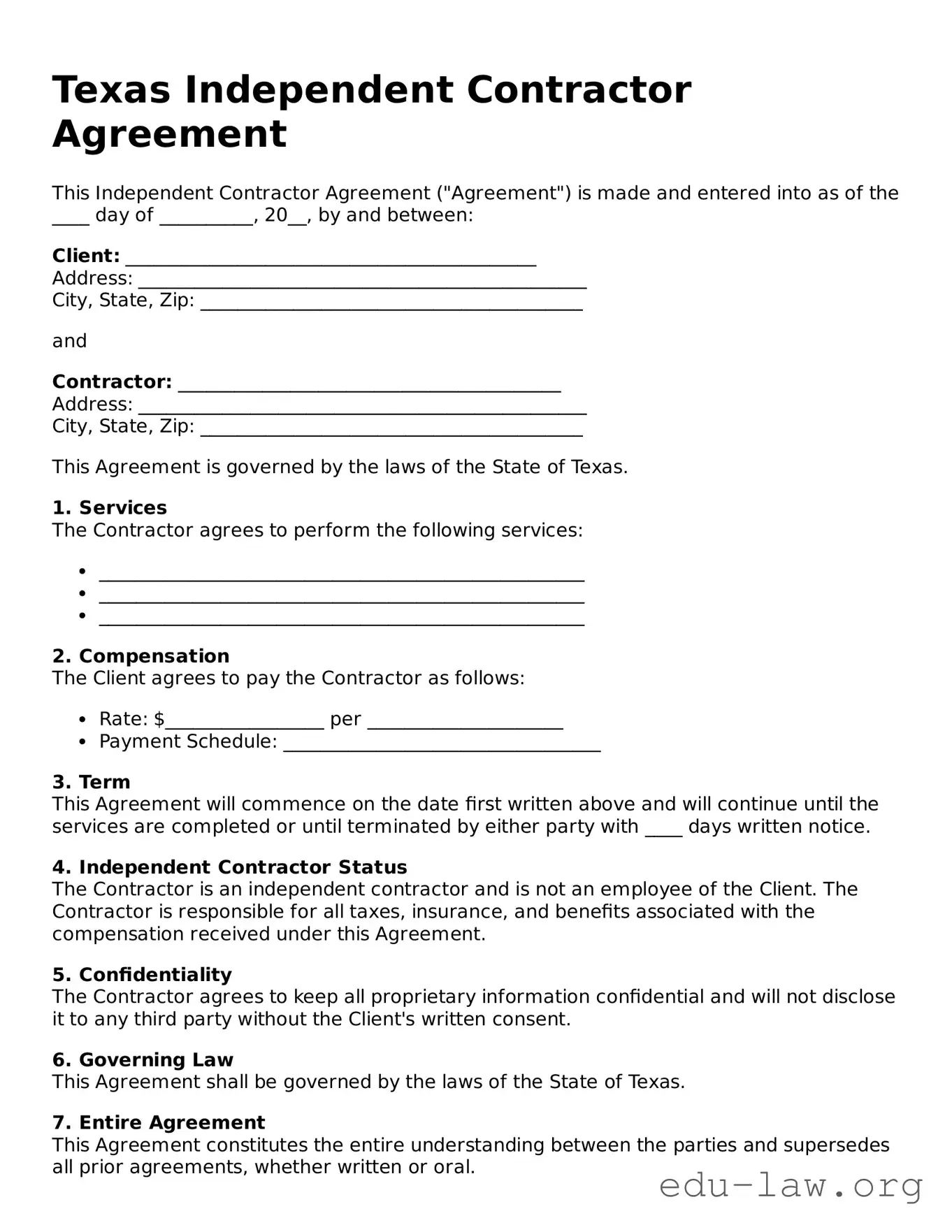
The Texas Independent Contractor Agreement form serves as a crucial document for businesses and individuals who engage independent contractors for various services. This agreement outlines the terms and conditions under which the contractor will operate, ensuring clarity and mutual understanding between the parties involved. Key components typically included in this form are the scope of work, payment terms, and the duration of the contract. It also addresses important aspects such as confidentiality, liability, and the nature of the relationship, explicitly stating that the contractor is not an employee of the hiring party. By defining these elements, the agreement helps to protect both the contractor and the client, minimizing potential disputes and fostering a professional working relationship. Understanding the nuances of this form is essential for anyone looking to hire or work as an independent contractor in Texas.
Texas Independent Contractor Agreement
This Independent Contractor Agreement ("Agreement") is made and entered into as of the ____ day of __________, 20__, by and between:
Client: ____________________________________________
Address: ________________________________________________
City, State, Zip: _________________________________________
and
Contractor: _________________________________________
Address: ________________________________________________
City, State, Zip: _________________________________________
This Agreement is governed by the laws of the State of Texas.
1. Services
The Contractor agrees to perform the following services:
2. Compensation
The Client agrees to pay the Contractor as follows:
3. Term
This Agreement will commence on the date first written above and will continue until the services are completed or until terminated by either party with ____ days written notice.
4. Independent Contractor Status
The Contractor is an independent contractor and is not an employee of the Client. The Contractor is responsible for all taxes, insurance, and benefits associated with the compensation received under this Agreement.
5. Confidentiality
The Contractor agrees to keep all proprietary information confidential and will not disclose it to any third party without the Client's written consent.
6. Governing Law
This Agreement shall be governed by the laws of the State of Texas.
7. Entire Agreement
This Agreement constitutes the entire understanding between the parties and supersedes all prior agreements, whether written or oral.
IN WITNESS WHEREOF, the parties hereto have executed this Independent Contractor Agreement as of the date first above written.
Client Signature: ___________________________ Date: _______________
Contractor Signature: _______________________ Date: _______________
| Fact Name | Description |
|---|---|
| Purpose | The Texas Independent Contractor Agreement outlines the terms between a business and an independent contractor. |
| Governing Law | This agreement is governed by the laws of the State of Texas. |
| Payment Terms | It specifies how and when the contractor will be paid for their services. |
| Scope of Work | The agreement details the specific tasks and responsibilities of the contractor. |
| Duration | It includes the start and end dates for the contractor's services. |
| Confidentiality | Provisions may be included to protect confidential information shared during the contract. |
| Termination Clause | The agreement outlines how either party can terminate the contract. |
| Indemnification | It may include clauses that protect against legal claims arising from the contractor's work. |
Filling out the Texas Independent Contractor Agreement form is an important step in establishing a clear understanding between the contractor and the hiring party. This agreement outlines the terms of the working relationship, ensuring that both parties are on the same page regarding expectations and responsibilities. Follow these steps to complete the form accurately.
Once the form is completed and signed, both parties should retain a copy for their records. This agreement serves as a reference point for the working relationship and can help prevent disputes down the line.
What is a Texas Independent Contractor Agreement?
A Texas Independent Contractor Agreement is a legal document that outlines the relationship between a business and an independent contractor. It specifies the terms under which the contractor will provide services, including payment, project scope, deadlines, and other responsibilities. This agreement helps clarify expectations and protects both parties by setting clear guidelines for the work to be performed.
Why is it important to have an Independent Contractor Agreement?
Having an Independent Contractor Agreement is crucial for several reasons. First, it defines the nature of the relationship, distinguishing between an employee and an independent contractor. This distinction can impact tax obligations and liability. Second, the agreement sets forth the specific terms of the engagement, which can prevent misunderstandings and disputes. Lastly, it provides legal protection in case either party fails to meet their obligations, offering a framework for resolution.
What should be included in a Texas Independent Contractor Agreement?
A comprehensive Texas Independent Contractor Agreement should include several key elements. First, it should identify the parties involved, including their legal names and contact information. Next, it should outline the scope of work, detailing the services to be provided. Payment terms are also essential, specifying the amount, payment schedule, and any expenses that will be reimbursed. Additionally, the agreement should address confidentiality, intellectual property rights, and termination conditions to ensure clarity and protection for both parties.
Can the terms of the Independent Contractor Agreement be modified?
Yes, the terms of an Independent Contractor Agreement can be modified, but changes must be made in writing and agreed upon by both parties. It’s important to document any amendments to avoid confusion in the future. Verbal agreements or informal changes may not hold up legally, so maintaining a written record is advisable. This ensures that all parties are on the same page and helps preserve the integrity of the agreement.
Failing to clearly define the scope of work. It is crucial to specify the exact services the contractor will provide. Without this clarity, misunderstandings can arise.
Not including payment terms. The agreement should outline how much the contractor will be paid, the payment schedule, and the method of payment.
Overlooking the importance of deadlines. Clearly stating deadlines for deliverables helps manage expectations and ensures accountability.
Neglecting to specify the duration of the agreement. Indicating the start and end dates of the contract is essential for both parties.
Using vague language. Ambiguous terms can lead to confusion. It is important to use precise language to avoid misinterpretations.
Not addressing confidentiality. If sensitive information will be shared, including a confidentiality clause protects both parties.
Failing to outline termination conditions. The agreement should specify how either party can terminate the contract and under what circumstances.
Ignoring compliance with laws. Ensuring that the agreement complies with local, state, and federal laws is essential to avoid legal issues.
Not having both parties sign the agreement. A signature from both the contractor and the hiring party is necessary to make the agreement legally binding.
The Texas Independent Contractor Agreement is a crucial document that outlines the terms of the working relationship between a contractor and a client. However, it is often accompanied by other forms and documents that help clarify the arrangement and ensure compliance with legal standards. Below are five common documents that are frequently used in conjunction with the Independent Contractor Agreement.
Utilizing these documents alongside the Texas Independent Contractor Agreement can help establish a clear, professional, and legally sound relationship between contractors and clients. Each document plays a vital role in protecting the interests of both parties and ensuring a successful working arrangement.
The Texas Independent Contractor Agreement shares similarities with the Employment Agreement, which outlines the terms of employment between an employer and an employee. While an Employment Agreement establishes an employer-employee relationship, the Independent Contractor Agreement defines a contractor-client relationship. Both documents specify the scope of work, payment terms, and duration of the engagement. However, the key distinction lies in the level of control; employers have more authority over employees, whereas independent contractors maintain greater autonomy in how they complete their tasks.
Another document that resembles the Texas Independent Contractor Agreement is the Service Agreement. This document is often used for various service-based transactions and details the services to be provided, payment structures, and timelines. Like the Independent Contractor Agreement, the Service Agreement can be tailored to suit specific projects or ongoing services. However, the Service Agreement may not always clarify the independent status of the service provider, which is a crucial aspect of the Independent Contractor Agreement.
The Consulting Agreement is also similar to the Texas Independent Contractor Agreement. This document is specifically designed for consulting services, outlining the consultant's responsibilities, deliverables, and compensation. Both agreements emphasize the independent nature of the contractor or consultant. However, a Consulting Agreement often includes provisions related to intellectual property and confidentiality, which may not be as prevalent in a standard Independent Contractor Agreement.
Additionally, the Freelance Agreement shares characteristics with the Texas Independent Contractor Agreement. Freelancers, like independent contractors, work on a project basis and are not considered employees. Both agreements typically cover project details, payment terms, and deadlines. The Freelance Agreement may incorporate unique clauses that address creative rights and ownership of work products, reflecting the specific needs of freelance work.
The Partnership Agreement can also be compared to the Texas Independent Contractor Agreement, although it serves a different purpose. This document governs the relationship between partners in a business venture. While both agreements outline roles and responsibilities, a Partnership Agreement involves shared ownership and liability, unlike the Independent Contractor Agreement, which maintains a clear distinction between the contractor and the client.
Finally, the Non-Disclosure Agreement (NDA) often accompanies the Texas Independent Contractor Agreement. While an NDA protects confidential information shared between parties, it complements the Independent Contractor Agreement by ensuring that sensitive business information remains secure. Both documents can be part of a broader contractual framework, but the NDA specifically addresses confidentiality, whereas the Independent Contractor Agreement focuses on the terms of the working relationship.
When filling out the Texas Independent Contractor Agreement form, it is essential to approach the task with care. Below are ten important guidelines to follow, along with some pitfalls to avoid.
Misconceptions about the Texas Independent Contractor Agreement can lead to confusion and potential issues for both contractors and businesses. Here are five common misconceptions:
Understanding these misconceptions can help ensure a smoother working relationship and protect both parties involved.
When filling out and using the Texas Independent Contractor Agreement form, it is essential to understand its key components and implications. Here are some important takeaways to consider:
By paying attention to these key elements, both contractors and hiring parties can create a solid foundation for their working relationship.