The Texas Affidavit of Service form plays a crucial role in the legal process, ensuring that all parties involved in a case are properly notified of legal actions. This document serves as proof that a particular legal document, such as a summons or complaint, has been delivered to the intended recipient. It outlines essential details, including the name of the individual being served, the date and time of service, and the method used for delivery—whether personal, by mail, or through another authorized means. Additionally, the form requires the signature of the person who completed the service, affirming that the information provided is accurate and truthful. By adhering to the specific requirements set forth by Texas law, the Affidavit of Service helps maintain the integrity of the judicial process, ensuring that no party is left unaware of legal proceedings that may affect their rights and obligations. Understanding the nuances of this form is vital for anyone involved in a legal dispute in Texas, as it not only facilitates communication but also upholds the principles of due process.
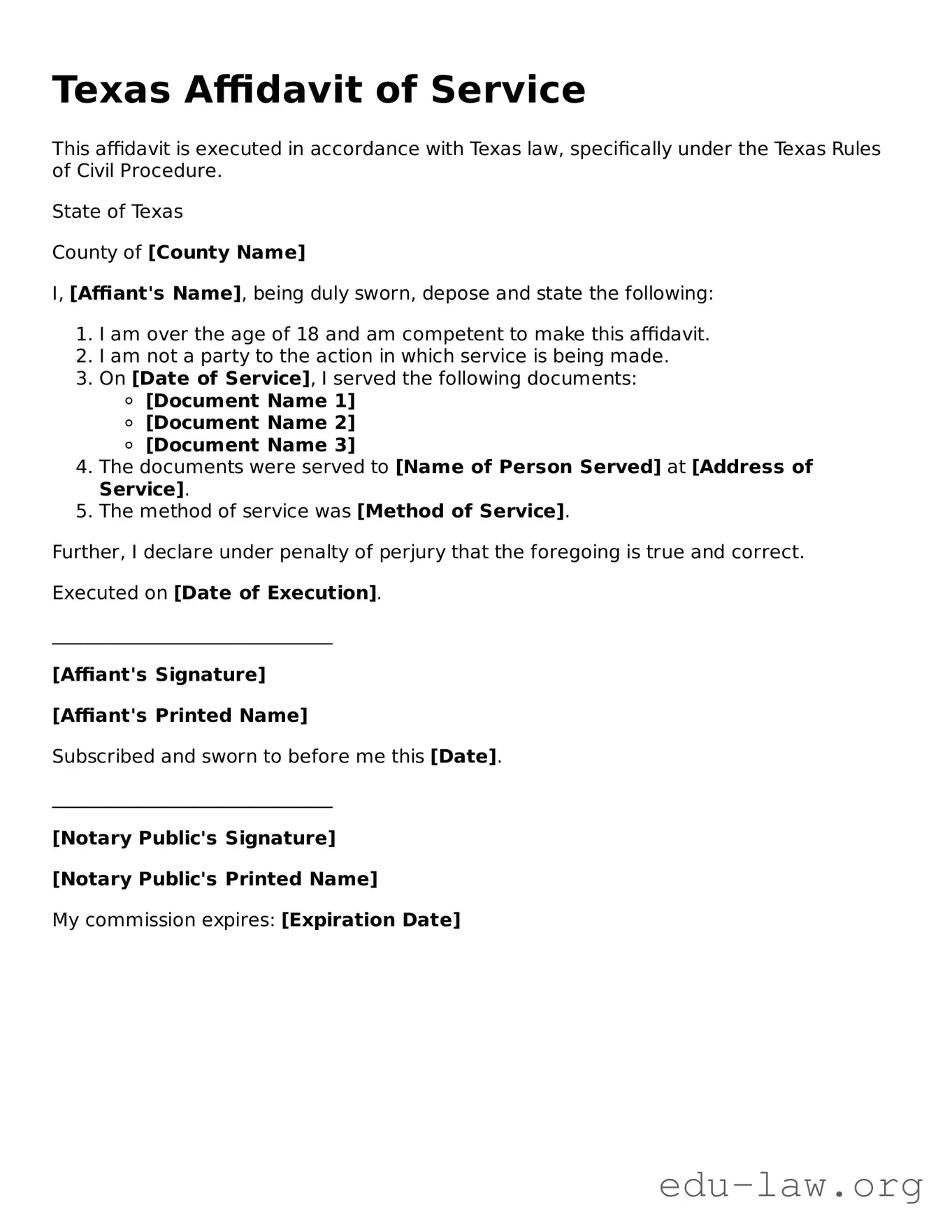
Texas Affidavit of Service
This affidavit is executed in accordance with Texas law, specifically under the Texas Rules of Civil Procedure.
State of Texas
County of [County Name]
I, [Affiant's Name], being duly sworn, depose and state the following:
Further, I declare under penalty of perjury that the foregoing is true and correct.
Executed on [Date of Execution].
______________________________
[Affiant's Signature]
[Affiant's Printed Name]
Subscribed and sworn to before me this [Date].
______________________________
[Notary Public's Signature]
[Notary Public's Printed Name]
My commission expires: [Expiration Date]
| Fact Name | Description |
|---|---|
| Purpose | The Texas Affidavit of Service form is used to document the service of legal documents to a party in a lawsuit. |
| Governing Law | This form is governed by the Texas Rules of Civil Procedure, specifically Rule 107. |
| Required Information | The form requires details such as the name of the person served, the date of service, and the method of service. |
| Signature | The affidavit must be signed by the person who served the documents, affirming that the information provided is true. |
| Filing | After completing the affidavit, it should be filed with the court to provide proof of service. |
| Deadline | Typically, the affidavit must be filed within a specified time frame after the service is completed, often within 10 days. |
Once you have the Texas Affidavit of Service form in hand, you will need to complete it accurately to ensure it meets the necessary requirements. This form serves as a declaration that a particular document was served to a party involved in a legal matter. After filling it out, it will need to be filed with the appropriate court or agency.
What is a Texas Affidavit of Service?
The Texas Affidavit of Service is a legal document that verifies that a specific legal document has been delivered to a party involved in a legal case. This form serves as proof that the recipient received the documents, such as a summons or complaint, which is essential for the legal process to proceed. Without proper service, a court may not have jurisdiction over the party, which can delay or even dismiss a case.
Who can serve documents and complete the Affidavit of Service?
In Texas, documents can be served by a variety of individuals. This includes a sheriff, constable, or a person who is over 18 years old and not a party to the case. It’s important that the person serving the documents is reliable and can accurately complete the Affidavit of Service. The individual must provide details about how and when the documents were served, ensuring that the process is transparent and accountable.
What information is required on the Affidavit of Service?
The Affidavit of Service must include several key pieces of information. This includes the name of the person who served the documents, the name of the person receiving them, the date and time of service, and the method used for service (such as personal delivery or certified mail). Additionally, the affidavit should state the type of documents served and may require a signature from the person who served the documents, confirming the accuracy of the information provided.
How is the Affidavit of Service filed with the court?
Once the documents have been served, the completed Affidavit of Service must be filed with the court where the case is pending. This filing should happen promptly to ensure that the court has a record of service. Typically, the affidavit can be submitted in person or electronically, depending on the court's rules. Always check the specific requirements of the court to ensure compliance.
What happens if the Affidavit of Service is not completed correctly?
If the Affidavit of Service is not completed correctly, it can lead to significant complications in your case. The court may find that the service was invalid, which could delay proceedings or even result in the dismissal of the case. To avoid these issues, it’s crucial to ensure that all information is accurate and that the affidavit is filed in a timely manner. If there are uncertainties, seeking guidance from a legal professional can provide clarity and help navigate the process effectively.
Failing to provide accurate service details. This includes the date and time of service, which must be precise.
Not including the correct recipient information. Ensure that the name and address of the person being served are complete and accurate.
Using the wrong form version. Always check to ensure that you are using the most current version of the Affidavit of Service form.
Neglecting to sign the affidavit. An unsigned affidavit is invalid and cannot be processed.
Providing insufficient witness information. If a witness is present during service, their details must be included.
Not including the method of service. Specify whether the documents were served in person, by mail, or through another method.
Overlooking the notary requirement. Many affidavits must be notarized to be considered valid.
Failing to keep a copy of the completed affidavit. Always retain a copy for your records after submission.
When dealing with legal processes in Texas, the Affidavit of Service is an important document that confirms the delivery of legal papers to the intended recipient. However, several other forms and documents often accompany it to ensure that the legal proceedings are properly documented and adhered to. Below is a list of commonly used forms that may be relevant in conjunction with the Texas Affidavit of Service.
Understanding these documents can help individuals navigate the complexities of the legal system more effectively. Each form plays a crucial role in ensuring that legal processes are followed correctly, which can ultimately impact the outcome of a case.
The Texas Affidavit of Service form is similar to the Proof of Service document used in many jurisdictions. Both serve the purpose of confirming that legal documents have been delivered to the intended recipients. In both cases, a person, often a process server or a legal representative, attests to the delivery of these documents. This ensures that the court has a record of service, which is essential for moving forward with legal proceedings.
Another document that shares similarities with the Texas Affidavit of Service is the Affidavit of Delivery. This affidavit is used to verify that specific items, such as contracts or notices, have been delivered to a party. Like the Texas form, it requires the person delivering the documents to provide a sworn statement detailing how and when the delivery took place, establishing a clear chain of custody for the documents in question.
The Return of Service form is also akin to the Texas Affidavit of Service. This document is often used in civil litigation to confirm that a defendant has been served with a lawsuit. It includes details about the service, such as the date, time, and method of service. Both documents serve as proof that a party has been properly notified, which is a crucial step in ensuring due process.
The Declaration of Service is another document that functions similarly. It is typically used in various legal contexts to declare that a party has served documents, such as court filings or notices, to another party. Like the Texas Affidavit of Service, it includes specific information about the service process and is signed under penalty of perjury, adding a layer of legal credibility to the statement.
The Certificate of Service is also comparable to the Texas Affidavit of Service. This document is often included with legal filings to confirm that all parties involved have received copies of the documents submitted to the court. It may not always require a sworn statement, but it serves the same fundamental purpose of ensuring that all parties are informed and that the court is aware of the service process.
The Affidavit of Service by Mail is another related document. This specific affidavit is used when legal documents are sent via postal mail rather than delivered in person. Similar to the Texas form, it requires a sworn statement from the sender confirming that the documents were mailed and provides details about the mailing process. This helps establish that the recipient was given notice, even if they did not receive the documents in person.
The Notice of Service is also comparable to the Texas Affidavit of Service. This document is often used to inform parties that a legal action has been initiated against them and that they will be served with documents. It outlines the upcoming steps in the legal process and ensures that all parties are aware of their rights and responsibilities, similar to how the Texas Affidavit serves to confirm delivery of legal documents.
Lastly, the Service of Process document is similar in that it encompasses the entire procedure of delivering legal documents to a party. This includes various methods of service, such as personal delivery, mail, or publication. The Texas Affidavit of Service focuses specifically on the confirmation aspect, while the Service of Process document provides a broader overview of the methods and requirements for serving legal documents.
When filling out the Texas Affidavit of Service form, it's important to follow certain guidelines to ensure accuracy and compliance. Here are some key dos and don'ts:
The Texas Affidavit of Service form is a crucial document in the legal process, yet several misconceptions surround its use and requirements. Below is a list of common misunderstandings regarding this form, along with clarifications.
Understanding these misconceptions can help individuals navigate the legal process more effectively and ensure compliance with Texas law regarding the Affidavit of Service.
Filling out and using the Texas Affidavit of Service form requires attention to detail and understanding of its purpose. Here are key takeaways to consider: