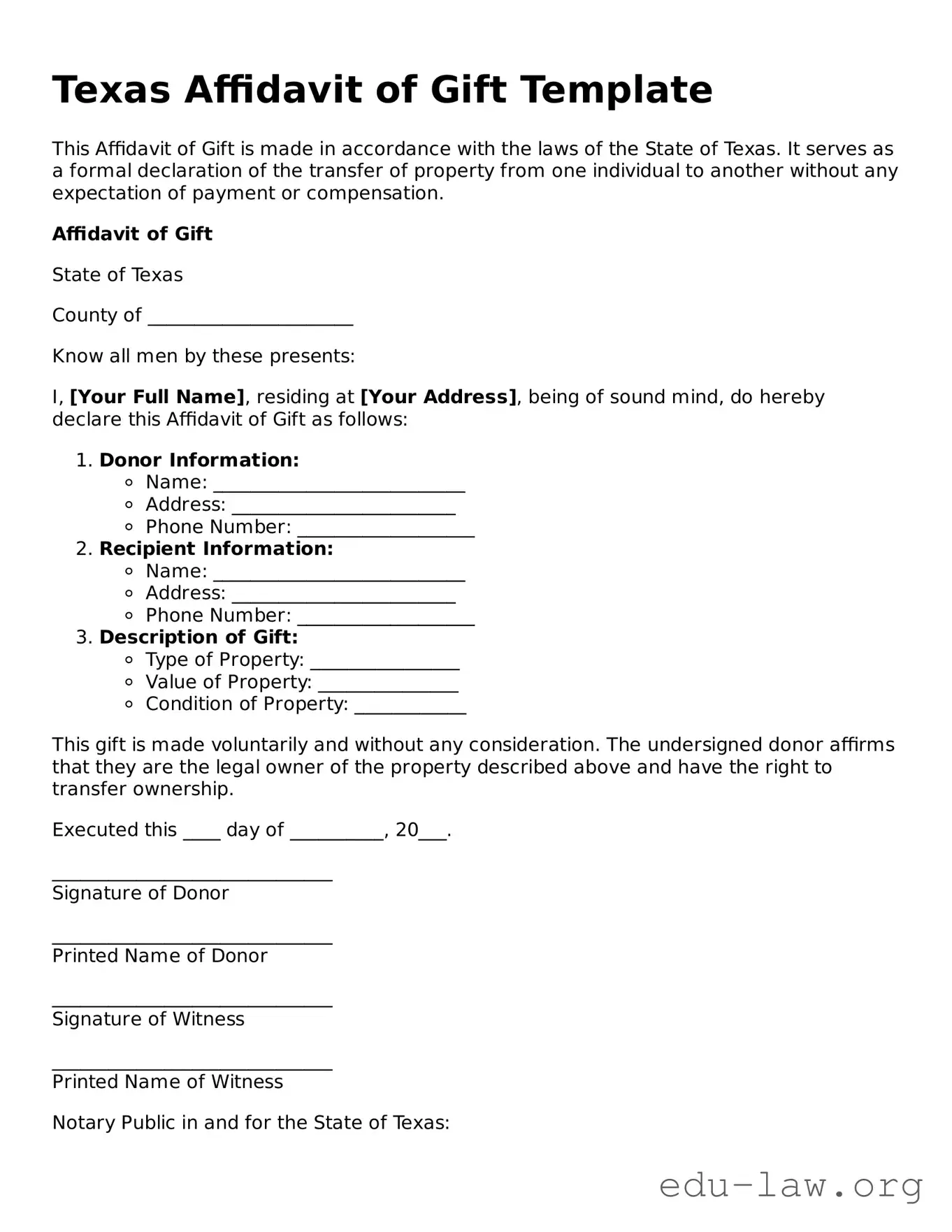
The Texas Affidavit of Gift form serves as a crucial document for individuals wishing to transfer ownership of property without the exchange of monetary compensation. This form is particularly relevant in situations where a donor intends to give real estate or personal property to a recipient, often a family member or friend. It outlines the specifics of the gift, including a detailed description of the property being transferred, the identities of both the donor and the recipient, and the intent behind the gift. Additionally, the form typically requires the signatures of both parties, as well as a notary public to verify the authenticity of the signatures. By utilizing this form, donors can ensure that their intentions are legally recognized, while recipients can establish clear ownership of the gifted property. Understanding the nuances of the Texas Affidavit of Gift form is essential for anyone involved in property transfer, as it helps to prevent future disputes and provides a clear record of the transaction.
Texas Affidavit of Gift Template
This Affidavit of Gift is made in accordance with the laws of the State of Texas. It serves as a formal declaration of the transfer of property from one individual to another without any expectation of payment or compensation.
Affidavit of Gift
State of Texas
County of ______________________
Know all men by these presents:
I, [Your Full Name], residing at [Your Address], being of sound mind, do hereby declare this Affidavit of Gift as follows:
This gift is made voluntarily and without any consideration. The undersigned donor affirms that they are the legal owner of the property described above and have the right to transfer ownership.
Executed this ____ day of __________, 20___.
______________________________
Signature of Donor
______________________________
Printed Name of Donor
______________________________
Signature of Witness
______________________________
Printed Name of Witness
Notary Public in and for the State of Texas:
______________________________
Signature of Notary
My Commission Expires: _______________
| Fact Name | Description |
|---|---|
| Purpose | The Texas Affidavit of Gift form is used to document the transfer of property as a gift from one individual to another. |
| Governing Law | This form is governed by Texas Property Code, specifically sections related to gifts and property transfers. |
| Signature Requirement | The form must be signed by both the donor (the person giving the gift) and the recipient (the person receiving the gift). |
| Notarization | It is recommended, though not always required, that the affidavit be notarized to ensure its validity. |
| Tax Implications | Gifts may have tax implications for both the donor and recipient, potentially affecting federal gift tax obligations. |
| Property Types | The affidavit can be used for various types of property, including real estate, vehicles, and personal belongings. |
| Record Keeping | It is advisable for both parties to keep a copy of the signed affidavit for their records. |
| Revocation | A gift made via this affidavit can be revoked by the donor at any time before the recipient takes possession of the property. |
| Legal Advice | Consulting a legal professional is recommended for individuals unfamiliar with property transfer laws and potential liabilities. |
Filling out the Texas Affidavit of Gift form requires careful attention to detail. Once you have completed the form, you will need to submit it according to the instructions provided by the relevant authorities.
What is the Texas Affidavit of Gift form?
The Texas Affidavit of Gift form is a legal document used to transfer ownership of property or assets as a gift without any expectation of payment or compensation. This form is particularly useful for individuals who wish to give property to family members or friends, ensuring that the transfer is documented and recognized by authorities.
Who needs to use the Texas Affidavit of Gift form?
What information is required to complete the form?
Is the Texas Affidavit of Gift form legally binding?
Do I need to have the form notarized?
Are there any tax implications associated with gifting property in Texas?
Can the Texas Affidavit of Gift form be revoked?
Where can I obtain the Texas Affidavit of Gift form?
Incomplete Information: One common mistake is failing to provide all required information. Every section of the form needs to be filled out completely to avoid delays in processing.
Incorrect Signatures: Signatures must match the names provided on the form. A mismatch can lead to complications. Make sure everyone involved signs where necessary.
Not Notarizing: The form requires notarization. Skipping this step can invalidate the affidavit. Ensure that you have a notary public witness your signature.
Missing Dates: Dates are crucial for legal documents. Omitting the date of the gift can create confusion. Always double-check that you’ve included all relevant dates.
Incorrect Property Description: When describing the gift, be as detailed as possible. Vague descriptions can lead to misunderstandings or disputes later on.
Not Keeping Copies: After submitting the affidavit, it’s important to keep a copy for your records. This can be helpful in case any issues arise in the future.
The Texas Affidavit of Gift form is often used in conjunction with several other documents to ensure a smooth transfer of property or assets. Below is a list of commonly associated forms and documents, each serving a specific purpose in the gifting process.
Each of these documents plays a crucial role in ensuring that the gifting process is legally sound and that all parties are protected. Properly preparing and executing these forms can help avoid potential disputes or complications in the future.
The Texas Affidavit of Gift form shares similarities with the Bill of Sale, a document used to transfer ownership of personal property from one party to another. Both documents serve as proof of the transaction and detail the items being transferred. While a Bill of Sale typically involves a monetary exchange, the Affidavit of Gift specifically pertains to gifts, emphasizing that no payment is involved in the transfer of ownership.
Another document that resembles the Affidavit of Gift is the Warranty Deed. A Warranty Deed is utilized in real estate transactions to guarantee that the seller has clear title to the property being transferred. Like the Affidavit of Gift, it provides assurance to the recipient regarding the ownership of the property. Both documents require the signature of the giver or seller, affirming the legitimacy of the transfer.
The Quitclaim Deed is also similar to the Affidavit of Gift, particularly in its function of transferring property rights. A Quitclaim Deed conveys whatever interest the grantor has in the property without making any warranties about the title. In both cases, the documents formalize the transfer of property, although the Quitclaim Deed may not provide the same level of assurance regarding ownership as the Warranty Deed.
The Gift Tax Return (Form 709) is another document that aligns with the Affidavit of Gift. This form is used to report gifts that exceed the annual exclusion limit set by the IRS. While the Affidavit of Gift serves to document the transfer of ownership without payment, the Gift Tax Return ensures compliance with tax regulations. Both documents are essential in the context of gift-giving and can impact tax obligations.
The Power of Attorney (POA) document shares some characteristics with the Affidavit of Gift, especially in terms of authority transfer. A POA allows one person to act on behalf of another in legal or financial matters. Although the purposes differ, both documents involve the transfer of rights and responsibilities, requiring clear and explicit consent from the parties involved.
The Trust Agreement is another related document. A Trust Agreement establishes a fiduciary relationship where one party holds property for the benefit of another. Similar to the Affidavit of Gift, it involves the transfer of ownership but typically includes ongoing management of the property by the trustee. Both documents require careful consideration of the intentions of the parties involved.
The Assignment of Benefits document also bears resemblance to the Affidavit of Gift. This document allows a person to transfer their rights to benefits, such as insurance claims, to another party. Like the Affidavit of Gift, it formalizes a transfer of rights without a financial exchange. Both documents require clear identification of the parties and the items or benefits being transferred.
The Donation Receipt is another document that parallels the Affidavit of Gift. This receipt is provided to the donor after they have given a gift, often to a charitable organization. It serves as proof of the donation for tax purposes. Both documents confirm the transfer of ownership and can have implications for tax deductions, reinforcing the importance of proper documentation in gift transactions.
Lastly, the Release of Liability form is similar in that it involves the transfer of rights, albeit in a different context. This document releases one party from liability for certain actions or events. While the Affidavit of Gift focuses on transferring ownership, both documents require clear consent and understanding from all parties involved to ensure that rights are properly conveyed.
When filling out the Texas Affidavit of Gift form, it's important to follow certain guidelines to ensure accuracy and compliance. Here’s a list of things you should and shouldn’t do:
The Texas Affidavit of Gift form is a document often used in the transfer of property or assets without the exchange of money. However, several misconceptions surround this form. Understanding these misconceptions can help individuals navigate the process more effectively.
By addressing these misconceptions, individuals can make informed decisions regarding the Texas Affidavit of Gift form and ensure that their intentions are clearly documented and legally recognized.
When filling out and using the Texas Affidavit of Gift form, consider the following key takeaways: