The Texas Affidavit of Correction serves as a vital tool for individuals seeking to amend or clarify information in public records. This form is particularly useful when errors, such as typographical mistakes or inaccuracies, appear in legal documents like property deeds or marriage certificates. By submitting this affidavit, individuals can officially correct these discrepancies, ensuring that the public record accurately reflects the intended information. The process typically involves providing specific details about the original document, including the nature of the error and the correct information that should replace it. Notably, the affidavit must be signed in the presence of a notary public, which adds an element of authenticity to the corrections being made. This form not only facilitates the rectification of mistakes but also helps prevent potential legal complications that could arise from incorrect public records. Understanding the nuances of the Texas Affidavit of Correction is essential for anyone looking to maintain the integrity of their legal documents and ensure that all pertinent information is accurately represented.
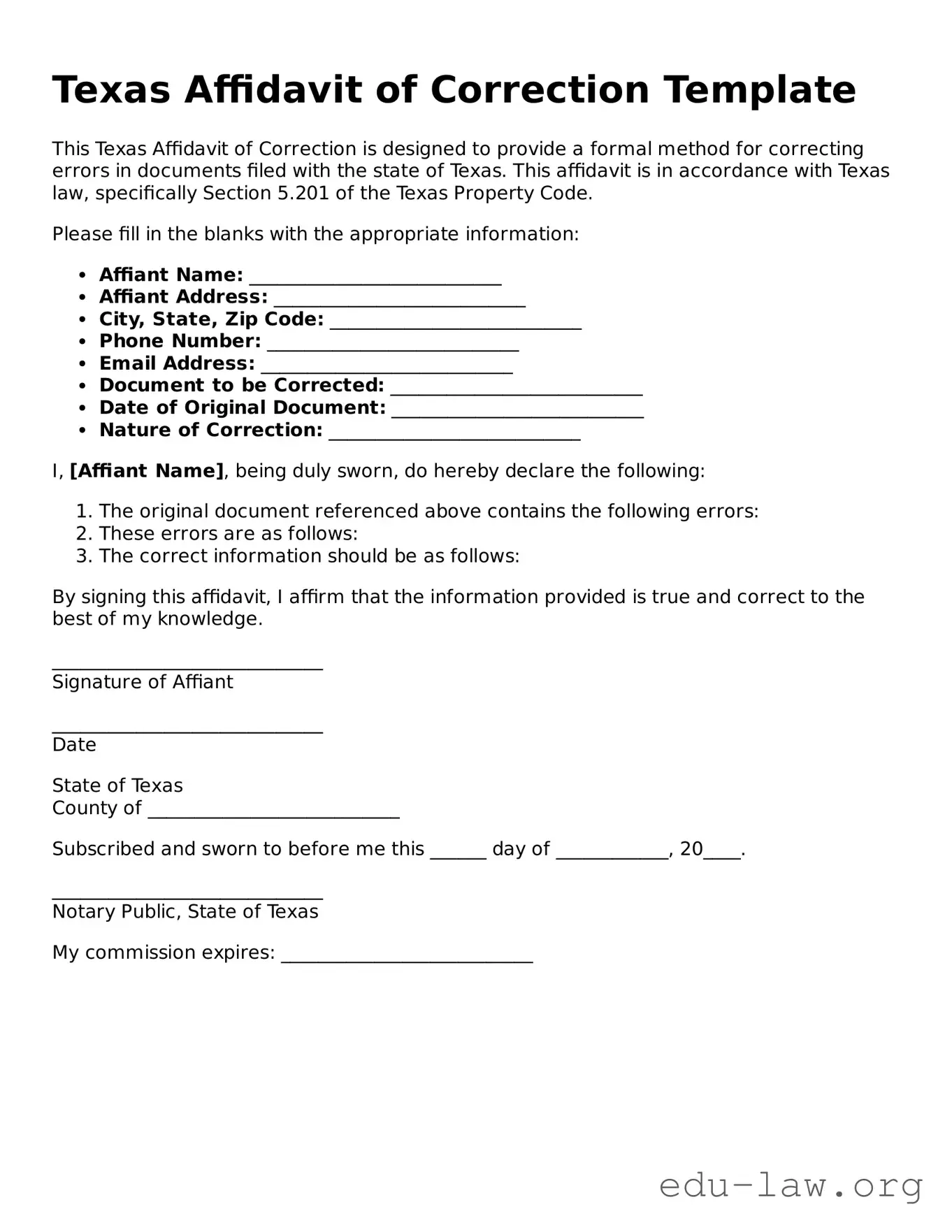
Texas Affidavit of Correction Template
This Texas Affidavit of Correction is designed to provide a formal method for correcting errors in documents filed with the state of Texas. This affidavit is in accordance with Texas law, specifically Section 5.201 of the Texas Property Code.
Please fill in the blanks with the appropriate information:
I, [Affiant Name], being duly sworn, do hereby declare the following:
By signing this affidavit, I affirm that the information provided is true and correct to the best of my knowledge.
_____________________________
Signature of Affiant
_____________________________
Date
State of Texas
County of ___________________________
Subscribed and sworn to before me this ______ day of ____________, 20____.
_____________________________
Notary Public, State of Texas
My commission expires: ___________________________
| Fact Name | Description |
|---|---|
| Purpose | The Texas Affidavit of Correction is used to correct mistakes in recorded documents, such as deeds or mortgages. |
| Governing Law | This form is governed by Texas Property Code, Section 5.027, which outlines the process for correcting errors in public records. |
| Eligibility | Any individual or entity that has made a mistake in a recorded document can file this affidavit to correct the error. |
| Filing Requirements | The affidavit must be signed in the presence of a notary public and then filed with the county clerk where the original document was recorded. |
| Types of Errors | Common errors include misspellings, incorrect legal descriptions, or wrong dates that need to be rectified. |
| Impact | Filing an Affidavit of Correction helps ensure that public records accurately reflect the true intentions of the parties involved. |
After obtaining the Texas Affidavit of Correction form, you are ready to provide the necessary information. Completing this form accurately is essential for ensuring that the corrections are recognized and processed correctly.
What is the Texas Affidavit of Correction form?
The Texas Affidavit of Correction form is a legal document used to correct clerical errors in public records, such as property deeds or other official documents. This form allows individuals to formally address mistakes, ensuring that the records accurately reflect the intended information.
Who can file an Affidavit of Correction in Texas?
Any individual or entity that identifies a clerical error in a public record can file an Affidavit of Correction. This includes property owners, their representatives, or any party with a vested interest in the accuracy of the record.
What types of errors can be corrected using this form?
The form is designed to correct typographical errors, incorrect names, wrong legal descriptions, and other minor mistakes that do not alter the intent of the original document. It is important to note that substantive changes to the content typically require a different legal process.
How do I complete the Texas Affidavit of Correction form?
To complete the form, provide the necessary details about the original document, including the type of document, date of recording, and the specific errors to be corrected. Ensure that all information is accurate and clearly stated to avoid further issues.
Where do I file the Affidavit of Correction?
The completed Affidavit of Correction must be filed with the county clerk’s office where the original document was recorded. It is advisable to check with the local office for any specific filing requirements or fees that may apply.
Is there a fee associated with filing the Affidavit of Correction?
Yes, there is typically a filing fee associated with submitting the Affidavit of Correction. The fee varies by county, so it is important to confirm the exact amount with the local county clerk's office before filing.
Do I need to have the Affidavit of Correction notarized?
Yes, the Affidavit of Correction must be signed in the presence of a notary public. This step is crucial to ensure the document is legally valid and can be accepted by the county clerk's office.
How long does it take for the correction to be processed?
The processing time can vary by county. Generally, once the Affidavit of Correction is filed, it may take a few days to a few weeks for the correction to be officially recorded. It is advisable to follow up with the county clerk’s office if you have not received confirmation within a reasonable timeframe.
What happens if I do not correct the error?
Failing to correct an error can lead to complications, such as disputes over property ownership or issues with legal transactions. It is in your best interest to ensure that all public records are accurate to avoid potential legal challenges in the future.
Incomplete Information: Failing to provide all required information can lead to delays. Ensure that every section of the form is filled out completely.
Incorrect Notarization: The affidavit must be notarized correctly. Some individuals forget to have their signature witnessed by a notary public, which can invalidate the document.
Missing Signatures: Omitting a signature is a common error. The form must be signed by all relevant parties to be considered valid.
Using Incorrect Dates: Entering wrong or outdated dates can create confusion. It is essential to double-check all dates for accuracy.
Not Following Instructions: Each form comes with specific instructions. Ignoring these can result in mistakes that may require resubmission.
Providing Insufficient Evidence: Supporting documents may be necessary to validate the corrections. Failing to attach these can lead to rejection of the affidavit.
Incorrect Filing Fees: Not including the correct filing fee can delay processing. Verify the current fee schedule before submitting the form.
Not Keeping Copies: Forgetting to make copies of the completed form and any attachments can be a mistake. Keeping records is essential for future reference.
The Texas Affidavit of Correction is a useful document for rectifying errors in public records. When utilizing this form, several other documents may also be required or beneficial for ensuring a comprehensive correction process. Below is a list of commonly used forms and documents that accompany the Texas Affidavit of Correction.
Understanding these documents can streamline the correction process and ensure that all necessary steps are taken to rectify any inaccuracies. Proper documentation is essential for maintaining clear and accurate public records.
The Texas Affidavit of Correction is similar to the Affidavit of Heirship, which is used to establish the heirs of a deceased person. This document helps clarify ownership of property after someone passes away. Like the Affidavit of Correction, it requires the signature of a notary public and must be filed with the appropriate county office. Both documents aim to provide clarity and rectify previous inaccuracies in public records.
Another document that shares similarities is the Correction Deed. This form is utilized to correct mistakes in a property deed, such as typographical errors or incorrect legal descriptions. Just as the Affidavit of Correction serves to amend inaccuracies, the Correction Deed ensures that the property records reflect the true intent of the parties involved. Both documents require proper notarization and must be filed with the county clerk’s office to be effective.
The Texas Quitclaim Deed also resembles the Affidavit of Correction in that it transfers ownership without guaranteeing the title's validity. This document is often used to clear up title issues or to transfer property between family members. While the Quitclaim Deed serves to transfer rights, the Affidavit of Correction focuses on amending existing records. Both documents are essential for maintaining accurate property records and resolving disputes.
The Affidavit of Title is another document that serves a similar purpose. It is often used in real estate transactions to affirm the seller's ownership of the property and to disclose any liens or encumbrances. This affidavit helps ensure that buyers are fully informed before completing a transaction. Like the Affidavit of Correction, it provides assurance and clarity regarding property ownership and title issues.
The Declaration of Trust is also akin to the Affidavit of Correction. This document outlines the terms of a trust and identifies the trustee and beneficiaries. If there are inaccuracies in the trust documentation, an Affidavit of Correction can be used to amend those records. Both documents help clarify intentions and ensure that all parties are aware of their rights and responsibilities.
Lastly, the Affidavit of Identity is similar in that it serves to confirm a person's identity, especially in situations where legal documents may contain errors. This affidavit can be used to rectify discrepancies in names or other identifying information. Both the Affidavit of Identity and the Affidavit of Correction aim to ensure that public records accurately reflect the truth, thereby preventing future legal complications.
When filling out the Texas Affidavit of Correction form, it’s important to follow certain guidelines to ensure accuracy and compliance. Here are some dos and don’ts to consider:
By following these guidelines, you can help ensure that your affidavit is processed smoothly and without delays.
The Texas Affidavit of Correction form is often misunderstood. Here are ten common misconceptions about this legal document:
The Affidavit of Correction is specifically designed for correcting clerical errors in certain types of documents, such as property records. It cannot be used for all documents.
Only individuals with a vested interest in the document, such as the original signers or their legal representatives, are authorized to file this affidavit.
Filing the affidavit does not automatically correct the error. The correction must be acknowledged and accepted by the appropriate authority.
The Affidavit of Correction serves a different purpose. It clarifies or corrects specific errors without re-recording the entire document.
Only specific types of errors, such as typographical mistakes or incorrect legal descriptions, can be corrected. More significant issues may require different legal remedies.
Filing fees may apply, depending on the jurisdiction. It's important to check with the local recording office for any associated costs.
While notarization is common, it is not a strict requirement in all cases. However, having the document notarized can add an extra layer of authenticity.
The affidavit can be subject to challenge if there are claims that the correction was made in bad faith or if the error was not clerical in nature.
The Affidavit of Correction cannot be used to transfer ownership. It is solely for correcting clerical errors, not for altering legal rights.
While the form may seem straightforward, it is essential to gather all necessary information and ensure accuracy before submission to avoid further complications.
Filling out and using the Texas Affidavit of Correction form can be straightforward if you follow these key takeaways:
By following these steps, you can effectively navigate the process of correcting errors in Texas public records.