The Teacher Letter Recommendation form plays a crucial role in the academic and professional advancement of students. This form typically includes sections for the teacher's personal information, the student's details, and specific areas where the teacher can provide insights into the student’s character and abilities. It often requires the teacher to assess the student's academic performance, work ethic, and social skills. Furthermore, the form may prompt teachers to highlight any particular achievements or challenges the student has faced, providing a comprehensive view of the student's capabilities. By capturing these elements, the form serves as a valuable tool for colleges, scholarship committees, and other organizations that rely on personal recommendations to evaluate candidates. Overall, the Teacher Letter Recommendation form is designed to facilitate a well-rounded portrayal of the student, aiding in their future opportunities.
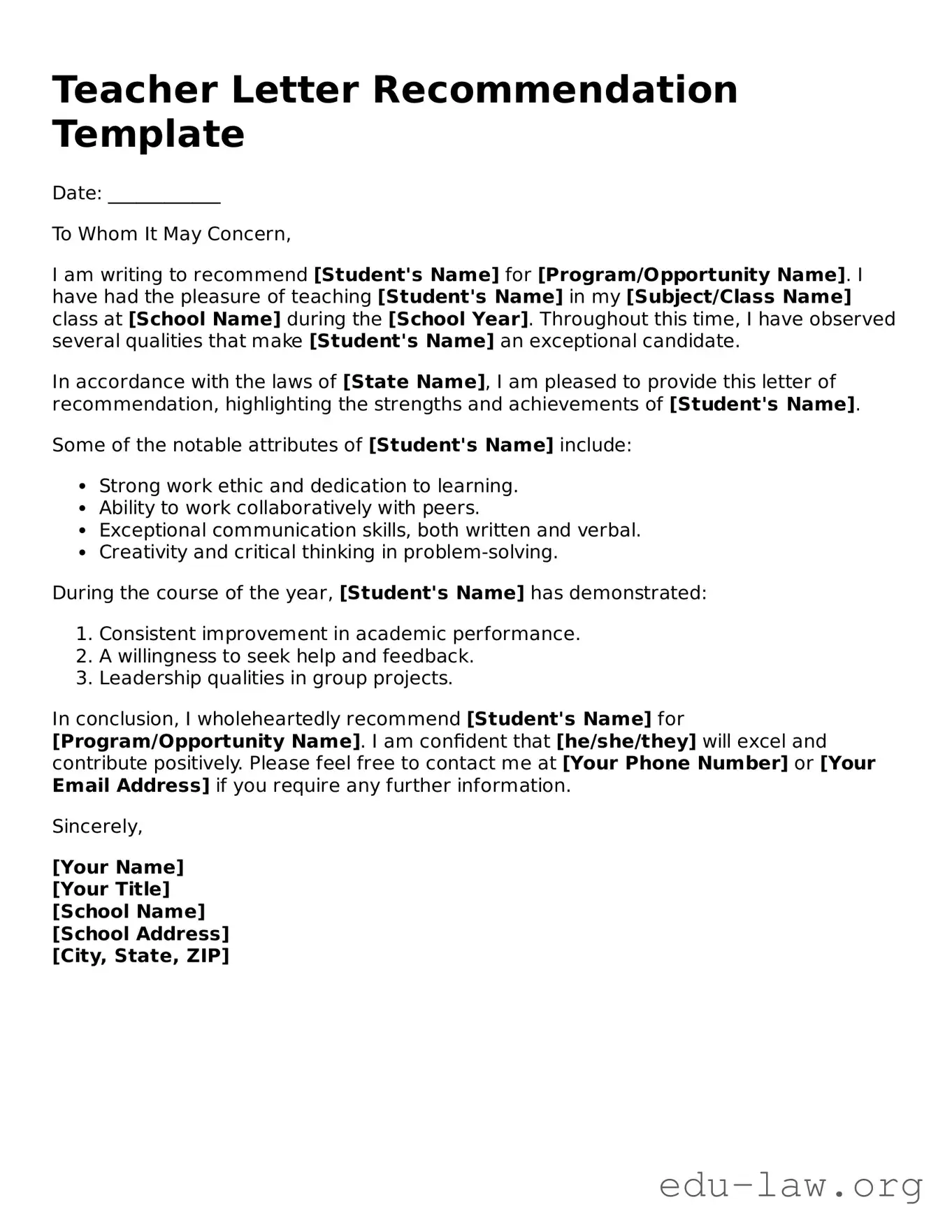
Teacher Letter Recommendation Template
Date: ____________
To Whom It May Concern,
I am writing to recommend [Student's Name] for [Program/Opportunity Name]. I have had the pleasure of teaching [Student's Name] in my [Subject/Class Name] class at [School Name] during the [School Year]. Throughout this time, I have observed several qualities that make [Student's Name] an exceptional candidate.
In accordance with the laws of [State Name], I am pleased to provide this letter of recommendation, highlighting the strengths and achievements of [Student's Name].
Some of the notable attributes of [Student's Name] include:
During the course of the year, [Student's Name] has demonstrated:
In conclusion, I wholeheartedly recommend [Student's Name] for [Program/Opportunity Name]. I am confident that [he/she/they] will excel and contribute positively. Please feel free to contact me at [Your Phone Number] or [Your Email Address] if you require any further information.
Sincerely,
[Your Name]
[Your Title]
[School Name]
[School Address]
[City, State, ZIP]
| Fact Name | Description |
|---|---|
| Purpose | The Teacher Letter Recommendation form is used to provide a written endorsement of a student's abilities and character for college or job applications. |
| Content | The form typically includes sections for the teacher to discuss the student's academic performance, personal qualities, and specific examples of their achievements. |
| Confidentiality | In some cases, the recommendation may be confidential, meaning the student will not see it. This can enhance the honesty of the feedback. |
| Submission Process | Teachers usually submit the form directly to the institution or organization requesting it, often through an online portal or by mail. |
| State-Specific Forms | Some states have specific forms or guidelines for teacher recommendations, often governed by education department regulations. |
| Timing | It's important to request the recommendation well in advance of deadlines to allow teachers sufficient time to write a thoughtful letter. |
| Governing Laws | In California, for example, Education Code § 49061 governs the confidentiality of student records, which may impact recommendation letters. |
| Formatting Guidelines | Teachers are often encouraged to use a standard format, including a header with their contact information and a closing signature. |
| Importance | A strong recommendation can significantly enhance a student's application, providing insights that grades alone may not convey. |
After obtaining the Teacher Letter Recommendation form, you will need to complete it accurately. Ensure that all required sections are filled out clearly. Follow the steps below to complete the form.
What is the Teacher Letter Recommendation form?
The Teacher Letter Recommendation form is a document used by students to request a letter of recommendation from their teachers. This letter is often required for college applications, scholarship opportunities, or other educational programs. It provides insight into the student’s academic abilities, character, and potential for success in further education.
Who should I ask to write my recommendation letter?
It is advisable to choose a teacher who knows you well and can speak positively about your skills and character. Ideally, this should be someone from a subject area relevant to your future studies or someone who has witnessed your growth and achievements over time. Consider teachers from your junior or senior year, as they will have the most recent perspective on your capabilities.
How much time should I give my teacher to write the letter?
It’s best to give your teacher at least two to four weeks to write the letter. This timeframe allows them to reflect on your strengths and craft a thoughtful recommendation. Be sure to communicate your deadlines clearly and check in with them as the date approaches, while also being respectful of their time.
What information should I provide to my teacher?
When requesting a recommendation, provide your teacher with relevant details to help them write a personalized letter. This can include your resume, a list of your achievements, extracurricular activities, and your goals for the future. You might also want to share why you are applying to a specific program or school, as this context can help them tailor their letter.
Can I see the letter before it is submitted?
Typically, recommendation letters are confidential, meaning that you may not have the opportunity to read them before they are submitted. This confidentiality allows teachers to provide honest and candid assessments of your abilities. However, you can ask your teacher if they are comfortable sharing a draft with you. Respect their decision if they choose not to do so.
What should I do if my teacher declines to write my letter?
If a teacher declines your request, do not take it personally. There could be various reasons, such as time constraints or feeling unqualified to write a strong recommendation. In this case, consider asking another teacher or mentor who can provide a positive endorsement of your skills and character. Always express gratitude to those who consider your request, regardless of their decision.
How do I submit the Teacher Letter Recommendation form?
The submission process can vary based on the requirements of the institution or program you are applying to. Typically, you will need to provide your teacher with the form and any specific instructions regarding submission. This may involve mailing the letter directly to the institution or submitting it online through an application portal. Ensure you confirm the submission method with your teacher to avoid any confusion.
What should I do after my teacher submits the letter?
Once your teacher has submitted the letter, it’s courteous to follow up with a thank-you note or email. Express your appreciation for their time and effort in supporting your application. Keeping your teachers informed about the outcome of your applications can also strengthen your relationship and encourage them to assist you in the future.
Neglecting to Provide Specific Examples: Many individuals fail to include specific instances that highlight the teacher's strengths or contributions. Instead of general statements, detailed anecdotes can significantly enhance the recommendation.
Using Generic Language: A common mistake is relying on clichés or overly broad descriptions. Phrases like "great teacher" or "very dedicated" do not convey the unique qualities of the teacher. Tailoring the language to reflect the teacher's specific attributes makes a stronger impact.
Ignoring the Audience: It's crucial to consider who will read the recommendation. Different institutions or programs may value different qualities. Failing to align the content with the expectations of the audience can weaken the recommendation's effectiveness.
Overlooking Proofreading: Errors in spelling, grammar, or punctuation can detract from the professionalism of the letter. A lack of attention to detail may lead to misunderstandings about the teacher's abilities or commitment.
The Teacher Letter Recommendation form is a crucial document in the educational landscape, especially for students applying to colleges, scholarships, or specialized programs. Alongside this form, several other documents are commonly utilized to provide a comprehensive view of a student's qualifications and character. Below is a list of these documents, each serving a specific purpose in the recommendation process.
Each of these documents plays a vital role in presenting a holistic view of a student’s qualifications. Together, they help educators and admissions committees make informed decisions regarding a student’s future opportunities.
The Teacher Letter of Recommendation form shares similarities with the College Application Essay. Both documents provide insight into the individual behind the application. The College Application Essay allows students to express their personal stories, experiences, and aspirations. In contrast, the Teacher Letter of Recommendation offers an external perspective, showcasing the student’s abilities, character, and contributions in a classroom setting. Together, they create a fuller picture of the applicant, emphasizing not just academic achievements but also personal growth and potential.
Another document akin to the Teacher Letter of Recommendation is the Resume. While a resume lists achievements and experiences in a structured format, the Teacher Letter provides a narrative that highlights a student's qualities in a more personalized manner. The resume showcases skills, extracurricular activities, and work history, whereas the recommendation letter can delve into specific instances that demonstrate a student's dedication, creativity, or leadership. Both documents serve to complement each other, enhancing the overall application by providing different lenses through which to view the applicant.
Lastly, the Scholarship Application often requires letters of recommendation, which bear a close resemblance to the Teacher Letter of Recommendation. Both types of letters aim to vouch for the applicant’s qualifications and character. However, scholarship letters may focus more on financial need and potential for success in the context of the scholarship’s goals. The Teacher Letter, on the other hand, emphasizes the student’s academic performance and interpersonal skills. Both documents, however, play a crucial role in influencing decisions made by committees, whether for admissions or funding.
When filling out the Teacher Letter Recommendation form, it's important to follow certain guidelines to ensure the process goes smoothly. Here are some things you should and shouldn't do:
Many people hold misconceptions about the Teacher Letter Recommendation form. Understanding these misconceptions can help clarify the purpose and process of obtaining a recommendation. Here are seven common misconceptions:
All teachers are qualified to write a recommendation. While many teachers can provide valuable insights, not every teacher may be familiar with the specific requirements of a recommendation letter.
Recommendations only matter for college applications. In reality, recommendation letters can be important for various opportunities, including scholarships, internships, and job applications.
Teachers have unlimited time to write recommendations. Teachers often have numerous responsibilities. It’s essential to give them ample time to craft a thoughtful letter.
A generic recommendation is sufficient. A personalized letter that reflects the unique strengths and experiences of the student is far more impactful than a generic one.
Students should not discuss their goals with teachers. Open communication about aspirations can help teachers write more relevant and supportive recommendations.
All recommendation letters are the same. Each letter varies based on the student’s experiences and the teacher’s perspective, making them unique and tailored.
Once submitted, a recommendation letter cannot be changed. In some cases, if there’s a significant issue, a teacher may be willing to revise the letter upon request.
By addressing these misconceptions, students can approach the recommendation process with a clearer understanding and greater confidence.
When it comes to filling out and utilizing the Teacher Letter Recommendation form, several important considerations can enhance its effectiveness. Below are key takeaways to keep in mind:
By keeping these points in mind, students can navigate the Teacher Letter Recommendation process more effectively, ensuring that their strengths are communicated clearly and persuasively.