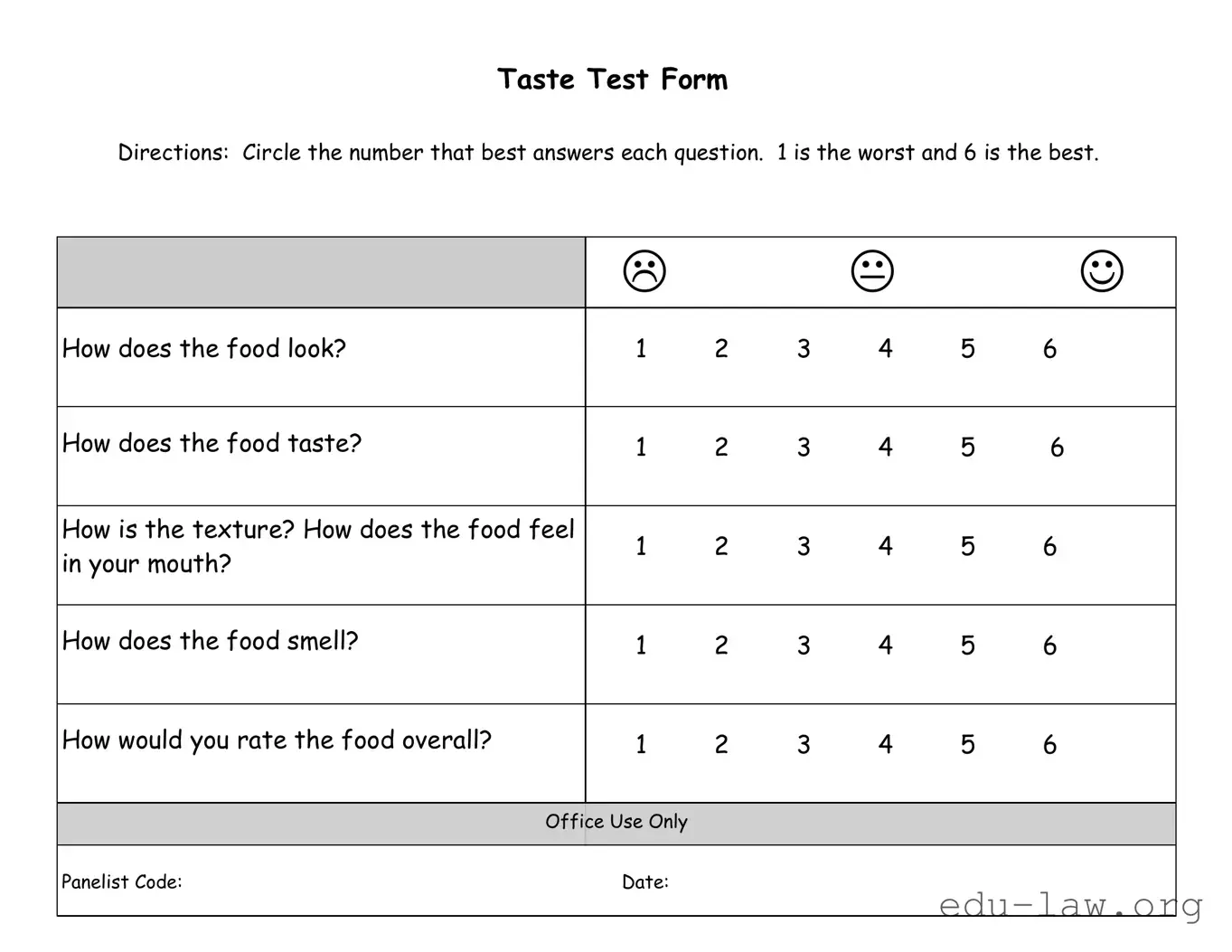
The Taste Test form is a valuable tool for gathering feedback on food products. It allows individuals to provide their opinions on various aspects of food, from appearance to taste, texture, and aroma. Each question is designed to elicit a specific response, helping to create a comprehensive understanding of the overall experience. Participants are asked to rate their impressions on a scale of 1 to 6, with 1 indicating the least favorable response and 6 representing the most favorable. This structured approach ensures that feedback is clear and consistent, making it easier for teams to analyze the results. Additionally, there is space for office use, where panelist codes and dates can be recorded, ensuring that the feedback can be tracked and referenced in the future. By utilizing this form, food producers can gain insights that may lead to improvements in their products, ultimately enhancing customer satisfaction.
TASTE TEST FORM
Directions: Circle the number that best answers each question. 1 is the worst and 6 is the best.
|
|
|
|
|
|
|
|
How does the food look? |
|
1 |
2 |
3 |
4 |
5 |
6 |
|
|
|
|
|
|
|
|
How does the food taste? |
|
1 |
2 |
3 |
4 |
5 |
6 |
|
|
|
|
|
|
|
|
How is the texture? How does the food feel |
1 |
2 |
3 |
4 |
5 |
6 |
|
in your mouth? |
|
||||||
|
|
|
|
|
|
|
|
|
|
|
|
|
|
|
|
How does the food smell? |
|
1 |
2 |
3 |
4 |
5 |
6 |
|
|
|
|
|
|
|
|
How would you rate the food overall? |
|
1 |
2 |
3 |
4 |
5 |
6 |
|
|
|
|
|
|
|
|
|
Office Use Only |
|
|
|
|
|
|
|
|
|
|
|
|
|
|
Panelist Code: |
|
Date: |
|
|
|
|
|
|
|
|
|
|
|
|
|
| Fact Name | Details |
|---|---|
| Purpose | The Taste Test form is designed to gather feedback on food products through a rating system. |
| Rating Scale | Participants use a scale from 1 to 6, where 1 indicates the worst experience and 6 indicates the best. |
| Evaluation Criteria | Participants assess the food based on appearance, taste, texture, smell, and overall impression. |
| Panelist Code | Each participant is assigned a unique panelist code for tracking responses while maintaining anonymity. |
| Date of Evaluation | The form includes a space for the date when the taste test is conducted, ensuring accurate record-keeping. |
| State-Specific Laws | In some states, food testing and safety regulations may apply. For example, California's Food and Agricultural Code governs food safety practices. |
Once you have the Taste Test form in front of you, take a moment to gather your thoughts about the food you are evaluating. You will be asked to rate various aspects of the food on a scale from 1 to 6. A score of 1 indicates the lowest quality, while a score of 6 indicates the highest. Your feedback is valuable and will help in assessing the food product.
What is the purpose of the Taste Test form?
The Taste Test form is designed to gather feedback on food items. Participants evaluate various aspects of the food, including appearance, taste, texture, smell, and overall satisfaction. This information helps food manufacturers and chefs understand consumer preferences and improve their products.
How do I fill out the Taste Test form?
To complete the Taste Test form, simply circle the number that best represents your opinion for each question. The scale ranges from 1 to 6, where 1 indicates the worst experience and 6 signifies the best. Take your time to assess each category carefully, as your feedback is valuable.
Can I provide additional comments on the Taste Test form?
The current version of the Taste Test form does not include a section for additional comments. However, if you have specific feedback or suggestions, consider reaching out to the organization conducting the taste test. They may appreciate your insights and could provide a platform for further discussion.
Who will see my responses on the Taste Test form?
Your responses will be kept confidential and used solely for the purpose of evaluating the food items. The information collected may be aggregated to analyze trends and preferences, but individual responses will not be shared publicly or used for any other purpose.
What should I do if I encounter an issue while filling out the form?
If you experience any difficulties while completing the Taste Test form, don't hesitate to ask for assistance. A staff member or organizer will be available to help clarify any questions or resolve any issues you may face during the process.
Ignoring the Instructions: Many individuals overlook the clear directions provided at the top of the form. Failing to circle a number for each question can lead to incomplete submissions.
Using Inconsistent Ratings: Some people rate the food differently across various questions without a clear rationale. Consistency is key for accurate feedback.
Not Considering All Aspects: Participants sometimes focus solely on taste and neglect other important factors like appearance, texture, and smell. Each question is designed to gather comprehensive feedback.
Failing to Use the Full Rating Scale: A common mistake is sticking to the middle of the scale (3 or 4). This does not provide a clear picture of opinions and can skew the results.
Rushing the Process: Some individuals fill out the form too quickly, leading to hasty judgments. Taking time to reflect on each aspect ensures more thoughtful responses.
Neglecting the Panelist Code: Forgetting to include the panelist code can hinder the ability to track feedback accurately. Always ensure this field is completed.
Overlooking the Date: Failing to write the date on the form can create confusion later. Each submission should be time-stamped for reference.
Not Providing Additional Comments: Some forms allow for comments. Skipping this section can miss the opportunity to elaborate on ratings and provide valuable insights.
The Taste Test form is an essential tool for gathering feedback on food products. However, several other forms and documents complement it, enhancing the overall evaluation process. Below is a list of these related documents, each serving a unique purpose in the assessment of food quality.
These documents collectively enhance the effectiveness of the Taste Test form, facilitating a thorough and comprehensive evaluation of food products. Proper use of these forms can lead to valuable insights and improved product quality.
The Taste Test form shares similarities with the Customer Satisfaction Survey. Both documents aim to gather feedback from individuals about their experiences. The Customer Satisfaction Survey typically includes questions regarding various aspects of a product or service, allowing respondents to rate their satisfaction on a scale. Just like the Taste Test form, it uses a numerical scale to quantify opinions, making it easy to analyze the data collected.
Another document akin to the Taste Test form is the Product Review Form. This form is designed for consumers to evaluate a product after use. Similar to the Taste Test form, it requests ratings on different attributes, such as quality and usability. Both forms encourage detailed feedback, enabling companies to understand consumer preferences and improve their offerings.
The Feedback Form for Events is also comparable. This document collects attendees' impressions of an event, focusing on aspects like organization, content, and overall enjoyment. Like the Taste Test form, it employs a rating scale for respondents to express their opinions succinctly. The feedback gathered can help organizers enhance future events based on participant insights.
Another related document is the Employee Evaluation Form. This form assesses an employee's performance and includes various criteria for evaluation. Both the Employee Evaluation Form and the Taste Test form use a rating system to provide clarity on performance or quality. This structured approach helps in identifying strengths and areas for improvement.
The Quality Assurance Checklist is similar in its purpose of ensuring standards are met. This document often includes a series of criteria that products must meet, with ratings assigned to each item. Both forms aim to maintain quality, whether in food products or services, by providing a clear framework for evaluation and feedback.
The Usability Testing Form also bears resemblance to the Taste Test form. This document is used to assess how easily users can interact with a product or service. Like the Taste Test form, it often includes a rating scale to gauge user experience. The insights gained from both forms can drive improvements in product design and functionality.
Lastly, the Sensory Evaluation Form is closely related. This document is specifically designed to assess the sensory attributes of food products, such as taste, smell, and texture. Similar to the Taste Test form, it gathers qualitative data through a structured rating system. Both forms focus on understanding consumer perceptions to enhance product quality and appeal.
When filling out the Taste Test form, it's important to provide accurate and thoughtful feedback. Here are some guidelines to help you navigate the process effectively.
By following these do's and don'ts, you can ensure that your feedback is both helpful and meaningful.
Understanding the Taste Test form is essential for providing valuable feedback on food products. However, several misconceptions can lead to confusion. Here are eight common misunderstandings:
By clearing up these misconceptions, everyone can contribute to the food evaluation process more effectively. Your feedback matters!
Filling out the Taste Test form can be a straightforward process, but understanding its components can enhance your experience. Here are some key takeaways to keep in mind:
By keeping these points in mind, you can provide valuable insights through the Taste Test form, contributing to a better understanding of food quality.