When it comes to creating videos, films, or any other media that features individuals, securing the proper permissions is essential. A Talent Release form plays a crucial role in this process. This document ensures that the talent—whether actors, musicians, or everyday people—grants permission for their likeness, voice, and performance to be used in a specific project. By signing this form, the talent acknowledges that they understand how their image and contributions will be utilized, often in exchange for compensation or credit. It also protects the creators from future legal disputes regarding the use of the talent’s work. Additionally, the form typically outlines the scope of usage, duration, and any limitations, providing clarity for both parties. Having a Talent Release form in place not only fosters trust but also helps to streamline production, ensuring that everyone is on the same page regarding rights and responsibilities.
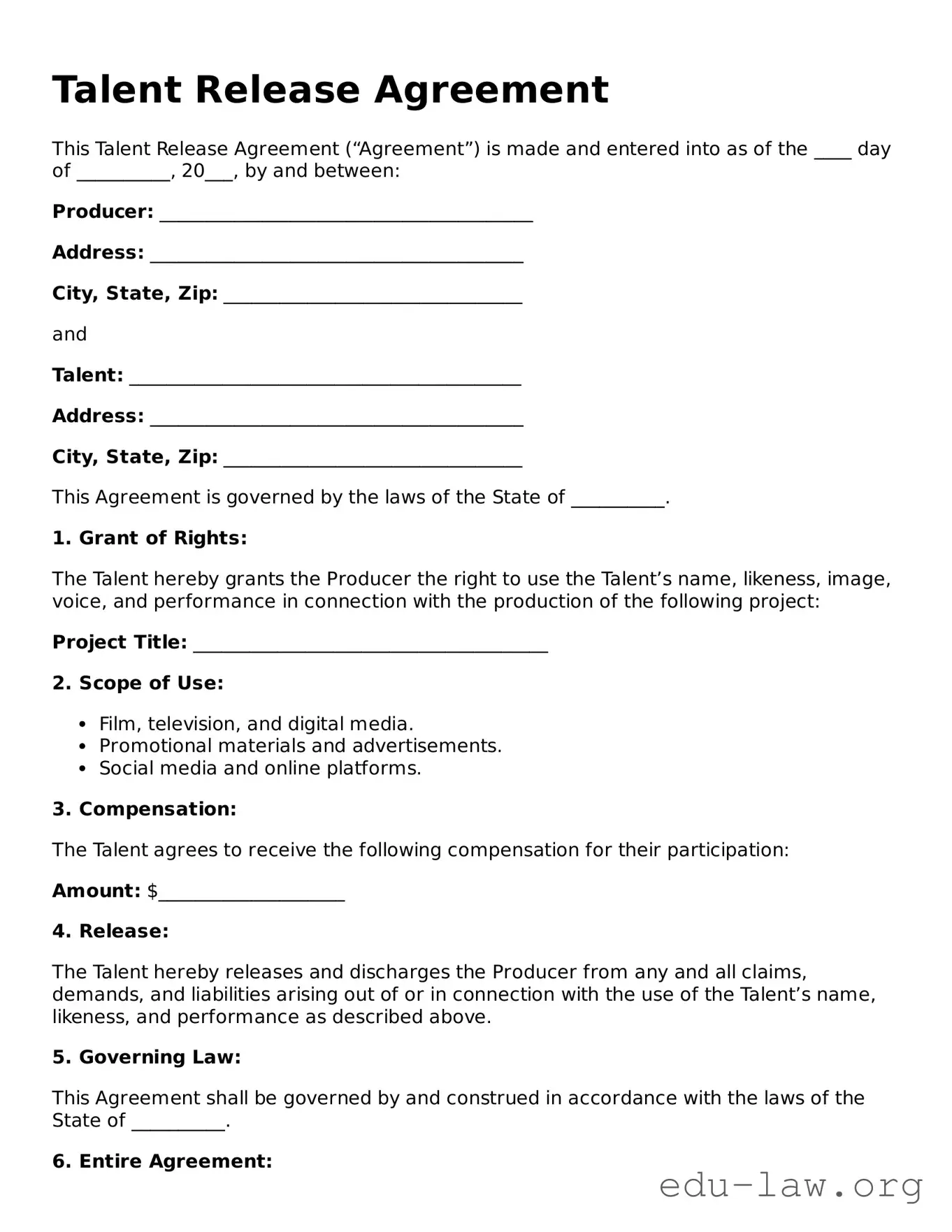
Talent Release Agreement
This Talent Release Agreement (“Agreement”) is made and entered into as of the ____ day of __________, 20___, by and between:
Producer: ________________________________________
Address: ________________________________________
City, State, Zip: ________________________________
and
Talent: __________________________________________
Address: ________________________________________
City, State, Zip: ________________________________
This Agreement is governed by the laws of the State of __________.
1. Grant of Rights:
The Talent hereby grants the Producer the right to use the Talent’s name, likeness, image, voice, and performance in connection with the production of the following project:
Project Title: ______________________________________
2. Scope of Use:
3. Compensation:
The Talent agrees to receive the following compensation for their participation:
Amount: $____________________
4. Release:
The Talent hereby releases and discharges the Producer from any and all claims, demands, and liabilities arising out of or in connection with the use of the Talent’s name, likeness, and performance as described above.
5. Governing Law:
This Agreement shall be governed by and construed in accordance with the laws of the State of __________.
6. Entire Agreement:
This Agreement constitutes the entire agreement between the parties and supersedes all prior agreements or understandings.
IN WITNESS WHEREOF, the parties hereto have executed this Agreement as of the date first above written.
Producer Signature: ____________________________
Date: ________________________________________
Talent Signature: _____________________________
Date: ________________________________________
| Fact Name | Description |
|---|---|
| Purpose | A Talent Release form grants permission for the use of an individual's likeness, voice, or performance in media projects. |
| Consent | The form ensures that the talent consents to the recording and distribution of their performance. |
| Governing Law (California) | California Civil Code Section 3344 governs the use of likeness and requires a signed release for commercial use. |
| Governing Law (New York) | New York Civil Rights Law Sections 50 and 51 protect individuals from unauthorized use of their name or likeness. |
| Duration | The rights granted in the form typically last indefinitely unless otherwise specified. |
| Revocation | Once signed, the talent may not easily revoke the release without specific conditions outlined in the agreement. |
Filling out the Talent Release form is a straightforward process. Once completed, the form will allow for the necessary permissions related to the use of your likeness and performance. Here’s how to fill it out step by step.
What is a Talent Release form?
A Talent Release form is a legal document that grants permission for the use of an individual's likeness, voice, or performance in various media. This form is typically used in film, television, photography, and other creative projects. By signing the form, the individual agrees that their image or performance can be used without further compensation or approval.
Why is a Talent Release form important?
This form is crucial for protecting both the creator and the talent involved in a project. It helps to clarify the rights of the parties and minimizes the risk of future disputes. Without a signed release, the creator may face legal challenges if the talent later decides to object to the use of their image or performance.
Who should sign a Talent Release form?
Anyone whose likeness or performance will be captured and used in a project should sign a Talent Release form. This includes actors, models, musicians, and even audience members in certain situations. If the individual is a minor, a parent or guardian must sign on their behalf.
What information is typically included in a Talent Release form?
A Talent Release form usually includes the name of the talent, a description of the project, the rights being granted, and any compensation details. It may also specify the duration of the rights granted and any limitations on the use of the talent's likeness or performance.
Can a Talent Release form be revoked?
Generally, once a Talent Release form is signed, it cannot be revoked. The individual gives up the right to contest the use of their likeness or performance in the specified project. However, some exceptions may apply, particularly if the release was signed under duress or if the terms of the release were violated.
What should I do if I have questions about a Talent Release form?
If you have questions about a Talent Release form, it is advisable to consult with a legal professional who specializes in entertainment law. They can provide guidance tailored to your specific situation and help ensure that all parties understand their rights and obligations.
Failing to provide complete personal information. This includes your full name, contact information, and any relevant identification numbers. Incomplete details can lead to delays or issues in processing.
Not reading the entire form before signing. It's crucial to understand what rights you are granting and any obligations you may have. Skimming can lead to misunderstandings.
Overlooking the expiration date of the release. Some releases are only valid for a specific period. Ensure you know how long your consent lasts.
Neglecting to specify the type of media. Whether it's video, audio, or print, clearly stating the media type helps clarify how your likeness or performance will be used.
Not asking questions. If any part of the form is unclear, seek clarification. Ignoring confusion can lead to unintended consequences.
Forgetting to include any additional terms. If you have specific requests or conditions regarding your participation, make sure to note them in the appropriate section.
Using outdated forms. Always ensure you are using the most current version of the Talent Release form, as terms and conditions may change over time.
Not keeping a copy of the signed form. Retaining a copy for your records is essential. This can serve as proof of your agreement and protect your rights.
Assuming verbal agreements are enough. Always get everything in writing. Relying on verbal promises can lead to disputes later on.
Rushing through the process. Take your time to review each section carefully. A hasty approach can lead to critical errors that may affect your rights.
A Talent Release form is essential for obtaining permission from individuals featured in a project, such as a film or commercial. However, several other documents often accompany it to ensure comprehensive legal protection and clarity. Below is a list of related forms and documents commonly used alongside the Talent Release form.
Using these forms in conjunction with the Talent Release form helps ensure that all parties involved are protected and that the production runs smoothly. Each document serves a specific purpose, contributing to the overall legal framework of the project.
A model release form is similar to a talent release form in that it grants permission for the use of a person's likeness in photographs or videos. This document is crucial for photographers and videographers who wish to use images of models in their portfolios or for commercial purposes. By signing a model release, the individual agrees that their image can be used without additional compensation, thereby protecting the creator from potential legal issues regarding unauthorized use of the model's likeness.
A location release form serves a similar purpose but focuses on the rights to use a specific location for filming or photography. This document is essential when a production team wants to shoot in a private space or a public area that may have restrictions. By obtaining a location release, the filmmakers ensure they have permission to use the site, avoiding potential disputes with property owners or local authorities.
An actor's agreement is closely related to a talent release form, as it outlines the terms under which an actor will perform in a production. This agreement typically includes details about compensation, the scope of work, and any rights related to the use of the actor's performance. Like a talent release, it protects the production team by clarifying expectations and responsibilities between the actor and the producers.
A waiver of liability is another document that shares similarities with a talent release form. This document is often used in situations where participants engage in activities that could pose risks. By signing a waiver, individuals acknowledge the risks involved and agree not to hold the organizers responsible for any injuries or damages. This protects the organizers and allows them to proceed without fear of legal repercussions.
A consent form is a broader document that can apply to various situations where permission is needed. This form can cover anything from medical procedures to participation in research studies. In the context of media production, a consent form ensures that individuals understand what they are agreeing to and gives permission for their involvement, similar to how a talent release allows for the use of their image or performance.
A copyright assignment agreement is relevant in the context of creative works, as it transfers ownership of copyright from one party to another. While a talent release focuses on the use of an individual's likeness, a copyright assignment deals with the rights to the creative content itself. Both documents are vital for protecting the interests of creators and ensuring that all parties understand their rights and obligations.
A public performance release is necessary when a production involves live performances. This document grants permission for the recording and distribution of a live event, ensuring that performers understand how their work will be used. Similar to a talent release, it protects the producers by confirming that they have the rights to use the recorded performance without further consent.
A video release form is akin to a talent release but specifically pertains to video recordings. This document allows filmmakers to use footage of individuals captured during filming. By signing a video release, individuals consent to the use of their image and voice in the final product, which helps avoid legal complications related to unauthorized use.
A broadcast release form is specifically designed for television and radio productions. It grants permission for the use of an individual's voice or image in broadcasts. Like a talent release, it ensures that the production team has the necessary rights to air the content without infringing on the individual's privacy or rights.
A testimonial release form is often used in marketing and advertising contexts. This document allows companies to use an individual's statements or endorsements in promotional materials. Similar to a talent release, it ensures that the individual is aware of how their words will be used and agrees to their inclusion, providing legal protection for the company while promoting transparency.
When filling out a Talent Release form, it is essential to approach the process with care and attention to detail. Below is a list of things you should and shouldn't do to ensure a smooth experience.
Misconceptions about Talent Release forms can lead to confusion for both talent and production teams. Here are four common misconceptions:
When filling out and using a Talent Release form, it’s important to keep several key points in mind. This ensures that all parties are protected and that the process runs smoothly.