When it comes to applying for colleges or scholarships, a Student Recommendation Letter can be a crucial component of the application process. This form serves as a valuable tool for educators, mentors, or employers to provide insight into a student's character, achievements, and potential. Typically, the form includes sections for the recommender to detail their relationship with the student, assess the student's skills and qualities, and provide specific examples that highlight the student’s strengths. Additionally, it often prompts the recommender to discuss the student’s contributions to the community, academic performance, and extracurricular involvement. By capturing these essential elements, the Student Recommendation Letter not only helps admissions committees or scholarship boards understand the student better but also allows the recommender to advocate for the student’s future opportunities. Understanding how to effectively complete this form can make a significant difference in a student's application journey.
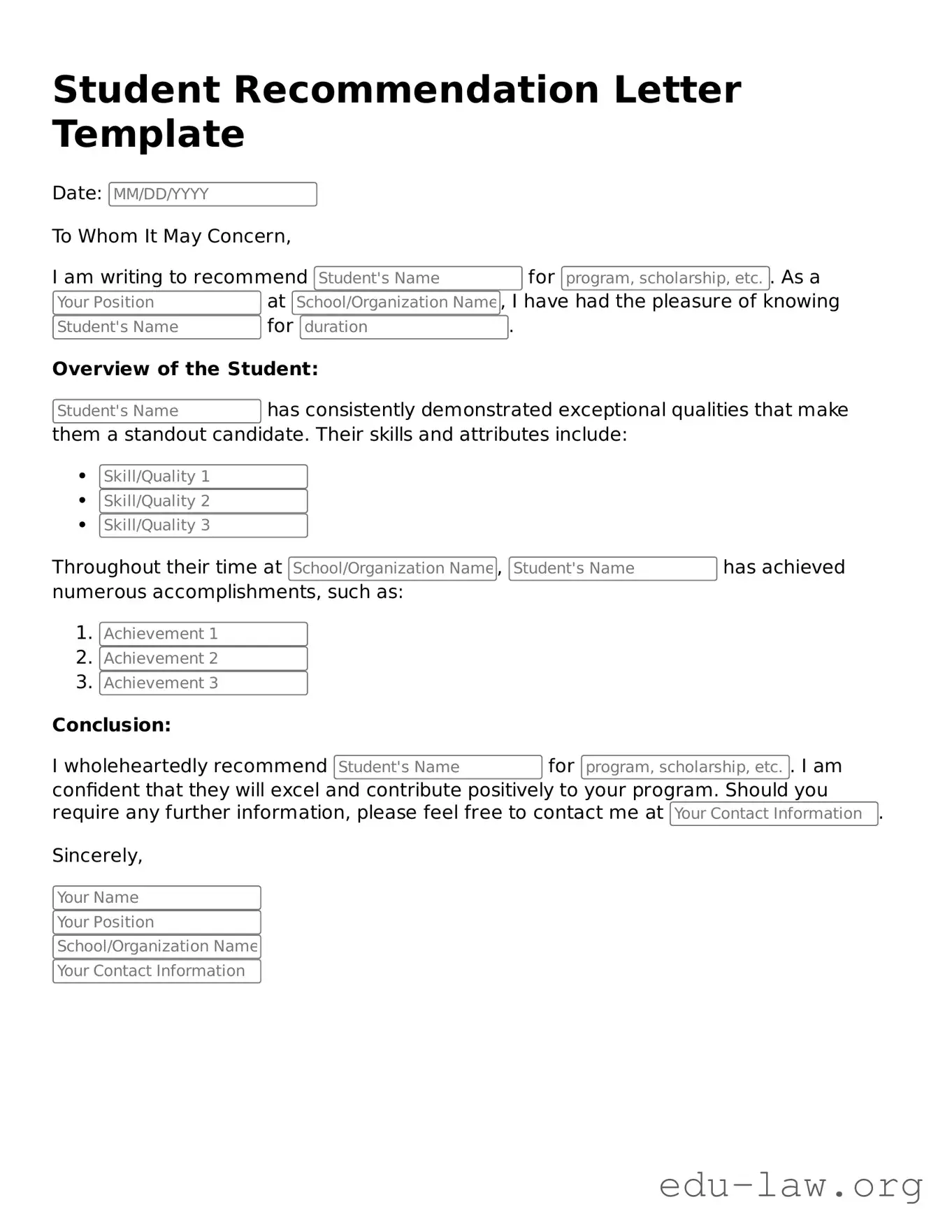
Student Recommendation Letter Template
Date:
To Whom It May Concern,
I am writing to recommend for . As a at , I have had the pleasure of knowing for .
Overview of the Student:
has consistently demonstrated exceptional qualities that make them a standout candidate. Their skills and attributes include:
Throughout their time at , has achieved numerous accomplishments, such as:
Conclusion:
I wholeheartedly recommend for . I am confident that they will excel and contribute positively to your program. Should you require any further information, please feel free to contact me at .
Sincerely,
| Fact Name | Description |
|---|---|
| Purpose | The Student Recommendation Letter form is used to provide insights into a student's character, achievements, and potential. It helps colleges and universities assess applicants. |
| Who Can Write | Teachers, counselors, and other professionals who know the student well can write the recommendation letter. |
| Content Requirements | The letter should include specific examples of the student's skills, accomplishments, and personal qualities that make them a strong candidate. |
| Submission Process | Typically, the completed letter is submitted directly to the institution, either online or by mail, depending on the school's requirements. |
| State-Specific Laws | In some states, such as California, the governing law regarding educational records (California Education Code § 49061) may influence how recommendation letters are handled. |
After you receive the Student Recommendation Letter form, it's important to fill it out accurately and thoroughly. This will ensure that the student receives a strong recommendation that reflects their abilities and character. Follow these steps to complete the form effectively.
What is a Student Recommendation Letter form?
A Student Recommendation Letter form is a document that allows teachers, mentors, or other individuals to provide a written endorsement of a student’s abilities, character, and achievements. This letter is often used for college applications, scholarships, or job opportunities, helping to highlight the student’s strengths and suitability for the position or program they are applying for.
Who should write a Student Recommendation Letter?
Typically, a recommendation letter should be written by someone who knows the student well and can provide specific examples of their skills and accomplishments. This could be a teacher, school counselor, coach, or employer. It is important that the writer can speak to the student’s qualifications and character in a meaningful way.
What information should be included in the letter?
A strong recommendation letter should include details about the student’s academic performance, extracurricular activities, personal qualities, and any specific achievements. It should also mention the relationship between the writer and the student, providing context for the endorsement. Personal anecdotes can make the letter more compelling and memorable.
How long should a Student Recommendation Letter be?
Generally, a recommendation letter should be one page in length, though it can be longer if necessary. The key is to be concise while still providing enough detail to effectively communicate the student’s qualifications. A well-structured letter that flows logically will be more impactful than a lengthy, unfocused one.
Is there a specific format for the letter?
While there is no strict format, a recommendation letter typically includes the writer’s contact information, the date, a salutation, the body of the letter, and a closing statement. It should be typed and printed on professional letterhead if possible. Using a clear and formal tone helps convey professionalism.
Can a student provide guidance to the writer?
Yes, students are encouraged to provide their recommenders with information that can help in writing the letter. This may include a resume, a list of achievements, or details about the program or job they are applying for. Offering this information can help the writer craft a more personalized and relevant letter.
How should the letter be submitted?
The submission method for a recommendation letter can vary based on the requirements of the application. Some institutions may request that the letter be submitted online through a portal, while others may require it to be mailed or emailed directly to them. It is essential to follow the specific instructions provided by the institution or organization.
Not Providing Specific Examples: Many recommenders fail to include concrete examples of the student's achievements and skills. Vague statements do not effectively convey the student's strengths.
Using Generic Language: Some letters read like templates. Personalizing the letter with the student's unique qualities and experiences is essential for making a strong impression.
Ignoring the Instructions: Each recommendation letter may have specific requirements. Omitting requested information or failing to follow the format can lead to a negative impression.
Submitting Late: Timeliness matters. A late recommendation can hinder a student's application process, potentially affecting their chances of acceptance.
Overemphasizing Weaknesses: While honesty is important, focusing too much on a student's weaknesses can overshadow their strengths. Balance is key to a fair assessment.
When applying for educational programs, students often need to submit various forms and documents alongside the Student Recommendation Letter. Each of these documents plays a crucial role in presenting a comprehensive view of the applicant's qualifications and character. Below is a list of commonly required forms and documents that may accompany the recommendation letter.
Understanding the significance of each of these documents is essential for students as they prepare their applications. A well-rounded submission can greatly enhance the chances of acceptance into competitive programs. Timely and thorough preparation is key to ensuring all materials are completed and submitted according to the deadlines set by the institutions.
The Student Recommendation Letter form shares similarities with the Academic Transcript. Both documents serve to provide a comprehensive overview of a student's achievements and capabilities. While the recommendation letter offers personal insights from educators or mentors about a student's character and potential, the academic transcript presents a formal record of grades and courses completed. Together, they create a fuller picture of a student's academic journey and readiness for future challenges.
Another document akin to the Student Recommendation Letter is the Personal Statement. Like the recommendation letter, the personal statement allows students to express their individual experiences, motivations, and aspirations. However, while the recommendation letter is written by someone else, the personal statement is authored by the student. This combination of perspectives enriches the application process, providing a balance between external validation and personal narrative.
The Resume is also comparable to the Student Recommendation Letter in that it outlines a student's skills, experiences, and accomplishments. Both documents highlight the strengths of the student, but the resume is typically more focused on work experience and extracurricular activities. The recommendation letter complements this by adding a personal touch, often detailing specific instances where the student demonstrated key qualities such as leadership or perseverance.
Letters of Intent can be viewed as another related document. Similar to a recommendation letter, a Letter of Intent expresses a candidate's commitment and interest in a specific program or opportunity. However, it is usually written by the applicant themselves, detailing their goals and reasons for pursuing a particular path. This self-advocacy, paired with the external endorsement from a recommendation letter, can significantly enhance an application.
Reference Letters are closely aligned with the Student Recommendation Letter as they both serve to endorse a student's qualifications. While recommendation letters are often more personalized and focused on a student's potential, reference letters may be broader in scope, providing insights into a student's overall character and work ethic. Both documents aim to support the student's application by validating their skills and experiences through the eyes of another.
Similar to the Student Recommendation Letter is the Portfolio, which showcases a student's work and achievements. While the recommendation letter provides qualitative insights into a student's abilities, the portfolio offers tangible evidence of their skills through projects, papers, or creative works. Together, they present a well-rounded view of the student's capabilities and contributions.
Finally, the Interview Summary can be compared to the Student Recommendation Letter. An interview summary captures the impressions and evaluations of a candidate during an interview process, much like a recommendation letter reflects the thoughts of someone who knows the student well. Both documents play a critical role in assessing a student's fit for a program or position, relying on personal insights and evaluations to inform decision-makers.
When filling out a Student Recommendation Letter form, it's essential to approach the task thoughtfully. Here are some key do's and don'ts to keep in mind:
Many people have misunderstandings about the Student Recommendation Letter form. Here are nine common misconceptions, along with clarifications to help clear things up.
While many students use recommendation letters for college, they can also be valuable for job applications, internships, and scholarships.
Not everyone qualifies. Ideally, the writer should know the student well and be able to speak to their skills and character.
Different colleges and organizations may have specific requirements or formats for recommendation letters.
It’s best to give recommenders ample time to write a thoughtful letter. Asking well in advance is courteous and beneficial.
While teachers are common choices, coaches, employers, or community leaders can also provide valuable insights.
Students can and should share their goals and achievements with recommenders to help them write a more personalized letter.
Each letter should be unique, reflecting the individual qualities and experiences of the student.
Strong recommendation letters can significantly enhance a student’s application and provide context to their achievements.
Recommenders can update or revise letters if necessary, especially if new information comes to light.
Understanding these misconceptions can help students navigate the recommendation process more effectively.
When filling out and using the Student Recommendation Letter form, several important considerations can enhance the effectiveness of the recommendation process. Here are some key takeaways: