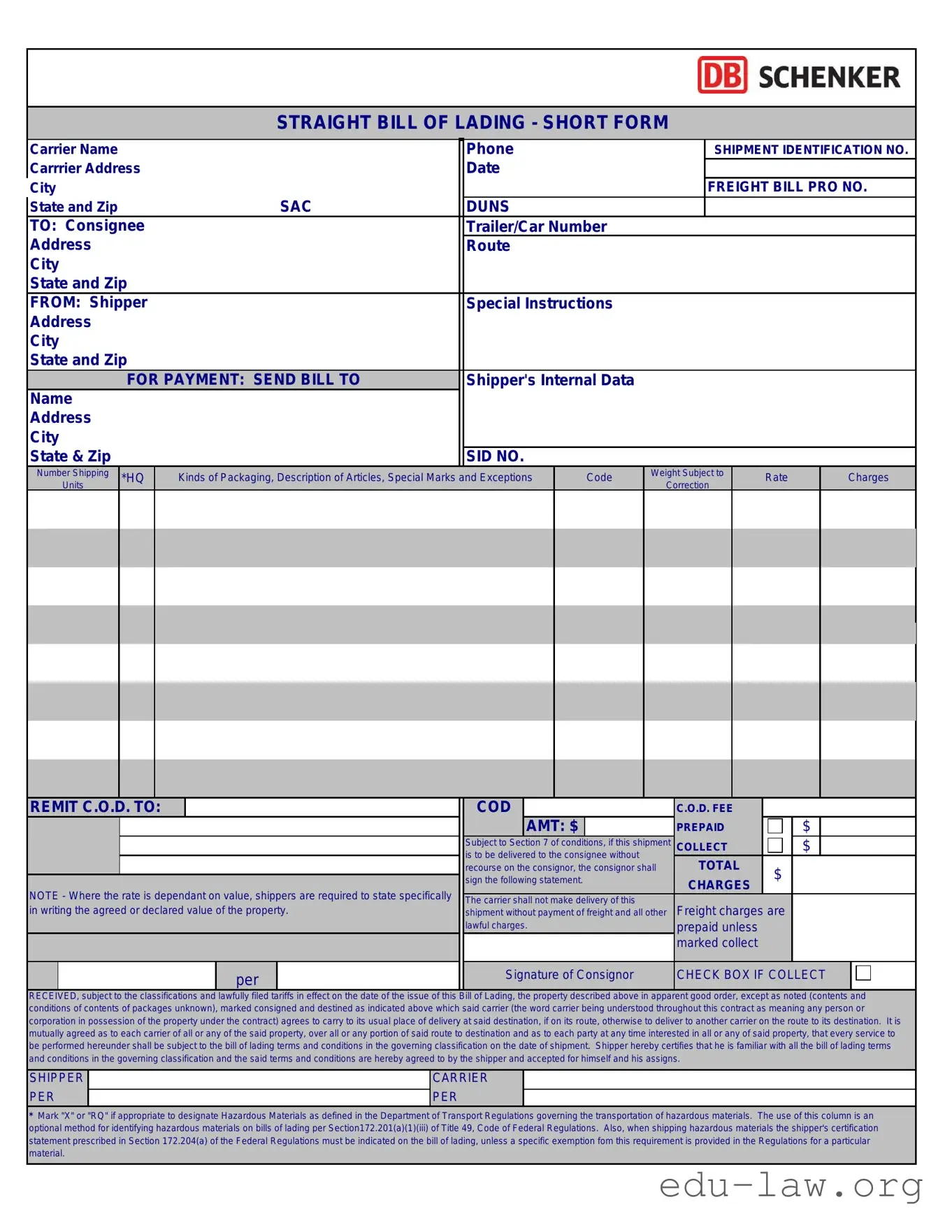
The Straight Bill of Lading is a crucial document in the shipping and freight industry, serving as a receipt for goods and a contract between the shipper and the carrier. This form is typically used when the goods are to be delivered directly to a specific recipient, ensuring that only the named party can claim the cargo. It contains essential details such as the description of the goods, the shipping instructions, and the names and addresses of both the shipper and the consignee. Unlike other types of bills of lading, the Straight Bill is non-negotiable, meaning that it cannot be transferred to another party. This aspect provides a layer of security for the parties involved, as it helps prevent unauthorized claims. Understanding the Straight Bill of Lading is vital for anyone involved in shipping, as it outlines the responsibilities and liabilities of each party, ensuring a smoother transaction and delivery process.
STRAIGHT BILL OF LADING - SHORT FORM
Carrier Name |
|
|
Phone |
|
|
SHIPMENT IDENTIFICATION NO. |
||
Carrrier Address |
|
|
Date |
|
|
|
|
|
City |
SAC |
|
|
|
|
FREIGHT BILL PRO NO. |
||
State and Zip |
|
DUNS |
|
|
|
|
|
|
TO: Consignee |
|
|
Trailer/Car Number |
|
|
|
|
|
Address |
|
|
Route |
|
|
|
|
|
City |
|
|
|
|
|
|
|
|
State and Zip |
|
|
|
|
|
|
|
|
FROM: Shipper |
|
|
Special Instructions |
|
|
|
|
|
Address |
|
|
|
|
|
|
|
|
City |
|
|
|
|
|
|
|
|
State and Zip |
|
|
|
|
|
|
|
|
FOR PAYMENT: SEND BILL TO |
|
Shipper's Internal Data |
|
|
|
|
||
Name |
|
|
|
|
|
|
|
|
Address |
|
|
|
|
|
|
|
|
City |
|
|
|
|
|
|
|
|
State & Zip |
|
|
SID NO. |
|
|
|
|
|
Number Shipping *HQ |
Kinds of Packaging, Description of Articles, Special Marks and Exceptions |
Code |
Weight Subject to |
Rate |
Charges |
|||
Units |
|
|
|
|
Correction |
|
|
|
|
|
|
|
|
|
|
|
|
|
|
|
|
|
|
|
|
|
|
|
|
|
|
|
|
|
|
|
|
|
|
|
|
|
|
|
|
|
|
|
|
|
|
|
|
|
|
|
|
|
|
|
|
|
|
|
|
|
|
|
|
|
|
|
|
|
|
|
|
REMIT C.O.D. TO: |
|
|
|
|
COD |
|
|
C.O.D. FEE |
|
|
|
|
||
Address |
|
|
|
|
|
|
AMT: $ |
|
PREPAID |
|
$ |
|
|
|
City |
|
|
|
|
|
Subject to Section 7 of conditions, if this shipment |
COLLECT |
|
$ |
|
|
|||
State & Zip |
|
|
|
|
|
is to be delivered to the consignee without |
TOTAL |
|
|
|
|
|||
|
|
|
|
|
recourse on the consignor, the consignor shall |
$ |
|
|
|
|||||
NOTE - Where the rate is dependant on value, shippers are required to state specifically |
|
sign the following statement. |
CHARGES |
|
|
|
||||||||
|
|
|
|
|
|
|
|
|||||||
|
The carrier shall not make delivery of this |
Freight charges are |
|
|
|
|||||||||
in writing the agreed or declared value of the property. |
|
shipment without payment of freight and all other |
|
|
|
|||||||||
|
|
|
|
|
|
|
lawful charges. |
prepaid unless |
|
|
|
|
||
The agreed or declared vlaue of the property is hereby specifically stated by the shipper to |
|
|
|
|
marked collect |
|
|
|
|
|||||
be not exceeding |
|
|
|
|
|
|
|
|
|
|
|
|||
$ |
|
|
|
per |
|
|
Signature of Consignor |
CHECK BOX IF COLLECT |
|
|||||
RECEIVED, subject to the classifications and lawfully filed tariffs in effect on the date of the issue of this Bill of Lading, the property described above in apparent good order, except as noted (contents and conditions of contents of packages unknown), marked consigned and destined as indicated above which said carrier (the word carrier being understood throughout this contract as meaning any person or corporation in possession of the property under the contract) agrees to carry to its usual place of delivery at said destination, if on its route, otherwise to deliver to another carrier on the route to its destination. It is mutually agreed as to each carrier of all or any of the said property, over all or any portion of said route to destination and as to each party at any time interested in all or any of said property, that every service to be performed hereunder shall be subject to the bill of lading terms and conditions in the governing classification on the date of shipment. Shipper hereby certifies that he is familiar with all the bill of lading terms and conditions in the governing classification and the said terms and conditions are hereby agreed to by the shipper and accepted for himself and his assigns.
SHIPPER |
|
CARRIER |
|
PER |
|
PER |
|
*Mark "X" or "RQ" if appropriate to designate Hazardous Materials as defined in the Department of Transport Regulations governing the transportation of hazardous materials. The use of this column is an optional method for identifying hazardous materials on bills of lading per Section172.201(a)(1)(iii) of Title 49, Code of Federal Regulations. Also, when shipping hazardous materials the shipper's certification statement prescribed in Section 172.204(a) of the Federal Regulations must be indicated on the bill of lading, unless a specific exemption fom this requirement is provided in the Regulations for a particular material.
| Fact Name | Description |
|---|---|
| Definition | A Straight Bill of Lading is a document that serves as a receipt for goods and a contract for transportation, specifying that the goods are to be delivered to a specific person or entity. |
| Transferability | This form is non-negotiable, meaning it cannot be transferred to another party. Only the named consignee has the right to claim the goods. |
| Governing Law | The Uniform Commercial Code (UCC) governs Straight Bills of Lading in most states, providing a consistent legal framework. |
| Usage | Commonly used in domestic shipping, the Straight Bill of Lading is ideal for transactions where the buyer and seller have a direct relationship. |
| Liability | The carrier assumes responsibility for the goods once they are loaded and is liable for any loss or damage during transit. |
| State-Specific Forms | Some states may have specific requirements or variations of the Straight Bill of Lading. For example, California's Commercial Code has particular stipulations regarding its use. |
To fill out the Straight Bill of Lading form, gather all necessary information about the shipment. This includes details about the sender, recipient, and the items being shipped. Once you have everything ready, follow these steps to complete the form accurately.
After completing the form, keep a copy for your records. Ensure that the original is sent with the shipment to the recipient. This will help in tracking and confirming delivery.
What is a Straight Bill of Lading?
A Straight Bill of Lading is a document used in the shipping industry that serves as a receipt for goods and a contract between the shipper and the carrier. It specifies the details of the shipment, including the type of goods, quantity, and destination. Unlike a negotiable bill of lading, a Straight Bill of Lading is non-transferable, meaning it can only be used by the named consignee to receive the goods.
Who uses a Straight Bill of Lading?
This document is commonly used by shippers, carriers, and consignees. Shippers prepare the bill to provide information about the shipment. Carriers use it to confirm receipt of the goods and outline their responsibilities during transport. Consignees rely on the Straight Bill of Lading to claim their goods upon arrival.
What information is included in a Straight Bill of Lading?
A Straight Bill of Lading typically includes the following information: the names and addresses of the shipper and consignee, a description of the goods being shipped, the quantity and weight of the goods, the shipping method, and any special instructions or terms related to the shipment. Additionally, it may contain tracking information and the date of shipment.
How does a Straight Bill of Lading differ from a negotiable bill of lading?
The key difference lies in transferability. A Straight Bill of Lading is non-negotiable, meaning it cannot be transferred to another party. Only the named consignee can claim the goods. In contrast, a negotiable bill of lading allows the holder to transfer ownership of the goods, making it possible for others to claim them.
What are the advantages of using a Straight Bill of Lading?
Using a Straight Bill of Lading offers several advantages. It simplifies the shipping process since it does not require endorsements for transfer. This can lead to faster processing at the destination. Additionally, it provides clear documentation of the transaction, which can be beneficial in case of disputes or claims regarding the shipment.
What should I do if my Straight Bill of Lading is lost or damaged?
If a Straight Bill of Lading is lost or damaged, it is important to notify the carrier immediately. The carrier may have specific procedures for handling such situations, which could include issuing a replacement document. It is advisable to keep copies of shipping documents and maintain communication with all parties involved to facilitate the resolution process.
Failing to provide complete shipper information. This includes the name, address, and contact details. Incomplete information can lead to delays in delivery.
Not specifying the consignee correctly. The consignee is the person or business that will receive the shipment. Ensure their details are accurate to avoid misdelivery.
Omitting the origin and destination addresses. Clearly listing where the shipment is coming from and where it is going is crucial for logistics.
Neglecting to describe the cargo adequately. Include details such as the type of goods, quantity, and any special handling instructions. This information helps in proper handling and transport.
Forgetting to indicate the freight charges terms. Clearly state whether the charges are prepaid or collect to avoid confusion and potential disputes later.
Leaving out the date of shipment. Including the date helps track the shipment and is essential for record-keeping.
Not signing the bill. The signature is a confirmation of the information provided and acceptance of the terms. An unsigned document may not be considered valid.
Using incorrect or outdated tracking numbers. Ensure that the tracking number is accurate and corresponds to the shipment to facilitate tracking.
Failing to check for special instructions. If there are any specific handling or delivery instructions, they should be clearly noted on the bill.
Overlooking the need for copies of the bill. Always keep copies for your records and provide necessary copies to all parties involved in the shipment.
The Straight Bill of Lading is an essential document in shipping and transportation. It serves as a receipt for goods and outlines the terms of the shipment. Alongside this form, several other documents are often utilized to ensure a smooth shipping process. Here are some of the most common forms you may encounter.
Understanding these documents can help facilitate the shipping process and ensure compliance with regulations. Each form plays a vital role in protecting the interests of both the sender and the recipient, contributing to a successful transaction.
The Straight Bill of Lading (BOL) is a key document in the shipping and logistics industry. It serves as a receipt for goods and a contract between the shipper and the carrier. Similar to the Straight BOL, the Uniform Commercial Code (UCC) governs transactions involving goods and provides a framework for understanding the rights and responsibilities of parties involved. The UCC outlines various types of sales and financing agreements, making it essential for businesses to comply with these regulations to ensure smooth transactions.
Another document that shares similarities with the Straight BOL is the Order Bill of Lading. While the Straight BOL is non-negotiable, the Order BOL allows the transfer of ownership of the goods during transit. This document is often used in transactions where the buyer may want to sell the goods before they reach their final destination. The Order BOL provides flexibility in the supply chain, enabling the buyer to manage their inventory and cash flow effectively.
The Sea Waybill is also comparable to the Straight BOL. Like the Straight BOL, it serves as a receipt for goods and outlines the terms of transport. However, the Sea Waybill is typically non-negotiable and does not require the physical transfer of the document for ownership transfer. This can simplify processes for businesses that do not need to transfer ownership while goods are in transit, making it a practical choice for many shipping scenarios.
A Commercial Invoice is another document that complements the Straight BOL. This invoice details the transaction between the buyer and seller, including product descriptions, quantities, and prices. While the Straight BOL focuses on the transportation of goods, the Commercial Invoice provides essential financial information, making it a vital part of international trade and customs clearance processes.
The Packing List is similar to the Straight BOL in that it provides a detailed inventory of the items being shipped. This document outlines the contents of each package, including weights and dimensions. It helps both the shipper and the receiver verify that the correct items have been loaded and delivered. The Packing List is often used alongside the Straight BOL to facilitate smoother logistics operations.
A Freight Bill is another document that shares similarities with the Straight BOL. This bill outlines the charges for transporting goods and serves as a receipt for payment. While the Straight BOL confirms the shipment details, the Freight Bill focuses on the financial aspect of the transportation service, ensuring that all parties are aware of the costs involved.
The Delivery Order is a document that can also be compared to the Straight BOL. It instructs the carrier to release the goods to the designated recipient. This document is often used in conjunction with the Straight BOL to ensure that the correct party receives the shipment. The Delivery Order helps streamline the final steps of the shipping process, ensuring efficient delivery to the end customer.
The Air Waybill is similar to the Straight BOL in that it serves as a contract between the shipper and the carrier for air freight shipments. This document outlines the terms of transport and acts as a receipt for the goods. However, unlike the Straight BOL, the Air Waybill is typically negotiable, allowing for ownership transfer during transit. This feature can be beneficial for businesses engaged in international air shipping.
Lastly, the Certificate of Origin is a document that, while not directly related to the shipping process, is important in international trade. It certifies the country of origin of the goods being shipped. This document can be crucial for customs clearance and determining tariff rates. Although it serves a different purpose than the Straight BOL, both documents play essential roles in ensuring compliance and facilitating smooth trade operations.
When filling out a Straight Bill of Lading form, there are important guidelines to follow. Here’s a list of things you should and shouldn't do:
Misconceptions about the Straight Bill of Lading can lead to confusion and potential issues in shipping and logistics. Understanding these misconceptions is crucial for anyone involved in the transportation of goods. Below are some common misunderstandings:
This is incorrect. A Straight Bill of Lading is non-negotiable, meaning it cannot be transferred to another party. The named consignee is the only one entitled to receive the goods. In contrast, a Negotiable Bill of Lading can be endorsed and transferred, allowing for flexibility in ownership during transit.
While a Straight Bill of Lading serves as proof of shipment, it does not guarantee that the goods will be delivered in perfect condition or on time. Factors such as weather, logistics issues, or unforeseen circumstances can affect delivery, regardless of the bill's terms.
This is a common belief, but it is not accurate. A Straight Bill of Lading can be used for both domestic and international shipments. Its primary function is to outline the terms of the shipment and identify the parties involved, regardless of the shipment's destination.
While it is true that changes to a Straight Bill of Lading may not be common, amendments can be made under certain circumstances. Parties involved in the shipment can agree to modify the terms, but this typically requires the consent of all parties involved and proper documentation.
The Straight Bill of Lading is an important document in the shipping and transportation industry. Understanding how to fill it out and use it effectively can streamline the shipping process. Here are seven key takeaways:
By paying attention to these key points, you can ensure that your shipping process is smooth and efficient.