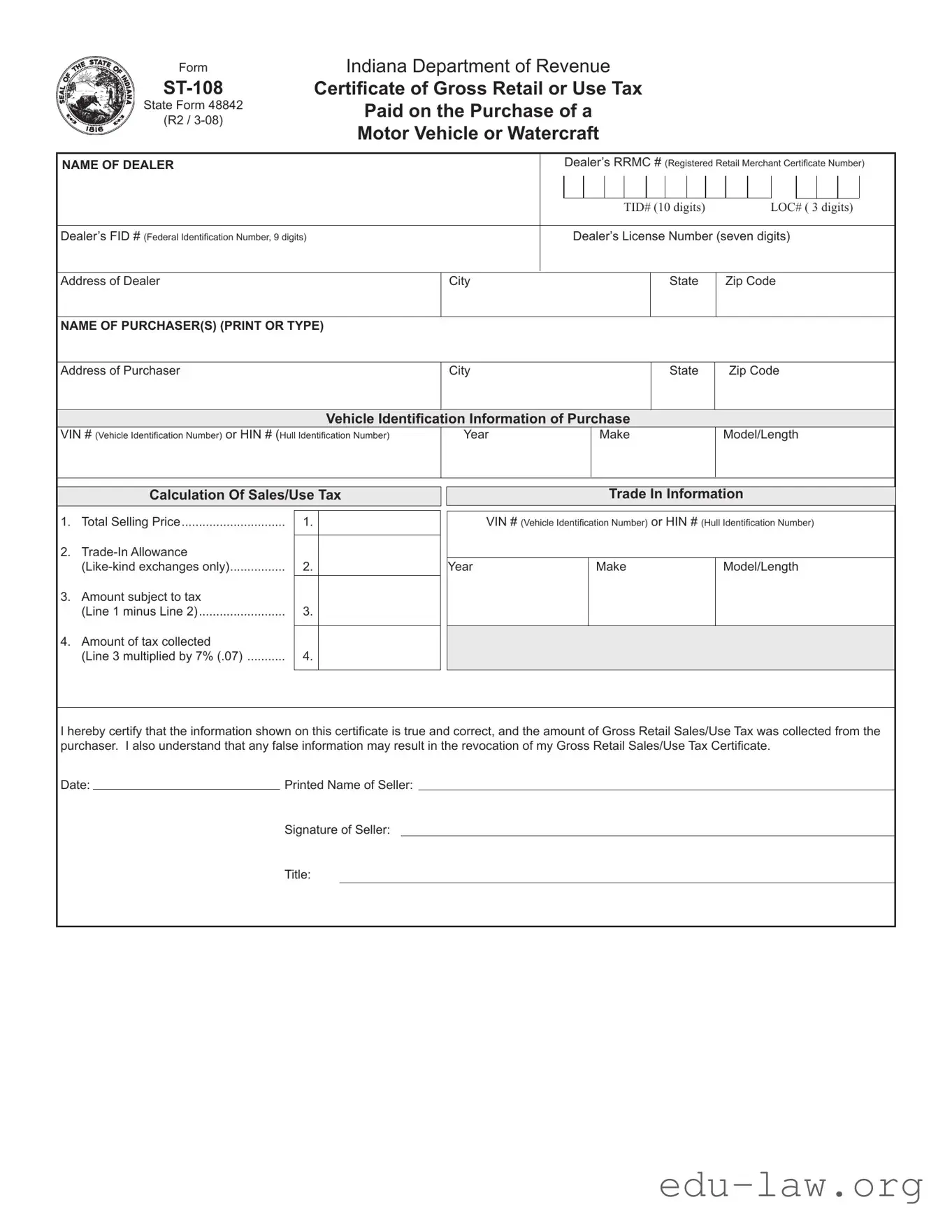
The ST-108 form is an essential document for anyone purchasing a motor vehicle or watercraft in Indiana, as it certifies that the appropriate gross retail or use tax has been paid. Designed by the Indiana Department of Revenue, this form must be completed by the dealer and presented at the Bureau of Motor Vehicles when titling the vehicle or watercraft. Key components of the ST-108 include the dealer's information, such as the Registered Retail Merchant Certificate Number, Federal Identification Number, and Dealer’s License Number. Additionally, it captures details about the purchaser, including their name and address, as well as the vehicle or watercraft’s identification information, including the Vehicle Identification Number (VIN) or Hull Identification Number (HIN). The form also outlines the calculation of sales or use tax, requiring dealers to provide the total selling price, any trade-in allowances, and the final amount of tax collected, which is typically 7% of the taxable amount. Importantly, the seller must certify the accuracy of the information provided by signing the form, ensuring compliance with Indiana tax regulations. Without this certification, the form may be rejected, causing delays in the titling process. Understanding the intricacies of the ST-108 is crucial for both dealers and purchasers to facilitate a smooth transaction and adhere to state requirements.
Form
State Form 48842
(R2 /
Indiana Department of Revenue
Certificate of Gross Retail or Use Tax
Paid on the Purchase of a
Motor Vehicle or Watercraft
NAME OF DEALER |
|
|
Dealer’s RRMC # (Registered Retail Merchant Certificate Number) |
||||||||||||||||
|
|
|
|
|
|
|
|
|
|
|
|
|
|
|
|
|
|
||
|
|
|
|
|
|
|
|
|
|
|
|
|
|
|
|
|
|
|
|
|
|
|
|
|
TID# (10 digits) |
|
|
LOC# ( 3 digits) |
|||||||||||
|
|
|
|
|
|
|
|
|
|
|
|
|
|
|
|
|
|
||
Dealer’s FID # (Federal Identification Number, 9 digits) |
|
|
Dealer’s License Number (seven digits) |
||||||||||||||||
|
|
|
|
|
|
|
|
|
|
|
|
|
|
|
|
|
|
|
|
Address of Dealer |
City |
|
|
|
|
|
|
|
State |
|
Zip Code |
||||||||
|
|
|
|
|
|
|
|
|
|
|
|
|
|
|
|
|
|
|
|
Name of Purchaser(s) (pRINT OR tYPE) |
|
|
|
|
|
|
|
|
|
|
|
|
|
|
|
|
|
|
|
|
|
|
|
|
|
|
|
|
|
|
|
|
|
|
|
|
|
|
|
Address of Purchaser |
City |
|
|
|
|
|
|
|
State |
|
Zip Code |
||||||||
Vehicle Identification Information of Purchase
VIN # (Vehicle Identification Number) or HIN # (Hull Identification Number) |
Year |
Make |
Model/Length |
|
|
|
|
Calculation Of Sales/Use Tax
1. |
Total Selling Price |
1. |
|
2. |
|
|
|
|
2. |
|
|
3. |
Amount subject to tax |
|
|
|
(Line 1 minus Line 2) |
3. |
|
4. |
Amount of tax collected |
|
|
|
|
||
|
(Line 3 multiplied by 7% (.07) |
4. |
|
|
|
|
|
Trade In Information
VIN # (Vehicle Identification Number) or HIN # (Hull Identification Number)
Year |
Make |
Model/Length |
|
|
|
|
|
|
I hereby certify that the information shown on this certificate is true and correct, and the amount of Gross Retail Sales/Use Tax was collected from the purchaser. I also understand that any false information may result in the revocation of my Gross Retail Sales/Use Tax Certificate.
Date: |
|
Printed Name of Seller: |
|
|
|
Signature of Seller: |
|
|
|
Title: |
|

Instructions for completing Form
or Use Tax on the Purchase of a Motor Vehicle or Watercraft.
INDIANA CODE
The
If an exemption from the tax is claimed, the purchaser and the dealer must complete Form
Seller Information
NAME OF DEALER: Indicate the name of the dealer as it appears on the Registered Retail Merchant Certificate (RRMC).
FID # (Federal Identification Number): Indicate the Federal Identification Number of the dealer, if applicable.
Dealer’s License #: Indicate the Dealer’s License Number(seven digits) as it appears on the Dealer’s License Certificate.
RRMC # (same as TID # - 10 Digits + LOC # - 3 Digits): Indicate the Indiana Taxpayer Identification Number and Location Number as it appears on the Registered Retail Merchant Certificate. This number must be in the following format:
Address of Dealer: Indicate the address of the dealer as it appears on the Registered Retail Merchant Certifi- cate.
Vehicle Identification Information
VIN or HIN ID #: Enter the Vehicle ID # (VIN) or the Hull ID # (HIN).
YEAR: Indicate the year the motor vehicle or watercraft was manufactured.
MODEL # OR WATERCRAFT LENGTH: If a motor vehicle is being sold indicate the model name for the vehicle. If a watercraft is being sold indicate the length of the craft.
Calculation of Sales/Use Tax
TOTAL SELLING PRICE: When determining the total selling price include all delivery, make ready, repair, or other costs incurred prior to transfer to the buyer. Federal excise tax is NOT included.
You must also indicate the make, model, year, and ID # of the
AMOUNT SUBJECT TO TAX: Line 1 minus Line 2 results in the amount on which the sales/use tax will be calcu- lated.
AMOUNT OF TAX COLLECTED: Line 3 multiplied by 7% or .07 equals the amount to be collected by the seller.
Signature Section: The Seller must sign the
| Fact Name | Description |
|---|---|
| Purpose of Form ST-108 | This form certifies that the gross retail or use tax has been paid on the purchase of a motor vehicle or watercraft in Indiana. |
| Governing Law | Indiana Code 6-2.5-9-6 mandates that individuals must present certification of tax payment when titling a vehicle or watercraft. |
| Tax Calculation | The form calculates the amount of sales/use tax by taking the total selling price, subtracting any trade-in allowance, and multiplying the result by 7%. |
| Signature Requirement | The seller must sign the form to certify that the sales/use tax has been collected and will be forwarded to the Indiana Department of Revenue. |
Filling out the ST-108 form is essential for certifying that sales or use tax has been paid on a motor vehicle or watercraft purchase. Completing this form accurately will help facilitate the titling process at the Bureau of Motor Vehicles. Follow the steps below to ensure proper completion of the form.
After completing the ST-108 form, it is essential to submit it along with any necessary documentation to the Bureau of Motor Vehicles. Ensure all information is accurate to avoid any delays or rejections during the titling process.
What is Form ST-108?
Form ST-108 is a certificate issued by the Indiana Department of Revenue that certifies the gross retail or use tax has been paid on the purchase of a motor vehicle or watercraft. This form is essential for individuals who are titling their vehicle or watercraft, as it serves as proof of tax payment to the Bureau of Motor Vehicles.
Who needs to complete Form ST-108?
The dealer selling the motor vehicle or watercraft is responsible for completing Form ST-108. This form must be provided to the purchaser at the time of sale. The purchaser will then present this certificate when titling the vehicle or watercraft at a Bureau of Motor Vehicles license branch.
What information is required on Form ST-108?
Form ST-108 requires several pieces of information. This includes the dealer's name, Registered Retail Merchant Certificate number, Federal Identification Number, and license number. Additionally, the form asks for details about the purchaser, including their name and address, as well as specific information about the vehicle or watercraft being purchased, such as the Vehicle Identification Number (VIN) or Hull Identification Number (HIN), year, make, and model or length.
How is the sales/use tax calculated on Form ST-108?
The sales/use tax is calculated based on the total selling price of the vehicle or watercraft. The total selling price should include all costs associated with the sale, except for federal excise tax. If a trade-in is involved, the trade-in allowance can be deducted from the total selling price. The taxable amount is then multiplied by 7% to determine the total tax collected.
What happens if the dealer does not provide Form ST-108?
If the dealer fails to provide Form ST-108, the purchaser will not be able to title the vehicle or watercraft at the Bureau of Motor Vehicles. In this case, the purchaser may need to return to the dealer to obtain the form, which can delay the titling process.
What is the significance of the seller's signature on Form ST-108?
The seller's signature on Form ST-108 is crucial. It certifies that the seller has collected the appropriate sales/use tax and will forward it to the Indiana Department of Revenue. Without this signature, the form will be rejected by the license branch, which means the purchaser must return to the seller to obtain a valid signature.
Can a purchaser claim an exemption from the tax using Form ST-108?
No, Form ST-108 does not allow for tax exemptions. If a purchaser believes they qualify for a tax exemption, they must complete Form ST-108E instead. This form serves as an affidavit of exemption and must be submitted alongside the ST-108 at the time of licensing.
What should I do if I make a mistake on Form ST-108?
If an error is made on Form ST-108, it is advisable to correct it before submission. The dealer should ensure that all information is accurate, as mistakes can lead to rejection by the Bureau of Motor Vehicles. If necessary, a new form can be completed to replace the incorrect one.
Incorrect Dealer Information: Failing to accurately enter the dealer's name as it appears on the Registered Retail Merchant Certificate can lead to rejection of the form.
Missing or Incorrect Tax Identification Numbers: Omitting the RRMC number or providing it in the wrong format (10 digits + 3 digits) will result in the form being rejected.
Incomplete Vehicle Identification Information: Not providing the Vehicle Identification Number (VIN) or Hull Identification Number (HIN) can cause delays in processing.
Failure to Calculate Tax Properly: Errors in calculating the amount subject to tax or the amount of tax collected can lead to incorrect tax submissions.
Omitting Trade-In Details: Not providing information about the trade-in vehicle or watercraft, including its make, model, year, and ID number, may invalidate the trade-in allowance.
Missing Signature: The seller must sign the form. A missing signature will result in rejection, requiring the purchaser to return for completion.
Incorrect Address Information: Providing an incorrect address for the dealer or purchaser can cause issues with documentation and processing.
Not Following Instructions: Ignoring specific instructions for completing the form, such as the requirement for like-kind exchanges for trade-ins, may lead to complications.
When purchasing a motor vehicle or watercraft in Indiana, several forms and documents are often required alongside the ST-108 form. Each of these documents serves a specific purpose in ensuring compliance with state regulations and facilitating the transaction. Here’s a brief overview of some of the most commonly used forms:
Understanding these forms and their purposes can simplify the process of purchasing a vehicle or watercraft in Indiana. Each document plays a vital role in ensuring that the transaction is legally sound and that all necessary taxes and fees are accounted for. Properly completing and submitting these forms can help avoid delays and complications in the registration process.
The ST-108 form is similar to the Form ST-105, which is a Sales Tax Exemption Certificate. Both documents serve to certify tax-related information but in different contexts. The ST-105 is used by purchasers to claim an exemption from sales tax when buying certain goods or services. Just like the ST-108, it requires details about the seller and the buyer, as well as the items involved in the transaction. While the ST-108 focuses on the tax paid for motor vehicles or watercraft, the ST-105 is broader, allowing for various exemptions based on the nature of the purchase.
Another document that shares similarities with the ST-108 is the Form ST-109, the Certificate of Exempt Use. This form is used when a buyer intends to use an item in a way that is exempt from sales tax. Like the ST-108, it requires information about the seller and the purchaser, along with a description of the item. Both forms aim to ensure compliance with tax regulations while facilitating the transfer of ownership. The ST-109, however, is specifically tailored for items that will be used in a tax-exempt manner rather than for resale.
The Form ST-138 is another related document, known as the Indiana Sales Tax Exemption Certificate for Resale. This form is utilized by businesses that purchase goods for resale without paying sales tax upfront. Similar to the ST-108, it includes information about both the buyer and seller, as well as the items being purchased. The primary difference lies in the purpose: while the ST-108 certifies tax paid on a vehicle or watercraft purchase, the ST-138 confirms that the buyer is exempt from paying sales tax because they plan to resell the goods.
Next, we have the Form ST-104, which is the Indiana Sales Tax Return. This document is filed by businesses to report sales tax collected during a specific period. While the ST-108 is a certificate related to a single transaction, the ST-104 provides a broader overview of tax obligations over time. Both forms require accurate reporting and detail, but the ST-104 focuses on the cumulative tax collected, whereas the ST-108 pertains to a specific sale of a motor vehicle or watercraft.
Lastly, the Form ST-108E is closely related, as it serves as an affidavit of exemption for certain purchases. This form is used when a buyer claims an exemption from sales tax, and both the purchaser and dealer must fill it out. Like the ST-108, it requires detailed information about the transaction. However, the ST-108E is specifically for claiming exemptions, while the ST-108 certifies that sales tax has been paid. Both forms are essential in ensuring compliance with Indiana tax laws, but they cater to different scenarios in the buying process.
When filling out the ST-108 form, it’s important to ensure accuracy and completeness. Here are some helpful guidelines to follow:
Understanding the ST-108 form is crucial for anyone involved in purchasing a motor vehicle or watercraft in Indiana. However, several misconceptions often arise regarding this form. Here are five common misunderstandings:
By clearing up these misconceptions, individuals can better navigate the process of purchasing a vehicle or watercraft and ensure that they are fulfilling all necessary requirements.
Filling out the ST-108 form correctly is essential for both dealers and purchasers of motor vehicles or watercraft in Indiana. Here are key takeaways to consider:
By following these guidelines, both dealers and purchasers can ensure a smoother transaction process when dealing with motor vehicles and watercraft in Indiana.