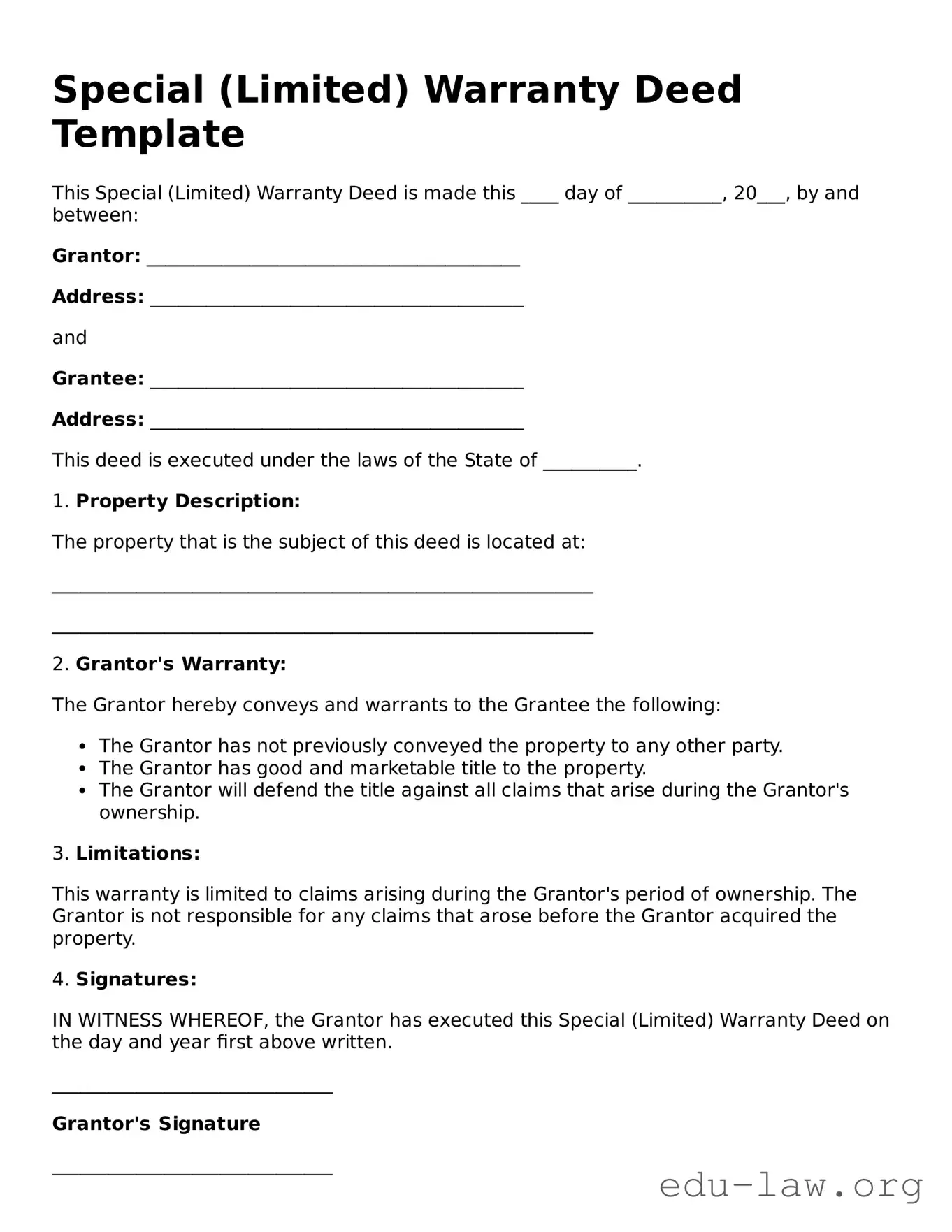
When it comes to real estate transactions, understanding the various types of deeds is essential for both buyers and sellers. One such deed is the Special (Limited) Warranty Deed, a legal document that serves a specific purpose in property transfers. This form provides a limited guarantee from the seller regarding the title of the property being sold. Unlike a general warranty deed, which offers broad protection against any claims or defects in title, the Special Warranty Deed only covers issues that arose during the seller's ownership. This means that if any title problems existed before the seller acquired the property, the seller is not responsible for resolving them. The form typically includes essential details such as the names of the parties involved, a description of the property, and the terms of the transfer. It also outlines the limited nature of the warranty, ensuring that both parties have a clear understanding of their rights and obligations. By using this deed, sellers can limit their liability while still providing some assurance to buyers, making it a popular choice in various real estate transactions.
Special (Limited) Warranty Deed Template
This Special (Limited) Warranty Deed is made this ____ day of __________, 20___, by and between:
Grantor: ________________________________________
Address: ________________________________________
and
Grantee: ________________________________________
Address: ________________________________________
This deed is executed under the laws of the State of __________.
1. Property Description:
The property that is the subject of this deed is located at:
__________________________________________________________
__________________________________________________________
2. Grantor's Warranty:
The Grantor hereby conveys and warrants to the Grantee the following:
3. Limitations:
This warranty is limited to claims arising during the Grantor's period of ownership. The Grantor is not responsible for any claims that arose before the Grantor acquired the property.
4. Signatures:
IN WITNESS WHEREOF, the Grantor has executed this Special (Limited) Warranty Deed on the day and year first above written.
______________________________
Grantor's Signature
______________________________
Grantee's Signature
______________________________
Witness Signature
______________________________
Notary Public Signature
My Commission Expires: ________________
| Fact Name | Description |
|---|---|
| Definition | A Special (Limited) Warranty Deed is a legal document used to transfer property ownership with limited guarantees about the title. |
| Liability | The grantor is only responsible for claims arising during their ownership, not for issues that existed prior to their tenure. |
| Usage | This type of deed is often used in real estate transactions involving commercial properties or foreclosures. |
| State-Specific Forms | Each state may have its own version of the Special Warranty Deed. For example, in California, it is governed by the California Civil Code. |
| Title Insurance | Buyers are encouraged to obtain title insurance to protect against any undisclosed claims or issues with the title. |
| Execution Requirements | The deed must be signed by the grantor and may need to be notarized and recorded in the appropriate county office. |
Filling out a Special (Limited) Warranty Deed form is an important step in transferring property ownership. Once you have completed the form, you will need to sign it in the presence of a notary public, and then file it with your local county recorder's office.
What is a Special (Limited) Warranty Deed?
A Special (Limited) Warranty Deed is a legal document used in real estate transactions. It transfers ownership of property from one party to another while providing limited guarantees. The seller, or grantor, only warrants that they have not caused any issues with the title during their ownership. This means that the seller is not responsible for any problems that may have arisen before they owned the property.
When should I use a Special (Limited) Warranty Deed instead of a General Warranty Deed?
You might choose a Special Warranty Deed in situations where you want to limit your liability as a seller. This type of deed is often used in commercial transactions or when a property is sold as-is. If you are unsure about the history of the property or if there are potential title issues from previous owners, a Special Warranty Deed can protect you from claims related to those past problems.
What are the key components of a Special (Limited) Warranty Deed?
A Special Warranty Deed typically includes several important elements. First, it identifies the parties involved—the grantor and the grantee. Next, it describes the property being transferred. The deed also contains the specific language that limits the warranties to the time the grantor owned the property. Finally, it must be signed and notarized to be legally binding.
Are there any risks associated with using a Special (Limited) Warranty Deed?
Yes, there are risks. The limited nature of the warranties means that if title issues arise from before the seller's ownership, the buyer may have no recourse against the seller. It's essential for buyers to conduct thorough due diligence before purchasing property with this type of deed. Title insurance can help mitigate some of these risks by protecting against unforeseen claims.
How do I prepare a Special (Limited) Warranty Deed?
Preparing a Special Warranty Deed involves several steps. First, gather all necessary information, including the legal description of the property and the names of the parties involved. You can find templates online or consult a legal professional to ensure accuracy. After drafting the deed, both parties must sign it in front of a notary. Finally, record the deed with the appropriate local government office to make the transfer official.
Incorrect Property Description: Failing to provide a precise and accurate description of the property can lead to confusion and potential disputes. Ensure that the legal description matches the one on the property title.
Omitting Grantor or Grantee Information: Leaving out the names of the grantor (the seller) or grantee (the buyer) can invalidate the deed. Both parties must be clearly identified with their full legal names.
Not Including Signatures: The deed must be signed by the grantor. Without a signature, the document is not legally binding. Ensure that all required parties sign the form.
Failure to Notarize: Many states require that the deed be notarized to be valid. Skipping this step can lead to issues with the recording of the deed.
Incorrect Date: Failing to include the date of signing or entering an incorrect date can create complications. The date is important for establishing the timeline of ownership.
Not Checking Local Laws: Different states have varying requirements for warranty deeds. Ignoring local regulations can lead to rejection of the deed when submitted for recording.
Neglecting to Review for Errors: Typos or mistakes in the document can cause significant issues. It’s crucial to review the entire form for accuracy before submission.
Improper Witness Requirements: Some states require witnesses to sign the deed. Failing to meet this requirement can jeopardize the validity of the document.
Not Recording the Deed: After the deed is signed and notarized, it must be recorded with the appropriate county office. Failing to do so may leave the ownership in question.
A Special (Limited) Warranty Deed is an important document used in real estate transactions. It provides a way for a seller to transfer property ownership while limiting their liability for any issues that may arise. Alongside this deed, several other forms and documents may be necessary to ensure a smooth transaction. Here’s a list of commonly used documents that often accompany a Special (Limited) Warranty Deed.
These documents work together to facilitate a successful real estate transaction. Understanding their roles can help both buyers and sellers navigate the complexities of property transfers with confidence.
A General Warranty Deed provides a comprehensive guarantee from the seller to the buyer. Unlike a Special (Limited) Warranty Deed, which only covers the period during which the seller owned the property, a General Warranty Deed ensures that the seller is responsible for any claims against the property, regardless of when they occurred. This document assures the buyer that they have clear title and protection against future claims, offering more extensive coverage than its limited counterpart.
A Quitclaim Deed transfers whatever interest the seller has in the property without any warranties. This means that if the seller has a claim to the property, the buyer receives that claim. However, if the seller has no legal interest, the buyer receives nothing. This document is often used between family members or in divorce settlements where the parties are familiar with each other's ownership status.
A Bargain and Sale Deed implies that the seller has the right to sell the property but does not guarantee a clear title. This deed is often used in foreclosure sales or tax sales, where the seller may not have full knowledge of the property's history. The buyer assumes the risk of any claims against the title, similar to a Quitclaim Deed, but with the implication that the seller has ownership rights.
A Trustee’s Deed is used when property is transferred by a trustee, often in the context of a trust or estate. This deed conveys the property without warranties, similar to a Quitclaim Deed. However, it includes the authority of the trustee to act on behalf of the trust or estate, ensuring that the transfer is valid under the terms of the trust.
An Executor’s Deed is issued when a property is transferred as part of a deceased person's estate. This deed is typically used to convey property to heirs or beneficiaries. Like a Quitclaim Deed, it does not provide warranties, meaning that the buyer must accept the property with any potential claims against it. The executor acts on behalf of the estate, making the process straightforward for the heirs.
A Deed in Lieu of Foreclosure allows a borrower to transfer property back to the lender to avoid foreclosure. This document effectively serves as an agreement between the borrower and lender, allowing the borrower to relinquish ownership without going through the lengthy foreclosure process. While it can help both parties, the lender does not provide any warranties regarding the title, similar to a Quitclaim Deed.
A Warranty Deed with Special Exceptions provides a level of assurance similar to a General Warranty Deed but with specific exceptions noted. This means that while the seller guarantees the title, they may exclude certain claims or defects from the warranty. Buyers should carefully review these exceptions, as they can impact the property's value and usability.
A Mineral Deed specifically transfers ownership of mineral rights beneath a property. This deed can be issued separately from the surface rights, allowing the owner of the mineral rights to extract resources such as oil, gas, or minerals. While it does not provide warranties about the surface property, it ensures that the buyer receives the rights to the minerals, making it a unique document in real estate transactions.
When filling out the Special (Limited) Warranty Deed form, it’s important to follow certain guidelines to ensure accuracy and compliance. Here are some things you should and shouldn't do:
When it comes to real estate transactions, the Special (Limited) Warranty Deed can often be misunderstood. Here are six common misconceptions about this type of deed:
Understanding these misconceptions can help buyers and sellers navigate their real estate transactions more effectively. It's essential to grasp the nuances of the Special Warranty Deed to make informed decisions.
When filling out and using a Special (Limited) Warranty Deed form, there are several important points to keep in mind. This document is crucial for transferring property ownership while limiting the seller's liability. Here are key takeaways to consider:
By keeping these points in mind, individuals can navigate the process of using a Special Warranty Deed more effectively. Understanding the limitations and requirements helps ensure a smooth transfer of property ownership.