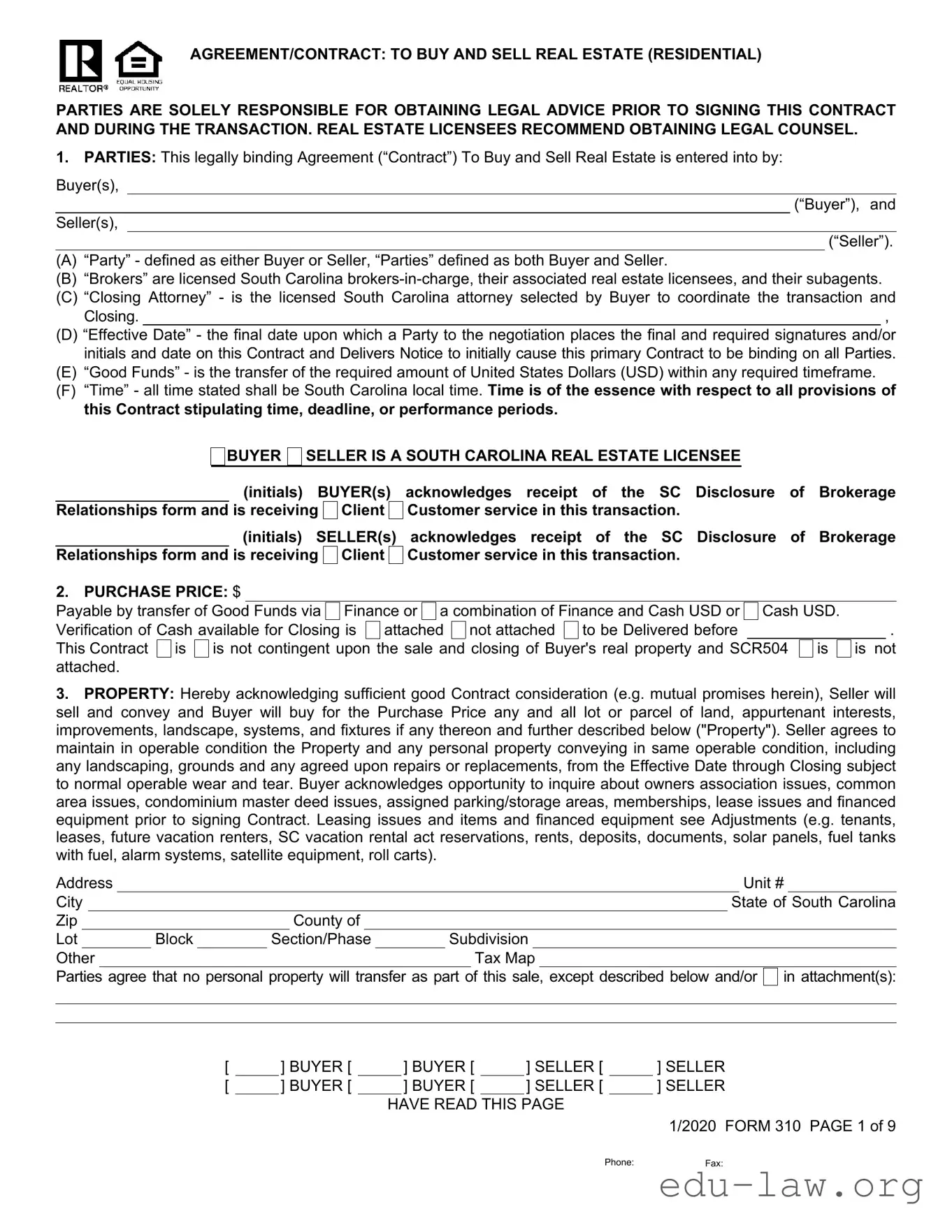
The South Carolina Real Estate Contract 310 form serves as a crucial document in the process of buying and selling residential property within the state. This legally binding agreement outlines the essential terms between the buyer and seller, including the identification of both parties and the property in question. It specifies the purchase price and the method of payment, whether through cash or financing, and includes details about earnest money deposits that demonstrate the buyer's commitment. The form also addresses the conveyance of the property, ensuring it is free from encumbrances and delivered in good condition. Notably, it includes provisions for possession, closing costs, and the responsibilities of both parties regarding inspections and repairs. Additionally, the contract outlines contingencies that may affect the sale, such as financing and property condition, while also addressing the potential risks involved. This comprehensive document not only facilitates a smoother transaction but also protects the interests of both buyers and sellers throughout the real estate process.
AGREEMENT/CONTRACT: TO BUY AND SELL REAL ESTATE (RESIDENTIAL)
PARTIES ARE SOLELY RESPONSIBLE FOR OBTAINING LEGAL ADVICE PRIOR TO SIGNING THIS CONTRACT AND DURING THE TRANSACTION. REAL ESTATE LICENSEES RECOMMEND OBTAINING LEGAL COUNSEL.
1.PARTIES: This legally binding Agreement (“Contract”) To Buy and Sell Real Estate is entered into by: Buyer(s),
(“Buyer”), and
Seller(s),
(“Seller”).
(A)“Party” - defined as either Buyer or Seller, “Parties” defined as both Buyer and Seller.
(B)“Brokers” are licensed South Carolina
(C)“Closing Attorney” - is the licensed South Carolina attorney selected by Buyer to coordinate the transaction and
Closing. |
, |
(D)“Effective Date” - the final date upon which a Party to the negotiation places the final and required signatures and/or initials and date on this Contract and Delivers Notice to initially cause this primary Contract to be binding on all Parties.
(E)“Good Funds” - is the transfer of the required amount of United States Dollars (USD) within any required timeframe.
(F)“Time” - all time stated shall be South Carolina local time. Time is of the essence with respect to all provisions of this Contract stipulating time, deadline, or performance periods.
BUYER SELLER IS A SOUTH CAROLINA REAL ESTATE LICENSEE
(initials) BUYER(s) acknowledges receipt of the SC Disclosure of Brokerage Relationships form and is receiving Client Customer service in this transaction.
(initials) SELLER(s) acknowledges receipt of the SC Disclosure of Brokerage Relationships form and is receiving Client Customer service in this transaction.
2. PURCHASE PRICE: $
|
|
|
|
|
|
|
Payable by transfer of Good Funds via Finance or a combination of Finance and Cash USD or Cash USD. |
|
|
||||
Verification of Cash available for Closing is |
attached not attached to be Delivered before |
|
|
|
. |
|
This Contract is is not contingent upon the sale and closing of Buyer's real property and SCR504 |
is |
is not |
||||
attached. |
|
|
|
|
|
|
3.PROPERTY: Hereby acknowledging sufficient good Contract consideration (e.g. mutual promises herein), Seller will sell and convey and Buyer will buy for the Purchase Price any and all lot or parcel of land, appurtenant interests, improvements, landscape, systems, and fixtures if any thereon and further described below ("Property"). Seller agrees to maintain in operable condition the Property and any personal property conveying in same operable condition, including any landscaping, grounds and any agreed upon repairs or replacements, from the Effective Date through Closing subject to normal operable wear and tear. Buyer acknowledges opportunity to inquire about owners association issues, common area issues, condominium master deed issues, assigned parking/storage areas, memberships, lease issues and financed equipment prior to signing Contract. Leasing issues and items and financed equipment see Adjustments (e.g. tenants, leases, future vacation renters, SC vacation rental act reservations, rents, deposits, documents, solar panels, fuel tanks with fuel, alarm systems, satellite equipment, roll carts).
Address |
|
|
|
|
|
|
|
|
|
|
|
|
Unit # |
|||||||
City |
|
|
|
|
|
|
|
|
|
|
|
|
State of |
South Carolina |
|
|||||
Zip |
|
|
|
|
|
|
County of |
|
|
|
|
|
|
|
|
|
|
|||
Lot |
|
|
|
|
Block |
|
|
Section/Phase |
|
|
Subdivision |
|
|
|
|
|||||
Other |
|
|
|
|
|
|
|
|
|
Tax Map |
|
|
|
|
|
|||||
Parties |
agree that no personal property will transfer as part of this sale, except described below and/or |
in attachment(s): |
|
|||||||||||||||||
|
|
|
|
|
|
|
|
|
|
|
|
|
|
|
|
|
|
|
|
|
|
|
|
|
|
|
|
|
|
|
|
|
|
|
|
|
|
|
|
|
|
[ |
|
] BUYER [ |
|
] BUYER [ |
|
] SELLER [ |
|
] SELLER |
[ |
|
] BUYER [ |
|
] BUYER [ |
|
] SELLER [ |
|
] SELLER |
|
|
|
HAVE READ THIS PAGE |
|
|
|||
1/2020 FORM 310 PAGE 1 of 9
Phone:Fax:

4.CONVEYANCE/CLOSING/POSSESSION: “Closing” occurs when Seller conveys Property to Buyer and occurs no
later than 5 PM on or before,(“Closing Date”). Conveyance shall be fee
simple made subject to all easements, reservations, rights of way, restrictive covenants of record (provided they do not make the title unmarketable or adversely affect the use/value of the Property in a material way) and to all government statutes, ordinances, rules, permits, and regulations. Seller agrees to convey marketable title with a properly recorded general warranty deed free of encumbrances and liens except as herein stated; and in name(s):
and ownership type determined by Buyer. The deed shall be delivered to the Closing Attorney's designated place on or before the Closing Date no later than 10 AM. Seller agrees to pay all statutory deed recording fees. Parties agree the Brokers shall have access to the closing and relevant documents; and the Brokers shall be given copies of the settlement statement prior to Closing for review. Parties agree to hire/use licensed Attorney(s). Seller shall convey possession of a vacant and reasonably clean Property, free of debris, along with all keys, codes, any remote controls, available documents (e.g. manuals, equipment warranties, service information) and similar ownership items to Buyer at Closing.
5. EARNEST MONEY: Total $ |
|
|
(USD) Earnest Money is paid as follows: |
|||||||||||
$ |
|
|
|
|
accompanies this offer and $ |
|
|
|
|
|
will be paid by 6 P.M. on |
|||
|
|
|
|
|
|
(date) and Earnest Money is in the form of |
|
check |
|
cash |
other (e.g. wire) |
|||
|
|
|
to be a Credit to Buyer at Closing or disbursed only as |
|
Parties agree in writing or by court |
|||||||||
order or |
by Contract or |
as required for Closing |
by Closing Attorney. |
Buyer |
and |
seller authorize |
||||||||
|
|
|
|
|
|
|
as Escrow Agent to deposit and hold and disburse earnest |
|||||||
money according to the terms of any separate escrow agreement, the law, and any regulations. Broker does not guarantee payment of a check or checks accepted as earnest money. Parties direct escrow agent to communicate reasonable information confirming receipt and status of earnest money upon a Broker request. If Earnest Money is not delivered by the agreed upon date above Seller may terminate the contract by delivering Notice of Termination to the Buyer.
THE PARTIES UNDERSTAND AND AGREE THAT UNDER ALL CIRCUMSTANCES INCLUDING DEFAULT, ESCROW AGENT WILL NOT DISBURSE EARNEST MONEY DEPOSIT TO EITHER PARTY UNTIL BOTH PARTIES HAVE EXECUTED AN AGREEMENT AUTHORIZING THE DISBURSEMENT (e.g. SCR518, SCR517, MEDIATION AGREEMENT) OR UNTIL A COURT OF COMPETENT JURISDICTION HAS DIRECTED A DISBURSEMENT. EARNEST MONEY WILL NOT BE DISBURSED UNTIL DETERMINED TO BE GOOD FUNDS. IF LEGAL ACTIONS OCCUR RELATED TO EARNEST MONEY, PARTY RECEIVING THE LEAST AMOUNT OF EARNEST MONEY IN THE COURT'S DISBURSEMENT ORDER AGREES TO INDEMNIFY ESCROW AGENT'S FEES, COURT COSTS AND ATTORNEY
FEES. IF INTERPLEADER IS TO BE UTILIZED, PARTIES AGREE THAT $SHALL BE PAID TO THE ESCROW AGENT BY THE PARTIES AS COMPENSATION BEFORE ESCROW AGENT INITIATES COURT OF COMPETENT JURISDICTION PROCEEDINGS ON EARNEST MONEY.
6.TRANSACTION COSTS: Buyer's transaction costs include all costs and closing costs resulting from selected financing,
All costs to obtain information from or pertaining to owners' association, private/public transfer fees, and any costs similar to transfer fees (e.g. certificate of assessment, capital contributions, working capital, estoppel fees or otherwise named but similar fees) are the Seller's or Buyer's transaction costs. If no box is checked these costs will be added to Seller's transaction costs.
At Closing, Seller will pay Buyer's transaction costs not to exceed $, which includes non-
allowable costs first and then allowable costs (FHA/VA). Buyer is responsible for any Buyer's transaction costs exceeding this amount. If the amount exceeds the actual amount of those costs or amount allowed by Lender, then any excess funds will revert to Seller. Seller will also provide or pay for all of Seller's transaction costs. If no Closing, Buyer is responsible for Buyer's transaction costs and Seller responsible for Seller's transaction costs.
Unless otherwise agreed upon in writing, Buyer will pay Buyer's transaction costs and Seller pay Seller's transaction costs.
[ |
|
] BUYER [ |
|
] BUYER [ |
|
] SELLER [ |
|
] SELLER |
[ |
|
] BUYER [ |
|
] BUYER [ |
|
] SELLER [ |
|
] SELLER |
|
|
|
HAVE READ THIS PAGE |
|
|
|||
1/2020 FORM 310 PAGE 2 of 9

7. FINANCE: Buyer's obligation under this Contract |
is is not contingent upon obtaining financing of a |
30 year or |
|||
15 year or |
other |
|
purchase money loan at reasonable prevailing market terms with loan(s) equal |
||
in amounts to a maximum |
% of the Purchase Price or Appraised Value whichever is lower. ("Financing |
||||
Contingency"). Financing Contingency expires at Closing ("Financing Period"). Buyer must make timely good faith efforts to apply for and obtain financing while refraining from contrary actions ("Financing Effort"). In a timely manner, Buyer shall inform Seller and Brokers of pertinent financing issues and authorize Buyer's Lender to disclose pertinent loan information
to Seller and Brokers ("Financing Disclosure"). Buyer shall apply for financing by(date) and
shall Deliver Notice to Seller of reasonable
contains no unreasonable credit, income, or asset conditions by(date) (no repairs required
prior to this Notice). Final loan approval occurs when Lender funds loan(s). If the Buyer changes their Lender during the
Financing Period they must notify the seller in writing within calendar days. Absent written approval by the Seller,
Buyer cannot change lender if the closing date agreed upon in Paragraph 4 will change as a direct result. If a Lender subsequently declines or fails to approve financing, the Buyer shall notify the Seller and Brokers as soon as possible. If the Seller and Brokers are notified of inability to obtain financing during the Financing Period, either Party may terminate
this Contract by Notice. |
|
|
|
|
|
|
||
Lender (may change): |
|
|
|
|
|
FHA VA Conventional Seller |
||
Other |
|
. An FHA VA Financing Addendum |
|
is |
|
|
is not attached. Additional financing terms |
|
are |
are not attached. |
|
|
|
|
|
|
|
8. REPAIRS:
CHECK ONLY ONE OF THE FOLLOWING OPTIONS. IF NO BOXES ARE CHECKED THIS CONTRACT WILL BE AN
REPAIR PROCEDURE:
All Repair Procedure Inspections and Requests shall be completed and delivered to the Seller by 6 P.M. on (date). Any and all requests necessary to place the heating systems, air conditioning systems, electrical systems, plumbing systems, water supply systems, water waste systems to be conveyed in operative
condition, to make the roof free of leaks, to address environmental concerns and to make the improvements structurally sound (Repair Requests) should be delivered by the deadline above. If the Buyer fails to notify the Seller within this timeframe, Buyer shall have waived any and all rights under terms of this section. If Lender's commitment requires any additional inspections or certifications, these are to be provided by the Buyer. Buyer at Buyer's expense shall have the privilege and responsibility of inspecting the structure, square footage, environmental concerns including but not limited to mold, radon gas, lead based hazards including lead based paints, wetlands study, appurtenant buildings, heating systems, air conditioning systems, electrical systems, plumbing systems, water supply systems, water waste systems, as well as, appurtenant equipment or appliances. Upon Seller's request the Buyer will provide with a copy of the Inspection Report.
No later than 6 P.M. on(date), Seller shall Deliver Notice agreeing or
not agreeing to make repairs in the Buyer's Repair Requests. The costs of all repairs to heating systems, air conditioning systems, electrical systems, plumbing systems, water supply systems, water waste systems making these systems operable, make roof free of leaks, address environmental concerns, and to make the improvements structurally sound to be paid by Seller ("Seller Paid Repairs"). Seller Paid Requests DO NOT include the following items: home maintenance, flooring, fogged windows, grandfathered code issues, landscaping, preventive maintenance, cosmetic changes, home improvement, and energy efficiency. If the Seller contractually agrees to make all the requested Seller Paid Repairs, the Parties agree to proceed under the amended Contract. The repairs to any other items are the sole responsibility of the Buyer.
If the Seller does not timely respond per above or does not agree to make all the Seller Paid Repairs, the Buyer shall within 2 Calendar Days choose any one of the following options (1) accept the Property in its present condition, (2) negotiate a new/amended Contract with the Seller for the payment of these repairs/price or (3) terminate this Contract by Delivered Notice. IF BUYER FAILS TO ACCEPT, RENEGOTIATE A NEW/AMENDED CONTRACT WITH SELLER, OR TERMINATE CONTRACT BY DELIVERED NOTICE WITHIN 2 CALENDAR DAYS: The Buyer agrees to buy and Seller agrees to sell the Property AS IS. Parties agree "As Is" means Buyer buys the Property for the Purchase Price while Seller maintains the Property from the Effective Date through Closing subject to normal wear otherwise without repair or replacement and sells the Property for the Purchase Price unless otherwise agreed upon in writing by the Parties in this Contract. The obligations of the Seller for repairs terminate upon Closing.
DUE DILIGENCE:
The DUE DILIGENCE PERIOD begins upon the Effective Date and shall expire at 6 P.M. on (date). Any extension to this date must be made in writing and agreed to by both Parties.
[ |
|
] BUYER [ |
|
] BUYER [ |
|
] SELLER [ |
|
] SELLER |
[ |
|
] BUYER [ |
|
] BUYER [ |
|
] SELLER [ |
|
] SELLER |
|
|
|
HAVE READ THIS PAGE |
|
|
|||
1/2020 FORM 310 PAGE 3 of 9

During the Due Diligence Period, Buyer may take timely/prudent steps to help Buyer/Inspectors, Seller/Estimators, and REALTORS® all have adequate time for: Buyer to coordinate Inspections and Repair Requests, Seller to obtain Repair estimates, Buyer and Seller to negotiate Repairs, and Buyer to potentially timely/properly Due Diligence terminate or buy.
During the Due Diligence Period, Seller agrees Buyer may rely on the following list of five items in accordance with Contract and laws. Buyer is solely responsible for Inspections. Buyer is not required to Inspect. Until Buyer timely/properly terminates the Contract or the Parties agree on an amended Contract, the Buyer can rely on #1, #2, #3, #4, and #5. TIME IS OF THE ESSENCE. Delivering a Repair Request does not extend the Due Diligence Period.
(1)Conduct/obtain Inspections [e.g. on site conditions, off site conditions]
(2)Deliver Repairs Requests Notice to Seller [e.g. SCR525 with all repair requests, all/portions of reports]
(3)Proceed under amended Contract [e.g. SCR310 and SCR525, SCR390, SCR391]
(4)Proceed under As Is Contract [e.g. Buyer desires to buy anyway, Buyer wants Property without Repair]
(5)Terminate Contract by timely/properly Delivering "Notice of Termination" and "Termination Fee" to Seller within the Due Diligence Period.
TERMINATION: During the Due Diligence Period, Buyer may unilaterally terminate this Contract only by
Delivering to the Seller both Notice of Termination and a Termination Fee of $USD Good Funds.
DURING THE DUE DILIGENCE PERIOD, SHOULD BUYER FAIL TO OBTAIN A NEW/AMENDED CONTRACT WITH THE SELLER OR BUYER FAIL TO TIMELY/PROPERLY DUE DILIGENCE TERMINATE THE CONTRACT DURING THE DUE DILIGENCE PERIOD: The Buyer agrees to buy and Seller agree to sell the Property AS IS. Parties agree "As Is" means Buyer buys the Property for the Purchase Price while Seller maintains the Property from the Effective Date through Closing subject to normal wear otherwise without repair or replacement and sells the Property for the Purchase Price unless otherwise agreed in writing by the Parties in this Contract
All Parties agree that Property is being sold
Contract. Buyer retains the right to inspect the Property by 6 P.M. on(date) for informational purposes only. The Seller is under no obligation to remedy any issues the Buyer discovers during their inspections, and the Buyer may not terminate the contract based on the results of any inspections conducted.
9.INSPECTION/REINSPECTION RIGHTS: Buyer and SC licensed and insured inspectors (“Inspectors”) reasonably perform any reasonable ultimately
Sellers will make the Property accessible for Inspection and not unreasonably withhold access, unless otherwise agreed in writing by the Parties. Seller will grant the Buyer the right to perform a final walkthrough inspection of the property within 48 hours prior to the closing date. Seller will keep all utilities operational through Closing unless otherwise agreed:
Seller grants Buyer permission to connect utilities, pay for utilities, and hire professionals (e.g. electricians, plumbers) to safely connect and operate the utilities during the Inspections
Other |
see attached. |
Buyer will hold harmless, indemnify, pay damages and attorneys fees to Seller and Brokers for all claims, injuries, and damages arising out of the exercise of these inspection rights. Seller will hold harmless, indemnify, pay damages and attorneys fees to Brokers for all claims, injuries, and damages arising out of the exercise of these inspection rights. Brokers recommend that Parties obtain all inspections as soon as possible. Brokers recommend that Parties and Inspectors use insurance to manage risk.
[ |
|
] BUYER [ |
|
] BUYER [ |
|
] SELLER [ |
|
] SELLER |
[ |
|
] BUYER [ |
|
] BUYER [ |
|
] SELLER [ |
|
] SELLER |
|
|
|
HAVE READ THIS PAGE |
|
|
|||
1/2020 FORM 310 PAGE 4 of 9
10. APPRAISED VALUE:
This Contract is contingent upon the Property being valued according to the Lender's appraisal or other appraisal as agreed upon by the Parties (“Appraised Value”) for the Purchase Price or higher. If the Parties are made aware that the Appraised Value is less than the Purchase Price and the Seller Delivers Notice to the Buyer within 5 Calendar Days or Closing (whichever earliest) of an amendment to reduce the Purchase Price to the Appraised Value, the Parties agree to proceed to Closing under terms of this Contract with the Purchase Price amended to be the Appraised Value. If Seller is aware and refuses to reduce as stated above, Buyer may proceed to Closing or terminate this Contract by Delivering Notice of Termination to the Seller.
This Contract is not contingent upon the Property being valued at an Appraised Value according to the Lender's appraisal or other appraisal as agreed upon by the Parties for the Purchase Price or more.
11.WOOD INFESTATION REPORT: If the Property to be sold has been previously occupied, this Contract is contingent not contingent upon the Buyer Seller having the Property inspected at their expense by a qualified/licensed/bonded pest control operator selected by the Buyer Seller. Buyer Seller shall deliver timely Notice of and shall deliver to Closing a CL100 Wood Infestation Report dated no earlier than 30 calendar days prior to
Closing and no later than calendar days prior to Closing. If the Buyer is responsible for having the Property
inspected as indicated above, but does not have the Property timely inspected for the report's required Delivery time frame, the Buyer waives any and all rights under the terms of this section. The Seller makes no warranties with regard to matters covered by such infestation report or any other improvement unless specifically stated in this Contract.
If the wood infestation report reveals the presence or indication of or damages by termite infestation or other wood destroying organisms, Seller shall remedy such deficiencies and shall furnish the Buyer with a CL100 wood infestation report by a qualified/licensed/bonded pest control operator (dated no earlier than 30 calendar days prior to Closing) that the Property is free from infestation or any damage herein mentioned; or documentation that the infestation has been treated and damage has been repaired as appropriate in a workmanlike manner on or before closing and reported by an appropriate licensee. State law and regulations control CL100 issues. If the Seller does not make the repairs and treatment, the Buyer shall have the option to
(1)accept the Property in its present condition, (2) negotiate with the Seller for the payment of these repairs and treatment, or
(3)terminate this Contract by Delivering Notice of Termination to the Seller. If the Property to be sold has not been previously occupied, Seller shall certify that the Dwelling has been treated by soil poisoning for the prevention of termites and other wood destroying organisms and shall provide at Closing to the Buyer a written certification from a qualified/licensed/bonded pest control operator. The obligations of the Seller under this Section terminate after the Closing.
12.SURVEY, TITLE EXAMINATION, ELEVATION, INSURANCE: Brokers recommend Buyer have Property surveyed, title examined, elevation/wetlands/beachfront determined, and appropriate insurance (e.g. flood, flood contents, hazard, liability, owner's title) effective at Closing. Unless otherwise agreed upon in writing by Parties, Buyer to obtain new insurance policies by Closing and Seller may cancel existing insurance after Closing. Flood Insurance, if required by Lender or at Buyer's option, shall be assigned to Buyer with permission of carrier and premium prorated to Closing. Buyers are solely responsible to investigate pricing, availability, coverage, and requirements of insurance (e.g. flood, flood contents, hazard, liability) for the property prior to signing Contract.
13.SURVIVAL: If any provision herein contained which by its nature or effect is required to be observed, kept, or performed after Closing, it will survive the Closing and remain binding upon for the parties hereto until fully observed, kept or performed.
14.HOME WARRANTY COMPANY OPTIONAL COVERAGE (“HWC”): Parties agree that a Home Warranty ordered by
|
|
with at least twelve months of coverage after Closing Date |
will will not be provided by |
|||
Closing and $ |
|
|
will be paid by |
|
to the Home Warranty Company. |
|
Buyer to pay any deficit and surplus reverts to payor. Proposed HWC and type of HWC: |
|
. |
||||
NOTICE: THIS IS TO GIVE YOU NOTICE THAT BROKERS HAVE/WILL/MAY RECEIVE COMPENSATION FROM HWC/OTHERS FOR REFERRAL/PROCESSING. YOU ARE NOT REQUIRED TO PURCHASE A HWC OR SIMILAR RESIDENTIAL SERVICE CONTRACT AND IF YOU CHOOSE TO PURCHASE SUCH COVERAGE YOU ARE FREE TO PURCHASE IT FROM ANOTHER PROVIDER.
15.FIRE OR CASUALTY OR INJURY: In case the Property is damaged wholly or partially by fire or other casualty prior to Closing, Parties will have the right for 5 Calendar Days after Notice of damage to Deliver Notice of Termination to other Party. If Party does not Deliver Notice of Termination, the Parties proceed according to the Contract and Seller is to be responsible to (1) repair all damage, (2) remit to Buyer an amount sufficient for repairs, or (3) assign to Buyer the right to all proceeds of insurance and remit any deductible amount applicable to such casualty. If Buyer or Inspections caused the damage, Buyer is responsible for indemnifying Seller for damages. Brokers and Parties should ensure that they are protected by appropriate risk management strategies such as insurance.
[ |
|
] BUYER [ |
|
] BUYER [ |
|
] SELLER [ |
|
] SELLER |
[ |
|
] BUYER [ |
|
] BUYER [ |
|
] SELLER [ |
|
] SELLER |
|
|
|
HAVE READ THIS PAGE |
|
|
|||
1/2020 FORM 310 PAGE 5 of 9

16. SC RESIDENTIAL PROPERTY CONDITION DISCLOSURE STATEMENT (“CDS”) [check one]:
Buyer and Seller agree that Seller has Delivered prior to this Contract, a CDS to Buyer, as required by SC Code of Laws Section
Buyer and Seller agree that Seller will NOT complete nor provide a CDS to Buyer in accordance with SC Code of Law, as amended, Section
17.LEAD BASED PAINT/LEAD HAZARDS: If Property was built or contains items created prior to 1978, it may contain lead based hazards and Parties agree to sign "Disclosure of Information of Lead Based Paint and/or Lead Hazards" forms (e.g. SCR315) and give copies to Brokers. Parties acknowledge receiving and understanding the EPA pamphlet "Protect Your Family From Lead in Your Home." For their protection, Buyers should conduct/obtain Inspections of all Property issues per their needs.
18.SEX OFFENDER/CRIMINAL INFORMATION: Parties agree that Brokers are not responsible for obtaining or disclosing information in the SC Sex Offender Registry and no course of action may be brought against any Brokers for failure to obtain or disclose sex offender or criminal information. Buyer and Seller agree that they have sole responsibility to obtain their own sex offender, death, psychological stigma, clandestine laboratory, and crime information from sources (e.g. law enforcement, P.I., web). The Buyer may obtain information about the Sex Offender Registry and persons registered with the Registry by contacting the local county Sheriff or other appropriate law enforcement officials.
19.TRUST ACCOUNT INTEREST/CHARITABLE CONTRIBUTION: According to the South Carolina Real Estate Commission regulations and South Carolina laws, any interest earned from deposit to Closing on Buyer's earnest money deposit belongs to Buyer. It is understood that Broker may may not place deposited earnest monies into an interest bearing trust account. If Buyer's earnest money deposit is deposited into an interest bearing trust account, Parties agree that Broker will retain all interest earned in said account and may contribute some or all to a charitable enterprise.
20.SC INCOME TAX ON
21.ENTIRE AND BINDING AGREEMENT (MERGER CLAUSE): Parties agree that this Contract expresses the entire agreement between the parties, that there is no other agreement, oral/otherwise, modifying the terms; and this Contract is binding on Parties and principals, heirs, personal representatives, successors, and assigns. Illegal provisions are severable.
22.ADJUSTMENTS: Buyer and Seller agree to settle or prorate, annually or as appropriate; as of Closing Date: (A) utilities and waste fees issued after Closing which include service for time Property was owned/occupied by Seller (B) real estate taxes and owner association fees/assessments for the calendar year of Closing (C) any rents, deposits, fees associated with leasing (D) insurance, EMS service, fuel/consumables, and assessments. Closing Attorney shall make tax proration based on the available tax information deemed reliable by the Closing Attorney. Should the tax or tax estimate or proration later become inaccurate or change, Buyer and Seller shall make any financial adjustments between themselves once accurate tax information is available and Buyer takes timely reasonable steps to minimize taxes. This section survives Closing. Buyer is solely responsible for timely and reasonably minimizing the Buyer's taxes and obtaining tax minimization procedural information including related legal counsel and financial counsel. Special assessments approved prior to Closing shall be the responsibility of the Seller. Special Assessments approved after Closing shall be the responsibility of the Buyer.
23.DEFAULT:
(A)If Seller defaults in the performance of any of the Seller's obligations under this Contract (“Default”), Buyer may:
(i)Deliver Notice of Default to Seller and terminate Contract; and
(ii)Pursue any remedies available to Buyer at law or equity; and
(iii)Recover attorneys' fees and all other direct costs of litigation if Seller found in default/breach of Contract.
(B)If Buyer defaults in the performance of any of the Buyer's obligations under this Contract ("Default"), Seller may:
(i)Deliver Notice of Default to Buyer and terminate Contract; and
(ii)Pursue any remedies available to Seller at law or equity; and
(iii)Recover attorneys' fees and all other direct costs of litigation if Buyer found in default/breach of Contract.
[ |
|
] BUYER [ |
|
] BUYER [ |
|
] SELLER [ |
|
] SELLER |
[ |
|
] BUYER [ |
|
] BUYER [ |
|
] SELLER [ |
|
] SELLER |
|
|
|
HAVE READ THIS PAGE |
|
|
|||
1/2020 FORM 310 PAGE 6 of 9

(C)If either/both Parties default, Parties agree to sign an escrow deposit disbursement agreement or release agreement.
(D)Parties may agree in writing to allow a Cure Period for a default. If within the Cure Period, either Party cures the Default and Delivers Notice, Parties shall proceed under the Contract.
24.MEDIATION: To potentially avoid expensive/lengthy/uncertain litigation, Parties may voluntarily/cooperatively decide which mediator to hire, how to pay the mediator, where to meet for mediation talks, and their own settlement agreement. Mediators do not decide settlement outcomes (Parties decide). Mediators merely facilitate the Parties reaching their own settlement and documenting settlement. Parties agree to attempt mediation for any dispute, claim, breach, representations made by any Party. Broker/other (e.g. concealment, misrepresentation, negligence, fraud) or service issues related to this Contract by using the National Association of REALTORS® Mediation Dispute Resolution System
25.
26.BROKER DISCLAIMER: Parties acknowledge that Brokers give no warranties or representations of any kind, expressed or implied as to: (1) condition of the Property, including but not limited to termites, radon, mold, asbestos, moisture, environmental issues, water, waste, air quality, HVAC, utilities, plumbing, electrical or structure, etc. (2) condition of the Property, survey or legal matters, square footage (3) off site conditions (4) schools (5) title including but not limited to easements, encroachments, projections, encumbrances, restrictions, covenants, setbacks, and the like (6) fitness for a particular purpose of the Property or the improvements (7) zoning ordinances and restrictions (8) projected income, value, marketability, taxes, insurance, or other possible benefits to Buyer. Parties consent that their Brokers may communicate with them via any means; and use or disclose information not made confidential by written instruction of Parties.
27.BROKERS COMPENSATION: Parties direct Closing Attorney to use settlement funds to collect and disburse Brokers Compensation to Brokers in accordance with agreements and document compensation on the settlement statement. If a Party disputes Brokers Compensation, that Party agrees to retain a South Carolina law firm to escrow only the disputed amount of Brokerage Compensation until the dispute is resolved by a written agreement signed by that Party and the Affected Broker, arbitration award, or court order. Party requesting the escrow shall pay all costs for escrow. If the dispute is not resolved within
180days of Closing, the escrow shall be disbursed to the Broker. Parties agree that Brokers are third party beneficiaries to this Contract and have standing to seek remedies at law and equity. Parties represent that their only enforceable agency and/or
28.ATTACHMENTS, OTHER CONTINGENCIES, TERMS, AND/OR STIPULATIONS: There may be attachments to this Contract. The most recent changes, amendments, attachments, contingencies, stipulations, addendum, additions, exhibits, or writings, agreed to by the Parties; is evidence of the Parties' intent and agreement and shall control any Contract language conflicts. Parties shall initial and date Contract changes. If any documents are attached as addenda, amendments, attachments, or exhibits considered part of this Agreement, such documents can be further identified or described here (e.g. SCR 390, 391, 503, 504, 315, 320, 393, 370, 375, 513, 610):
29.NOTICE AND DELIVERY: Notice is any unilateral communication (e.g. offers, counteroffers, acceptance, termination, unilateral requests for better terms, and associated addenda/amendments) from one Party to the other. Notice to/from a Broker representing a Party is deemed Notice to/from the Party. All Notice, consents, approvals, counterparts, and similar actions required under Contract must be in paper or electronic writing and will only be effective as of delivery to the Notice address/email/fax written below and awareness of receipt by Broker (“Delivered”) unless Parties agree otherwise in writing.
[ |
|
] BUYER [ |
|
] BUYER [ |
|
] SELLER [ |
|
] SELLER |
[ |
|
] BUYER [ |
|
] BUYER [ |
|
] SELLER [ |
|
] SELLER |
|
|
|
HAVE READ THIS PAGE |
|
|
|||
1/2020 FORM 310 PAGE 7 of 9
30.Acknowledgements: Due to potential criminal activity, parties are solely responsible to verify all wiring instructions with law firm/bank. Parties are also advised and understand that audio/visual surveillance may occur in the property and parties should plan accordingly and comply with all federal, state, and local laws. Parties acknowledge receiving, reading, reviewing, and understanding: this Contract, the SC Disclosure of Real Estate Brokerage Relationships form, any agency agreements, and copies of these documents. Parties acknowledge having time and opportunity to review all documents and receive legal counsel from their attorneys prior to signing Contract.
31.EXPIRATION OF OFFER: When signed by a Party and intended as an offer or counter offer, this document
represents an offer to the other Party that may be rescinded any time prior to or expires at |
|
AM PM |
||
on |
, |
unless accepted or |
Party in written form Delivered |
|
prior to such deadline. This offer will expire automatically if no action is taken by either party 30 calendar days after the offer's submittal.
IN WITNESS WHEREOF, this Contract has been duly executed by the Parties as true to the best of their knowledge/belief. If signee is not a Party, appropriate legal documents (e.g. Power of Attorney, Corporate Authorization)
are attached or to be Delivered to the other Party within |
|
Calendar Days. |
|
|
||||||
Parties shall initial and date all changes in this Contract and initial all pages. |
|
|
||||||||
BUYER: |
|
|
|
|
Date: |
|
Time: |
|
||
BUYER: |
|
|
|
|
Date: |
|
Time: |
|
||
BUYER: |
|
|
|
|
Date: |
|
Time: |
|
||
BUYER: |
|
|
|
|
Date: |
|
Time: |
|
||
NOTICE ADDRESS/EMAIL/FAX: |
|
|
|
|
|
|
|
|
||
|
|
|
|
|
|
|
|
|||
|
|
|
|
|
|
|
|
|||
SELLER: |
|
|
|
|
Date: |
|
Time: |
|
||
SELLER: |
|
|
|
|
Date: |
|
Time: |
|
||
SELLER: |
|
|
|
|
Date: |
|
Time: |
|
||
SELLER: |
|
|
|
|
Date: |
|
Time: |
|
||
NOTICE ADDRESS/EMAIL/FAX:
[ |
|
] BUYER [ |
|
] BUYER [ |
|
] SELLER [ |
|
] SELLER |
[ |
|
] BUYER [ |
|
] BUYER [ |
|
] SELLER [ |
|
] SELLER |
|
|
|
HAVE READ THIS PAGE |
|
|
|||
1/2020 FORM 310 PAGE 8 of 9
Buyer's Agent/Company |
Buyer's Agent License #/LLR Office Code |
|
|
Buyer's Agent's Email Address |
Buyer's Agent Telephone Number |
|
|
Seller's Agent/Company |
Seller's Agent License #/LLR Office Code |
|
|
Seller's Agent's Email Address |
Seller's Agent Telephone Number |
REALTOR® is the registered collective membership mark which may be used only by those real estate licensees who are members of the NATIONAL ASSOCIATION OF REALTORS® and who subscribe to its strict professional Code of Ethics. The South Carolina Association of REALTORS® (SCR) owns copyright to the content of this form and expressly prohibits the display, distribution, duplication, transmission, alteration, or reproduction of any part of SCR copyright content as well as the use of the name "South Carolina Association of REALTORS®" in connection with any written or electronic format without the prior written consent of SCR. SCR makes no representation as to the legal adequacy of this form or the information added for a specific transaction and recommends that Parties consult a SC attorney prior to signing to ensure the completed form meets your legal need.
[ |
|
] BUYER [ |
|
] BUYER [ |
|
] SELLER [ |
|
] SELLER |
[ |
|
] BUYER [ |
|
] BUYER [ |
|
] SELLER [ |
|
] SELLER |
|
|
|
HAVE READ THIS PAGE |
|
|
|||
1/2020 FORM 310 PAGE 9 of 9
| Fact Name | Details |
|---|---|
| Parties Involved | The form identifies the Buyer(s) and Seller(s) as the main parties in the real estate transaction. |
| Property Description | The form requires a detailed description of the property, including its address, tax map number, and any improvements or fixtures included in the sale. |
| Conveyance of Title | The Seller agrees to convey a marketable title and deliver a proper general warranty deed, free of encumbrances, unless stated otherwise. |
| Possession Timing | Possession of the property is granted to the Buyer at the time of closing, with conditions for maintenance prior to that date. |
| Earnest Money | An earnest money deposit is required, which will be held by an escrow agent until the transaction is consummated or otherwise directed by a court. |
| Loan Contingency | The Buyer’s obligation to proceed is contingent upon obtaining financing, with specific timelines for application and approval. |
| Closing Costs | Closing costs are typically divided between the Buyer and Seller, with specific responsibilities outlined for each party. |
| Expiration of Offer | The offer from the Buyer is valid until a specified time unless accepted or countered by the Seller in writing. |
| Governing Law | This contract is governed by the laws of South Carolina, specifically referencing the South Carolina Code of Laws. |
Filling out the South Carolina Real Estate Contract 310 form is an important step in the process of buying or selling property. Completing this form accurately ensures that both parties are clear about the terms of the transaction. Follow these steps carefully to fill out the form correctly.
Once you have completed the form, it is advisable to review it carefully for accuracy. Both parties should retain a copy for their records. After this step, you can proceed with the next stages of the transaction, such as negotiations or closing preparations.
What is the South Carolina Real Estate Contract 310 form?
The South Carolina Real Estate Contract 310 form is a legally binding agreement used for residential real estate transactions in South Carolina. It outlines the terms and conditions under which a buyer agrees to purchase property from a seller. This form includes details about the parties involved, the property being sold, the purchase price, payment methods, and various contingencies that may apply to the transaction.
Who are the parties involved in this contract?
The contract involves two main parties: the buyer(s) and the seller(s). The buyer is the individual or entity purchasing the property, while the seller is the individual or entity selling the property. Both parties must sign the contract for it to be legally binding.
What information is required about the property being sold?
The contract requires specific details about the property, including its address, tax map number, and any relevant subdivision or block information. It also specifies whether the property is connected to public water, sewer systems, or other utilities. Additionally, any personal property included in the sale must be clearly described.
What is earnest money, and how is it handled?
Earnest money is a deposit made by the buyer to demonstrate their serious intent to purchase the property. The contract specifies the amount of earnest money and how it will be held by an escrow agent. This deposit is credited to the buyer at closing, but it will not be disbursed until both parties agree or a court orders it. The contract outlines the conditions under which the earnest money may be forfeited or returned.
What are the closing costs, and who is responsible for them?
Closing costs include various fees associated with the finalization of the sale, such as title insurance, appraisal fees, and recording fees. Typically, the seller pays for the preparation of the deed and any necessary charges to deliver a marketable title. The buyer is generally responsible for costs related to obtaining financing, credit reports, and property insurance. However, these responsibilities can be negotiated between the parties.
What happens if the buyer fails to secure financing?
If the buyer is unable to secure financing as outlined in the contract, the seller has the option to terminate the agreement. The buyer must apply for a loan within a specified timeframe and provide satisfactory loan approval. Failure to do so could result in the loss of the earnest money deposit and other consequences as detailed in the contract.
What contingencies can be included in the contract?
Contingencies are conditions that must be met for the contract to remain valid. Common contingencies include the buyer obtaining financing, the property passing inspections, and the property appraising at or above the purchase price. The contract allows for the inclusion of additional contingencies, which should be clearly specified to protect both parties' interests.
Incomplete Information: One of the most common mistakes is failing to fill out all required fields. Each section of the form must be completed, including the names of the buyer and seller, property details, and payment methods. Leaving any part blank can lead to confusion and delays.
Incorrect Dates: Dates play a crucial role in the contract. Buyers and sellers often forget to enter the correct dates for the agreement and closing. Missing or incorrect dates can create legal complications and misunderstandings.
Misunderstanding Earnest Money: Some buyers do not fully understand the earnest money section. They may fail to specify the amount or the method of payment. This can lead to disputes later on, especially if the earnest money is not properly documented.
Omitting Contingencies: Buyers sometimes neglect to include important contingencies, such as financing or inspection contingencies. This can put them at risk if issues arise after the contract is signed.
Ignoring Closing Costs: Failing to address closing costs can lead to unexpected expenses. Both parties should clearly outline who is responsible for which costs to avoid surprises during the closing process.
Not Understanding the Property Condition: Buyers often overlook the importance of the Seller’s Property Condition Disclosure statement. Not reviewing this document can result in unexpected repairs or issues that the buyer is unaware of.
Failure to Review the Entire Agreement: A frequent mistake is not thoroughly reviewing the entire contract before signing. Each party should understand all terms and conditions to prevent future disputes.
The South Carolina Real Estate Contract 310 form is a crucial document in real estate transactions within the state. Alongside this form, several other documents are often utilized to ensure a smooth and legally sound process. Below is a list of five commonly associated forms and documents, each serving a specific purpose in the transaction.
Understanding these documents can significantly enhance the real estate transaction experience. Each plays a vital role in protecting the interests of both buyers and sellers, ensuring transparency and compliance with legal standards. It is advisable for all parties involved to familiarize themselves with these forms to facilitate a successful transaction.
The South Carolina Residential Purchase and Sale Agreement is comparable to the standard Purchase Agreement used in many states across the U.S. Both documents serve the fundamental purpose of outlining the terms and conditions under which a buyer agrees to purchase a property from a seller. Like the South Carolina form, a standard Purchase Agreement typically includes details about the parties involved, property description, purchase price, and methods of payment. However, regional variations may exist in terms of specific legal requirements and customary practices, reflecting local real estate laws and market conditions.
The Exclusive Right to Sell Agreement is another document similar to the South Carolina Real Estate Contract 310 form. This agreement establishes a relationship between a seller and a real estate agent, granting the agent exclusive rights to market and sell the property. While the Real Estate Contract 310 focuses on the actual sale transaction, the Exclusive Right to Sell Agreement outlines the responsibilities of the agent and the seller, including commission rates and the duration of the agreement. Both documents are essential in the real estate process, but they serve different purposes in the transaction lifecycle.
The Listing Agreement bears similarities to the South Carolina Real Estate Contract 310 form as well. This document is used when a seller lists their property for sale through a real estate broker. It includes terms related to the property’s listing price, duration of the listing, and the commission structure for the broker. While the Real Estate Contract 310 is executed upon an accepted offer, the Listing Agreement is executed prior to that, establishing the groundwork for the sale process and ensuring that the seller’s interests are represented in the market.
The Buyer’s Agency Agreement is akin to the South Carolina Real Estate Contract 310 in that it formalizes the relationship between a buyer and their agent. This document outlines the responsibilities of the agent to find suitable properties and negotiate on behalf of the buyer. Similar to the Real Estate Contract, it includes terms related to compensation and duration of the agreement. However, while the Real Estate Contract 310 focuses on the purchase of a specific property, the Buyer’s Agency Agreement encompasses the broader scope of the buyer’s search for a home.
The Lease Agreement shares some characteristics with the South Carolina Real Estate Contract 310 form, particularly in the context of residential transactions. Both documents include terms regarding the parties involved, property details, and conditions of occupancy. A Lease Agreement, however, is specifically designed for rental situations, outlining the rights and obligations of landlords and tenants. In contrast, the Real Estate Contract 310 is focused on the transfer of property ownership rather than the temporary use of the property.
The Option to Purchase Agreement is another document that resembles the South Carolina Real Estate Contract 310. This agreement grants a buyer the right, but not the obligation, to purchase a property within a specified timeframe at a predetermined price. Like the Real Estate Contract, it includes essential terms such as the purchase price and property description. However, the Option to Purchase is often used as a preliminary step before a formal sale agreement, allowing buyers to secure a property while they finalize their financing or other conditions.
The Addendum to Purchase Agreement is similar in that it supplements the main contract with additional terms or contingencies. Just as the South Carolina Real Estate Contract 310 may include specific conditions regarding financing or inspections, an Addendum provides a way to address unique circumstances that may arise during the transaction. Both documents work together to ensure that all parties have a clear understanding of their obligations and the conditions under which the sale will proceed.
The Seller’s Disclosure Statement is another document that complements the South Carolina Real Estate Contract 310. This statement provides potential buyers with critical information about the property's condition, including any known defects or issues. Similar to the Real Estate Contract, it plays a vital role in the transaction process by ensuring transparency and protecting both parties. While the Real Estate Contract formalizes the sale, the Seller’s Disclosure Statement helps inform the buyer’s decision-making process.
Finally, the Closing Statement, often referred to as the HUD-1 Settlement Statement, is closely related to the South Carolina Real Estate Contract 310. This document outlines all financial transactions involved in the closing process, including the purchase price, closing costs, and any credits or debits to the buyer and seller. While the Real Estate Contract establishes the terms of the sale, the Closing Statement provides a detailed account of the financial aspects, ensuring that both parties understand their financial obligations at the time of closing.
When filling out the South Carolina Real Estate Contract 310 form, it's essential to approach the process with care. Here are four important do's and don'ts to keep in mind:
Following these guidelines will help ensure a smoother transaction process. Always take your time to read through the document thoroughly and ask questions if something is unclear.
This form is a legally binding agreement between the buyer and seller once signed. Both parties are obligated to adhere to its terms.
Earnest money is held in escrow and will only be disbursed according to the terms of the contract or a court order, regardless of the circumstances.
Buyers must apply for financing within a specified period. If they fail to do so, the seller can terminate the agreement.
Sellers are only obligated to make specific repairs as outlined in the contract. Buyers are responsible for other repairs.
While not mandatory, buyers are strongly encouraged to have a home inspection to uncover potential issues before closing.
The contract requires sellers to provide a Property Condition Disclosure Statement, which informs buyers of any known issues with the property.
Closing costs can be negotiated and may be the responsibility of one party or the other, as specified in the contract.
If a buyer defaults, the seller may pursue legal remedies, including keeping the earnest money deposit.
If contingencies are not met, the contract allows for a one-time extension, but it must be agreed upon by both parties.
The South Carolina Real Estate Contract 310 form can be customized with additional terms and conditions to fit the specific needs of the transaction.
Understand the Parties Involved: Clearly identify the Buyer(s) and Seller(s) in the contract. Ensure that all names are accurate and complete to avoid confusion later.
Property Details Matter: Be specific about the property being sold. Include the address, tax map number, and any relevant details about the property’s condition and utilities.
Know Your Payment Methods: Clearly outline how the purchase price will be paid. Specify if it's cash or financed and detail the type of financing being used.
Earnest Money is Crucial: Include an earnest money deposit to show commitment. Understand that this money is held in escrow and won't be released until both parties agree.
Closing Costs and Responsibilities: Clarify who pays for closing costs. Typically, the Seller covers the deed preparation and recording, while the Buyer handles loan-related costs.