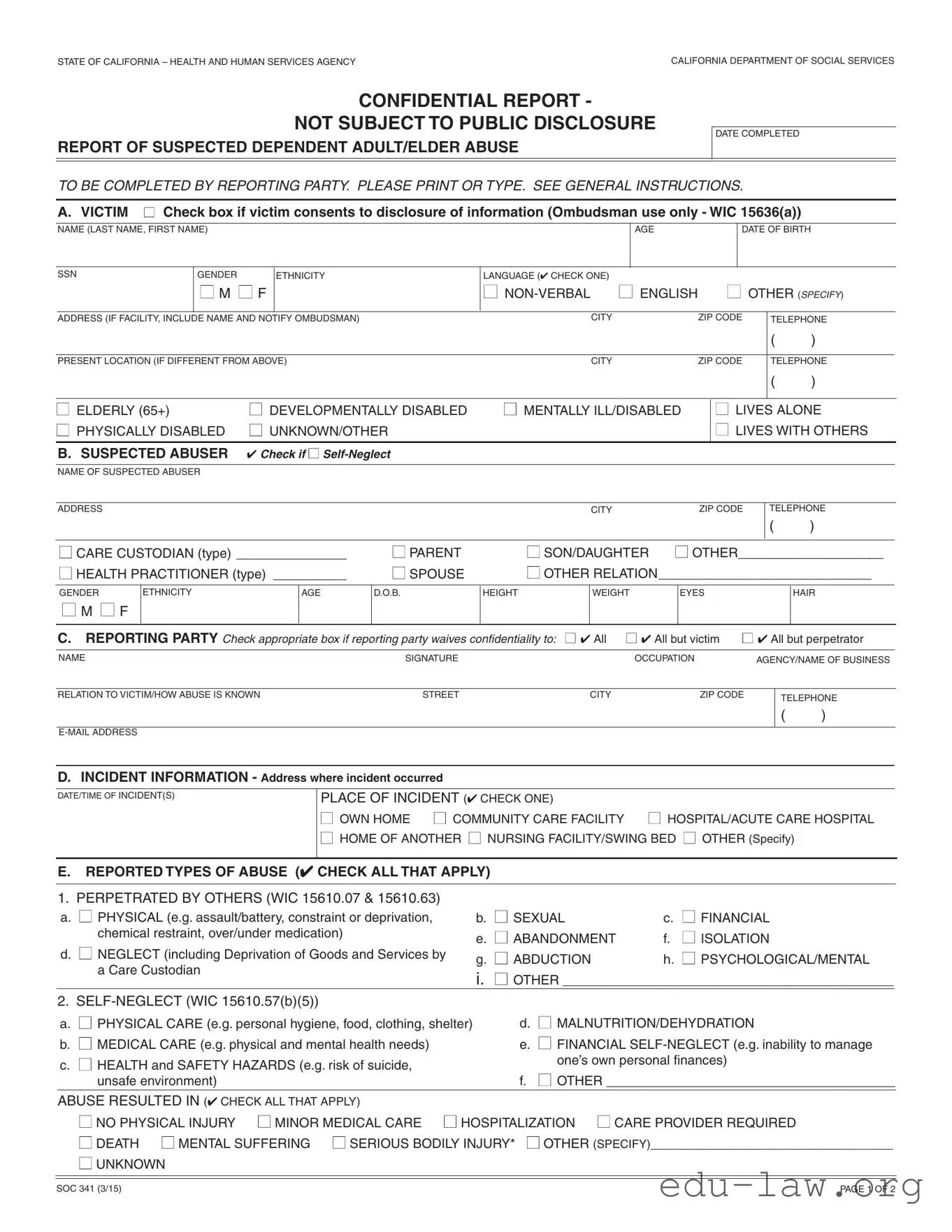
The SOC 341 form plays a crucial role in the protection of vulnerable adults, specifically those who are elderly or dependent. Designed for use by individuals who suspect abuse or neglect, this form serves as a confidential report that is not subject to public disclosure. It is vital for documenting incidents of suspected dependent adult or elder abuse, ensuring that the necessary information is collected for further investigation. The form requires details about the victim, including their name, age, and living situation, as well as information about the suspected abuser and the reporting party. It also prompts the reporter to describe the nature of the alleged abuse, whether it be physical, financial, or neglectful in nature. Additionally, it asks for observations and any statements made by the victim, which can be critical in assessing the situation. The SOC 341 form emphasizes the importance of timely reporting, especially in cases where serious bodily injury is involved, and outlines the responsibilities of mandated reporters. By facilitating the reporting process, this form aims to safeguard the well-being of those who may be unable to protect themselves, ensuring that they receive the support and intervention they need.

STATE OF CALIFORNIA – HEALTH AND HUMAN SERVICES AGENCY |
CALIFORNIA DEPARTMENT OF SOCIAL SERVICES |
CONFIDENTIAL REPORT -
NOT SUBJECT TO PUBLIC DISCLOSURE
REPORT OF SUSPECTED DEPENDENT ADULT/ELDER ABUSE
DATE COMPLETED
TO BE COMPLETED BY REPORTING PARTY. PLEASE PRINT OR TYPE. SEE GENERAL INSTRUCTIONS.
A. VICTIM ■ Check box if victim consents to disclosure of information (Ombudsman use only - WIC 15636(a))
NAME (LAST NAME, FIRST NAME)
AGE
DATE OF BIRTH
SSN
GENDER
■ M ■ F
ETHNICITY
LANGUAGE (✔ CHECK ONE)
■
ADDRESS (IF FACILITY, INCLUDE NAME AND NOTIFY OMBUDSMAN) |
CITY |
ZIP CODE |
TELEPHONE |
|
|||
|
|
|
|
|
( |
) |
|
|
|
|
|
|
|
||
PRESENT LOCATION (IF DIFFERENT FROM ABOVE) |
CITY |
ZIP CODE |
TELEPHONE |
|
|||
|
|
|
|
|
( |
) |
|
|
|
|
|
|
|
|
|
■ ELDERLY (65+) |
■ DEVELOPMENTALLY DISABLED |
■ MENTALLY ILL/DISABLED |
|
■ LIVES ALONE |
|
||
■ PHYSICALLY DISABLED |
■ UNKNOWN/OTHER |
|
|
■ LIVES WITH OTHERS |
|
||
|
|
|
|
|
|
|
|
B. SUSPECTED ABUSER |
✔ Check if ■ |
|
|
|
|
|
|
|
|
|
|
|
|
|
|
NAME OF SUSPECTED ABUSER |
|
|
|
|
|
|
|
ADDRESS |
CITY |
ZIP CODE |
TELEPHONE
()
■ ■
CARE CUSTODIAN (type) _______________
HEALTH PRACTITIONER (type) __________
■ ■
PARENT SPOUSE
■ ■
SON/DAUGHTER OTHER RELATION
■ OTHER____________________
_____________________________
GENDER
■ M ■ F
ETHNICITY
AGE
D.O.B.
HEIGHT
WEIGHT
EYES
HAIR
C. |
REPORTING PARTY Check appropriate box if reporting party waives confidentiality to: ■ ✔ All |
■ ✔ All but victim |
■ ✔ All but perpetrator |
|
|
|
|
NAME |
SIGNATURE |
OCCUPATION |
AGENCY/NAME OF BUSINESS |
RELATION TO VICTIM/HOW ABUSE IS KNOWN |
STREET |
CITY |
ZIP CODE |
TELEPHONE
()
D.INCIDENT INFORMATION - Address where incident occurred
DATE/TIME OF INCIDENT(S)
PLACE OF INCIDENT (✔ CHECK ONE)
■ OWN HOME ■ COMMUNITY CARE FACILITY ■ HOSPITAL/ACUTE CARE HOSPITAL ■ HOME OF ANOTHER ■ NURSING FACILITY/SWING BED ■ OTHER (Specify)
E. REPORTED TYPES OF ABUSE (✔ CHECK ALL THAT APPLY)
1.PERPETRATED BY OTHERS (WIC 15610.07 & 15610.63) a. ■ PHYSICAL (e.g. assault/battery, constraint or deprivation,
chemical restraint, over/under medication)
d.■ NEGLECT (including Deprivation of Goods and Services by a Care Custodian
b. |
■ SEXUAL |
c. ■ FINANCIAL |
e. |
■ ABANDONMENT |
f. ■ ISOLATION |
g. |
■ ABDUCTION |
h. ■ PSYCHOLOGICAL/MENTAL |
i. |
■ OTHER _____________________________________________ |
|
2.
a.■ PHYSICAL CARE (e.g. personal hygiene, food, clothing, shelter)
b.■ MEDICAL CARE (e.g. physical and mental health needs)
c.■ HEALTH and SAFETY HAZARDS (e.g. risk of suicide,
unsafe environment)
d.■ MALNUTRITION/DEHYDRATION
e.■ FINANCIAL
f.■ OTHER ________________________________________
ABUSE RESULTED IN (✔ CHECK ALL THAT APPLY)
■ NO PHYSICAL INJURY ■ MINOR MEDICAL CARE ■ HOSPITALIZATION ■ CARE PROVIDER REQUIRED
■ DEATH ■ MENTAL SUFFERING ■ SERIOUS BODILY INJURY* ■ OTHER (SPECIFY)_________________________________
■UNKNOWN
SOC 341 (3/15) |
PAGE 1 OF 2 |

F.REPORTER’S OBSERVATIONS, BELIEFS, AND STATEMENTS BY VICTIM IF AVAILABLE. DOES ALLEGED PERPETRATOR STILL HAVE ACCESS TO THE VICTIM? DOES THE ALLEGATION INVOLVE A SERIOUS BODILY INJURY (see definition in section “Reporting Responsibilities and Time Frames” within the General Instructions)? PROVIDE ANY KNOWN TIME FRAME (2 days, 1 week, ongoing, etc.). LIST ANY POTENTIAL DANGER FOR INVESTIGATOR (animals, weapons, communicable diseases, etc.).
■ ✔ CHECK IF MEDICAL, FINANCIAL (ACCOUNT INFORMATION, ETC.), PHOTOGRAPHS, OR OTHER SUPPLEMENTAL INFORMATION IS ATTACHED.
G.OTHER PERSON BELIEVED TO HAVE KNOWLEDGE OF ABUSE (family, significant others, neighbors, medical providers, agencies involved, etc.)
NAME
ADDRESS
RELATIONSHIP
TELEPHONE
()
H. FAMILY MEMBER OR OTHER PERSON RESPONSIBLE FOR VICTIM’S CARE (If unknown, list contact person)
NAME
ADDRESS
IF CONTACT PERSON ONLY ✔ CHECK ■ |
|
RELATIONSHIP |
||
|
|
TELEPHONE |
||
CITY |
|
ZIP CODE |
||
|
|
|
( |
) |
|
|
|
|
|
I. TELEPHONE REPORT MADE TO ■ APS ■ Law Enforcement ■ Local Ombudsman ■ Calif. Dept. of State Hospitals
■Calif. Dept. of Developmental Services
NAME OF OFFICIAL CONTACTED BY PHONE
TELEPHONE
()
DATE/TIME
J.WRITTEN REPORT Enter information about the agencies receiving this report. If the abuse occurred in a LTC facility and resulted in Serious Bodily Injury*, please refer to “Reporting Responsibilities and Time Frames” in the General Instructions. Do not submit report to California Department of Social Services Adult Programs Division.
AGENCY NAME
AGENCY NAME
AGENCY NAME
ADDRESS OR FAX
|
■ Date Mailed |
■ Date Faxed |
|
|
|
ADDRESS OR FAX |
|
|
|
■ Date Mailed |
■ Date Faxed |
ADDRESS OR FAX |
|
|
|
■ Date Mailed |
■ Date Faxed |
|
|
|
K. RECEIVING AGENCY USE ONLY |
■ Telephone Report |
■ Written Report |
||||||
|
|
|
|
|
|
|
|
|
1. |
Report Received by |
|
|
|
|
|
Date/Time |
|
|
|
|
|
|
|
|||
2. |
Assigned ■ Immediate Response |
■ |
■ No Initial Response (NIR) |
|||||
|
■ Not APS |
■ Not Ombudsman |
■ No |
|||||
|
|
|
|
|
|
|
|
|
|
Approved by |
|
|
|
|
Assigned to (optional) |
||
|
|
|
|
|||||
3. |
■ Local Ombudsman; ■ Bureau of |
|||||||
|
■ Calif. Dept. of State Hospitals; |
■ Law Enforcement; ■ Professional Licensing Board; |
||||||
|
■ Calif. Dept. of Developmental Services; |
■ APS; |
||||||
|
■ Other (Specify) |
|
|
|
|
Date of |
||
4. APS/Ombudsman/Law Enforcement Case File Number
SOC 341 (3/15) |
PAGE 2 OF 2 |

STATE OF CALIFORNIA - HEALTH AND HUMAN SERVICES AGENCY |
CALIFORNIADEPARTMENTOFSOCIALSERVICES |
REPORT OF SUSPECTED DEPENDENT ADULT/ELDER ABUSE
GENERAL INSTRUCTIONS
PURPOSE OF FORM
This form, as adopted by the California Department of Social Services (CDSS), is required under Welfare and Institutions Code (WIC) Sections 15630 and 15658(a)(1). This form documents the information given by the reporting party on the suspected incident of abuse or neglect of an elder or dependent adult. Abuse means any treatment with resulting physical harm, pain, or mental suffering or the deprivation by a care custodian of goods or services that are necessary to avoid physical harm or mental suffering. Neglect means the negligent failure of an elder or dependent adult or of any person having the care or custody of an elder or a dependent adult to exercise that degree of
COMPLETION OF THE FORM
1.This form may be used by the receiving agency to record information through a telephone report of suspected dependent adult/elder abuse.
2.If any item of information is unknown, enter "unknown.”
3.Item A: Check box to indicate if the victim waives confidentiality.
4.Item C: Check box if the reporting party waives confidentiality. Please note that mandated reporters are required to disclose their names, however,
REPORTING RESPONSIBILITIES AND TIME FRAMES:
Any mandated reporter, who in his or her professional capacity, or within the scope of his or her employment, has observed or has knowledge of an incident that reasonably appears to be abuse or neglect, or is told by an elder or dependent adult that he or she has experienced behavior constituting abuse or neglect, or reasonably suspects that abuse or neglect has occurred, shall complete this form for each report of known or suspected instance of abuse (physical abuse, sexual abuse, financial abuse, abduction, neglect
*Serious bodily injury means an injury involving extreme physical pain, substantial risk of death, or protracted loss or impairment of function of a bodily member, organ or of mental faculty, or requiring medical intervention, including, but not limited to, hospitalization, surgery, or physical rehabilitation (WIC Section 15610.67).
Reporting shall be completed as follows:
•If the abuse occurred in a
•If the abuse occurred in a LTC facility, was physical abuse, but did not result in serious bodily injury, report by telephone to the local law enforcement agency within 24 hours of observing, obtaining knowledge of, or suspecting physical abuse. Send the written report to the local law enforcement agency, the local LTCOP, and the appropriate licensing agency (for
•If the abuse occurred in a LTC facility, was physical abuse, did not result in serious bodily injury, and was perpetrated by a resident with a physician's diagnosis of dementia, report by telephone to the local law enforcement agency or the local LTCOP, immediately or as soon as practicably possible. Follow by sending the written report to the LTCOP or the local law enforcement agency within 24 hours of observing, obtaining knowledge of, or suspecting physical abuse.
•If the abuse occurred in a LTC facility, was abuse other than physical abuse, report by telephone to the LTCOP or the law enforcement agency immediately or as soon as practicably possible. Follow by sending the written report to the local law enforcement agency or the LTCOP within two working days.
SOC 341 (3/15) GENERAL INSTRUCTIONS |
INSTRUCTIONS - PAGE 1 OF 3 |

•If the abuse occurred in a state mental hospital or a state developmental center, mandated reporters shall report by telephone or through a confidential Internet reporting tool (established in WIC Section 15658) immediately or as soon as practicably possible and submit the report within two (2) working days of making the telephone report to the responsible agency as identified below:
•If the abuse occurred in a State Mental Hospital, report to the local law enforcement agency or the California Department of State Hospitals.
•If the abuse occurred in a State Developmental Center, report to the local law enforcement agency or to the California Department of Developmental Services.
•For all other abuse, mandated reporters shall report by telephone or through a confidential Internet reporting tool to the adult protective services agency or the local law enforcement agency immediately or as soon as practicably possible. If reported by telephone, a written or an Internet report shall be sent to adult protective services or law enforcement within two working days.
REPORTING PARTY DEFINITIONS
Mandated Reporter (WIC Section 15630 (a)) Any person who has assumed full or intermittent responsibility for care or custody of an elder or dependent adult, whether or not that person receives compensation, including administrators, supervisors, and any licensed staff of a public or private facility that provides care or services for elder or dependent adults, or any elder or dependent adult care custodian, health practitioner, clergy member, or employee of a county adult protective services agency or a local law enforcement agency, is a mandated reporter.
Care Custodian (WIC Section 15610.17) means an administrator or an employee of any of the following public or private facilities or agencies, or persons providing are or services for elders or dependent adults, including members of the support staff and maintenance staff: (a)
(h)Camps; (i) Alzheimer's Disease Day Care Resource Centers; (j) Community care facilities, as defined in Section 1502 of the Health and Safety Code, and residential care facilities for the elderly, as defined in Section 1569.2 of the Health and Safety Code; (k) Respite care facilities; (l) Foster homes; (m) Vocational rehabilitation facilities and work activity centers; (n) Designated area agencies on aging;
(o)Regional centers for persons with developmental disabilities; (p) State Department of Social Services and State Department of Health Services licensing divisions; (q) County welfare departments; (r) Offices of patients' rights advocates and clients' rights advocates, including attorneys; (s) The Office of the State
Health Practitioner (WIC Section 15610.37) means a physician and surgeon, psychiatrist, psychologist, dentist, resident, intern, podiatrist, chiropractor, licensed nurse, dental hygienist, licensed clinical social worker or associate clinical social worker, marriage, family, and child counselor, or any other person who is currently licensed under Division 2 (commencing with Section 500) of the Business and Professions Code, any emergency medical technician I or II, paramedic, or person certified pursuant to Division 2.5 (commencing with Section 1797) of the Health and Safety Code, a psychological assistant registered pursuant to Section 2913 of the Business and Professions Code, a marriage, family, and child counselor trainee, as defined in subdivision (c) of Section 4980.03 of the Business and Professions Code, or an unlicensed marriage, family, and child counselor intern registered under Section 4980.44 of the Business and Professions Code, state or county public health or social service employee who treats an elder or a dependent adult for any condition, or a coroner.
Any officer and/or employee of a financial institution is a mandated reporter of suspected financial abuse and shall report suspected financial abuse of an elder or dependent adult on form SOC 342, “Report of Suspected Dependent Adult/Elder Financial Abuse”.
MULTIPLE REPORTERS
When two or more mandated reporters are jointly knowledgeable of a suspected instance of abuse of a dependent adult or elder, and when there is agreement among them, the telephone report may be made by one member of the group. Also, a single written report may be completed by that member of the group. Any person of that group, who believes the report was not submitted, shall submit the report.
SOC 341 (3/15) GENERAL INSTRUCTIONS |
INSTRUCTIONS - PAGE 2 OF 3 |

IDENTITY OF THE REPORTER
The identity of all persons who report under WIC Chapter 11 shall be confidential and disclosed only among APS agencies, local law enforcement agencies, LTCOPs, California State Attorney General Bureau of
FAILURE TO REPORT
Failure to report by mandated reporters (as defined under “Reporting Party Definitions”) any suspected incidents of physical abuse (including sexual abuse), abandonment, isolation, financial abuse, abduction, or neglect (including
Officers or employees of financial institutions are mandated reporters of financial abuse (effective January 1, 2007). These mandated re- porters who fail to report financial abuse of an elder or dependent adult are subject to a civil penalty not exceeding $1,000. Individuals who willfully fail to report financial abuse of an elder or dependent adult are subject to a civil penalty not exceeding $5,000. These civil penalties shall be paid by the financial institution, which is the employer of the mandated reporter, to the party bringing the action.
EXCEPTIONS TO REPORTING
Per WIC Section 15630(b)(3)(A), a mandated reporter who is a physician and surgeon, a registered nurse, or a psychotherapist, as defined in Section 1010 of the Evidence Code, shall not be required to report a suspected incident of abuse where all of the following conditions exist:
(1)The mandated reporter has been told by an elder or a dependent adult that he or she has experienced behavior constituting physical abuse (including sexual abuse), abandonment, isolation, financial abuse, abduction, or neglect (including
(2)The mandated reporter is not aware of any independent evidence that corroborates the statement that the abuse has occurred.
(3)The elder or the dependent adult has been diagnosed with a mental illness or dementia, or is the subject of a
(4)In the exercise of clinical judgment, the physician and surgeon, the registered nurse, or the psychotherapist, as defined in Section 1010 of the Evidence Code, reasonably believes that the abuse did not occur.
DISTRIBUTION OF SOC 341 COPIES
Mandated reporter: After making the telephone report to the appropriate agency or agencies, the reporter shall send the written report to the designated agencies (as defined under “Reporting Responsibilities and Time Frames”); and keep one copy for the reporter’s file.
Receiving agency: Place the original copy in the case file. Send a copy to a
DO NOT SEND A COPY TO THE CALIFORNIA DEPARTMENT OF SOCIAL SERVICES ADULT PROGRAMS DIVISION.
SOC 341 (3/15) GENERAL INSTRUCTIONS |
INSTRUCTIONS - PAGE 3 OF 3 |
| Fact Name | Description |
|---|---|
| Governing Law | The SOC 341 form is governed by the Welfare and Institutions Code (WIC) Sections 15630 and 15658(a)(1). |
| Confidentiality | This report is confidential and not subject to public disclosure. It is intended for use by authorized agencies only. |
| Reporting Requirements | Mandated reporters must complete this form for any suspected abuse of an elder or dependent adult. |
| Victim Definition | An elder is defined as any person aged 65 or older, while a dependent adult is between the ages of 18 and 64 with physical or mental limitations. |
| Submission Timeline | Reports of suspected abuse must be submitted to the appropriate agency within specific time frames, typically within 2 hours or 24 hours, depending on the severity. |
Completing the SOC 341 form is a critical step in reporting suspected elder or dependent adult abuse. It is essential to provide accurate and thorough information to ensure that the appropriate agencies can take action. Follow these steps carefully to fill out the form correctly.
What is the SOC 341 form used for?
The SOC 341 form is used to report suspected elder or dependent adult abuse in California. It is a confidential document that helps ensure the safety and well-being of vulnerable individuals. The form captures essential information about the victim, the suspected abuser, and the incident itself.
Who is required to fill out the SOC 341 form?
Any individual who suspects elder or dependent adult abuse can fill out the SOC 341 form. However, mandated reporters—such as healthcare professionals, social workers, and law enforcement—are legally required to report any suspected abuse they observe or are informed about in their professional capacity.
What types of abuse can be reported using this form?
The SOC 341 form allows for reporting various types of abuse, including physical abuse, sexual abuse, financial abuse, neglect, isolation, and abandonment. Self-neglect is also included, which refers to situations where an individual fails to provide for their own basic needs.
Can I report abuse anonymously?
Yes, non-mandated reporters have the option to report anonymously. If you are a mandated reporter, your name will be disclosed as part of the reporting process. However, non-mandated reporters can choose not to provide their identity when submitting the SOC 341 form.
What information is needed to complete the SOC 341 form?
To complete the form, you will need to provide details about the victim, the suspected abuser, and the incident. This includes names, addresses, and a description of the abuse. If any information is unknown, you can simply indicate that on the form.
What should I do if the abuse occurred in a long-term care facility?
If the abuse occurred in a long-term care facility and resulted in serious bodily injury, you must report it to local law enforcement immediately and submit the written report within two hours. For other types of abuse, the reporting timelines vary, so it's important to follow the specific guidelines outlined in the form's instructions.
What happens after I submit the SOC 341 form?
Once submitted, the form will be reviewed by the appropriate agencies, such as Adult Protective Services or law enforcement. They will investigate the report and take necessary actions to protect the victim and address the situation.
Is there a specific format for submitting the SOC 341 form?
The SOC 341 form can be filled out electronically or printed and completed by hand. Ensure that all sections are filled out accurately. If additional information or documentation is available, such as medical records or photographs, these can be attached to the report.
What if I have more questions about the SOC 341 form?
If you have further questions about the SOC 341 form or the reporting process, you can contact local agencies involved in elder and dependent adult services. They can provide guidance and support to ensure that you have the information you need to make a report.
Failing to provide complete victim information: It is essential to fill in all required fields, including the victim's name, age, and address. Incomplete information can delay the investigation.
Not checking the appropriate consent boxes: Ensure that the correct boxes are checked regarding the victim's consent for information disclosure. This is crucial for compliance with legal requirements.
Neglecting to include incident details: Provide a clear and accurate account of the incident, including the date, time, and location. Vague or missing details can hinder the response.
Incorrectly identifying the suspected abuser: Make sure to accurately fill out the section regarding the suspected abuser, including their relationship to the victim and any relevant details about their identity.
Omitting the types of abuse: It is important to check all applicable types of abuse in the form. Failing to do so may result in inadequate responses from authorities.
Not including reporting party information: The reporting party must provide their contact information and relationship to the victim. This helps investigators follow up as needed.
Forgetting to attach supplemental information: If there are any additional documents or evidence, such as photographs or medical records, these should be included with the report.
Submitting the form to the wrong agency: Ensure that the SOC 341 form is sent to the correct agency as specified in the instructions. Sending it to the wrong entity can delay the response.
The SOC 341 form is a crucial document used to report suspected elder and dependent adult abuse in California. Along with this form, there are several other documents that may be required to provide a comprehensive view of the situation. Each of these documents serves a specific purpose in the reporting and investigation process, ensuring that the rights and well-being of vulnerable individuals are protected. Below is a list of additional forms and documents often used in conjunction with the SOC 341.
Each of these documents plays a vital role in the process of reporting and investigating suspected elder and dependent adult abuse. They help ensure that all aspects of a case are thoroughly examined, promoting the safety and well-being of vulnerable individuals. If you are involved in such a situation, it’s important to gather all relevant documentation to facilitate a comprehensive review and response.
The Form SOC 341, which reports suspected elder abuse, shares similarities with the Adult Protective Services (APS) Intake Form. Both documents are designed to collect essential information about incidents involving vulnerable adults. They require details about the victim, the suspected abuser, and the reporting party. Like the SOC 341, the APS Intake Form aims to ensure that reports are clear and comprehensive, facilitating timely investigations and interventions to protect at-risk individuals.
Another document that resembles the SOC 341 is the Child Abuse Report Form. This form is used to report suspected child abuse and includes sections for victim information, alleged abuser details, and the nature of the abuse. Both forms emphasize the importance of confidentiality and the responsibilities of the reporting party. They serve a similar purpose in safeguarding vulnerable populations, whether they are children or dependent adults, by documenting incidents of abuse or neglect.
The Domestic Violence Incident Report is also comparable to the SOC 341 form. It captures details about incidents of domestic violence, including victim and perpetrator information. Both documents require the reporting party to provide information about the circumstances surrounding the incident. They are vital for law enforcement and social services to take appropriate action and ensure the safety of the individuals involved.
The Vulnerable Adult Abuse Reporting Form is yet another document that aligns closely with the SOC 341. This form is specifically designed for reporting abuse against vulnerable adults, similar to the SOC 341's focus on elder and dependent adult abuse. It collects information about the victim, the suspected abuser, and the type of abuse, making it a critical tool for agencies tasked with protecting vulnerable populations.
Lastly, the Incident Report Form used by healthcare facilities shares similarities with the SOC 341. This form documents incidents that occur within a healthcare setting, including abuse or neglect of patients. Both forms emphasize the importance of accurate reporting and detail the circumstances of the incident. They are crucial for maintaining safety and accountability in environments where vulnerable individuals receive care.
When filling out the SOC 341 form, it is essential to follow specific guidelines to ensure the report is completed accurately and effectively. Here are six things to keep in mind:
By following these guidelines, you can help ensure that the SOC 341 form is completed correctly, which is vital for the protection and support of vulnerable individuals.
Understanding the SOC 341 form is essential for anyone involved in reporting suspected elder or dependent adult abuse. However, several misconceptions can cloud this understanding. Here are six common misconceptions about the SOC 341 form:
This form can be completed by anyone who suspects abuse, not just mandated reporters. While professionals are often more familiar with the process, any concerned individual can report suspected abuse using this form.
It is not necessary to have every detail. If certain information is unknown, you can simply indicate that by writing "unknown" in the relevant fields. The priority is to report the suspicion of abuse as soon as possible.
While mandated reporters must provide their names, non-mandated reporters have the option to remain anonymous. This encourages more individuals to come forward without fear of repercussions.
While submitting the form initiates the reporting process, it does not guarantee immediate intervention. The response may vary based on the agency's assessment and available resources.
The SOC 341 form covers a wide range of abuse types, including physical, emotional, financial, and neglect. All forms of suspected abuse should be reported using this form.
The SOC 341 form is classified as confidential and is not subject to public disclosure. This confidentiality is crucial for protecting the identities of both the victims and the reporting parties.
Understanding the Purpose: The SOC 341 form is crucial for reporting suspected elder or dependent adult abuse in California. It helps document incidents of abuse or neglect.
Who Should Use It: This form should be completed by anyone who suspects abuse, including mandated reporters and concerned individuals.
Confidentiality Options: Reporters can choose to waive confidentiality for various parties, including the victim or the perpetrator, which can affect how the report is handled.
Provide Accurate Information: Fill out all sections as completely as possible. If you don't know certain details, simply write "unknown" to ensure the report remains valid.
Reporting Time Frames: Time is of the essence. Depending on the severity of the abuse, reports must be made immediately or within specific time frames, often within 2 to 24 hours.
Types of Abuse: The form allows you to check multiple types of abuse, including physical, sexual, financial, and neglect. Be thorough in selecting all that apply.
Observations Matter: Include any observations or statements from the victim, if available. This information can be vital for investigators.
Follow Up: After submitting the form, ensure that it reaches the appropriate agencies. You may need to follow up with local law enforcement or the Ombudsman.