The Small Estate Affidavit form is a useful tool for individuals navigating the process of settling a deceased loved one’s estate without the need for formal probate. Designed for estates that fall below a certain value threshold, this form simplifies the transfer of assets, allowing heirs to access property and funds more efficiently. By completing the affidavit, individuals can affirm their relationship to the deceased and outline the assets involved, streamlining what can often be a lengthy and complicated process. This form is particularly beneficial for families dealing with modest estates, as it helps to avoid the costs and delays associated with traditional probate proceedings. Understanding how to properly fill out and submit the Small Estate Affidavit can save time and reduce stress during an already challenging period.
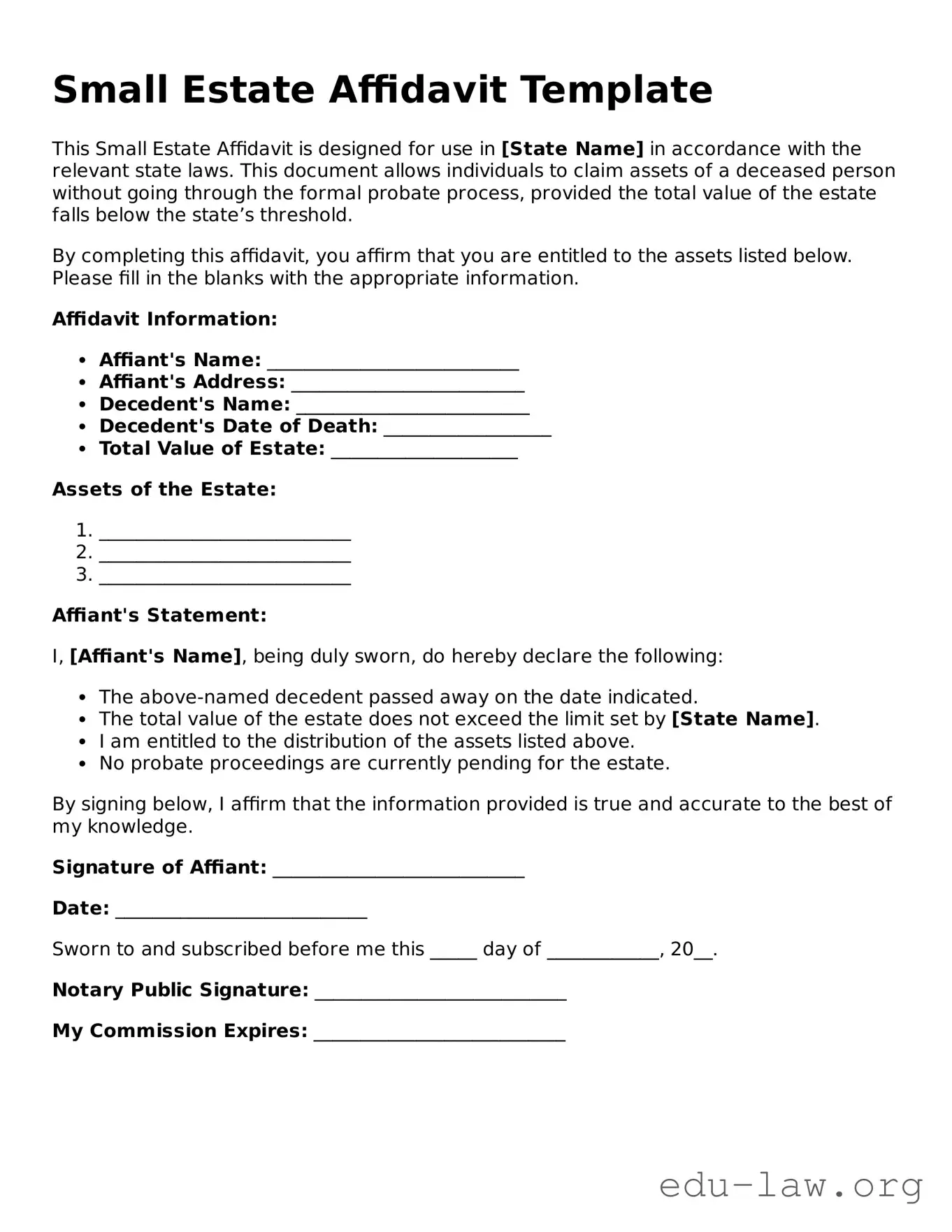
Small Estate Affidavit Template
This Small Estate Affidavit is designed for use in [State Name] in accordance with the relevant state laws. This document allows individuals to claim assets of a deceased person without going through the formal probate process, provided the total value of the estate falls below the state’s threshold.
By completing this affidavit, you affirm that you are entitled to the assets listed below. Please fill in the blanks with the appropriate information.
Affidavit Information:
Assets of the Estate:
Affiant's Statement:
I, [Affiant's Name], being duly sworn, do hereby declare the following:
By signing below, I affirm that the information provided is true and accurate to the best of my knowledge.
Signature of Affiant: ___________________________
Date: ___________________________
Sworn to and subscribed before me this _____ day of ____________, 20__.
Notary Public Signature: ___________________________
My Commission Expires: ___________________________
| Fact Name | Description |
|---|---|
| Purpose | The Small Estate Affidavit is used to simplify the process of transferring assets from a deceased person's estate without the need for formal probate proceedings. |
| Eligibility | Typically, the estate must meet a specific value threshold, which varies by state, to qualify for the use of a Small Estate Affidavit. |
| Governing Laws | Each state has its own laws governing the Small Estate Affidavit. For example, in California, it is governed by California Probate Code Section 13000. |
| Required Information | The form generally requires information such as the deceased's name, date of death, and a list of assets, along with the signatures of heirs or beneficiaries. |
Once you have gathered all necessary information and documents, you can begin filling out the Small Estate Affidavit form. This process will help you declare the assets of the deceased and facilitate the transfer of those assets to the rightful heirs or beneficiaries.
After completing the form, ensure that you make copies for your records and for any parties involved. You may need to file the affidavit with the appropriate court or present it to institutions holding the deceased's assets. Always check local regulations, as requirements can vary by state.
What is a Small Estate Affidavit?
A Small Estate Affidavit is a legal document that allows heirs to claim assets of a deceased person without going through the lengthy and often costly probate process. This form is typically used when the total value of the estate is below a certain threshold, which varies by state. By using this affidavit, heirs can access bank accounts, transfer property titles, and settle debts more efficiently.
Who is eligible to use a Small Estate Affidavit?
Eligibility to use a Small Estate Affidavit generally depends on the value of the estate and the relationship to the deceased. Most states allow immediate family members, such as spouses, children, or parents, to file this affidavit. However, it's essential to check your state’s specific requirements, as the rules may vary. If the estate is above the specified limit, or if there are disputes among heirs, probate may be necessary.
How do I complete a Small Estate Affidavit?
Completing a Small Estate Affidavit involves gathering information about the deceased's assets and liabilities. You will need to provide details such as the deceased's name, date of death, and a description of the assets. After filling out the form, it usually requires notarization to confirm its authenticity. Some states may also require you to file the affidavit with the local probate court, so be sure to check the specific procedures in your area.
What happens after I submit the Small Estate Affidavit?
Once you submit the Small Estate Affidavit, the next steps depend on the assets involved. If the affidavit is accepted, financial institutions and other entities will allow you to access the deceased's accounts or transfer property titles. It’s important to keep copies of all documents submitted and received, as you may need them for future reference or to prove your authority over the estate. If there are complications, such as disputes among heirs, you may need to consult with a legal professional for further assistance.
Not including all necessary information. When filling out the Small Estate Affidavit, it’s essential to provide complete details about the deceased, such as their full name, date of death, and last known address. Missing any of this information can lead to delays or complications.
Failing to list all assets. Some people forget to mention certain assets or underestimate their value. It’s important to include all property, bank accounts, and other assets that belong to the deceased. Omitting assets can create legal issues later on.
Not having the required signatures. The affidavit must be signed by the appropriate individuals, often including heirs or beneficiaries. If the necessary signatures are missing, the form will not be accepted.
Incorrectly completing the affidavit. Errors in the form, such as typos or incorrect dates, can lead to rejection. It’s crucial to double-check all entries for accuracy before submitting.
The Small Estate Affidavit is a useful tool for settling estates with limited assets, allowing heirs to bypass the lengthy probate process. However, it often works in conjunction with several other forms and documents. Each of these documents serves a specific purpose in the estate settlement process, ensuring that all legal requirements are met and that the estate is administered properly.
By understanding these additional documents, individuals can navigate the small estate process more effectively. Each piece plays a vital role in ensuring that the estate is settled according to the law and the wishes of the deceased, providing clarity and peace of mind to the heirs involved.
The Small Estate Affidavit is often compared to the Will. Both documents serve to distribute a deceased person's assets, but they do so in different ways. A Will is a formal legal document that outlines how a person's estate should be managed and distributed after their death. It typically requires probate, a court process that validates the Will and oversees the distribution of assets. In contrast, a Small Estate Affidavit allows heirs to bypass probate for smaller estates, streamlining the transfer of assets directly to beneficiaries.
Another similar document is the Letter of Administration. This document is issued by a court to appoint an administrator for an estate when there is no Will. Like the Small Estate Affidavit, it facilitates the distribution of assets, but it requires a court process. The Letter of Administration grants authority to the appointed individual to manage the estate's affairs, while the Small Estate Affidavit allows heirs to claim assets without court involvement, provided the estate meets specific criteria.
The Affidavit of Heirship is also akin to the Small Estate Affidavit. This document is used to establish the identity of heirs when a person dies without a Will. It is often utilized for real estate transactions. Both documents help heirs claim property, but the Affidavit of Heirship focuses specifically on proving relationships, while the Small Estate Affidavit is used to facilitate the transfer of all types of assets in smaller estates.
A Trust is another legal instrument that shares similarities with the Small Estate Affidavit. A Trust allows individuals to manage their assets during their lifetime and dictate how those assets should be distributed upon death. Unlike the Small Estate Affidavit, which is used posthumously, a Trust can be effective during a person's life. Both documents can help avoid probate, but a Trust often requires more formal setup and ongoing management.
The Durable Power of Attorney can also be seen as similar in function. This document allows an individual to designate someone to make financial decisions on their behalf while they are alive. While it does not deal with post-death asset distribution like the Small Estate Affidavit, both documents empower individuals to manage their affairs and can simplify the process of handling an estate.
The Transfer on Death (TOD) deed is another relevant document. This deed allows property owners to designate beneficiaries who will inherit real estate upon their death. The Small Estate Affidavit can be used to transfer other types of assets without probate, but the TOD deed specifically addresses real estate. Both documents provide a way to avoid probate, but the TOD deed focuses solely on real property.
The Probate Claim Form is also somewhat related. This form is used by creditors to make claims against a deceased person's estate during probate. While the Small Estate Affidavit allows heirs to claim assets directly, the Probate Claim Form is part of the probate process, which oversees the payment of debts and the distribution of remaining assets. Both documents are essential in the context of estate management but serve different roles in the process.
The Declaration of Trust is another document that has similarities with the Small Estate Affidavit. This document outlines the terms of a trust and the responsibilities of the trustee. While the Small Estate Affidavit is used for simpler asset transfers, a Declaration of Trust involves a more complex arrangement for managing and distributing assets. Both can help in estate planning and avoiding probate, but they operate at different levels of complexity.
Finally, the Assignment of Property is worth mentioning. This document transfers ownership of specific assets from one person to another. While the Small Estate Affidavit addresses the transfer of an entire estate, an Assignment of Property focuses on individual items or assets. Both documents facilitate the transfer of ownership, but the scope and context of their use differ significantly.
When filling out the Small Estate Affidavit form, it’s essential to approach the process with care. Here’s a helpful list of dos and don’ts to guide you through.
By following these guidelines, you can navigate the Small Estate Affidavit process with greater confidence and ease.
The Small Estate Affidavit is a useful tool for settling the estates of individuals who have passed away. However, there are several misconceptions surrounding this form. Here are four common misunderstandings:
This is not true. The Small Estate Affidavit is designed for estates that fall below a certain value threshold, which varies by state. It is meant to simplify the process for individuals with modest assets.
Many people believe that court involvement is necessary. In fact, the Small Estate Affidavit allows you to bypass the formal probate process, making it a quicker and less costly option.
This is a common misconception. While it’s important to address debts, you can still use the Small Estate Affidavit even if there are outstanding debts, as long as the estate meets the requirements.
This is incorrect. Anyone who has a legal interest in the estate, such as a close friend or business partner, may file the affidavit, provided they meet the necessary criteria.
Understanding these misconceptions can help you navigate the process more effectively and ensure that you use the Small Estate Affidavit correctly.
When dealing with the Small Estate Affidavit form, understanding its key aspects can simplify the process of settling a loved one’s estate. Here are some important takeaways to consider:
By keeping these points in mind, you can navigate the Small Estate Affidavit process more effectively, ensuring a smoother transition during a challenging time.