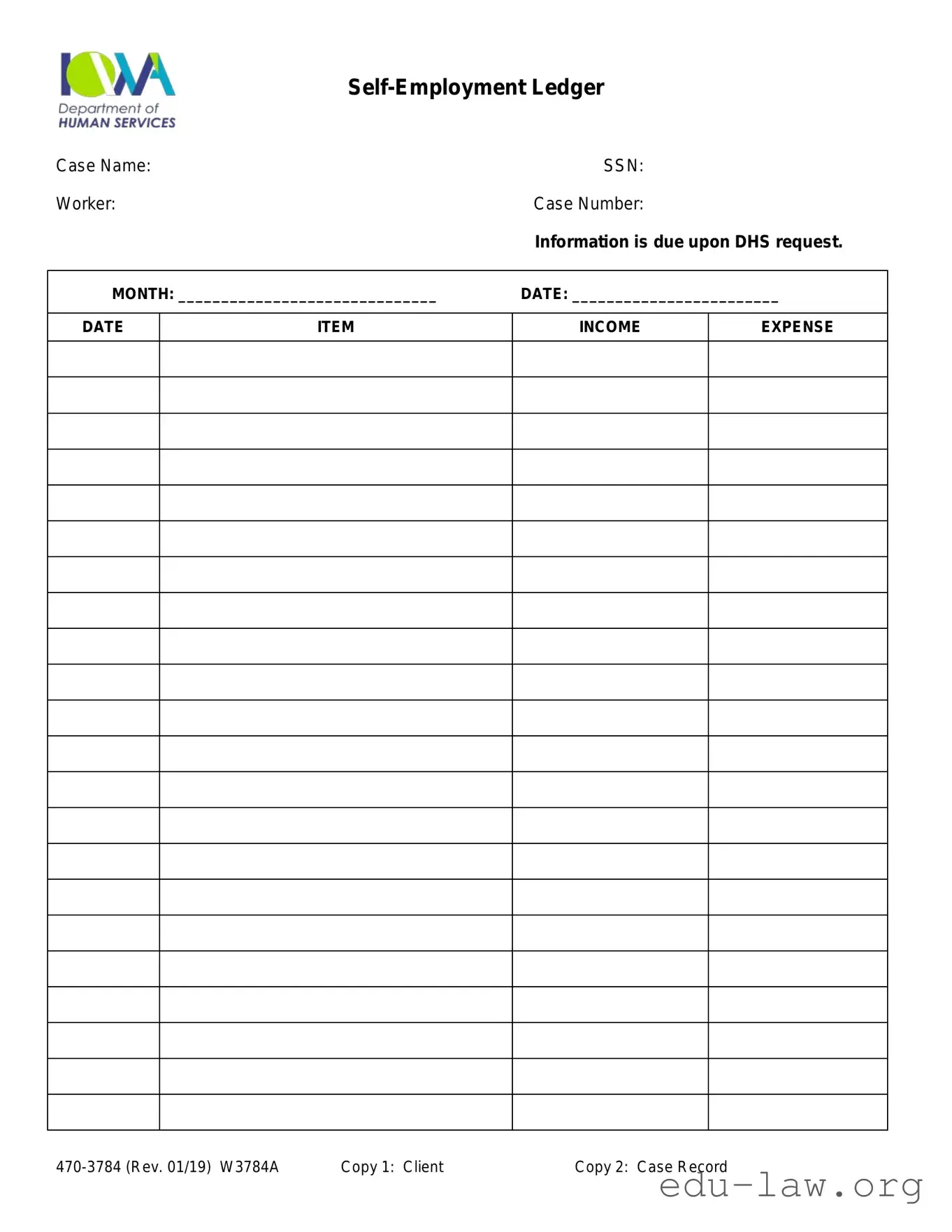
The Self Employment Ledger form is a crucial tool for individuals managing their own businesses, particularly when it comes to reporting income and expenses for various programs. This form, issued by the Iowa Department of Human Services, serves as a detailed record that helps ensure compliance with state requirements. Each ledger requires essential information, including the case name, Social Security Number (SSN), worker, and case number, all of which facilitate accurate tracking and processing. Users must fill out the monthly sections, detailing specific dates, income earned, and expenses incurred. This organized approach not only aids in transparency but also allows for efficient evaluation during audits or reviews. Additionally, it is important to remember that this information is due upon DHS request, emphasizing the need for timely and accurate submissions. The Self Employment Ledger is more than just a form; it is a vital component in the financial management of self-employed individuals within the state's welfare system.
Case Name: |
|
SSN: |
|
Worker: |
|
Case Number: |
|
|
|
Information is due upon DHS request. |
|
|
|
|
|
MONTH: ______________________________ |
DATE: ________________________ |
||
|
|
|
|
DATE |
ITEM |
INCOME |
EXPENSE |
|
|
|
|
|
|
|
|
|
|
|
|
|
|
|
|
|
|
|
|
|
|
|
|
|
|
|
|
|
|
|
|
|
|
|
|
|
|
|
|
|
|
|
|
|
|
|
|
|
|
|
|
|
|
|
|
|
|
|
|
|
|
|
|
|
|
|
|
|
|
|
|
|
|
|
|
|
|
|
|
|
|
|
|
|
|
|
|
|
|
|
|
Copy 1: Client |
Copy 2: Case Record |
| Fact Name | Description |
|---|---|
| Form Title | Iowa Department of Human Services Self-Employment Ledger |
| Purpose | This form is used to document income and expenses for individuals who are self-employed, ensuring accurate reporting for assistance programs. |
| Governing Law | The use of this form is governed by Iowa state laws pertaining to public assistance and welfare programs. |
| Information Requirement | Information must be provided upon request by the Iowa Department of Human Services (DHS). |
| Form Revision | The current version of the form is 470-3784, revised in March 2012. |
| Distribution | Copies of the form are provided for the client and for the case record, ensuring both parties have access to the necessary documentation. |
Filling out the Self Employment Ledger form is an important step in documenting your income and expenses related to self-employment. This information will be used by the Iowa Department of Human Services when requested. Ensure that you have all necessary details at hand before starting the process.
Once you have completed the form, review it for accuracy. Make sure all information is clear and legible. Keep a copy for your records, as you may need it for future reference or additional requests from the Department of Human Services.
What is the purpose of the Self Employment Ledger form?
The Self Employment Ledger form is designed to help individuals track their income and expenses related to self-employment. This information is essential for the Iowa Department of Human Services (DHS) to assess eligibility for various assistance programs. By maintaining accurate records, individuals can ensure they provide the necessary documentation when requested by DHS.
Who needs to fill out the Self Employment Ledger form?
This form is intended for individuals who are self-employed and receive assistance from DHS. If you run your own business or work as a freelancer, you will need to complete this form to report your earnings and expenses accurately. It is a vital part of maintaining compliance with DHS requirements.
How often should I update the Self Employment Ledger?
What information is required on the Self Employment Ledger?
The Self Employment Ledger requires you to provide your case name, Social Security Number (SSN), worker's name, and case number. Additionally, you need to fill in the month and date for which you are reporting income and expenses. You will list your income and expenses in the designated sections, ensuring all entries are clear and accurate.
What should I do if I have no income for a particular month?
If you have no income for a month, you should still complete the Self Employment Ledger form. Indicate zero income in the income section for that month. It is important to report this information to DHS, as they need a complete picture of your financial situation to make informed decisions regarding your assistance.
Can I use the Self Employment Ledger for multiple businesses?
What happens if I do not submit the Self Employment Ledger when requested?
Failing to submit the Self Employment Ledger when requested by DHS can lead to delays in processing your assistance or even loss of benefits. It is crucial to respond promptly to any requests for information to maintain your eligibility for assistance programs. Keeping accurate records and submitting them on time can help you avoid these issues.
Where can I find the Self Employment Ledger form?
The Self Employment Ledger form can be obtained from the Iowa Department of Human Services website or by visiting a local DHS office. You can also request a copy from your caseworker. Ensure you are using the most recent version of the form to comply with current requirements.
Failing to include the case name and Social Security Number (SSN). This information is essential for proper identification.
Not specifying the month for which the income and expenses are being reported. Each entry must correspond to a specific time frame.
Omitting the worker's name or case number. These details help in tracking the case efficiently.
Incorrectly entering income figures. Ensure that all income is reported accurately and reflects the correct amounts.
Neglecting to list expenses in the appropriate section. All business-related expenses should be documented clearly.
Using inconsistent dates for income and expenses. All entries should align chronologically to avoid confusion.
Not keeping copies of the form for personal records. Always retain a copy for your reference and future needs.
Failing to submit the form on time. Information is due upon DHS request, so timely submission is crucial.
Neglecting to sign or date the form. A signature confirms the accuracy of the information provided.
Forgetting to update the form with any changes in business status or personal information. Keep the ledger current to reflect your situation accurately.
When managing self-employment, several forms and documents may accompany the Self Employment Ledger form. Each of these documents serves a specific purpose and provides essential information for accurate record-keeping and compliance with regulations. Below is a list of commonly used forms that may be beneficial in conjunction with the Self Employment Ledger.
Having these documents organized and readily available can facilitate smoother interactions with the Department of Human Services and ensure compliance with reporting requirements. Proper documentation not only aids in financial management but also supports the integrity of your self-employment records.
The Self Employment Ledger form shares similarities with the Profit and Loss Statement. Both documents track income and expenses related to a business. A Profit and Loss Statement summarizes the revenues, costs, and expenses incurred during a specific period. This helps business owners assess their financial performance, while the Self Employment Ledger serves a similar purpose for individuals reporting self-employment income to the Iowa Department of Human Services.
Another document similar to the Self Employment Ledger is the Business Expense Report. This report provides a detailed account of expenses incurred while running a business. It lists each expense category and the corresponding amounts spent. Like the Self Employment Ledger, it helps individuals organize their financial records, making it easier to report income and expenses accurately.
The Schedule C form, used for reporting profit or loss from a business, is also comparable. This tax form allows self-employed individuals to detail their income and expenses on their annual tax returns. Both the Schedule C and the Self Employment Ledger require similar information about earnings and costs, making them useful for financial tracking and reporting.
The Income Statement is another related document. This financial statement summarizes revenues and expenses over a specified period, showing the net profit or loss. Similar to the Self Employment Ledger, it helps individuals understand their financial position and can be useful for tax purposes.
The Cash Flow Statement has similarities as well. It tracks the cash inflows and outflows of a business over a period. While the Self Employment Ledger focuses on income and expenses, the Cash Flow Statement provides a broader view of financial health, highlighting how cash moves in and out of the business.
The Expense Tracking Spreadsheet is also akin to the Self Employment Ledger. This tool allows individuals to manually record and categorize their business expenses. It serves as a practical way to monitor spending, similar to how the Self Employment Ledger organizes financial data for reporting purposes.
Lastly, the Annual Financial Report can be compared to the Self Employment Ledger. This document provides a comprehensive overview of a business's financial activities over the year, including income, expenses, and net profit. Like the Self Employment Ledger, it serves to summarize financial information for stakeholders and assists in meeting reporting requirements.
When filling out the Self Employment Ledger form, it's crucial to follow specific guidelines to ensure accuracy and compliance. Here’s a list of things you should and shouldn't do:
Understanding the Self Employment Ledger form is crucial for individuals managing their self-employment income and expenses. However, several misconceptions can lead to confusion and mismanagement. Below are some common misunderstandings about this important document:
Some individuals believe that completing the Self Employment Ledger is not mandatory. In reality, it is required by the Iowa Department of Human Services when requested, as it helps in assessing eligibility for benefits.
Many assume that only established businesses with significant income must use the ledger. However, anyone engaged in self-employment, regardless of the size or scale of their operations, must complete this form.
Some believe that the Self Employment Ledger is solely for documenting income. In fact, it requires both income and expense reporting to provide a complete picture of an individual's financial situation.
While it may seem daunting at first, the Self Employment Ledger is designed to be straightforward. Clear sections for income and expenses simplify the process of reporting financial information.
Individuals often think they can list expenses without any proof. However, it is essential to keep receipts and records to substantiate the reported expenses in case of an audit or review.
Some individuals may think that once they fill out the ledger, they do not need to update it. In reality, it should be updated regularly to reflect current income and expenses, especially when requested by DHS.
Many believe that submitting the Self Employment Ledger concludes the process. However, it is often just one part of a larger review process, and additional information may be requested.
When using the Self Employment Ledger form, there are several important points to keep in mind. These will help ensure that your records are accurate and complete.
Following these guidelines will make the process smoother and help you maintain accurate records for your self-employment activities.