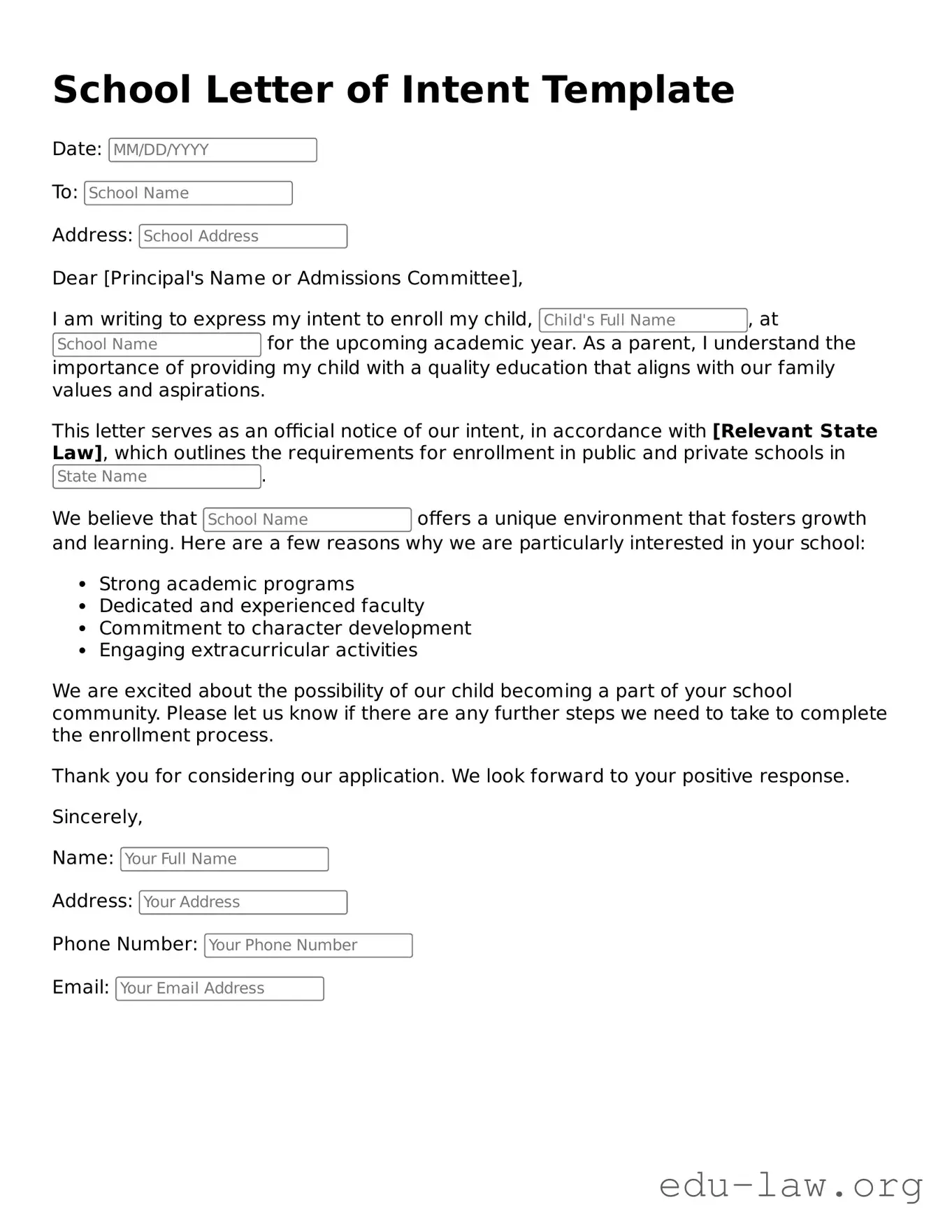
The School Letter of Intent form serves as an important document for students and parents navigating the educational landscape. This form is typically used to express a student's intention to enroll in a particular school, whether it be for the upcoming academic year or for a specific program. It outlines key information, including the student's name, contact details, and the school they wish to attend. By completing this form, families can formally communicate their commitment to the institution, which can help schools prepare for incoming students. Additionally, the form may include sections for special requests or considerations, allowing parents to address any unique needs their child may have. Understanding the purpose and components of the School Letter of Intent form can ease the enrollment process and foster a positive relationship between families and educational institutions.
School Letter of Intent Template
Date:
To:
Address:
Dear [Principal's Name or Admissions Committee],
I am writing to express my intent to enroll my child, , at for the upcoming academic year. As a parent, I understand the importance of providing my child with a quality education that aligns with our family values and aspirations.
This letter serves as an official notice of our intent, in accordance with [Relevant State Law], which outlines the requirements for enrollment in public and private schools in .
We believe that offers a unique environment that fosters growth and learning. Here are a few reasons why we are particularly interested in your school:
We are excited about the possibility of our child becoming a part of your school community. Please let us know if there are any further steps we need to take to complete the enrollment process.
Thank you for considering our application. We look forward to your positive response.
Sincerely,
Name:
Address:
Phone Number:
Email:
| Fact Name | Description |
|---|---|
| Purpose | The School Letter of Intent form is used to express a student's intent to enroll in a particular school or program. |
| Timing | Typically, the form should be submitted during the application period set by the school or district. |
| State Variability | Each state may have its own version of the form, reflecting local requirements and regulations. |
| Governing Laws | In many states, the form is governed by education laws specific to enrollment processes, such as the Every Student Succeeds Act (ESSA). |
| Required Information | The form generally requires personal information, including the student's name, address, and intended school. |
| Signature Requirement | Most forms require a signature from a parent or guardian, confirming the intent to enroll. |
| Submission Method | Forms can often be submitted online, by mail, or in person, depending on the school's policies. |
| Deadline | Each school or district may set its own deadline for when the form must be submitted. |
| Impact on Enrollment | Submitting the form does not guarantee enrollment, as it may depend on additional criteria or space availability. |
| Follow-up | It is advisable to follow up with the school to confirm receipt of the form and to inquire about next steps. |
After obtaining the School Letter of Intent form, you will need to complete it with accurate information. This process is essential for ensuring that all necessary details are captured correctly. Once the form is filled out, it will be submitted to the appropriate school authorities for review.
What is a School Letter of Intent?
A School Letter of Intent is a formal document that expresses a student's intention to enroll in a specific school or program. This letter often outlines the student's commitment and can include details about their academic interests, extracurricular activities, and future goals. It serves as a way for students to communicate their enthusiasm and readiness to join the school community.
Who should use a School Letter of Intent?
Students who are applying to a school, particularly in competitive admissions scenarios, should consider using a School Letter of Intent. This includes high school students applying to colleges or universities, as well as younger students transitioning to new educational environments. Parents may also assist in drafting the letter to ensure it reflects the student's voice and aspirations.
When should a School Letter of Intent be submitted?
The ideal time to submit a School Letter of Intent is after receiving an acceptance offer but before the enrollment deadline. This timing allows the school to understand the student's commitment and helps the student secure their place. However, some may choose to submit it earlier in the application process to express interest and strengthen their candidacy.
What should be included in a School Letter of Intent?
A well-crafted School Letter of Intent should include the student's full name, contact information, and the name of the school or program. It should express gratitude for the acceptance offer, outline the reasons for choosing that particular school, and highlight the student's academic and personal achievements. Additionally, mentioning future goals and how the school aligns with those goals can strengthen the letter.
Is a School Letter of Intent legally binding?
No, a School Letter of Intent is not legally binding. It serves as a declaration of intent rather than a contractual obligation. Students can still change their minds about enrollment after submitting the letter, although it is advisable to communicate any changes to the school promptly to maintain a good relationship.
Can a School Letter of Intent be used for scholarships?
While a School Letter of Intent primarily indicates a student's commitment to a school, it can also support scholarship applications. By demonstrating a strong interest in the institution, the letter may enhance the student's appeal to scholarship committees. However, it is essential to follow specific scholarship guidelines, as some may require additional documentation or essays.
Are there any tips for writing an effective School Letter of Intent?
To write an effective School Letter of Intent, students should maintain a professional tone while allowing their personality to shine through. Clarity and conciseness are crucial; therefore, avoid overly complex language. Proofreading for grammar and spelling errors is essential. Personal anecdotes can make the letter more engaging, and expressing genuine enthusiasm about joining the school will leave a positive impression.
Incomplete Information: One common mistake is failing to provide all required details. Ensure that you fill out every section of the form, including names, addresses, and contact information. Missing information can delay the process.
Incorrect Dates: People often overlook the importance of accurate dates. Double-check that all dates, such as enrollment dates and deadlines, are correct. An error here could lead to confusion or missed opportunities.
Not Following Instructions: Each School Letter of Intent may have specific instructions. Ignoring these can lead to your form being rejected. Always read the guidelines carefully before submitting.
Omitting Signatures: A signature is often required to validate the form. Some individuals forget to sign or have the wrong person sign. Make sure the appropriate parties have signed the document.
Providing Outdated Information: It’s crucial to use current information. Using outdated contact details or previous school information can create complications. Always verify that your information is up to date.
Neglecting to Keep a Copy: After submitting the form, people sometimes forget to keep a copy for their records. Retaining a copy is important for future reference and to confirm what was submitted.
When preparing to submit a School Letter of Intent, several other forms and documents may be required to support your application. Each of these documents plays a critical role in providing the school with a comprehensive view of the student's background and intentions. Below is a list of common documents that are often used alongside the School Letter of Intent.
Gathering these documents can seem daunting, but they are essential for presenting a complete application. Taking the time to prepare each one carefully will strengthen your submission and enhance your chances of acceptance.
The School Letter of Intent form shares similarities with the Memorandum of Understanding (MOU). Both documents outline the intentions of parties involved, providing a framework for future collaboration. An MOU typically serves as a preliminary agreement that details the roles and responsibilities of each party, much like how a School Letter of Intent indicates a student's commitment to a specific educational institution. Both documents foster clarity and set expectations, although an MOU may cover a broader range of collaborative efforts beyond just educational commitments.
Another document akin to the School Letter of Intent is the Enrollment Agreement. This agreement formalizes a student's intent to enroll in a particular school, similar to the Letter of Intent, which expresses a student's desire to attend. While the Enrollment Agreement often includes specific terms regarding tuition, fees, and other obligations, the School Letter of Intent focuses more on the student's commitment to the school and their future academic plans.
The Application Form is also comparable to the School Letter of Intent. Both documents are crucial in the admissions process, as they provide essential information about the applicant. The Application Form collects data such as academic history and personal details, while the School Letter of Intent communicates the applicant's intentions and motivations for choosing that specific school. Together, they create a comprehensive picture of the prospective student.
The Letter of Acceptance is another related document. Once a student submits a School Letter of Intent and meets the school's admission criteria, they may receive a Letter of Acceptance. This letter confirms the school's approval of the student's application and solidifies their place in the institution. While the School Letter of Intent indicates a desire to attend, the Letter of Acceptance represents the official acknowledgment of that intent.
The Letter of Recommendation bears similarities as well. While the School Letter of Intent focuses on the student's intentions, the Letter of Recommendation highlights the student's qualifications and character from the perspective of a teacher or mentor. Both documents play a vital role in the admissions process, influencing the decision-making of the school by providing insights into the applicant's suitability for the institution.
The Intent to Enroll form is another document that aligns closely with the School Letter of Intent. After receiving a Letter of Acceptance, students often fill out the Intent to Enroll form to confirm their commitment to the school. This document serves as a formal declaration of the student's decision to attend, similar to how the School Letter of Intent expresses initial interest and commitment to the institution.
Additionally, the Financial Aid Application is a relevant document. While the School Letter of Intent indicates a student's desire to enroll, the Financial Aid Application addresses the financial aspects of attending school. Both documents are essential in the admissions process, as the Financial Aid Application helps determine the financial support available to the student, which can influence their final decision to attend.
Lastly, the Transfer Request Form can be seen as similar to the School Letter of Intent in certain contexts. If a student wishes to transfer from one school to another, they may submit a Transfer Request Form, indicating their intent to change schools. This form, like the School Letter of Intent, expresses a commitment to a new educational path, albeit in a different context. Both documents emphasize the importance of clear communication regarding a student's educational journey.
When filling out the School Letter of Intent form, it is important to approach the task thoughtfully. This document often serves as a formal declaration of your intention to enroll in a particular school, and it can influence your application process. Here are six essential do's and don'ts to keep in mind.
By following these guidelines, you can enhance the clarity and professionalism of your Letter of Intent, making a positive impression on the admissions committee.
The School Letter of Intent form is often misunderstood. Here are four common misconceptions:
Filling out and using the School Letter of Intent form is an important step for students and parents. Here are some key takeaways to keep in mind: