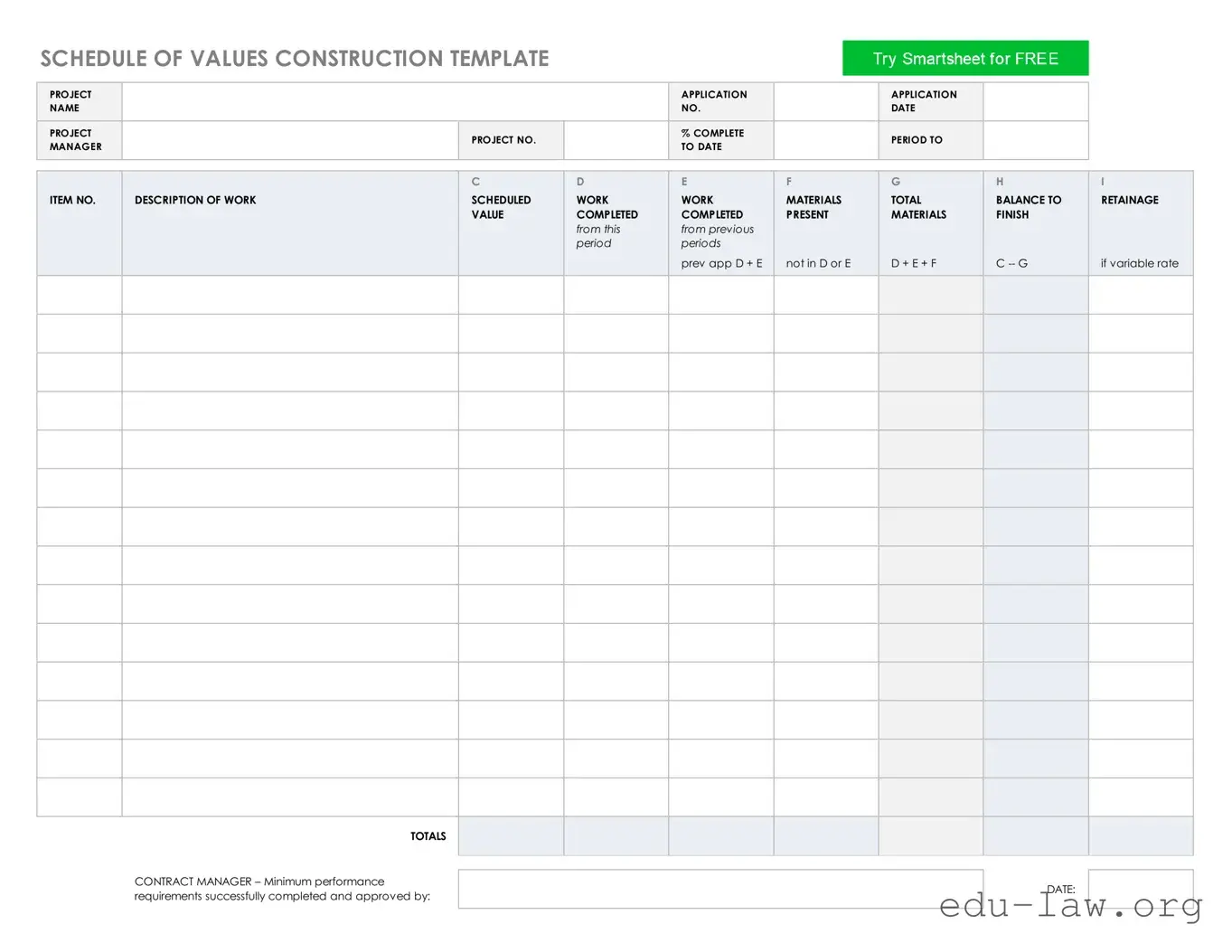
The Schedule of Values form plays a crucial role in the construction industry, serving as a detailed breakdown of project costs. This document outlines various components of a construction project, including the description of work, scheduled work, and materials. Each item is assigned a value that reflects its contribution to the overall project budget. The form typically includes columns for item numbers, descriptions, work completed, and retainage values, allowing project managers to track financial progress effectively. Additionally, it captures the percentage of completion for each work item, providing a clear snapshot of the project's status at any given time. The form is essential for ensuring transparency and accountability throughout the construction process, as it facilitates communication between contractors and project managers. Furthermore, it helps in managing cash flow by detailing the balance due for completed work and materials. While the Schedule of Values form is a valuable tool, users should be aware that the information provided by sources like Smartsheet is intended for reference purposes only and should be verified for accuracy before reliance.
SCHEDULE OF VALUES CONSTRUCTION TEMPLATE
PROJECT |
|
|
|
APPLICATION |
|
APPLICATION |
|
|
NAME |
|
|
|
NO. |
|
DATE |
|
|
PROJECT |
|
PROJECT NO. |
|
% COMPLETE |
|
PERIOD TO |
|
|
MANAGER |
|
|
TO DATE |
|
|
|
||
|
|
|
|
|
|
|
||
|
|
C |
D |
E |
F |
G |
H |
I |
ITEM NO. |
DESCRIPTION OF WORK |
SCHEDULED |
WORK |
WORK |
MATERIALS |
TOTAL |
BALANCE TO |
RETAINAGE |
|
|
VALUE |
COMPLETED |
COMPLETED |
PRESENT |
MATERIALS |
FINISH |
|
|
|
|
from this |
from previous |
|
|
|
|
|
|
|
period |
periods |
|
|
|
|
|
|
|
|
prev app D + E |
not in D or E |
D + E + F |
C |
if variable rate |
TOTALS |
|
|
CONTRACT MANAGER – Minimum performance |
DATE: |
|
requirements successfully completed and approved by: |
||
|

DISCLAIMER
Any articles, templates, or information provided by Smartsheet on the website are for reference only. While we strive to keep the information up to date and correct, we make no representations or warranties of any kind, express or implied, about the completeness, accuracy, reliability, suitability, or availability with respect to the website or the information, articles, templates, or related graphics contained on the website. Any reliance you place on such information is therefore strictly at your own risk.
| Fact Name | Description |
|---|---|
| Purpose | The Schedule of Values form is used to itemize the various components of a construction project, providing a detailed breakdown of costs. |
| Components | This form includes sections for project name, application name, project number, percentage complete, and various financial values related to work completed. |
| Governing Laws | In the United States, the governing laws for the Schedule of Values may vary by state. For example, California follows the California Civil Code, while Texas adheres to the Texas Property Code. |
| Retainage | Retainage is a percentage of the total value that is withheld until the project is completed satisfactorily, ensuring that all work meets contractual standards. |
| Disclaimer | The information provided in the Schedule of Values form is for reference only. Users should verify details and seek guidance to ensure compliance and accuracy. |
Completing the Schedule Values form is a crucial step in managing your project’s financials. Once you have filled out the form accurately, it will facilitate tracking progress and payments. Follow these steps to ensure you complete the form correctly.
What is the Schedule Values form used for?
The Schedule Values form is primarily utilized in construction projects to outline the financial status of various work items. It provides a clear breakdown of scheduled work, materials, and their respective values. This transparency helps project managers and stakeholders track progress and manage budgets effectively.
How do I fill out the Schedule Values form?
To complete the Schedule Values form, start by entering the project details, including the application name, project number, and date. Next, list each item number along with a description of the work. Fill in the scheduled work value, materials completed, and any retainage amounts. Ensure that the totals are calculated accurately to reflect the overall project status.
What does the "Balance to Complete" column indicate?
The "Balance to Complete" column shows the remaining value of work that has yet to be finished. This figure is crucial for understanding how much work is left to do and helps in forecasting project completion. It is calculated by subtracting the completed work value from the total scheduled work value.
What does "Retainage" mean in the context of this form?
Retainage refers to a portion of the payment that is withheld until the project is completed satisfactorily. It acts as a financial incentive for contractors to finish their work to the agreed standards. The Schedule Values form allows you to specify the retainage amount for each item, ensuring clarity in financial transactions.
How often should I update the Schedule Values form?
It is advisable to update the Schedule Values form regularly, typically at the end of each reporting period. This could be weekly or monthly, depending on the project's size and complexity. Frequent updates ensure that all stakeholders are aware of the current status and any financial implications.
What should I do if I notice discrepancies in the values?
If discrepancies arise in the values reported on the Schedule Values form, it is essential to investigate promptly. Cross-reference the figures with actual work completed and materials used. If necessary, communicate with team members to resolve any issues and ensure that the form reflects accurate information.
Is there a specific format I need to follow when using the Schedule Values form?
While the Schedule Values form provides a structured template, it can be adapted to fit the needs of your project. However, maintaining clarity and consistency is key. Ensure that all necessary columns are filled out and that the format allows for easy understanding and tracking of project progress.
Not including the project name and project number. These details are crucial for identifying the specific project.
Failing to update the % complete section. This should reflect the current status of the project accurately.
Incorrectly calculating the total balance. Ensure that all values are summed correctly to avoid discrepancies.
Omitting the retainage value. This is important for understanding the funds held back until project completion.
Not breaking down the description of work clearly. Each item should be detailed to provide clarity on what is being billed.
Neglecting to have the contract manager approve the form. This step is essential for ensuring all entries are validated.
The Schedule of Values form is a crucial document in construction projects, detailing the breakdown of costs associated with various aspects of the work. It is often used alongside other forms to ensure proper documentation, tracking, and management of project finances. Below is a list of commonly used forms that complement the Schedule of Values.
Utilizing these forms in conjunction with the Schedule of Values helps maintain transparency and accountability throughout the construction process. Proper documentation is key to a successful project and can prevent disputes and delays.
The Schedule of Values (SOV) form is closely related to the Progress Billing form. Both documents serve to track the financial progress of a construction project. The Progress Billing form details the amounts due to contractors at specific intervals, reflecting the work completed. Similar to the SOV, it breaks down the total contract value into smaller, manageable parts, allowing for clear visibility of what has been accomplished and what remains. This ensures that payments align with the actual work performed, promoting transparency and accountability in financial transactions.
Another document similar to the Schedule of Values is the Change Order form. Change Orders are used to document any modifications to the original construction contract, including changes in scope, materials, or costs. Like the SOV, it requires detailed descriptions and values associated with the changes made. Both forms are essential for maintaining accurate financial records and ensuring that all parties are aware of any adjustments that may affect the overall project budget.
The Invoice form also shares similarities with the Schedule of Values. Invoices are issued to request payment for services rendered or goods provided. Much like the SOV, invoices break down charges into specific line items, which helps clients understand what they are being billed for. Both documents aim to provide clarity on financial transactions, ensuring that all parties are aligned on costs and services delivered.
Additionally, the Payment Application form is akin to the Schedule of Values. This form is submitted by contractors to request payment based on the work completed during a specific period. The Payment Application typically references the SOV to justify the amounts requested, ensuring that payments correspond with the agreed-upon values for completed work. Both documents facilitate the payment process and help maintain financial accuracy throughout the project lifecycle.
The Retainage Release form is another document that parallels the Schedule of Values. Retainage refers to a portion of the payment withheld until the project reaches completion. The Retainage Release form specifies the amount being released and typically references the SOV to confirm that all necessary work has been satisfactorily completed. This ensures that contractors receive their full payment while providing a safeguard for project owners against incomplete work.
In addition, the Daily Log form is similar in that it tracks the progress of a construction project. While the Schedule of Values focuses on financial aspects, the Daily Log records daily activities, including work completed, materials used, and any issues encountered. Both documents serve to provide a comprehensive overview of the project's status, ensuring that all stakeholders are informed about progress and any potential delays.
The Budget Tracking form also bears resemblance to the Schedule of Values. This form is used to monitor the financial health of a project by comparing actual expenditures against the budgeted amounts. Like the SOV, it helps project managers identify variances and make informed decisions regarding resource allocation. Both documents are essential for maintaining control over project finances and ensuring that costs remain within the established budget.
Finally, the Project Schedule form shares similarities with the Schedule of Values. While the SOV focuses on financial values, the Project Schedule outlines the timeline for completing various tasks. Both documents are critical for project management, as they provide a framework for tracking progress and ensuring that all aspects of the project align with the overall goals and timelines. Together, they help keep the project on track and within budget.
When filling out the Schedule Values form, it's important to ensure accuracy and clarity. Here are some helpful tips on what to do and what to avoid:
Understanding the Schedule Values form is crucial for effective project management in construction. However, several misconceptions can lead to confusion and improper use. Here are nine common misconceptions:
Addressing these misconceptions can lead to more effective use of the Schedule Values form, ultimately contributing to the success of construction projects.
Filling out the Schedule Values form is an essential step in managing construction projects effectively. Here are some key takeaways to consider: