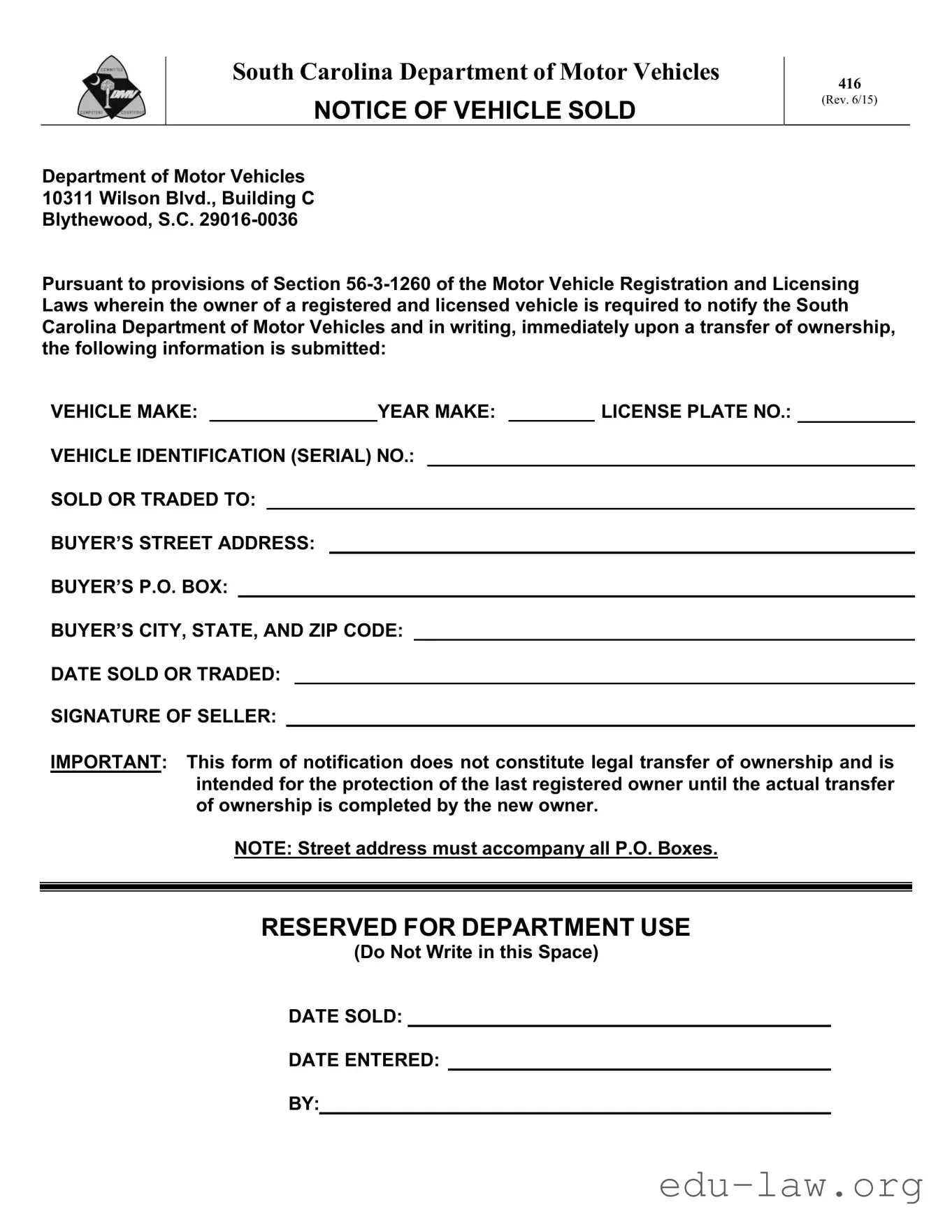
The SC DMV 416 form plays a crucial role in the process of transferring vehicle ownership in South Carolina. When a vehicle is sold or traded, the last registered owner must notify the South Carolina Department of Motor Vehicles (DMV) by submitting this form. This requirement is outlined in Section 56-3-1260 of the Motor Vehicle Registration and Licensing Laws. The form collects essential details, including the vehicle's make, year, license number, and the Vehicle Identification Number (VIN). Additionally, it requires information about the new owner, such as their street address and P.O. Box, along with the date of the sale or trade. While completing the SC DMV 416 is important, it is essential to understand that this notification does not legally transfer ownership of the vehicle. Instead, it serves to protect the last registered owner until the new owner completes the official transfer process. The DMV reserves a section for its own use, ensuring that all submissions are properly recorded. This form, therefore, acts as a vital step in ensuring a smooth transition of vehicle ownership and safeguarding the interests of the seller.

South Carolina Department of Motor Vehicles |
416 |
NOTICE OF VEHICLE SOLD |
(Rev. 6/15) |
|
Department of Motor Vehicles
10311 Wilson Blvd., Building C
Blythewood, S.C.
Pursuant to provisions of Section
VEHICLE MAKE: |
|
YEAR MAKE: |
|
LICENSE PLATE NO.: |
VEHICLE IDENTIFICATION (SERIAL) NO.:
SOLD OR TRADED TO:
BUYER’S STREET ADDRESS:
BUYER’S P.O. BOX:
BUYER’S CITY, STATE, AND ZIP CODE:
DATE SOLD OR TRADED:
SIGNATURE OF SELLER:
IMPORTANT: This form of notification does not constitute legal transfer of ownership and is intended for the protection of the last registered owner until the actual transfer of ownership is completed by the new owner.
NOTE: Street address must accompany all P.O. Boxes.
RESERVED FOR DEPARTMENT USE
(Do Not Write in this Space)
DATE SOLD:
DATE ENTERED:
BY:
| Fact Name | Description |
|---|---|
| Purpose | The SC DMV 416 form serves as a notification to the South Carolina Department of Motor Vehicles when a vehicle is sold or traded. It helps protect the last registered owner until the new owner completes the transfer of ownership. |
| Governing Law | This form is governed by Section 56-3-1260 of the Motor Vehicle Registration and Licensing Laws in South Carolina. |
| Required Information | When filling out the form, the seller must provide details such as the vehicle make, year, license number, and the vehicle identification number. The buyer's address and the date of the transaction are also required. |
| Legal Status | Filing this form does not legally transfer ownership of the vehicle. It is a notification tool to keep the last registered owner informed until the new owner completes the official transfer. |
Completing the SC DMV 416 form is an important step after selling or trading your vehicle. After filling it out, you will submit it to the South Carolina Department of Motor Vehicles to notify them of the change in ownership. This helps protect you as the previous owner until the new owner completes the transfer process.
Once you have completed the form, make sure to submit it to the South Carolina DMV. Keep a copy for your records as proof of notification.
What is the SC DMV 416 form?
The SC DMV 416 form, also known as the Notice of Vehicle Sold, is a document required by the South Carolina Department of Motor Vehicles (DMV). It serves to notify the DMV of the sale or transfer of ownership of a registered vehicle. This form must be completed by the seller to ensure that the DMV updates its records accordingly.
Who needs to fill out the SC DMV 416 form?
The seller of a registered vehicle in South Carolina is responsible for completing the SC DMV 416 form. This includes private individuals or businesses that are selling or trading a vehicle. It is important for the seller to notify the DMV to protect themselves from any potential liabilities associated with the vehicle after the sale.
What information is required on the SC DMV 416 form?
The form requires specific details about the vehicle being sold, including the make, year, license number, and vehicle identification number (VIN). Additionally, the seller must provide the name and address of the buyer, the date of the sale or trade, and their signature. This information is crucial for the DMV to update its records accurately.
Is the SC DMV 416 form a legal transfer of ownership?
No, the SC DMV 416 form does not constitute a legal transfer of ownership. It is merely a notification to the DMV that the vehicle has been sold or traded. The actual transfer of ownership is completed when the new owner registers the vehicle in their name. Until that happens, the last registered owner remains responsible for the vehicle.
How does one submit the SC DMV 416 form?
The completed SC DMV 416 form can be mailed to the South Carolina DMV at the address provided on the form: P.O. Box 1498, Blythewood, S.C. 29016-0036. It is important to ensure that the form is filled out completely and accurately to avoid any delays in processing.
What happens if the SC DMV 416 form is not submitted?
If the SC DMV 416 form is not submitted, the last registered owner may remain liable for any issues related to the vehicle, including traffic violations or accidents. Failing to notify the DMV can lead to complications and potential legal issues for the seller, as they may be held responsible for actions taken with the vehicle after the sale.
Can the SC DMV 416 form be used for vehicles traded to a dealership?
Yes, the SC DMV 416 form can be used for vehicles that are traded to a dealership. The seller should provide the dealership's information in the section designated for the buyer. This ensures that the DMV is aware of the transaction and can update their records accordingly.
What should I do if I need to make changes to the SC DMV 416 form after submission?
If changes need to be made to the SC DMV 416 form after it has been submitted, it is advisable to contact the South Carolina DMV directly for guidance. They can provide instructions on how to correct any errors or update the information as necessary.
Where can I obtain the SC DMV 416 form?
The SC DMV 416 form can typically be obtained from the South Carolina DMV's official website or by visiting a local DMV office. It is important to ensure that you have the most current version of the form, as it may be updated periodically.
When filling out the South Carolina DMV 416 form, individuals often encounter challenges that can lead to mistakes. Here are five common errors to avoid:
Many people forget to fill in all required fields, such as the vehicle make, year, and identification number. Omitting any detail can delay the processing of the form.
Some individuals mistakenly provide only a P.O. Box without including the street address. The form clearly states that a street address must accompany all P.O. Boxes, and failing to do so can lead to complications.
It is essential to sign the form. A signature is necessary to validate the notification of the vehicle sale or trade. Without it, the form may be deemed incomplete.
People sometimes enter the wrong date of sale or trade. This can create confusion and may affect the official records of the vehicle's ownership.
Some may not realize that this form does not legally transfer ownership. Understanding that it serves to protect the last registered owner until the new owner completes the transfer is crucial.
Being mindful of these common mistakes can help ensure a smoother process when submitting the South Carolina DMV 416 form.
When completing the South Carolina DMV 416 form, several other documents may be necessary to ensure a smooth transfer of vehicle ownership. Understanding these forms can help streamline the process and avoid potential issues. Below is a list of commonly used documents that accompany the DMV 416 form.
Being aware of these additional documents can simplify the vehicle transfer process. By preparing everything in advance, both buyers and sellers can ensure compliance with state regulations and facilitate a seamless transaction.
The South Carolina DMV Form 400 is similar to the DMV 416 form in that it also serves as a notification of vehicle ownership changes. The Form 400 is used for the application of a title for a vehicle that has been purchased or acquired. Both forms require details about the vehicle, such as the make, year, and vehicle identification number (VIN). While the DMV 416 focuses on notifying the DMV of a sale or trade, the Form 400 emphasizes the application for a new title, ensuring that the new owner can legally register the vehicle.
The South Carolina DMV Form 405 is another document that parallels the DMV 416. This form is used to report a vehicle that has been lost or stolen. Similar to the DMV 416, it requires specific information about the vehicle, including the VIN and make. Both forms aim to protect the interests of the last registered owner, although the 405 form addresses situations involving theft, while the 416 form pertains to sales or trades.
The DMV Form 447 is also akin to the DMV 416, as it deals with the transfer of vehicle ownership. This form is utilized when a vehicle is being gifted rather than sold. Like the DMV 416, it requires details about the vehicle and the new owner. The primary distinction lies in the nature of the transfer—one is a sale, while the other is a gift. Both documents ensure that the DMV is informed of the change in ownership, protecting the interests of the previous owner.
The South Carolina DMV Form 460 is similar in function to the DMV 416, as it is used for reporting a vehicle that has been junked or permanently removed from service. Both forms require the vehicle's identification details. The key difference is that the DMV 460 is used to inform the DMV that a vehicle is no longer in use, while the DMV 416 is focused on documenting a sale or trade. Both forms serve to update the DMV records and protect the last registered owner.
The DMV Form 440 serves as a duplicate title application and shares similarities with the DMV 416. Both forms require information about the vehicle, such as the VIN and make. While the DMV 416 is about notifying the DMV of a sale or transfer, the Form 440 is used when the original title is lost or damaged. Both forms play crucial roles in maintaining accurate vehicle ownership records.
The DMV Form 450 is used for reporting a vehicle that has been totaled or declared a total loss. This form is similar to the DMV 416 in that it requires information about the vehicle and serves to update the DMV records. The main difference is that the 450 form addresses situations where the vehicle is no longer roadworthy, whereas the 416 form is focused on ownership changes through sale or trade.
The DMV Form 430 is another document that is comparable to the DMV 416. It is used for reporting a change of address for a vehicle owner. Both forms aim to keep the DMV informed about the status of vehicle ownership. However, the 430 form specifically addresses the owner's contact information, while the 416 form is concerned with the transfer of ownership itself. Maintaining accurate records helps protect all parties involved.
The DMV Form 470 is used for the notification of a vehicle being repossessed. Similar to the DMV 416, it requires details about the vehicle and serves to inform the DMV about changes in ownership. The key distinction is that the 470 form is related to repossession due to non-payment, while the 416 form deals with voluntary sales or trades. Both forms aim to protect the last registered owner until the ownership transfer is officially completed.
Finally, the DMV Form 460C is used for reporting a vehicle that has been declared a salvage vehicle. Like the DMV 416, it requires information about the vehicle and serves to keep the DMV informed about its status. The difference lies in the fact that the 460C is focused on vehicles that have been damaged beyond repair, while the 416 form is concerned with the transfer of ownership through sale or trade. Both documents help ensure accurate records are maintained by the DMV.
When filling out the South Carolina DMV 416 form, it is important to follow certain guidelines to ensure the process goes smoothly. Here are four things to do and not to do:
When it comes to the South Carolina DMV 416 form, there are several misconceptions that can lead to confusion. Understanding the true purpose and implications of this form is essential for anyone involved in the sale or transfer of a vehicle. Here are six common misconceptions:
By clarifying these misconceptions, vehicle owners can ensure they are following the correct procedures and protecting their interests during the transfer of ownership process.
Filling out the SC DMV 416 form is an important step when selling or trading a vehicle in South Carolina. Here are some key takeaways to keep in mind:
By following these guidelines, you can ensure a smooth transaction and protect your interests as a seller.