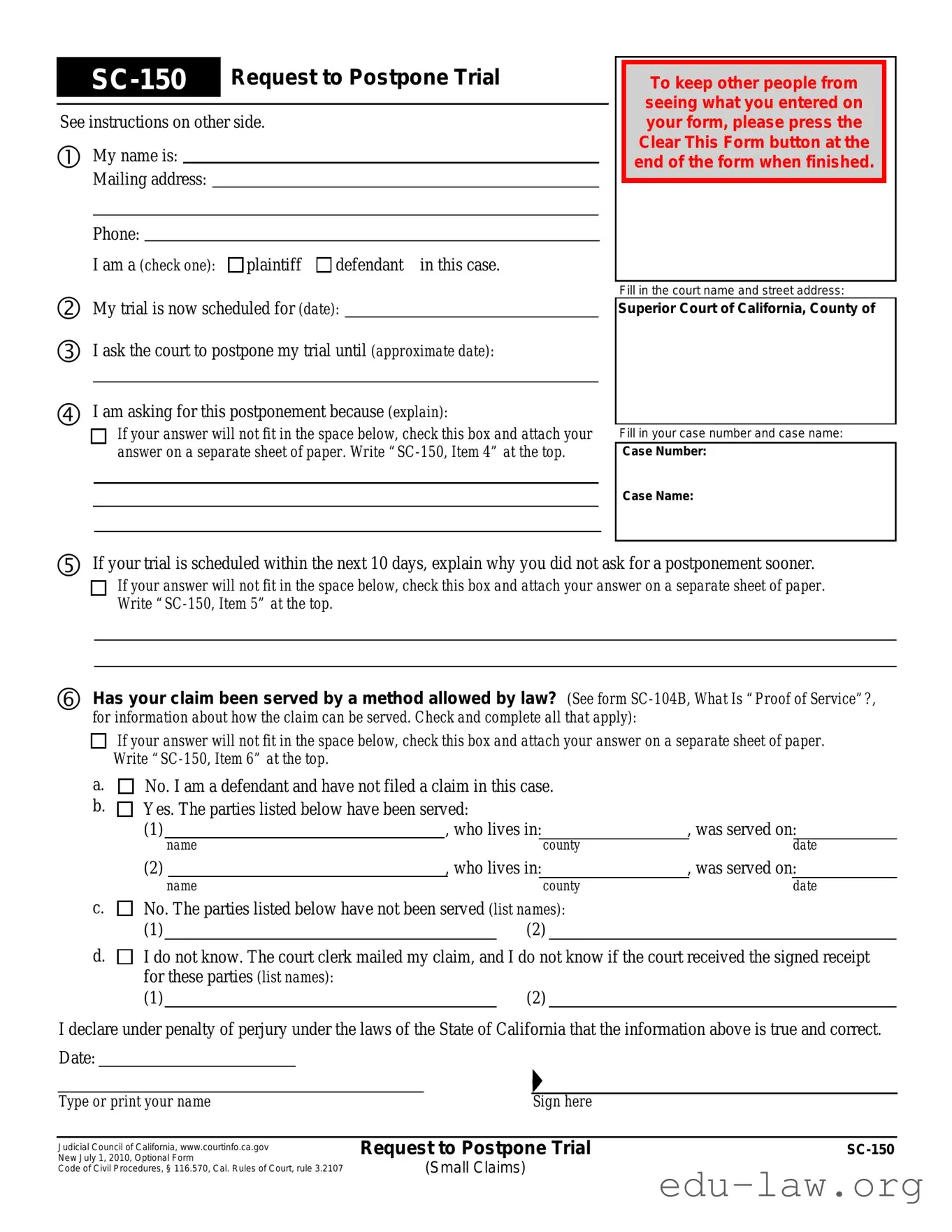
The SC-150 form, officially known as the Request to Postpone Trial, serves as a crucial tool for individuals involved in small claims cases in California. This form is designed for both plaintiffs and defendants who find themselves needing to reschedule their court dates for valid reasons, such as not having served all necessary parties or facing unforeseen circumstances. When filling out the SC-150, you will need to provide your personal information, including your name, mailing address, and phone number, as well as details about the scheduled trial date and the new date you are requesting. It's essential to clearly explain the reasons for your request, as this will help the court understand your situation. If your trial is approaching within the next ten days, you'll also need to address why you didn't request a postponement earlier. Additionally, the form includes sections to confirm whether all parties have been served according to legal requirements. While using this form is not mandatory—you can opt to write a letter instead—completing the SC-150 ensures that you provide all necessary information in a structured manner. After submitting your request, the court will notify you of its decision, and if granted, a new hearing date will be communicated to all involved parties. Understanding the SC-150 form is essential for effectively navigating the small claims process, ensuring that your rights are protected and that you have the opportunity to present your case fully.
See instructions on other side.
cMy name is: Mailing address:
Phone:
I am a (check one): |
plaintiff |
defendant in this case. |
dMy trial is now scheduled for (date):
eI ask the court to postpone my trial until (approximate date):
f I am asking for this postponement because (explain):
If your answer will not fit in the space below, check this box and attach your answer on a separate sheet of paper. Write
Clerk stamps here when form is filed.
To keep other people from seeing what you entered on your form, please press the Clear This Form button at the end of the form when finished.
Fill in the court name and street address:
Superior Court of California, County of
Fill in your case number and case name:
Case Number:
Case Name:
gIf your trial is scheduled within the next 10 days, explain why you did not ask for a postponement sooner.
If your answer will not fit in the space below, check this box and attach your answer on a separate sheet of paper. Write
hHas your claim been served by a method allowed by law? (See form
If your answer will not fit in the space below, check this box and attach your answer on a separate sheet of paper. Write
a.
b.
c.
d.
No. I am a defendant and have not filed a claim in this case. |
|
|
|
|
||||||
Yes. The parties listed below have been served: |
|
|
|
|
||||||
(1) |
|
|
, who lives in: |
, was served on: |
||||||
|
name |
|
|
county |
|
|
|
date |
||
(2) |
|
|
, who lives in: |
, was served on: |
||||||
|
|
|
|
|
|
|
|
|
|
|
|
name |
|
|
county |
|
|
date |
|||
No. The parties listed below have not been served (list names): |
|
|
|
|
||||||
(1) |
|
|
|
(2) |
|
|
|
|
|
|
I do not know. The court clerk mailed my claim, and I do not know if the court received the signed receipt for these parties (list names):
(1) |
|
(2) |
I declare under penalty of perjury under the laws of the State of California that the information above is true and correct. Date:
Type or print your name |
|
Sign here |
Judicial Council of California, www.courtinfo.ca.gov New July 1, 2010, Optional Form
Code of Civil Procedures, § 116.570, Cal. Rules of Court, rule 3.2107
Request to Postpone Trial |
(Small Claims)

Instructions for Form
(This page is not part of Form
Who can use this form?
•Anyone who filed a small claims case and wants to postpone or reschedule the trial for any good reason, including because he or she has not served all of the defendants
•Anyone who was sued in a small claims case and wants to postpone or reschedule the trial for any good reason
Do I have to use this form?
No. You may write a letter instead of using this form. Your letter should explain why you want to change your court date and include the other information that is requested on this form.
How do I ask for a postponement?
•Fill out Form
•Have all other parties in your case served with a copy of your request. You may serve by mail or in person. Use Form
•File your request and the completed Proof of Service with the small claims court clerk. You may have to pay a $10 fee, depending on when (or if) the claim was served. If you cannot afford to pay a required fee, see Form
How will I know the court’s decision?
If the court postpones the trial, the court will mail a notice with the new hearing date to all plaintiffs and defendants in this case.
If the court does not postpone the trial, the trial will be on the date when it is currently scheduled. The court will notify the person who filed the Request.
If you do not hear from the court, you should go to court on the scheduled trial date.
Need help?
For free help, contact your county’s small claims advisor: [local info here]
Or go to
New July 1, 2010 |
Request to Postpone Trial |
||
|
|
|
|
|
|
(Small Claims) |
|
|
|
|
|
For your protection and privacy, please press the Clear This Form |
|
|
|
|
Save This Form |
||
button after you have printed the form. |
|
|
|
|
|
|
|
Print This Form Clear This Form
| Fact Name | Details |
|---|---|
| Purpose | The SC-150 form is used to request a postponement of a small claims trial. |
| Eligibility | Anyone involved in a small claims case, either as a plaintiff or defendant, can use this form. |
| Filing Fee | A $10 fee may be required to file the request, depending on when the claim was served. |
| Governing Law | This form is governed by California Code of Civil Procedures, § 116.570. |
| Notification | If the court approves the postponement, it will mail a notice with the new hearing date to all parties. |
| Alternative | A letter can be submitted instead of using the SC-150 form, as long as it includes the required information. |
Filling out the SC-150 form is a straightforward process that requires you to provide specific information about your case and the reasons for your request to postpone the trial. After completing the form, you will need to serve it to the other parties involved in your case and file it with the court clerk. Following these steps will help ensure that your request is properly submitted.
What is the SC-150 form used for?
The SC-150 form, known as the Request to Postpone Trial, is used by individuals involved in small claims cases who wish to delay their trial date. This request can be made by either the plaintiff or the defendant for various valid reasons, such as needing more time to prepare or not having served all parties involved in the case.
Do I have to use the SC-150 form to request a postponement?
No, using the SC-150 form is not mandatory. You can write a letter instead. However, your letter should include all the information requested on the SC-150 form to ensure clarity and completeness in your request.
How do I properly submit the SC-150 form?
To submit the SC-150 form, first complete it with all required information. Next, ensure that all other parties in your case receive a copy of your request, either by mail or in person. You can use Form SC-104 or Form SC-112A to document this service. Finally, file the completed SC-150 form along with the Proof of Service with the small claims court clerk. Be aware that a fee may apply, depending on the timing of your request.
How will I know if my request to postpone the trial is approved?
If the court approves your request, you will receive a notice by mail with the new trial date. If your request is denied, the trial will proceed as originally scheduled. The court will inform the person who submitted the request, so it is important to monitor for any communication from the court.
What should I do if I don’t hear back from the court?
If you do not receive any notification from the court regarding your request to postpone the trial, you should plan to attend the trial on the originally scheduled date. It is crucial to be present unless you have received confirmation of a new date.
Incomplete Information: One common mistake is not filling out all the required fields. Ensure that your name, mailing address, phone number, and case details are complete. Leaving any section blank can delay the processing of your request.
Missing Justification: Failing to provide a clear explanation for the postponement request is another frequent error. The court needs to understand your reasons for asking for a delay. If your explanation does not fit in the designated space, remember to attach a separate sheet with "SC-150, Item 4" at the top.
Ignoring Service Requirements: Not confirming whether all parties have been served properly can lead to complications. Make sure to check the appropriate boxes regarding service and provide details for each party involved. If unsure, indicate that you do not know and list the names as required.
Not Following Submission Guidelines: Some individuals neglect to serve all parties with a copy of the request before filing it with the court. This step is crucial. Use the appropriate proof of service forms to ensure compliance. If you skip this step, it may result in the court not considering your request.
The SC-150 form, known as the Request to Postpone Trial, is an essential document for individuals involved in small claims cases who need to reschedule their trial. However, there are several other forms that often accompany the SC-150 to ensure the process runs smoothly. Below is a list of these forms, each serving a specific purpose in the legal process.
Using these forms in conjunction with the SC-150 can help streamline the postponement process, making it easier for individuals to navigate their small claims cases. Each document plays a vital role in maintaining clarity and ensuring that all parties are informed and engaged in the proceedings.
The SC-150 form, which is used to request a postponement of a trial, shares similarities with the SC-104 form, known as the Proof of Service. Both documents are essential in the small claims process. The SC-104 form serves to confirm that all parties involved have been properly notified about the proceedings. Just as the SC-150 requires the requester to provide details about their case and the reason for the postponement, the SC-104 demands information about how and when the parties were served. This ensures that everyone is aware of their rights and responsibilities in the case, maintaining fairness in the legal process.
Another document that resembles the SC-150 is the SC-112A form, which is also a Proof of Service by Mail. This form is specifically used when a party serves documents through the mail rather than in person. Similar to the SC-150, the SC-112A requires specific information about the parties involved and the dates of service. Both forms aim to ensure that due process is followed, providing a clear record that all parties have been informed about the proceedings. This is crucial for the integrity of the small claims system.
The SC-101 form, known as the Small Claims Plaintiff's Claim and Order to Go to Small Claims Court, is another document that aligns with the SC-150. The SC-101 initiates the small claims process by allowing a plaintiff to file a claim against a defendant. Like the SC-150, it requires detailed information about the parties and the nature of the claim. Both forms facilitate communication between the court and the parties involved, ensuring that all necessary information is presented for a fair trial. They serve as foundational documents in the small claims process.
Lastly, the FW-001 form, or the Request to Waive Court Fees, is similar in that it addresses procedural aspects of small claims cases. While the SC-150 focuses on postponing a trial, the FW-001 is used by individuals who cannot afford to pay court fees. Both documents require the filer to provide personal information and specific reasons for their requests. This similarity highlights the importance of accessibility in the legal system, ensuring that all individuals, regardless of financial status, can participate in the judicial process effectively.
When filling out the SC-150 form, there are several important dos and don'ts to keep in mind. Following these guidelines can help ensure your request is processed smoothly and efficiently.
By following these simple guidelines, you can navigate the process of requesting a trial postponement with confidence. Always remember that clear communication and thoroughness are key to a successful submission.
Understanding the SC-150 form is crucial for those involved in small claims cases. However, several misconceptions can lead to confusion. Below are six common misconceptions regarding the SC-150 form, along with clarifications.
This is incorrect. Both plaintiffs and defendants can use the SC-150 form to request a postponement of the trial for valid reasons.
While the SC-150 form is a standardized option, individuals can also write a letter to request a postponement. The letter must include all the information requested on the form.
It is possible to request a postponement even if the trial is within ten days. However, you must explain why you did not request it sooner.
This is not true. The court will review each request and will notify the parties involved whether the trial has been postponed or will proceed as scheduled.
In addition to filing the SC-150 form, all other parties in the case must be served with a copy of the request. Proof of service must also be filed with the court.
While there is typically no fee for filing the SC-150 itself, there may be a $10 fee depending on when the claim was served. If you cannot afford this fee, options for a fee waiver are available.
Clarifying these misconceptions can help individuals navigate the small claims process more effectively. Understanding the requirements and procedures surrounding the SC-150 form can lead to better outcomes in your case.
Filling out and using the SC-150 form is an important step for anyone looking to postpone a small claims trial. Here are key takeaways to consider: