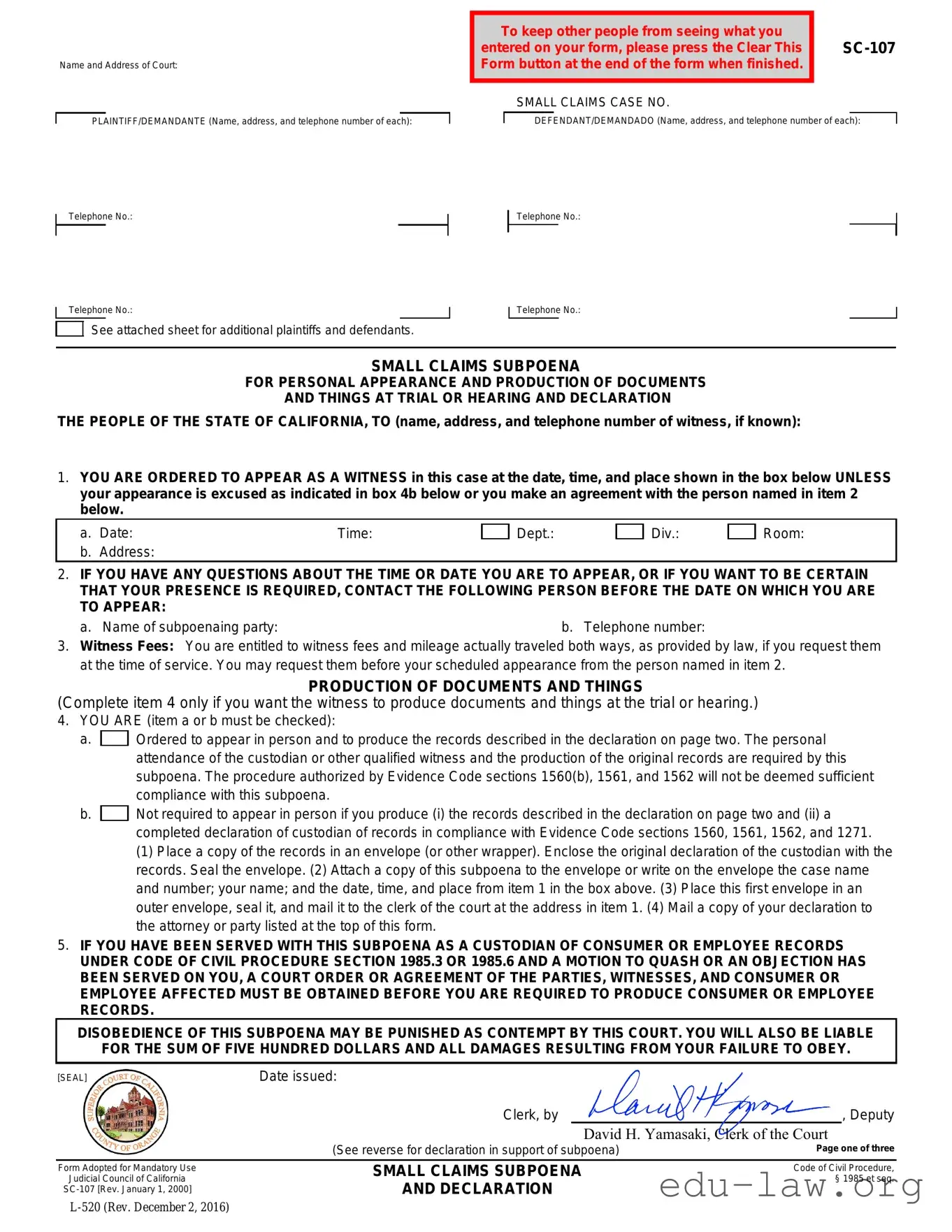
The SC-107 form is a crucial document used in small claims court proceedings in California. It serves as a subpoena, compelling a witness to appear in court and produce specific documents relevant to a case. This form includes essential information such as the names and addresses of both the plaintiff and defendant, as well as the court's contact details. It outlines the date, time, and location where the witness must appear, providing clear instructions on how to comply with the subpoena. Additionally, it informs witnesses of their rights, including the ability to request witness fees and mileage reimbursement. The form also allows for the production of documents, detailing the process for submitting records either in person or by mail. It is important for parties involved in small claims to understand how to properly fill out and serve the SC-107 form to ensure that their case proceeds smoothly and that all necessary evidence is presented during the hearing.
Name and Address of Court:
PLAINTIFF/DEMANDANTE (Name, address, and telephone number of each):
Telephone No.:
Telephone No.:
See attached sheet for additional plaintiffs and defendants.
To keep other people from seeing what you |
|
entered on your form, please press the Clear This |
|
Form button at the end of the form when finished. |
|
|
|
SMALL CLAIMS CASE NO.
DEFENDANT/DEMANDADO (Name, address, and telephone number of each):
Telephone No.:
Telephone No.:
SMALL CLAIMS SUBPOENA
FOR PERSONAL APPEARANCE AND PRODUCTION OF DOCUMENTS
AND THINGS AT TRIAL OR HEARING AND DECLARATION
THE PEOPLE OF THE STATE OF CALIFORNIA, TO (name, address, and telephone number of witness, if known):
1.YOU ARE ORDERED TO APPEAR AS A WITNESS in this case at the date, time, and place shown in the box below UNLESS your appearance is excused as indicated in box 4b below or you make an agreement with the person named in item 2 below.
a. |
Date: |
Time: |
b. |
Address: |
|
Dept.:
Div.:
Room:
2.IF YOU HAVE ANY QUESTIONS ABOUT THE TIME OR DATE YOU ARE TO APPEAR, OR IF YOU WANT TO BE CERTAIN THAT YOUR PRESENCE IS REQUIRED, CONTACT THE FOLLOWING PERSON BEFORE THE DATE ON WHICH YOU ARE TO APPEAR:
a. Name of subpoenaing party: |
b. Telephone number: |
3.Witness Fees: You are entitled to witness fees and mileage actually traveled both ways, as provided by law, if you request them at the time of service. You may request them before your scheduled appearance from the person named in item 2.
PRODUCTION OF DOCUMENTS AND THINGS
(Complete item 4 only if you want the witness to produce documents and things at the trial or hearing.)
4.YOU ARE (item a or b must be checked):
a. |
|
Ordered to appear in person and to produce the records described in the declaration on page two. The personal |
|
|
attendance of the custodian or other qualified witness and the production of the original records are required by this |
|
|
subpoena. The procedure authorized by Evidence Code sections 1560(b), 1561, and 1562 will not be deemed sufficient |
|
|
compliance with this subpoena. |
b. |
|
Not required to appear in person if you produce (i) the records described in the declaration on page two and (ii) a |
|
|
completed declaration of custodian of records in compliance with Evidence Code sections 1560, 1561, 1562, and 1271. |
(1)Place a copy of the records in an envelope (or other wrapper). Enclose the original declaration of the custodian with the records. Seal the envelope. (2) Attach a copy of this subpoena to the envelope or write on the envelope the case name and number; your name; and the date, time, and place from item 1 in the box above. (3) Place this first envelope in an outer envelope, seal it, and mail it to the clerk of the court at the address in item 1. (4) Mail a copy of your declaration to the attorney or party listed at the top of this form.
5.IF YOU HAVE BEEN SERVED WITH THIS SUBPOENA AS A CUSTODIAN OF CONSUMER OR EMPLOYEE RECORDS UNDER CODE OF CIVIL PROCEDURE SECTION 1985.3 OR 1985.6 AND A MOTION TO QUASH OR AN OBJECTION HAS BEEN SERVED ON YOU, A COURT ORDER OR AGREEMENT OF THE PARTIES, WITNESSES, AND CONSUMER OR EMPLOYEE AFFECTED MUST BE OBTAINED BEFORE YOU ARE REQUIRED TO PRODUCE CONSUMER OR EMPLOYEE RECORDS.
DISOBEDIENCE OF THIS SUBPOENA MAY BE PUNISHED AS CONTEMPT BY THIS COURT. YOU WILL ALSO BE LIABLE
FOR THE SUM OF FIVE HUNDRED DOLLARS AND ALL DAMAGES RESULTING FROM YOUR FAILURE TO OBEY.
[SEAL] |
Date issued: |
|
|
||
|
Clerk, by |
|
|
, Deputy |
|
|
|
David H. Yamasaki, Clerk of the Court |
|||
|
(See reverse for declaration in support of subpoena) |
Page one of three |
|||
Form Adopted for Mandatory Use |
SMALL CLAIMS SUBPOENA |
Code of Civil Procedure, |
|||
Judicial Council of California |
§ 1985 et seq. |
||||
AND DECLARATION |
|||||
|
|
||||

PLAINTIFF/PETITIONER:
DEFENDANT/RESPONDENT:
CASE NUMBER:
DECLARATION IN SUPPORT OF
SMALL CLAIMS SUBPOENA FOR PERSONAL APPEARANCE
AND PRODUCTION OF DOCUMENT AND THINGS AT TRIAL OR HEARING
(Code Civil Procedure sections 1985, 1987.5)
1. I, the undersigned, declare I am the
other (specify):
plaintiff
defendant
judgment creditor
in the above entitled action.
2. The witness has possession or control of the following documents or other things and shall produce them at the time and place specified on the Small Claims Subpoena on the first page of this form.
a.
For trial or hearing (specify the exact documents or other things to be produced by the witness):
b.
Continued on Attachment 2a.
After trial to enforce a judgment (specify the exact documents or other things to be produced by the party who is the judgment debtor or other witness possessing records relating to the judgment debtor):
(1) |
|
Payroll receipts, stubs, and other records concerning employment of the party. Receipts, invoices, documents, |
|
|
and other papers or records concerning any and all accounts receivable of the party. |
(2) |
|
Bank account statements, canceled checks, and check registers from any and all bank accounts in which the party |
|
||
|
|
has an interest. |
(3) |
|
Savings account passbooks and statements, savings and loan account passbooks and statements, and credit |
|
||
|
|
union share account passbooks and statements of the party. |
(4) |
|
Stock certificates, bonds, money market certificates, and any other records, documents, or papers concerning all |
|
||
|
|
investments of the party. |
(5) |
|
California registration certificates and ownership certificates for all vehicles registered to the party. |
|
||
(6) |
|
Deeds to any and all real property owned or being purchased by the party. |
|
||
(7) |
|
Other (specify): |
|
3. Good cause exists for the production of the documents or other things described in paragraph 2 for the following reasons:
Continued on Attachment 3.
4. These documents are material to the issues involved in this case for the following reasons:
Continued on Attachment 4.
I declare under penalty of perjury under the laws of the State of California that the foregoing is true and correct.
Date:
. . . . . . . . . . . . . . . . . . . . . . . . . . . . . . . . . . . . . . . . . . . . .
(TYPE OR PRINT NAME) |
(SIGNATURE OF PARTY) |
(See proof of service on page three)
SMALL CLAIMS SUBPOENA
AND DECLARATION
Page two of three
PLAINTIFF/PETITIONER:
DEFENDANT/RESPONDENT:
CASE NUMBER:
PROOF OF SERVICE OF SMALL CLAIMS SUBPOENA FOR PERSONAL APPEARANCE
AND PRODUCTION OF DOCUMENTS AND THINGS AT TRIAL OR HEARING
AND DECLARATION
1.I served this Small Claims Subpoena for Personal Appearance and Production of Documents and Things at Trial or Hearing and Declaration by personally delivering a copy to the person served as follows:
a.Person served (name):
b.Address where served:
c.Date of delivery:
d.Time of delivery:
e.Witness fees (check one):
(1) |
|
were offered or demanded |
|
|
and paid. Amount: . . . . . $ |
(2) |
|
were not demanded or paid. |
f.Fee for service: . . . . . . . . . . . . . . . $
2.I received this subpoena for service on (date):
3.Person serving:
a. |
|
Not a registered California process server. |
|
|
|
b. |
|
California sheriff, marshal, or constable. |
|
|
|
c. |
|
Registered California process server. |
|
|
|
d. |
|
Employee or independent contractor of a registered California process server. |
|
|
|
e. |
|
Exempt from registration under Business & Professions Code section 22350(b). |
|
|
|
f. |
|
Registered professional photocopier. |
|
|
|
g. |
|
Exempt from registration under Business & Professions Code section 22451. |
h. Name, address, and telephone number and, if applicable, county of registration and number:
I declare under penalty of perjury under the laws of the State |
(For California sheriff, marshal, or constable use only) |
of California that the foregoing is true and correct. |
I certify that the foregoing is true and correct. |
Date: |
Date: |
(SIGNATURE) |
(SIGNATURE) |
PROOF OF SERVICE OF SMALL CLAIMS SUBPOENA
FOR PERSONAL APPEARANCE AND PRODUCTION OF DOCUMENTS
AT TRIAL OF HEARING AND DECLARATION
Page three of three
Print This Form
For your protection and privacy, please press the Clear This
Form button after you have printed the form.
Clear This Form
| Fact Name | Description |
|---|---|
| Purpose of SC-107 | The SC-107 form is used as a subpoena in small claims cases, requiring a witness to appear in court and produce certain documents or items relevant to the case. |
| Governing Law | This form is governed by the California Code of Civil Procedure, specifically sections 1985 and 1987.5, which outline the procedures for issuing subpoenas in civil cases. |
| Witness Fees | Individuals who receive a subpoena are entitled to witness fees and mileage for their travel, provided they request these fees at the time of service. |
| Production of Documents | The form allows for the production of specific documents by a witness, which may include financial records, employment documents, and other relevant materials needed for the trial. |
| Consequences of Non-Compliance | Failure to comply with the SC-107 subpoena may result in penalties, including being held in contempt of court and potential financial liabilities. |
Filling out the SC-107 form is a straightforward process that involves providing specific information related to a small claims case. After completing the form, ensure you review all entries for accuracy before submitting it to the court.
Once you have completed the SC-107 form, make sure to keep a copy for your records. Submit the original to the court and follow any additional instructions provided by the court regarding service of the subpoena.
What is the SC-107 form?
The SC-107 form is a Small Claims Subpoena used in California. It orders a witness to appear in court and produce specific documents or items for a trial or hearing. This form ensures that the necessary evidence is available for the case at hand.
Who can issue an SC-107 form?
The SC-107 form can be issued by any party involved in a small claims case. This includes plaintiffs and defendants who need to gather evidence or require witness testimony to support their case.
What information is required on the SC-107 form?
The form requires the name and address of the court, the names and contact information of both the plaintiff and defendant, and details about the witness, including their name, address, and telephone number. It also includes sections for the date, time, and location of the required appearance.
What should a witness do if they receive an SC-107 form?
If a witness receives an SC-107 form, they are ordered to appear in court on the specified date and time. If they have questions or need clarification, they should contact the subpoenaing party listed on the form. Witness fees and mileage may be requested at the time of service.
What happens if a witness does not comply with the SC-107 form?
Failure to comply with the SC-107 form can result in legal consequences. The court may hold the witness in contempt, which can lead to fines or other penalties. It is crucial for witnesses to take the subpoena seriously and respond accordingly.
Can a witness produce documents without appearing in court?
Yes, a witness can produce documents without appearing in person if they follow specific instructions outlined in the SC-107 form. They must provide the required documents along with a completed declaration of the custodian of records, ensuring all legal requirements are met.
What are witness fees, and how can they be requested?
Witness fees are compensation for the time and travel of a witness attending court. If a witness wants to receive these fees, they should request them at the time of service or before their scheduled appearance from the subpoenaing party. It's important to ask for these fees to ensure they are compensated for their attendance.
How can I protect my privacy when filling out the SC-107 form?
To protect your privacy, you should press the "Clear This Form" button at the end of the form after you have finished filling it out. This action will ensure that sensitive information is not accessible to others.
When filling out the SC-107 form, it's easy to make mistakes that could delay your case or create unnecessary complications. Here are four common errors to avoid:
Many people forget to fill in all required fields, such as the names, addresses, and telephone numbers of both the plaintiff and defendant. Ensure that every section is complete to avoid delays.
Failing to provide accurate details about the witness can lead to confusion. Double-check the name, address, and phone number of the witness to ensure they receive the subpoena correctly.
Some individuals overlook the need for a signature on the form. Not signing can invalidate the subpoena, so make sure to sign and date the document before submission.
When producing documents, it's crucial to follow the specified procedures. Many forget to include the necessary copies or to properly label their submissions, which can lead to complications in court.
By being mindful of these common mistakes, you can help ensure that your SC-107 form is filled out correctly and efficiently. Taking the time to review your information can save you from potential headaches down the line.
The SC-107 form, known as the Small Claims Subpoena for Personal Appearance and Production of Documents, is a critical document in small claims court proceedings. It allows a party to summon witnesses to appear in court and produce documents relevant to the case. In addition to the SC-107, there are several other forms that are often used in conjunction with it to facilitate the legal process. Below is a list of these forms, along with a brief description of each.
Understanding these forms and their purposes can greatly assist individuals navigating the small claims court system. Each document plays a vital role in ensuring that all parties have the opportunity to present their cases effectively and that the legal process proceeds smoothly.
The SC-107 form, which serves as a Small Claims Subpoena for Personal Appearance and Production of Documents, shares similarities with several other legal documents designed to facilitate court proceedings. One such document is the Subpoena Duces Tecum. This type of subpoena specifically requires a person to produce documents or evidence at a legal proceeding. Like the SC-107, it emphasizes the importance of producing original records and outlines the procedures for compliance, ensuring that relevant information is available for the court’s consideration.
Another comparable document is the Summons. A Summons notifies a defendant that they are being sued and provides details about the court proceedings. While the SC-107 focuses on compelling a witness to appear and produce evidence, both documents serve the purpose of ensuring that all parties are informed and can adequately prepare for the case. Each document plays a crucial role in the legal process, promoting transparency and fairness.
The Notice to Produce is also similar to the SC-107 form. This document is used to request specific documents from a party involved in a legal dispute. Like the SC-107, it outlines the exact documents needed for the case and sets a timeline for their production. Both documents aim to streamline the discovery process, allowing parties to gather necessary evidence efficiently.
The Affidavit of Service is another document that bears resemblance to the SC-107. This affidavit provides proof that a legal document has been properly served to the intended recipient. While the SC-107 includes a section for proof of service, the Affidavit of Service is a standalone document that formalizes the delivery of legal notices, ensuring that all parties are aware of their obligations and rights.
Additionally, the Request for Admission shares similarities with the SC-107 form. This document allows one party to request that the other party admit or deny specific facts related to the case. Both documents aim to clarify issues in dispute and facilitate the trial process. By establishing what is agreed upon, they help narrow the focus of the proceedings, making them more efficient.
The Motion to Compel is another document that aligns with the SC-107. This motion is filed when one party believes that the other has failed to comply with discovery requests, such as producing documents. Both documents emphasize the necessity of obtaining information for a fair trial, underscoring the importance of cooperation between parties in the legal process.
Lastly, the Declaration of Custodian of Records is closely related to the SC-107 form. This declaration is often used when a witness is required to produce documents but is unable to appear in person. It allows for the submission of records along with a sworn statement regarding their authenticity. Both documents facilitate the introduction of evidence in court, ensuring that necessary documentation is presented while adhering to legal standards.
When filling out the SC-107 form, there are important steps to follow to ensure accuracy and compliance. Here are five things you should and shouldn't do:
Understanding the SC-107 form can be challenging, and several misconceptions often arise. Here are six common misunderstandings about this form:
It is essential to understand these points to navigate the legal process effectively. If you have further questions about the SC-107 form, seeking assistance from a qualified professional may be beneficial.
Key Takeaways for Filling Out and Using the SC-107 Form: