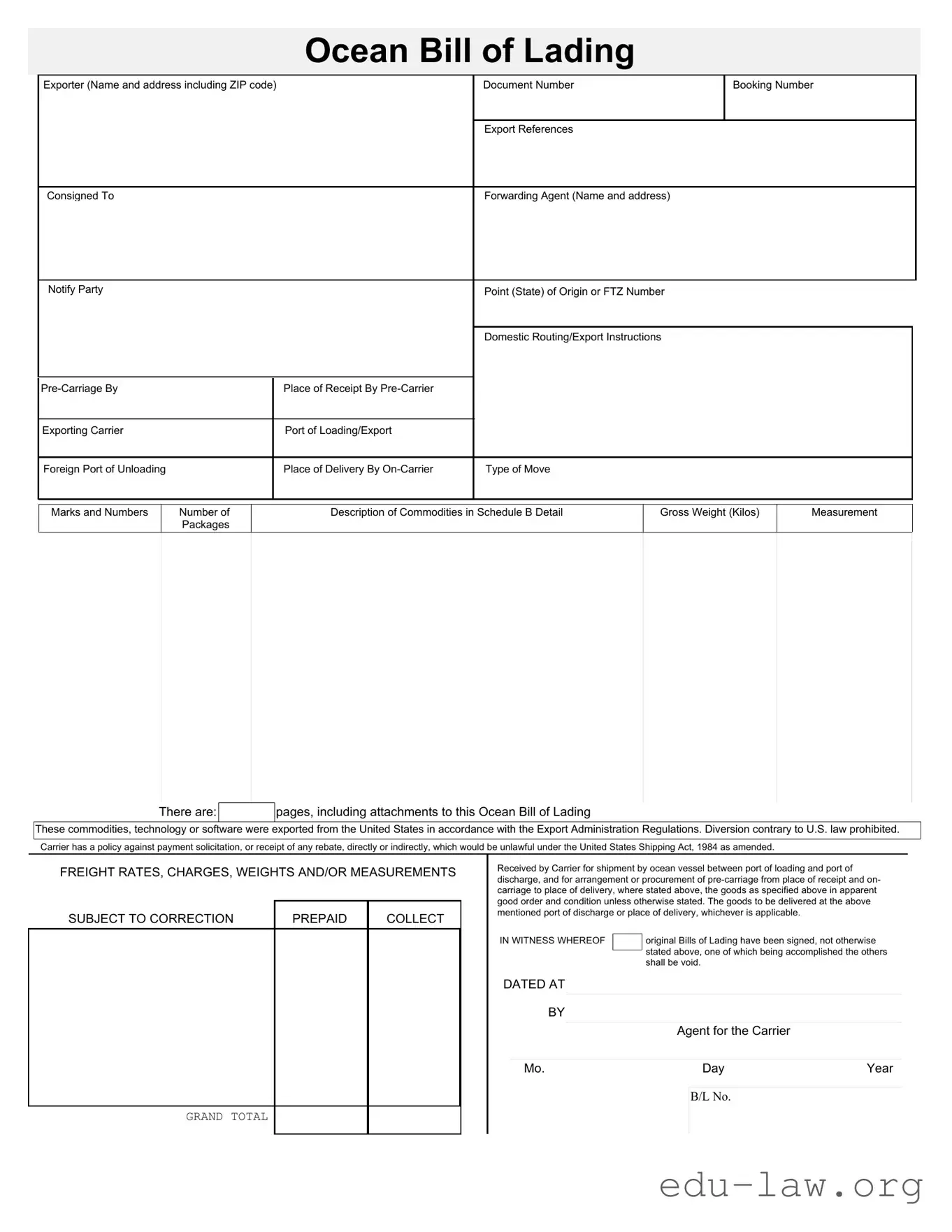
The Sample Ocean Bill of Lading form serves as a crucial document in international shipping, providing essential details about the shipment of goods by sea. It includes vital information such as the names and addresses of the exporter and forwarding agent, along with booking and document numbers. This form outlines the points of origin and destination, specifying the ports of loading and unloading. It also identifies the commodities being shipped, including their gross weight and packaging details. The form emphasizes compliance with U.S. Export Administration Regulations, making it clear that any diversion of the goods contrary to U.S. law is prohibited. Furthermore, it contains important legal disclaimers regarding freight rates, charges, and the responsibilities of the carrier. The document requires acknowledgment of receipt by the carrier, ensuring that goods are accepted in good order unless otherwise noted. Ultimately, the Sample Ocean Bill of Lading is a foundational element of maritime commerce, ensuring that all parties involved have a clear understanding of their rights and responsibilities in the shipping process.

Ocean Bill of Lading
Exporter (Name and address including ZIP code) |
|
Document Number |
|
Booking Number |
|||||
|
|
|
|
|
|
|
|
|
|
|
|
|
|
|
|
Export References |
|
|
|
|
|
|
|
|
|
|
|
|
|
Consigned To |
|
|
|
|
Forwarding Agent (Name and address) |
|
|||
|
|
|
|
|
|
|
|
|
|
Notify Party |
|
|
|
|
Point (State) of Origin or FTZ Number |
|
|||
|
|
|
|
|
|
|
|
|
|
|
|
|
|
|
|
Domestic Routing/Export Instructions |
|
||
|
|
|
|
|
|
|
|
|
|
|
|
|
Place of Receipt By |
|
|
|
|
||
|
|
|
|
|
|
|
|
|
|
Exporting Carrier |
|
|
|
Port of Loading/Export |
|
|
|
|
|
|
|
|
|
|
|
|
|
|
|
Foreign Port of Unloading |
|
|
|
Place of Delivery By |
Type of Move |
|
|
|
|
|
|
|
|
|
|
|
|
|
|
|
|
|
|
|
|
|
|||
Marks and Numbers |
|
Number of |
|
|
Description of Commodities in Schedule B Detail |
Gross Weight (Kilos) |
Measurement |
||
|
|
Packages |
|
|
|
|
|
|
|
There are:
pages, including attachments to this Ocean Bill of Lading
These commodities, technology or software were exported from the United States in accordance with the Export Administration Regulations. Diversion contrary to U.S. law prohibited.
Carrier has a policy against payment solicitation, or receipt of any rebate, directly or indirectly, which would be unlawful under the United States Shipping Act, 1984 as amended.
FREIGHT RATES, CHARGES, WEIGHTS AND/OR MEASUREMENTS
SUBJECT TO CORRECTION |
PREPAID |
COLLECT |
GRAND TOTAL
Received by Carrier for shipment by ocean vessel between port of loading and port of discharge, and for arrangement or procurement of
IN WITNESS WHEREOF |
|
original Bills of Lading have been signed, not otherwise |
|
|
stated above, one of which being accomplished the others |
|
|
|
|
|
shall be void. |
DATED AT
BY
Agent for the Carrier
Mo. |
Day |
Year |
B/L NO.
| Fact Name | Description |
|---|---|
| Exporter Information | The form requires the name and address of the exporter, including the ZIP code, ensuring accurate identification. |
| Document Number | A unique document number is assigned to track the Ocean Bill of Lading throughout the shipping process. |
| Booking Number | This number is essential for referencing the specific shipment and coordinating logistics with the carrier. |
| Consigned To | The form must include the name and address of the party to whom the goods are being shipped, ensuring proper delivery. |
| Port of Loading | The location where the goods are loaded onto the vessel is specified, which is crucial for shipping logistics. |
| Governing Law | This document is governed by the laws of the state where the shipment originates, typically the state of the exporter. |
| Carrier's Policy | The carrier has a policy against unlawful payment solicitation, which aligns with the United States Shipping Act of 1984. |
Filling out the Sample Ocean Bill of Lading form is a critical step in the shipping process. This document serves as a receipt for the goods being transported and outlines the terms of the shipment. Follow these steps carefully to ensure accurate completion of the form.
Finally, ensure that you check the number of pages and any attachments related to this Bill of Lading. Review all entries for accuracy before submitting the form to the carrier.
What is an Ocean Bill of Lading?
An Ocean Bill of Lading is a legal document issued by a carrier to acknowledge receipt of cargo for shipment. It serves as a contract between the shipper and the carrier, outlining the details of the shipment, including the type of goods, destination, and shipping terms.
What information is included in the Sample Ocean Bill of Lading form?
The form contains several key details, such as the exporter’s name and address, document number, booking number, and consigned party information. It also includes specifics like the point of origin, port of loading, foreign port of unloading, and a description of the commodities being shipped.
Why is the "Notify Party" section important?
The "Notify Party" section identifies the individual or organization that should be informed upon the arrival of the shipment. This ensures that the right person is notified about the cargo's status, facilitating smooth communication and coordination for pickup or further handling.
What does "pre-carriage" and "on-carriage" mean?
"Pre-carriage" refers to the transportation of goods from the shipper's location to the port of loading. "On-carriage" involves the transportation of goods from the port of discharge to the final destination. Both terms are crucial for understanding the full logistics of the shipment.
What are the implications of the statement regarding U.S. export regulations?
This statement highlights that the exported goods comply with U.S. Export Administration Regulations. It emphasizes the legal responsibility of the shipper to ensure that the goods are not diverted contrary to U.S. law, which is essential for compliance and avoiding legal issues.
What does "FREIGHT RATES, CHARGES, WEIGHTS AND/OR MEASUREMENTS SUBJECT TO CORRECTION" mean?
This phrase indicates that the freight rates and other charges listed may be adjusted if errors are found. It serves as a reminder that the figures provided are preliminary and could change based on final measurements or weight assessments.
What does the statement about "original Bills of Lading" signify?
This statement means that only one original Bill of Lading is necessary for the shipment. Once one is fulfilled, any other originals become void. This helps prevent confusion and ensures that the shipment is properly tracked and managed.
How does the Ocean Bill of Lading protect both the shipper and the carrier?
The Ocean Bill of Lading serves as proof of the agreement between the shipper and the carrier. It protects the shipper by documenting the condition of the goods at the time of shipment. For the carrier, it provides a legal framework to limit liability and clarify responsibilities during the shipping process.
Inaccurate Information Entry: One of the most common mistakes is providing incorrect details, such as the name or address of the exporter or consignee. This can lead to significant delays or even the return of goods. Always double-check the spelling and accuracy of all names and addresses.
Missing Required Fields: Failing to fill out mandatory sections, like the document number or booking number, can render the Bill of Lading invalid. Ensure that every required field is completed before submission.
Inadequate Description of Commodities: Describing the goods inaccurately or vaguely can cause confusion and complications during shipping. Use clear and specific terms, including the Schedule B classification, to avoid misunderstandings.
Ignoring Freight Charges and Payment Terms: Not specifying whether the freight is prepaid or collect can lead to disputes later on. Clearly state the payment terms to ensure all parties are on the same page regarding charges.
Overlooking Signature Requirements: The absence of a signature from the agent for the carrier can invalidate the document. Make sure to sign the Bill of Lading where indicated and ensure that all necessary parties have done the same.
The Ocean Bill of Lading is a crucial document in international shipping. Several other forms and documents often accompany it to ensure compliance and facilitate smooth transactions. Below is a list of commonly used documents along with brief descriptions.
Each of these documents plays a vital role in the shipping process. Together, they help ensure that shipments are processed efficiently and comply with all legal requirements.
The Air Waybill (AWB) serves a similar purpose to the Ocean Bill of Lading but is specifically designed for air cargo. Like the Ocean Bill of Lading, it acts as a receipt for the goods and outlines the terms of transportation. The AWB includes details such as the sender's and receiver's information, flight details, and descriptions of the cargo. Both documents serve as evidence of the contract between the shipper and the carrier, ensuring that the goods are transported according to agreed terms. However, while the Ocean Bill of Lading is used for maritime shipping, the AWB is exclusively for air transport.
The Bill of Lading for Rail (Rail BOL) is another document that shares similarities with the Ocean Bill of Lading. This document is used when goods are transported via rail. Like its ocean counterpart, the Rail BOL serves as a receipt and a contract between the shipper and the rail carrier. It contains critical information such as the origin and destination of the shipment, the type of cargo, and the weight. Both documents ensure that the goods are handled appropriately and delivered to the correct location, although the modes of transportation differ.
The Truck Bill of Lading (Truck BOL) is also akin to the Ocean Bill of Lading, but it pertains to road transport. This document outlines the details of the shipment, including the consignor and consignee information, the nature of the cargo, and the terms of transport. Both the Truck BOL and the Ocean Bill of Lading function as contracts and receipts, ensuring that the goods are transported safely and efficiently. The primary difference lies in the mode of transportation, with the Truck BOL specifically addressing ground shipping.
The Combined Transport Bill of Lading is a versatile document that integrates multiple modes of transport, including ocean, air, and land. Similar to the Ocean Bill of Lading, it serves as a receipt and contract for the shipment. This document is particularly useful for international shipments that require various transportation methods. It provides a comprehensive overview of the shipping process, detailing each leg of the journey, while the Ocean Bill of Lading focuses solely on maritime transport.
The Warehouse Receipt is another document that bears resemblance to the Ocean Bill of Lading, though it serves a different purpose. This document is issued by a warehouse operator and acknowledges the receipt of goods for storage. While the Ocean Bill of Lading is primarily concerned with the transport of goods, the Warehouse Receipt confirms that the goods have been stored safely. Both documents provide proof of custody and ownership, but they are used at different stages in the supply chain.
The Freight Invoice is similar to the Ocean Bill of Lading in that it details the charges associated with transporting goods. This document outlines the costs incurred during shipment, including freight charges, handling fees, and any additional expenses. Both documents are essential for financial record-keeping and help ensure transparency in shipping transactions. However, while the Ocean Bill of Lading acts as a contract for transport, the Freight Invoice focuses on the financial aspects of the shipping process.
The Packing List is another important document that parallels the Ocean Bill of Lading. It provides a detailed account of the items included in a shipment, including quantities, descriptions, and weights. While the Ocean Bill of Lading serves as a contract and receipt for the shipment, the Packing List is primarily used for inventory management and customs clearance. Both documents play crucial roles in ensuring that shipments are accurately documented and accounted for, but they serve different functions in the shipping process.
Finally, the Certificate of Origin is a document that is often required for international shipments, including those covered by an Ocean Bill of Lading. This certificate verifies the country in which the goods were produced or manufactured. While the Ocean Bill of Lading focuses on the transport and receipt of goods, the Certificate of Origin serves to confirm the origin of the products, which can affect tariffs and trade regulations. Both documents are essential for compliance with international trade laws and ensure that shipments are processed smoothly through customs.
When filling out the Sample Ocean Bill of Lading form, attention to detail is crucial. Here are nine important guidelines to follow:
Following these guidelines will help ensure that the form is completed correctly and efficiently.
Understanding the Sample Ocean Bill of Lading can be challenging, especially with the various misconceptions that surround it. Here are six common misunderstandings:
By addressing these misconceptions, individuals can better navigate the complexities of international shipping and ensure compliance with necessary regulations.
When filling out and using the Sample Ocean Bill of Lading form, it is crucial to ensure accuracy and completeness. Here are some key takeaways to consider:
By following these guidelines, you can help ensure that the Ocean Bill of Lading is filled out correctly, facilitating a smooth shipping process.