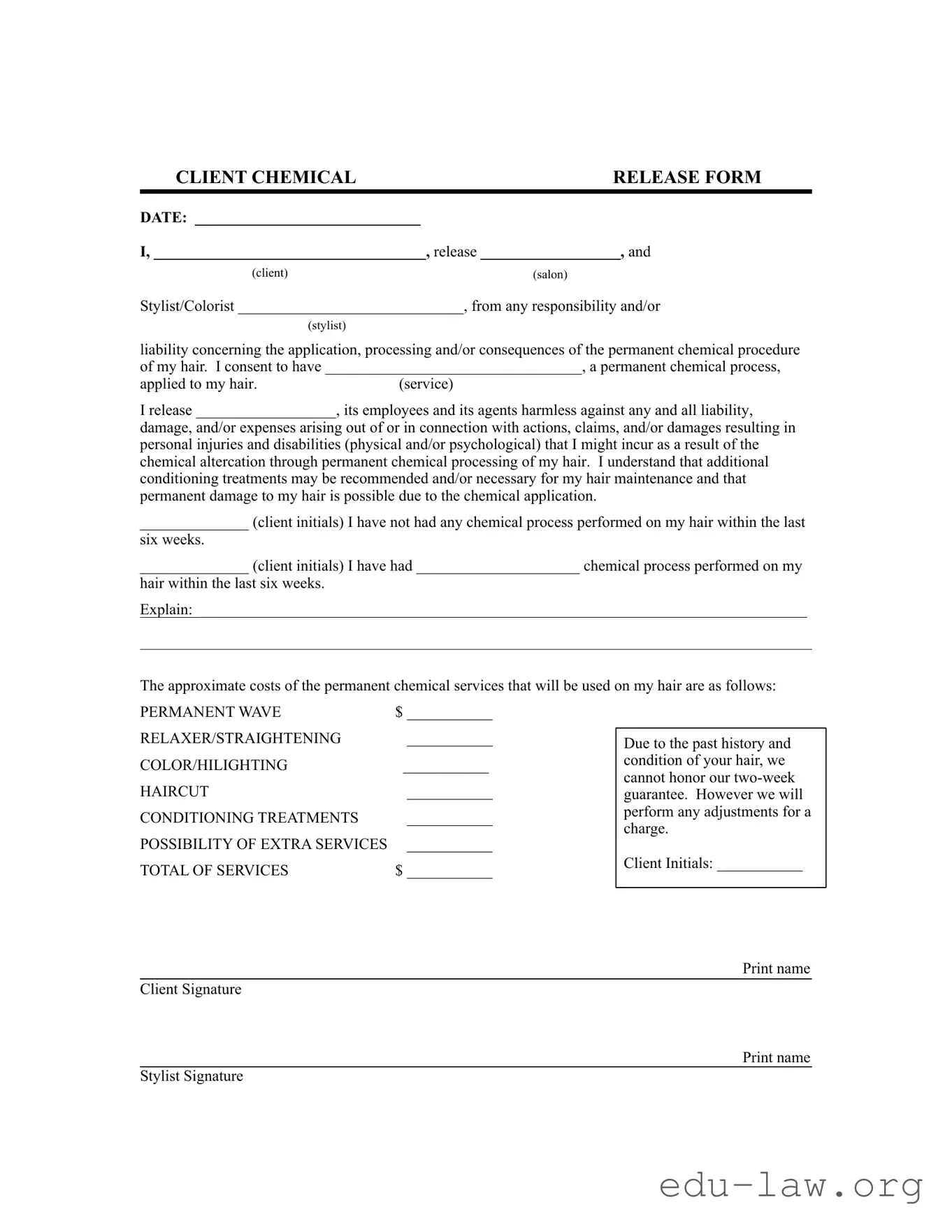
The Salon Chemical Waiver form is an essential document designed to protect both clients and salons during the application of permanent chemical treatments. By signing this form, clients acknowledge their understanding of the risks associated with chemical processes, such as hair coloring, relaxing, or perming. The form outlines the client's release of liability for the salon and its staff regarding any potential injuries or damages that may arise from these procedures. It also emphasizes the importance of disclosing any previous chemical treatments, ensuring that the stylist can make informed decisions about the client's hair care. Furthermore, the form details the costs associated with various services and highlights the possibility of additional treatments or adjustments that may be necessary. Clients must initial specific sections to confirm their awareness of these factors, reinforcing their informed consent. Ultimately, the Salon Chemical Waiver form serves as a critical tool in maintaining transparency and safety within the salon environment.

CLIENT CHEMICALRELEASE FORM
DATE: _____________________________
I, ___________________________________, release __________________, and
(client)(salon)
Stylist/Colorist _____________________________, from any responsibility and/or
(stylist)
liability concerning the application, processing and/or consequences of the permanent chemical procedure of my hair. I consent to have _________________________________, a permanent chemical process,
applied to my hair.(service)
I release __________________, its employees and its agents harmless against any and all liability,
damage, and/or expenses arising out of or in connection with actions, claims, and/or damages resulting in personal injuries and disabilities (physical and/or psychological) that I might incur as a result of the chemical altercation through permanent chemical processing of my hair. I understand that additional conditioning treatments may be recommended and/or necessary for my hair maintenance and that permanent damage to my hair is possible due to the chemical application.
______________ (client initials) I have not had any chemical process performed on my hair within the last
six weeks.
______________ (client initials) I have had _____________________ chemical process performed on my
hair within the last six weeks.
Explain: ______________________________________________________________________________
The approximate costs of the permanent chemical services that will be used on my hair are as follows:
PERMANENT WAVE |
$ ___________ |
|
|
RELAXER/STRAIGHTENING |
___________ |
|
|
Due to the past history and |
|||
COLOR/HILIGHTING |
___________ |
condition of your hair, we |
|
HAIRCUT |
___________ |
cannot honor our |
|
guarantee. However we will |
|||
CONDITIONING TREATMENTS |
___________ |
perform any adjustments for a |
|
charge. |
|||
POSSIBILITY OF EXTRA SERVICES |
___________ |
||
Client Initials: ___________ |
|||
TOTAL OF SERVICES |
$ ___________ |
||
|
|||
|
|
|
Print name
Client Signature
Print name
Stylist Signature
| Fact Name | Description |
|---|---|
| Client Release | The Salon Chemical Waiver form requires the client to release the salon and stylist from any liability related to the chemical procedure, including potential injuries or damages. |
| Consent for Treatment | Clients must provide consent for the specific permanent chemical process being applied to their hair, ensuring they understand the nature of the treatment. |
| Historical Conditions | The form asks clients to disclose any chemical processes performed on their hair within the last six weeks, which helps assess the suitability of the treatment. |
| Cost Disclosure | Clients are informed of the approximate costs associated with the services, allowing for transparency regarding financial commitments before treatment. |
Completing the Salon Chemical Waiver form is an important step in your salon experience. This document ensures that both you and the salon are on the same page regarding the chemical services to be performed. To fill out the form accurately, follow these detailed steps.
What is the purpose of the Salon Chemical Waiver form?
The Salon Chemical Waiver form serves as a legal agreement between the client and the salon. By signing this document, clients acknowledge and accept the risks associated with permanent chemical procedures, such as hair coloring, relaxing, or perming. The form protects the salon and its staff from liability related to any adverse reactions or damages that may occur as a result of these chemical treatments. It ensures that clients are informed about potential outcomes and the need for ongoing hair maintenance.
What should I include when filling out the form?
When completing the Salon Chemical Waiver form, clients must provide their name, the date, and the name of the salon and stylist performing the service. Additionally, clients must specify the type of permanent chemical process they wish to have applied to their hair. If there has been any previous chemical treatment within the last six weeks, clients should disclose this information, as it may affect the outcome of the new service. It's also essential to initial the sections that confirm understanding of the risks and any recommendations for additional treatments.
Are there any risks associated with permanent chemical treatments?
Yes, there are inherent risks involved with permanent chemical treatments. These procedures can lead to various outcomes, including potential damage to hair, scalp irritation, or allergic reactions. Clients should be aware that permanent changes to hair structure may occur, and some individuals may experience physical or psychological effects due to these changes. The waiver form emphasizes the importance of understanding these risks and encourages clients to discuss any concerns with their stylist prior to treatment.
What happens if I have had a chemical process recently?
If a client has undergone a chemical process within the last six weeks, they must disclose this on the waiver form. This information is crucial, as recent treatments can affect the hair's condition and how it reacts to new chemical applications. The salon may advise against proceeding with the desired treatment if there is a risk of damage or adverse effects. Clients should always be transparent about their hair history to ensure the best possible results and maintain hair health.
What costs are associated with the services listed on the waiver?
The waiver form outlines the approximate costs for various permanent chemical services, including permanent waves, relaxers, color treatments, haircuts, and conditioning treatments. Clients are encouraged to review these costs carefully before signing the form. If additional services are required due to the condition of the hair or if adjustments are necessary after the initial treatment, these may incur extra charges. Clients should have a clear understanding of the total costs involved to avoid any surprises.
Incomplete Client Information: Failing to fill in your full name can lead to confusion and delays. Always ensure your name is clearly written.
Missing Date: Not including the date at the top of the form can create issues for record-keeping. Always write the date when you fill out the form.
Not Specifying the Service: Leaving the service section blank means the salon won't know what treatment you are receiving. Clearly state the chemical process you want.
Ignoring Initials: Forgetting to initial next to the statements about previous chemical processes can lead to misunderstandings. Always check that you have initialed all required sections.
Not Disclosing Previous Treatments: If you have had a chemical process in the last six weeks, failing to mention it can cause complications. Be honest about your hair history.
Leaving Cost Sections Blank: Not filling in the cost of services can lead to confusion about charges. Make sure to write down the prices for each service you are receiving.
Not Understanding Risks: Skimming over the section about potential damage can lead to unexpected results. Take the time to read and understand the risks involved.
Missing Signatures: Forgetting to sign the form can invalidate it. Ensure both you and your stylist sign the document.
Not Asking Questions: If anything is unclear, not asking for clarification can lead to mistakes. Don't hesitate to ask your stylist for help.
Rushing Through the Form: Filling out the form quickly can lead to mistakes. Take your time to ensure everything is accurate.
When visiting a salon for chemical treatments, several forms and documents are often used alongside the Salon Chemical Waiver form. These documents help ensure that both the client and the salon are protected and informed about the services being provided. Here’s a list of common forms you might encounter:
These documents are essential for ensuring a smooth and transparent salon experience. They help protect both clients and stylists while promoting clear communication about the services provided.
The Salon Chemical Waiver form shares similarities with a Medical Release Form. Both documents serve to protect professionals from liability. In a Medical Release Form, a patient acknowledges the risks associated with medical procedures and agrees not to hold the healthcare provider responsible for any adverse effects. Just like the Salon Chemical Waiver, it requires the patient’s consent and understanding of potential outcomes, ensuring that the provider is not liable for unforeseen complications.
Another document akin to the Salon Chemical Waiver is the Sports Injury Waiver. Athletes often sign this waiver before participating in sports activities. It informs them of the inherent risks involved and releases coaches or organizations from liability for injuries sustained during play. Similar to the salon waiver, it emphasizes the participant's acknowledgment of risks and their agreement not to pursue claims for injuries that may occur.
The Personal Training Waiver also resembles the Salon Chemical Waiver. Clients who engage in personal training often sign this document to acknowledge the physical risks associated with fitness activities. By signing, they release the trainer from liability for any injuries that may arise during training sessions. Both waivers focus on the participant's understanding of risks and their agreement to assume responsibility for any resulting injuries.
A Release of Liability for Recreational Activities is another comparable document. Individuals participating in activities like zip-lining or rock climbing must sign this form to acknowledge the risks involved. Similar to the salon waiver, it protects the service provider from claims related to injuries that may occur. The emphasis is on the participant's informed consent and acceptance of potential dangers.
The Liability Waiver for Pet Services is also similar. Pet owners often sign this waiver before using services like grooming or boarding. It releases the service provider from liability for any injuries or accidents that may happen to the pet during their care. Like the Salon Chemical Waiver, it requires the owner to acknowledge potential risks and agree to hold the provider harmless.
A Travel Waiver is another document that aligns with the Salon Chemical Waiver. Travelers often sign this form to acknowledge the risks associated with travel, including accidents or injuries. By signing, they release the travel company from liability for any incidents that may occur during the trip. This document, like the salon waiver, emphasizes the traveler’s understanding of risks and their agreement to assume responsibility.
The Event Participation Waiver is also similar. Participants in events like marathons or festivals often sign this waiver to acknowledge the risks of participation. It releases the event organizers from liability for any injuries or accidents that may occur. Both waivers focus on the participant's understanding of potential risks and their agreement not to hold the organizers responsible for injuries.
Lastly, the Home Improvement Waiver has similarities with the Salon Chemical Waiver. Homeowners often sign this waiver before renovations or repairs, acknowledging the risks involved with construction work. By signing, they release contractors from liability for any injuries or damages that may occur. Both documents ensure that the individual understands the risks and agrees to waive their right to pursue claims for related issues.
When filling out the Salon Chemical Waiver form, it's important to follow certain guidelines to ensure clarity and accuracy. Here are five things to do and not to do:
Understanding the Salon Chemical Waiver form is essential for clients considering chemical treatments for their hair. Here are six common misconceptions about this form:
While the waiver does release the salon from certain liabilities, it does not mean that they can neglect safety standards or provide subpar service. Clients still have rights and can hold salons accountable for negligence.
Even with a signed waiver, clients can still report concerns to regulatory boards or seek legal advice if they believe they have been harmed due to negligence or improper procedures.
The waiver covers a range of potential issues, including minor reactions or damage to the hair. Clients should be aware that it addresses both physical and psychological effects.
Each salon may have its own version of a waiver, tailored to its specific services and policies. Clients should read the document carefully, as terms can vary significantly.
Clients can discuss any concerns or ask questions about the waiver before signing. It is important to feel comfortable and informed about what you are agreeing to.
The waiver does not protect the salon from all claims. If a client can prove that the salon acted irresponsibly or failed to follow proper procedures, the salon may still be held liable.
Filling out and using the Salon Chemical Waiver form is a critical step for both clients and stylists. Here are key takeaways to consider: