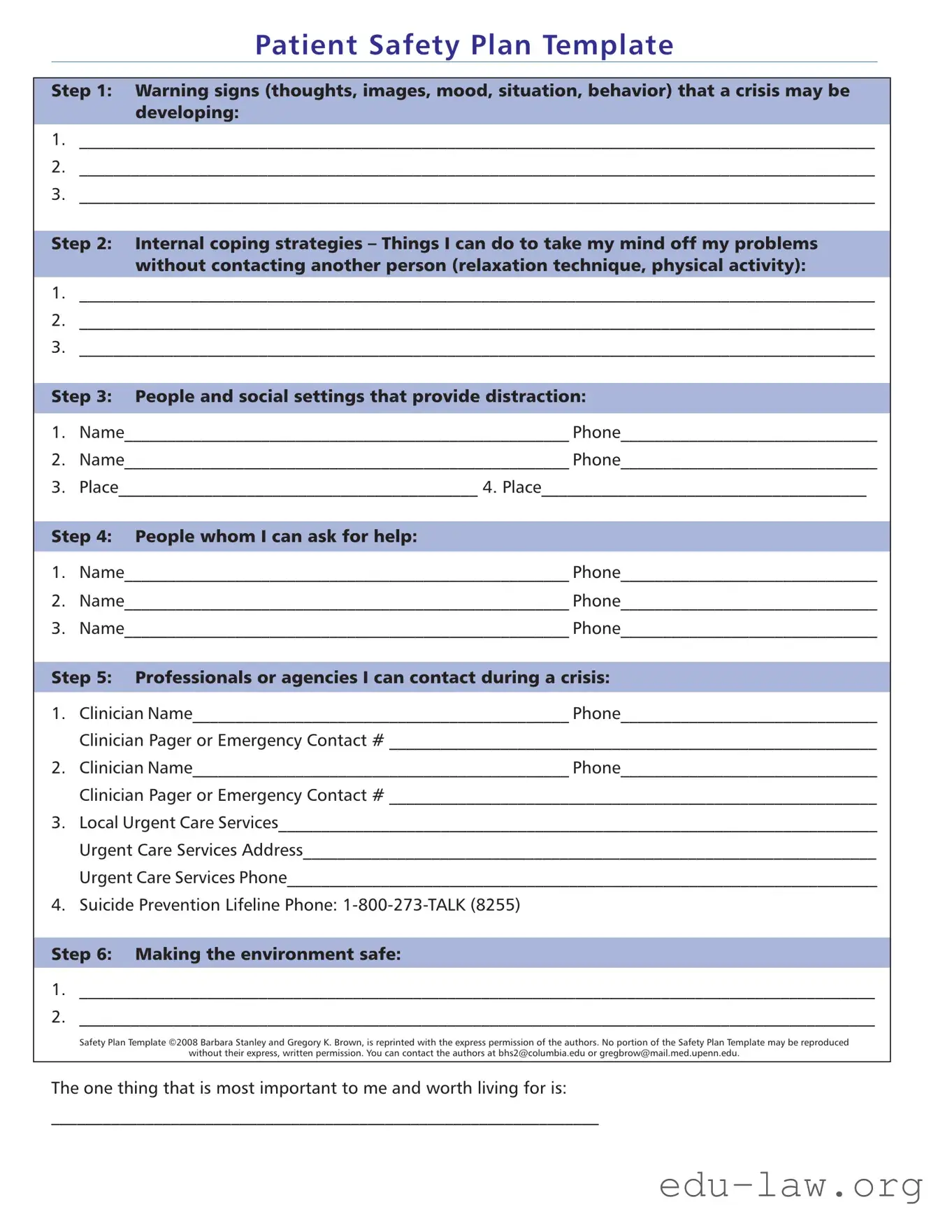
The Safety Plan form serves as a crucial tool for individuals facing mental health challenges, providing a structured approach to managing crises effectively. It begins by identifying warning signs, such as specific thoughts, feelings, or behaviors that may indicate a developing crisis. This awareness is vital for early intervention. Next, the form encourages individuals to outline internal coping strategies—simple techniques or activities that can help divert their attention from distressing thoughts without needing to reach out to others. In addition, it emphasizes the importance of social support by listing people and places that can offer distraction during tough times. Furthermore, the form includes a section for identifying trusted individuals who can provide assistance when needed. It also highlights the importance of professional support, offering a space to list clinicians and emergency contacts, including local urgent care services and the Suicide Prevention Lifeline. Finally, the Safety Plan addresses environmental safety, prompting individuals to consider how to create a secure space for themselves. Ultimately, this form not only facilitates personal reflection but also empowers individuals to take proactive steps toward their well-being.

Patient Safety Plan Template
Step 1: Warning signs (thoughts, images, mood, situation, behavior) that a crisis may be developing:
1._____________________________________________________________________________________________
2._____________________________________________________________________________________________
3._____________________________________________________________________________________________
Step 2: Internal coping strategies – Things I can do to take my mind off my problems without contacting another person (relaxation technique, physical activity):
1._____________________________________________________________________________________________
2._____________________________________________________________________________________________
3._____________________________________________________________________________________________
Step 3: People and social settings that provide distraction:
1.Name____________________________________________________ Phone______________________________
2.Name____________________________________________________ Phone______________________________
3.Place__________________________________________ 4. Place______________________________________
Step 4: People whom I can ask for help:
1.Name____________________________________________________ Phone______________________________
2.Name____________________________________________________ Phone______________________________
3.Name____________________________________________________ Phone______________________________
Step 5: Professionals or agencies I can contact during a crisis:
1.Clinician Name____________________________________________ Phone______________________________
Clinician Pager or Emergency Contact # _________________________________________________________
2.Clinician Name____________________________________________ Phone______________________________
Clinician Pager or Emergency Contact # _________________________________________________________
3.Local Urgent Care Services______________________________________________________________________
Urgent Care Services Address___________________________________________________________________
Urgent Care Services Phone_____________________________________________________________________
4.Suicide Prevention Lifeline Phone:
Step 6: Making the environment safe:
1._____________________________________________________________________________________________
2._____________________________________________________________________________________________
Safety Plan Template ©2008 Barbara Stanley and Gregory K. Brown, is reprinted with the express permission of the authors. No portion of the Safety Plan Template may be reproduced
without their express, written permission. You can contact the authors at [email protected] or [email protected].
The one thing that is most important to me and worth living for is:
________________________________________________________________
| Fact Name | Details |
|---|---|
| Purpose | The Safety Plan form helps individuals identify warning signs and coping strategies during a crisis. |
| Step Structure | The form is divided into six steps, guiding users through identifying triggers and support systems. |
| Emergency Contacts | Users can list professionals and agencies to contact during a crisis, ensuring immediate support is available. |
| Distraction Techniques | Internal coping strategies include personal activities that help divert attention from problems. |
| Legal Basis | In some states, safety plans are governed by mental health laws that emphasize patient safety and crisis management. |
| Copyright Information | This template is ©2008 by Barbara Stanley and Gregory K. Brown, and cannot be reproduced without permission. |
Completing the Safety Plan form is an important step toward ensuring your well-being and establishing a support system during challenging times. The process involves reflecting on your personal experiences, identifying resources, and outlining strategies that can help you cope effectively. Here are the steps to fill out the form:
At the end of the form, reflect on what is most important to you and worth living for. This can serve as a powerful reminder of your values and motivations.
The one thing that is most important to me and worth living for is: ________________________________________________________________.
What is the purpose of the Safety Plan form?
The Safety Plan form is designed to help individuals identify warning signs of a crisis and develop strategies for coping. It serves as a personalized guide that outlines steps to take when feeling overwhelmed or in distress. By creating a plan, individuals can better manage their emotions and know whom to reach out to for support.
How do I fill out the warning signs section?
In the warning signs section, list specific thoughts, images, moods, situations, or behaviors that indicate a crisis may be developing. Reflect on past experiences to identify these signs. This could include feelings of sadness, irritability, or specific situations that trigger distress. The goal is to recognize these signs early to take proactive steps.
What internal coping strategies can I include?
Internal coping strategies are personal techniques that can help divert your mind from distressing thoughts. These might include relaxation techniques like deep breathing, engaging in physical activities such as walking or jogging, or practicing mindfulness. Think about what has worked for you in the past and list those strategies in the designated section.
Who should I list as people and social settings for distraction?
Consider individuals who make you feel supported and safe. This could be friends, family members, or colleagues. Additionally, think about social settings that provide comfort or distraction, such as a favorite café, park, or community center. Include their names and contact information to ensure you can reach them when needed.
What types of professionals or agencies should I include?
List mental health professionals, such as therapists or counselors, who can provide support during a crisis. Include their contact information and emergency contacts if available. Additionally, consider local urgent care services and the Suicide Prevention Lifeline, which can offer immediate assistance. It is important to have multiple options available.
How can I make my environment safer?
Making your environment safe involves identifying potential hazards and removing or mitigating them. This could include securing harmful substances, removing sharp objects, or creating a calming space. Reflect on what changes you can make to ensure your surroundings support your well-being during difficult times.
What is the most important thing to me worth living for?
This section encourages personal reflection. Identify a value, goal, or person that gives your life meaning. This could be a loved one, a passion, or a dream you wish to pursue. Keeping this in mind can provide motivation and strength during challenging moments.
Failing to identify warning signs clearly. It's crucial to articulate specific thoughts, feelings, or behaviors that indicate a crisis is approaching. Without clarity, it becomes challenging to recognize when to take action.
Overlooking internal coping strategies. Many people forget to list effective techniques that help them manage stress or anxiety on their own. This can lead to reliance on external support during critical moments.
Not including enough distraction sources. It's important to name various people and places that can help divert attention from distressing thoughts. Limiting options may restrict available support during tough times.
Neglecting to specify people to ask for help. Listing trusted individuals who can provide support is vital. Without their contact information, reaching out in a crisis can become more difficult.
Forgetting to include professional contacts. It's essential to have names and phone numbers of clinicians or agencies readily available. In a crisis, having these contacts can save precious time.
Not addressing environmental safety. It's important to think about how to make one's surroundings safer. Ignoring this step can leave individuals vulnerable during a crisis.
Leaving out the most important reason to live. This personal reflection can serve as a powerful motivator during difficult times. Without it, the plan may lack a critical element of hope.
When developing a comprehensive Safety Plan, several other forms and documents can complement the process. Each of these documents serves a specific purpose and can enhance the effectiveness of the Safety Plan by providing additional support and resources. Here are some commonly used forms:
Utilizing these additional documents alongside the Safety Plan can create a more robust support system. Each form plays a vital role in ensuring that individuals have the tools and resources necessary to navigate crises effectively.
The Safety Plan form shares similarities with a Crisis Intervention Plan. Both documents serve as proactive measures to identify potential triggers and outline steps to manage crises effectively. A Crisis Intervention Plan typically includes warning signs, coping strategies, and resources for support, much like the Safety Plan. By providing a structured approach to addressing crises, both documents aim to empower individuals to take control of their mental health and seek help when needed.
Another related document is the Mental Health Advance Directive. This legal tool allows individuals to outline their preferences for treatment in the event that they cannot communicate their wishes. Similar to the Safety Plan, it emphasizes the importance of recognizing warning signs and having a plan in place. Both documents focus on preemptive measures to ensure that individuals receive appropriate care during challenging times.
The Relapse Prevention Plan also bears resemblance to the Safety Plan. It is designed for individuals recovering from substance use disorders and outlines strategies to prevent relapse. Like the Safety Plan, it identifies triggers and coping mechanisms, creating a roadmap for maintaining stability. Both documents underscore the significance of support systems and professional resources to aid individuals in navigating difficult situations.
A Safety Assessment Tool is another document that aligns with the Safety Plan. This tool is often used by mental health professionals to evaluate the risk of harm to oneself or others. It includes elements such as identifying warning signs and assessing the availability of support networks. While the Safety Plan is more personal and individualized, both documents aim to enhance safety and well-being by promoting awareness and preparedness.
The Personal Safety Plan is also similar to the Safety Plan. This document focuses on creating a safe environment and outlines specific actions individuals can take to protect themselves from harm. It shares the same emphasis on identifying risks and resources, making it a practical companion to the Safety Plan. Both documents encourage individuals to think critically about their circumstances and develop strategies to ensure their safety.
Another comparable document is the Emergency Contact List. This list serves as a quick reference for individuals to access support during a crisis. Similar to the Safety Plan, it emphasizes the importance of having trusted individuals readily available to provide assistance. By compiling essential contacts, both documents facilitate immediate access to help when it is most needed.
The Wellness Recovery Action Plan (WRAP) is also akin to the Safety Plan. WRAP is a self-directed program designed to help individuals manage their mental health. It includes components such as identifying triggers, developing coping strategies, and creating a support network. Like the Safety Plan, WRAP promotes self-advocacy and encourages individuals to take an active role in their mental health management.
The Behavioral Intervention Plan (BIP) shares commonalities with the Safety Plan, particularly in educational settings. A BIP outlines strategies to address specific behavioral challenges and includes interventions to promote positive behaviors. Both documents prioritize understanding triggers and implementing effective coping mechanisms, thereby fostering a supportive environment for individuals to thrive.
Lastly, the Support Network Map is similar to the Safety Plan in that it visually represents the individuals and resources available for support. This tool helps individuals identify key relationships and support systems, akin to the sections in the Safety Plan that list people to contact for help. Both documents aim to strengthen connections and provide a sense of security during difficult times.
When filling out the Safety Plan form, it’s important to be thorough and careful. Here’s a list of things you should and shouldn’t do:
Here are some common misconceptions about the Safety Plan form:
When utilizing the Safety Plan form, it is essential to approach the process methodically. Here are key takeaways to consider: