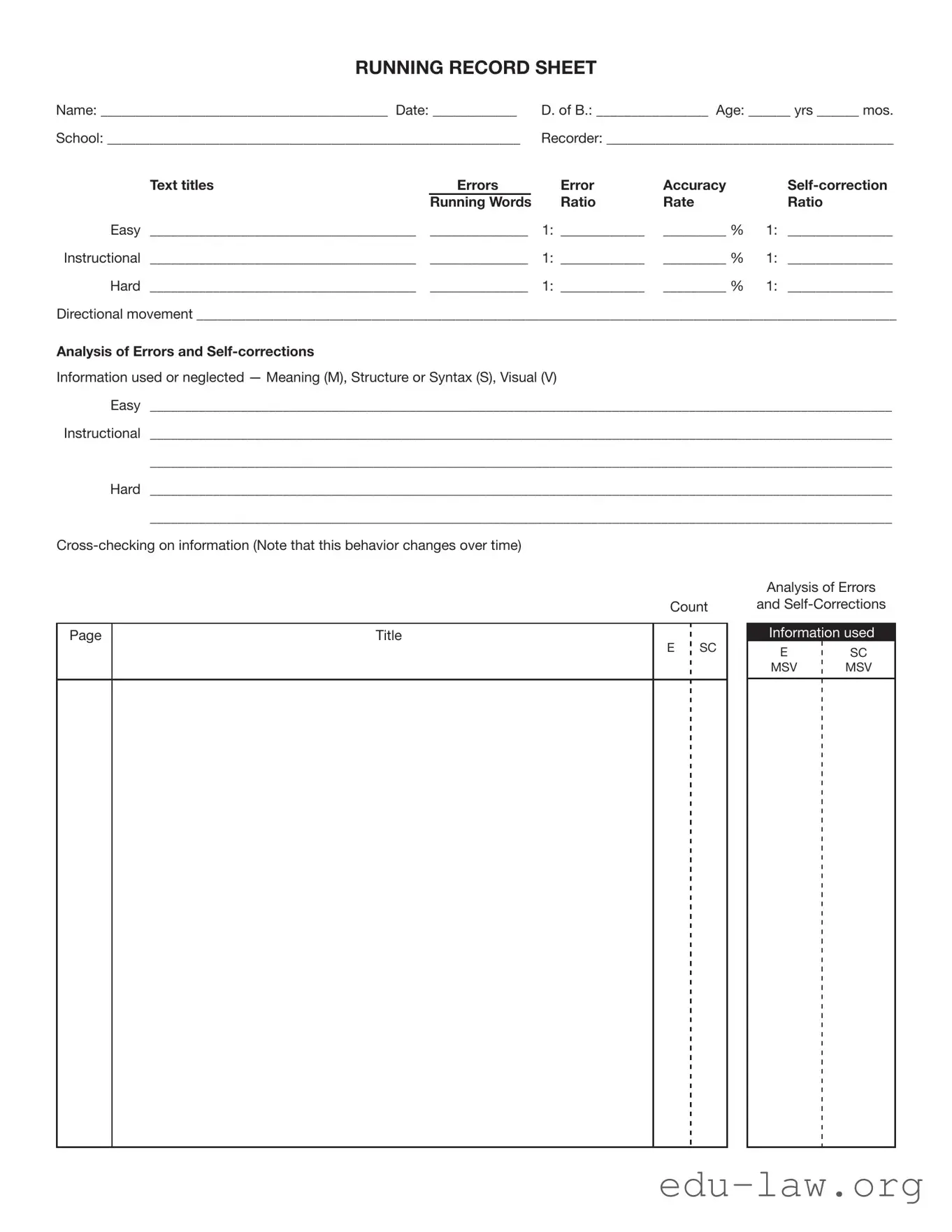
The Running Record Sheet is an essential tool utilized in educational settings to assess a student's reading abilities and comprehension skills. This form captures vital information about the reader, including their name, date, date of birth, age, school, and the recorder's name. It provides a structured format for documenting various text titles and the corresponding errors made during reading. Each entry on the sheet outlines the accuracy of the reading, self-correction rates, and the overall running words ratio. Additionally, the form categorizes texts into three levels of difficulty: easy, instructional, and hard, allowing educators to tailor their teaching strategies accordingly. The analysis section focuses on errors and self-corrections, highlighting the types of information used or neglected by the reader, such as meaning, structure, or visual cues. This comprehensive approach ensures that educators can effectively monitor progress and adapt instruction to meet individual student needs.

RUNNING RECORD SHEET
Name: _________________________________________ Date: ____________ |
D. of B.: ________________ Age: ______ yrs ______ mos. |
|||||
School: ___________________________________________________________ |
Recorder: _________________________________________ |
|||||
|
Text titles |
Errors |
|
Error |
Accuracy |
|
|
|
Running Words |
Ratio |
Rate |
Ratio |
|
Easy |
______________________________________ |
______________ |
|
1: ____________ |
_________ % |
1: _______________ |
Instructional |
______________________________________ |
______________ |
|
1: ____________ |
_________ % |
1: _______________ |
Hard |
______________________________________ |
______________ |
|
1: ____________ |
_________ % |
1: _______________ |
Directional movement ____________________________________________________________________________________________________
Analysis of Errors and
Information used or neglected — Meaning (M), Structure or Syntax (S), Visual (V)
Easy __________________________________________________________________________________________________________
Instructional __________________________________________________________________________________________________________
__________________________________________________________________________________________________________
Hard __________________________________________________________________________________________________________
__________________________________________________________________________________________________________
Page
Title
Count
ESC
Analysis of Errors
and
Information used
ESC
MSV MSV

Page
Title
Count
ESC
Analysis of Errors
and
Information used
ESC
MSV MSV
| Fact Name | Description |
|---|---|
| Purpose | The Running Record Sheet is used to assess a student's reading ability by tracking errors, self-corrections, and overall reading fluency. |
| Components | Key components include student information, text titles, error counts, accuracy percentages, and self-correction rates. |
| Age Range | This form is suitable for students of various ages, typically ranging from preschool to middle school. |
| Instructional Levels | The Running Record Sheet categorizes texts into three levels: Easy, Instructional, and Hard, helping educators select appropriate reading materials. |
| Governing Laws | In many states, the use of assessment tools like the Running Record Sheet is guided by educational laws such as the Every Student Succeeds Act (ESSA). |
| Error Analysis | The form allows for detailed analysis of errors, focusing on meaning, structure, and visual cues to understand student comprehension. |
| Self-Correction Tracking | It tracks self-corrections, which are crucial indicators of a student's ability to monitor their reading and make adjustments. |
| Data Collection | Teachers can use the collected data to inform instruction, tailor interventions, and support individual student needs. |
| Directional Movement | The sheet includes a section for noting directional movement, which can affect reading fluency and comprehension. |
| Usage Flexibility | While the Running Record Sheet is commonly used in classrooms, it can also be adapted for various educational settings, including special education. |
Completing the Running Record Sheet form is essential for accurately assessing reading skills. This process will help you gather valuable insights about a reader's performance, which can guide future instruction. Follow these steps to ensure you fill out the form correctly and comprehensively.
What is a Running Record Sheet?
A Running Record Sheet is a tool used by educators to assess a student's reading ability. It helps track how well a student reads a particular text. The sheet includes sections for noting errors, self-corrections, and overall accuracy. By filling out this form, teachers can gain insights into a student's reading skills and identify areas for improvement.
How do I fill out the Running Record Sheet?
To fill out the Running Record Sheet, start by entering the student's name, date, date of birth, age, school, and the recorder's name at the top. Then, as the student reads, note any errors and self-corrections in the designated sections. Record the text title, the number of errors, the accuracy percentage, and the self-correction ratio for each level of difficulty: easy, instructional, and hard. This process allows for a comprehensive analysis of the student's reading performance.
What do the terms 'Errors' and 'Self-correction' mean on the form?
'Errors' refer to any mistakes a student makes while reading. This could include mispronunciations, omissions, or substitutions of words. 'Self-correction' occurs when a student recognizes their mistake and corrects it without prompting. Both elements are crucial for understanding how a student processes text and can inform teaching strategies to support their learning.
Why is the Analysis of Errors and Self-corrections important?
The Analysis of Errors and Self-corrections section helps educators understand the types of mistakes a student is making. By categorizing errors based on meaning, structure, or visual cues, teachers can identify patterns in a student's reading behavior. This information is vital for tailoring instruction to meet the student's specific needs, ensuring they receive the support necessary to improve their reading skills.
How can I use the Running Record Sheet to support a struggling reader?
The Running Record Sheet can be a valuable resource for supporting struggling readers. By regularly assessing a student's reading using this form, teachers can monitor progress over time. Identifying frequent errors or challenges allows educators to adjust their teaching methods and provide targeted interventions. This might include focused practice on specific types of words or strategies to improve comprehension, ultimately helping the student become a more confident reader.
Failing to provide complete personal information. Many individuals neglect to fill out all sections, such as the name, date, and date of birth. This omission can lead to confusion later.
Incorrectly calculating the error accuracy percentage. It's crucial to ensure that the errors are counted accurately and that the formula for calculating the percentage is followed precisely.
Not distinguishing between easy, instructional, and hard texts. Participants often mislabel the text difficulty, which can affect the overall analysis and understanding of a student's reading level.
Neglecting to analyze errors and self-corrections thoroughly. A superficial review can result in missing important insights about a student's reading strategies and areas needing improvement.
Overlooking the importance of directional movement. Failing to note how a student navigates the text can lead to an incomplete understanding of their reading process.
The Running Record Sheet is a valuable tool for assessing a student's reading abilities. Along with this form, several other documents can enhance the evaluation process. Each of these forms serves a unique purpose, contributing to a comprehensive understanding of a student's progress and challenges. Below is a list of commonly used documents that often accompany the Running Record Sheet.
Each of these documents plays a crucial role in supporting the assessment process. Together with the Running Record Sheet, they provide a holistic view of a student's reading abilities, guiding educators in their efforts to foster growth and development.
The Running Record Sheet is similar to the Reading Assessment Form, which also tracks a student's reading performance. Both documents collect information on the text being read, the errors made, and the accuracy of the reading. The Reading Assessment Form often includes sections for comprehension questions and specific observations about the reader's fluency and expression, providing a broader context for understanding the reader's abilities.
Another comparable document is the Literacy Progress Monitoring Sheet. This form is designed to monitor a student’s growth over time in literacy skills. Like the Running Record Sheet, it records errors and self-corrections but typically focuses more on tracking progress across multiple assessments. It may include benchmarks and goals, allowing educators to see trends in a student's literacy development.
The Observation Checklist is also similar, as it allows educators to document specific behaviors and strategies a student uses while reading. This checklist can highlight strengths and areas for improvement, much like the Running Record Sheet. However, the Observation Checklist emphasizes qualitative observations over quantitative data, providing a different perspective on the student's reading process.
Finally, the Fluency Assessment Form shares similarities with the Running Record Sheet in that it measures a student's reading rate and accuracy. This form often includes timed readings to assess fluency more directly. While the Running Record Sheet focuses on errors and self-corrections, the Fluency Assessment Form specifically targets the speed and smoothness of reading, making it a useful complementary tool for evaluating a student’s overall reading proficiency.
When filling out the Running Record Sheet form, it's essential to keep certain best practices in mind to ensure accuracy and clarity. Here’s a helpful list of what to do and what to avoid:
By following these guidelines, you can help ensure that the Running Record Sheet is filled out effectively, making it a valuable tool for assessing reading progress.
Here are some common misconceptions about the Running Record Sheet form:
When filling out and using the Running Record Sheet form, keep these key takeaways in mind: