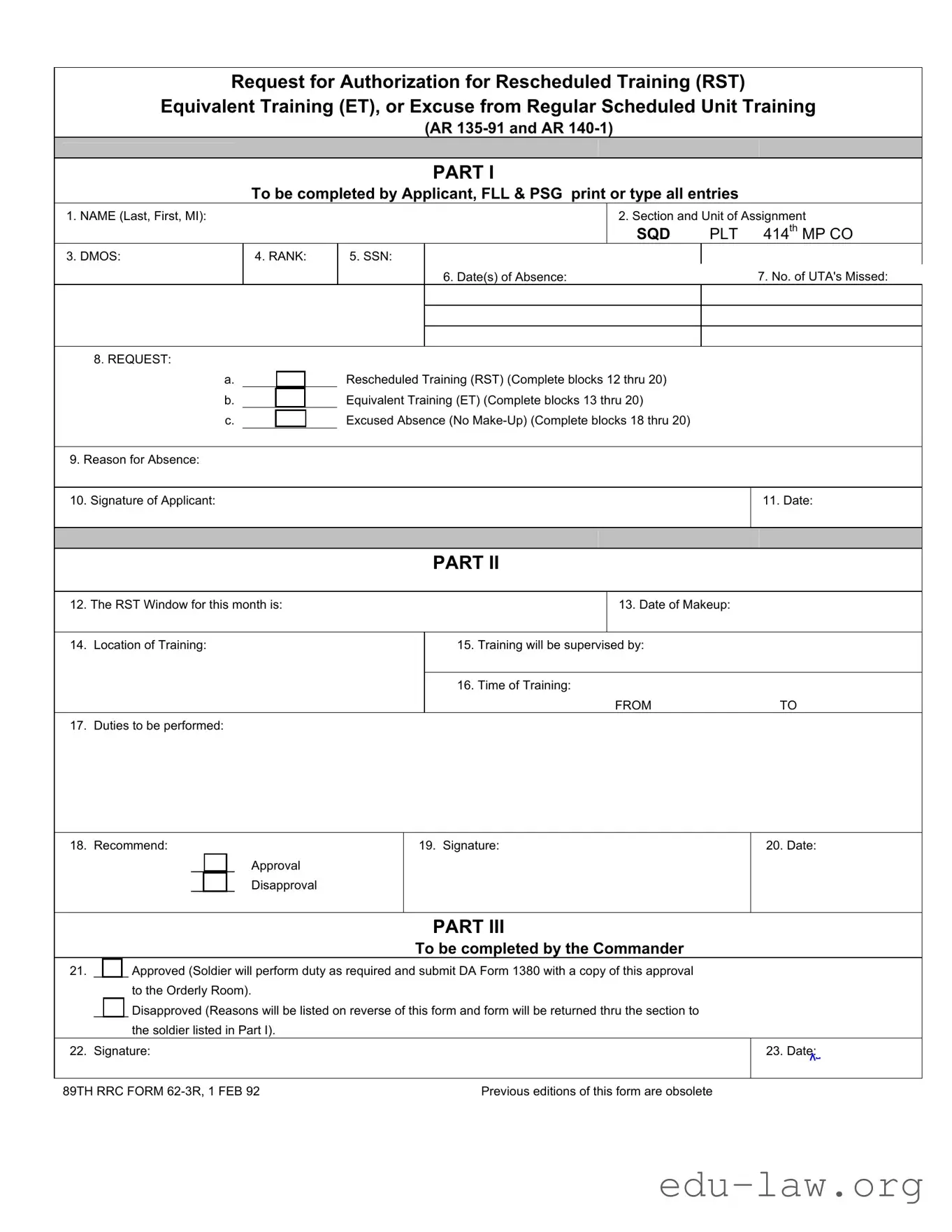
The Request for Authorization for Rescheduled Training (RST) form is an essential document for service members who need to request a change in their training schedule. This form serves multiple purposes, allowing soldiers to seek rescheduled training, equivalent training, or an excused absence from regular unit training. It is divided into three parts, each requiring specific information. In Part I, the applicant, along with their First Line Leader (FLL) and Platoon Sergeant (PSG), must fill in details such as their name, unit assignment, and reason for absence. This section also asks for the dates of absence and the number of Unit Training Assemblies (UTAs) missed. Part II focuses on the logistics of the rescheduled training, including the date, location, and supervising authority. Finally, Part III is reserved for the commander’s approval or disapproval, ensuring that all requests are reviewed and documented appropriately. Understanding this form is crucial for maintaining compliance with Army regulations and ensuring that soldiers can fulfill their training obligations effectively.
Request for Authorization for Rescheduled Training (RST)
Equivalent Training (ET), or Excuse from Regular Scheduled Unit Training
(AR
PART I
To be completed by Applicant, FLL & PSG print or type all entries
1. NAME (Last, First, MI):
2. Section and Unit of Assignment
SQD |
PLT 414th MP CO |
3. DMOS:
4. RANK:
5. SSN:
6. Date(s) of Absence: |
7. No. of UTA's Missed: |
8. REQUEST:
a.
b.
c.
Rescheduled Training (RST) (Complete blocks 12 thru 20) Equivalent Training (ET) (Complete blocks 13 thru 20) Excused Absence (No
9. Reason for Absence:
10. Signature of Applicant:
11. Date:
PART II
12. The RST Window for this month is:
13. Date of Makeup:
14. Location of Training: |
15. Training will be supervised by: |
16. Time of Training:
FROMTO
17. Duties to be performed:
18. Recommend:
_____ Approval
_____ Disapproval
19. Signature:
20. Date:
PART III
To be completed by the Commander
21._____ Approved (Soldier will perform duty as required and submit DA Form 1380 with a copy of this approval to the Orderly Room).
_____ Disapproved (Reasons will be listed on reverse of this form and form will be returned thru the section to
the soldier listed in Part I).
22. Signature: |
|
23. Date: |
|
|
|
89TH RRC FORM |
Previous editions of this form are obsolete |
|
| Fact Name | Details |
|---|---|
| Form Purpose | This form is used to request authorization for rescheduled training, equivalent training, or an excuse from regular scheduled unit training. |
| Governing Laws | The form is governed by AR 135-91 and AR 140-1, which outline the regulations for training and attendance. |
| Applicant Information | Applicants must provide their name, section, unit of assignment, DMOS, rank, SSN, dates of absence, and number of UTAs missed. |
| Training Options | Applicants can request Rescheduled Training (RST), Equivalent Training (ET), or an Excused Absence (No Make-Up). |
| Training Details | Part II of the form requires details such as the RST window, date of makeup, location of training, supervisor, and time of training. |
| Recommendation | In Part II, the applicant must recommend approval or disapproval of the request. |
| Commander’s Role | Part III is for the Commander to approve or disapprove the request, with reasons for disapproval noted on the reverse side. |
| Form Version | The current version of this form is 89TH RRC FORM 62-3R, dated 1 FEB 92. Previous editions are considered obsolete. |
Filling out the RST Army form requires careful attention to detail. Follow these steps to ensure that you complete the form accurately and submit it correctly. Once completed, the form will be reviewed by the appropriate authorities for approval or disapproval.
What is the purpose of the RST Army form?
The RST Army form is designed to formally request authorization for rescheduled training, equivalent training, or an excuse from regular scheduled unit training. It serves as a mechanism for soldiers to document their absences and provide necessary details to their superiors for approval. This ensures that all training requirements are met while accommodating individual circumstances.
Who needs to complete the RST Army form?
The form must be completed by the applicant, which typically includes the soldier requesting the rescheduled training or excuse. Additionally, the First Line Leader (FLL) and Platoon Sergeant (PSG) are required to print or type their entries in the designated sections. This collaborative effort ensures that all relevant parties are informed and involved in the process.
What information is required in Part I of the form?
In Part I, the applicant must provide personal details such as their name, section and unit of assignment, duty military occupational specialty (DMOS), rank, and social security number (SSN). The applicant also needs to specify the dates of absence, the number of Unit Training Assemblies (UTAs) missed, the reason for absence, and their signature along with the date. This section is crucial as it sets the foundation for the request.
How is the training information documented in Part II?
Part II requires the applicant to provide specific details regarding the rescheduled training or equivalent training. This includes the RST window for the month, the date and location of the makeup training, the supervisor overseeing the training, the time of training, and the duties to be performed. The applicant also indicates whether they recommend approval or disapproval of the request. This section ensures that all logistical aspects of the training are clearly outlined.
What happens in Part III of the form?
Part III is designated for the Commander’s review and decision. The Commander will either approve or disapprove the request. If approved, the soldier must perform the required duties and submit a DA Form 1380 along with a copy of the approval to the Orderly Room. If disapproved, reasons will be documented on the reverse side of the form, and it will be returned to the soldier through the section. This final step is essential for maintaining accountability and communication within the unit.
Are there any consequences for not completing the RST Army form?
Failure to complete the RST Army form may lead to a lack of documentation for the absence, potentially resulting in disciplinary actions or missed training opportunities. It is crucial for soldiers to adhere to the process to ensure they receive the appropriate consideration for their circumstances. Proper completion of the form helps maintain the integrity of training schedules and unit readiness.
Omitting Personal Information: Many applicants forget to fill in their full name, including last name, first name, and middle initial. This basic information is crucial for processing the form correctly.
Incorrect Unit Information: Providing the wrong section and unit of assignment can lead to delays. Ensure that the unit information is accurate to avoid confusion.
Missing Dates: Failing to specify the date(s) of absence can result in the form being returned. Always double-check that you’ve included all necessary dates.
Not Indicating the Type of Request: Applicants sometimes forget to select the appropriate request type, whether it's Rescheduled Training (RST), Equivalent Training (ET), or Excused Absence. Each option requires different sections to be filled out.
Insufficient Reason for Absence: Providing vague or unclear reasons for absence can lead to disapproval. Be specific and clear in your explanation to support your request.
Neglecting Signatures: Skipping the signature of the applicant or the commander is a common mistake. Ensure all required signatures are present before submission.
Ignoring the RST Window: Failing to check the RST window for the month can result in submitting a request outside the allowable timeframe. Always verify the current training schedule.
Incomplete Recommendations: Not clearly indicating whether the request is for approval or disapproval can lead to confusion. Be sure to mark your recommendation clearly.
The Request for Authorization for Rescheduled Training (RST) form is an essential document used by military personnel to request changes to their training schedule due to various circumstances. In conjunction with the RST form, several other forms and documents are often utilized to ensure proper processing and approval. Below are four key documents that frequently accompany the RST form.
These documents work together to facilitate a smooth process for managing training schedules and ensuring that soldiers fulfill their obligations while accommodating their individual circumstances. Understanding each form's purpose is crucial for effective communication and compliance within military training environments.
The Request for Leave form is a document that serves a similar purpose to the RST Army form. Both forms are designed to formally request permission for an absence from scheduled duties. The Request for Leave form typically requires the individual to provide their name, unit, reason for the leave, and the dates of absence. Just as the RST form allows for the possibility of rescheduling training, the Request for Leave form also often includes options for leave types, such as annual leave or emergency leave. This similarity highlights the importance of documenting absences and ensuring that proper protocols are followed within military operations.
The DA Form 1380, which is the Record of Individual Performance of Reserve Duty Training, is another document that aligns closely with the RST Army form. Both forms require detailed information about the individual’s training and performance. The DA Form 1380 records actual training performed, while the RST form focuses on requests for rescheduling or excusal from training. This connection emphasizes the need for accurate tracking of training and attendance, ensuring that service members receive appropriate credit for their participation or absences.
The Leave and Earnings Statement (LES) is also comparable to the RST Army form in that it provides essential information about a service member’s status. While the RST form deals with training requests, the LES reflects pay, leave balances, and deductions. Both documents are vital for maintaining accurate records within military personnel management. They serve to inform service members of their entitlements and responsibilities, ensuring clarity in their service obligations.
Lastly, the DA Form 1059, which is used to document the completion of training courses, bears resemblance to the RST Army form. Both forms are integral to the training and development of service members. The DA Form 1059 certifies that an individual has successfully completed a training program, while the RST form allows for the rescheduling or excusal of training. This similarity underscores the importance of documentation in the military, as it helps track progress and ensure that all members are meeting their training requirements effectively.
When filling out the RST Army form, attention to detail is crucial. Here’s a straightforward list of things to do and avoid to ensure your application is processed smoothly.
By following these guidelines, you can help ensure that your RST Army form is filled out correctly and stands the best chance of approval. Good luck!
Here are six common misconceptions about the RST Army form:
Filling out the Request for Authorization for Rescheduled Training (RST) form is an important process for soldiers who need to request a change in their training schedule. Here are some key takeaways to keep in mind:
By following these guidelines, you can navigate the RST form process more smoothly and ensure that your training needs are met effectively.