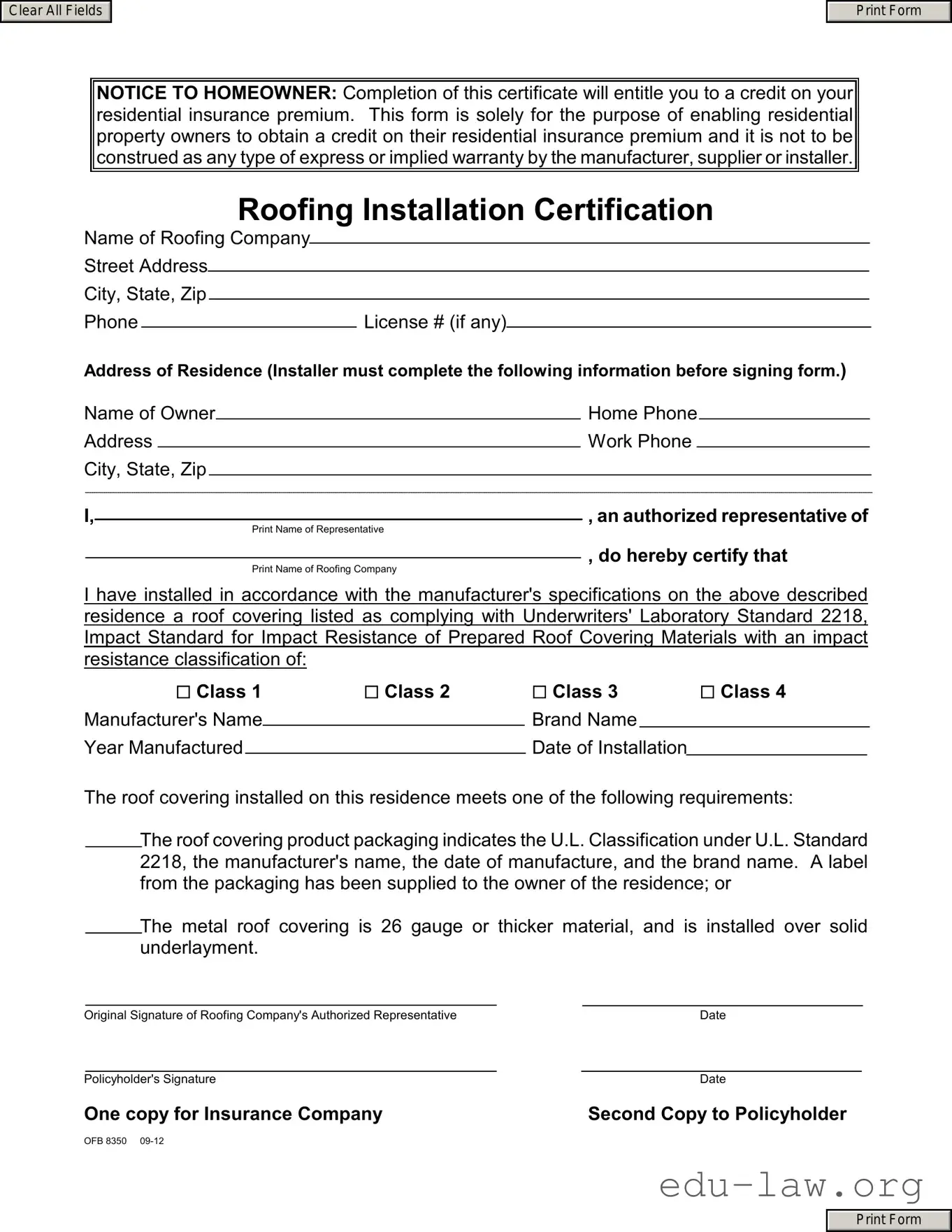
The Roofing Installation Certification form serves as an essential document for homeowners seeking to secure a credit on their residential insurance premiums. By completing this form, homeowners can potentially lower their insurance costs while ensuring that their roofing installation meets specific safety and quality standards. The form requires detailed information about the roofing company, including its name, address, and license number, alongside the homeowner's details, such as name and contact information. An authorized representative from the roofing company must certify that the installation complies with the manufacturer's specifications and meets the Underwriters' Laboratory Standard 2218 for impact resistance. This standard categorizes roofing materials into various classes based on their durability, with options ranging from Class 1 to Class 4. Additionally, the form stipulates that the roof covering must either display the necessary U.L. classification on its packaging or meet specific material requirements if it is a metal roof. Homeowners should be aware that while this certification can lead to insurance benefits, it does not serve as a warranty from the manufacturer, supplier, or installer. Proper completion of this form is crucial for both the homeowner and the roofing company, ensuring that all parties are aligned in their understanding of the installation's compliance and the benefits that may follow.
Clear All Fields
Print Form
NOTICE TO HOMEOWNER: Completion of this certificate will entitle you to a credit on your residential insurance premium. This form is solely for the purpose of enabling residential property owners to obtain a credit on their residential insurance premium and it is not to be construed as any type of express or implied warranty by the manufacturer, supplier or installer.
Roofing Installation Certification
Name of Roofing Company
Street Address
City, State, Zip
PhoneLicense # (if any)
Address of Residence (Installer must complete the following information before signing form.)
Name of Owner |
|
Home Phone |
|
|
|||||
Address |
|
|
|
Work Phone |
|
|
|||
City, State, Zip |
|
|
|
|
|
|
|||
I, |
|
|
, an authorized representative of |
||||||
|
|
||||||||
|
|
|
|
|
Print Name of Representative |
||||
|
|
|
|
|
|
, do hereby certify that |
|||
|
|
|
|
|
|
||||
|
|
|
|
|
Print Name of Roofing Company |
||||
I have installed in accordance with the manufacturer's specifications on the above described residence a roof covering listed as complying with Underwriters' Laboratory Standard 2218, Impact Standard for Impact Resistance of Prepared Roof Covering Materials with an impact resistance classification of:
Class 1 |
Class 2 |
|
Class 3 |
Class 4 |
||||
Manufacturer's Name |
|
|
Brand Name |
|
|
|
||
Year Manufactured |
|
|
|
Date of Installation |
|
|
||
|
|
|
|
|
|
|
|
|
The roof covering installed on this residence meets one of the following requirements:
The roof covering product packaging indicates the U.L. Classification under U.L. Standard 2218, the manufacturer's name, the date of manufacture, and the brand name. A label from the packaging has been supplied to the owner of the residence; or
The metal roof covering is 26 gauge or thicker material, and is installed over solid underlayment.
|
|
|
|
|
Original Signature of Roofing Company's Authorized Representative |
|
Date |
||
|
|
|
|
|
|
Policyholder's Signature |
|
Date |
|
One copy for Insurance Company |
|
Second Copy to Policyholder |
||
OFB 8350 |
|
|
|
|
Print Form
| Fact Name | Details |
|---|---|
| Purpose | This form helps homeowners obtain a credit on their residential insurance premium. |
| Not a Warranty | Completion of this certificate does not imply any warranty from the manufacturer, supplier, or installer. |
| Required Information | Homeowners must provide details about the roofing company, including name, address, and license number. |
| Certification | An authorized representative of the roofing company must certify that the installation meets specific standards. |
| Impact Resistance | The roof covering must comply with Underwriters' Laboratory Standard 2218 for impact resistance. |
| Documentation | Homeowners should receive product packaging or labels indicating U.L. Classification and other details. |
| Gauge Requirement | If using metal roofing, it must be 26 gauge or thicker and installed over solid underlayment. |
| Signature Requirement | The form must be signed by both the roofing company's authorized representative and the policyholder. |
Filling out the Roofing Installation Certification form is a straightforward process. Once completed, this form can help homeowners secure a credit on their residential insurance premium. Ensure that all necessary information is accurate and complete before submitting the form.
What is the Roofing Installation Certification form?
The Roofing Installation Certification form is a document that homeowners can use to certify that their roof has been installed according to specific standards. Completing this form can help homeowners receive a credit on their residential insurance premium.
Who needs to fill out this form?
This form must be completed by an authorized representative of the roofing company that installed the roof. Homeowners should ensure that the roofing company provides all necessary information before signing the form.
What information is required on the form?
The form requires details such as the name of the roofing company, the address of the residence, the name of the owner, and contact information. It also includes information about the roof covering, including its impact resistance classification and the manufacturer's details.
What is the purpose of the certification?
The primary purpose of the Roofing Installation Certification is to enable homeowners to obtain a credit on their residential insurance premium. It does not serve as a warranty from the manufacturer, supplier, or installer regarding the roof's performance.
What does U.L. Standard 2218 mean?
U.L. Standard 2218 refers to a set of criteria established by Underwriters Laboratories that evaluates the impact resistance of roof covering materials. Roofs that meet this standard are classified into four categories based on their resistance to impact.
What are the classifications under U.L. Standard 2218?
The classifications include Class 1, Class 2, Class 3, and Class 4. Class 4 offers the highest level of impact resistance, making it the most desirable for homeowners looking for durable roofing options.
What if my roof covering does not meet the U.L. Standard 2218?
If your roof covering does not meet the U.L. Standard 2218, it may not qualify for the insurance premium credit. Homeowners should consult with their roofing contractor to explore options for compliant materials if this is a concern.
How many copies of the form should be submitted?
The form requires two copies: one for the insurance company and one for the policyholder. This ensures that both parties have a record of the certification.
What happens after I submit the form?
Once the form is submitted to your insurance company, they will review it. If everything is in order, you should see a credit applied to your residential insurance premium. Keep your copy for your records.
Is there a cost associated with obtaining this certification?
Typically, there is no fee for the certification itself, but homeowners should check with their roofing company to confirm if there are any associated costs for the installation or documentation process.
Failing to complete all required fields, such as the roofing company name, address, and license number.
Not providing accurate contact information for both the homeowner and the roofing company.
Overlooking the impact resistance classification of the roof covering, which is crucial for compliance.
Neglecting to include the manufacturer's name and brand name, which are essential for verification.
Forgetting to specify the year of manufacture and the date of installation, leading to potential discrepancies.
Not attaching the required label from the product packaging, which serves as proof of compliance.
Using an incorrect signature or failing to sign the form, which invalidates the certification.
Submitting the form without ensuring that it has been properly dated by both the roofing company representative and the policyholder.
Not keeping a copy of the form for personal records, which can be important for future reference.
Failing to understand that this form is not a warranty, leading to misinterpretation of its purpose.
Along with the Roofing Installation Certification form, several other documents are commonly used in the roofing installation process. These documents help ensure compliance, facilitate communication, and protect the interests of all parties involved. Below is a list of these essential forms.
These documents collectively support the roofing installation process, ensuring clarity and protection for homeowners and contractors alike. Properly managing these forms can help avoid disputes and facilitate a smoother project completion.
The Home Energy Rating Certificate serves a similar purpose to the Roofing Installation Certification form by providing documentation that can lead to financial benefits for homeowners. This certificate assesses the energy efficiency of a home and allows homeowners to qualify for energy efficiency credits or rebates. Just as the Roofing Installation Certification verifies that roofing materials meet specific standards, the Home Energy Rating Certificate confirms that a home meets certain energy performance benchmarks. Both documents aim to enhance property value and reduce costs for homeowners.
The Building Permit is another document that parallels the Roofing Installation Certification. It is required before construction or renovation begins and ensures that the work complies with local building codes. The Roofing Installation Certification, in turn, verifies that the roofing work has been completed according to the manufacturer's specifications and local regulations. Both documents protect homeowners by ensuring that construction meets safety and quality standards, ultimately safeguarding property investments.
The Certificate of Occupancy is similar in that it signifies that a building is safe for occupancy. After construction or significant renovations, this certificate is issued to confirm compliance with building codes. The Roofing Installation Certification, while specific to roofing, also serves to assure homeowners that the roofing work meets industry standards. Both documents provide essential verification that can affect insurance premiums and property values.
The Warranty Certificate for roofing materials is akin to the Roofing Installation Certification, as it provides assurance regarding the quality and longevity of the roofing products used. This document outlines the terms under which the manufacturer will repair or replace defective materials. While the Roofing Installation Certification focuses on installation compliance, both documents work together to assure homeowners of the reliability and safety of their roofing systems.
The Insurance Certificate is another document that shares similarities with the Roofing Installation Certification. It serves as proof of insurance coverage for a specific property or project. Homeowners often present this certificate to their insurance providers to demonstrate compliance with certain risk management practices. Similarly, the Roofing Installation Certification can help homeowners secure discounts on their insurance premiums by verifying that their roofing meets specific safety standards.
The Inspection Report is comparable to the Roofing Installation Certification as it provides an assessment of the quality and safety of a completed roofing installation. This report is often required by insurance companies and can affect coverage rates. Both documents serve to ensure that the work performed meets established standards and can impact the homeowner's financial responsibilities related to insurance.
The Home Improvement Contract is another document that relates to the Roofing Installation Certification. This contract outlines the terms of the work to be performed, including materials and costs. While the Roofing Installation Certification focuses on the completed work's compliance with standards, the Home Improvement Contract establishes the initial agreement between the homeowner and the contractor. Both documents are critical in protecting the interests of homeowners during renovation projects.
Finally, the Manufacturer's Installation Instructions are similar to the Roofing Installation Certification in that they provide detailed guidelines for the proper installation of roofing materials. These instructions ensure that contractors follow the manufacturer's specifications, which is essential for maintaining product warranties. The Roofing Installation Certification confirms that these guidelines were adhered to during the installation process, thus providing additional assurance to the homeowner regarding the quality of the work performed.
When filling out the Roofing Installation Certification form, it is important to ensure accuracy and completeness. Here are nine key actions to take and avoid:
Following these guidelines can help ensure that the certification process goes smoothly and that you receive the appropriate credit on your insurance premium.
Misunderstandings about the Roofing Installation Certification form can lead to confusion for homeowners and roofing professionals alike. Here are ten common misconceptions:
Understanding these misconceptions can help homeowners navigate the roofing certification process more effectively. Clarity on the purpose and requirements of the form is essential for maximizing benefits related to insurance premiums.
Here are key takeaways regarding the Roofing Installation Certification form: