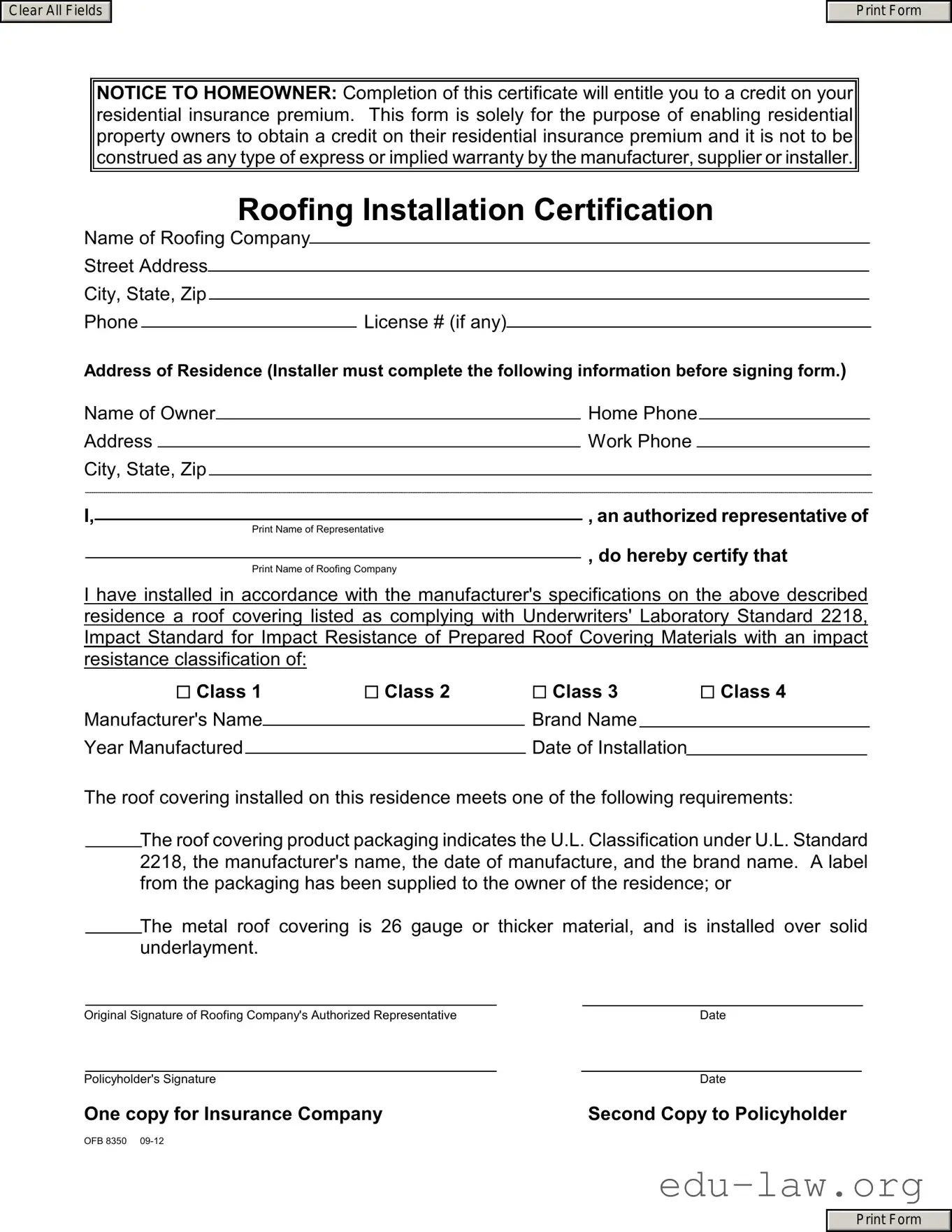
The Roofing Certificate form plays a crucial role in the intersection of home insurance and roofing standards in Texas. Homeowners who complete this form can potentially benefit from reduced residential insurance premiums, incentivizing them to invest in quality roofing materials and installations. This certificate requires detailed information about the roofing company, including its name, address, and license number, ensuring that only qualified professionals are involved in the roofing process. Additionally, the form mandates that the installer provide specific details about the roof covering used, including its compliance with the Underwriters’ Laboratory Standard 2218, which assesses impact resistance. Homeowners must also provide their personal information, including their address and contact numbers, to ensure accurate record-keeping. The form includes a certification statement, signed by an authorized representative of the roofing company, confirming that the installation adheres to the manufacturer's specifications and meets the necessary impact resistance classifications. It is important to note that this certification does not serve as a warranty from the manufacturer, supplier, or installer, but rather as a tool for homeowners to secure premium reductions. Furthermore, the form emphasizes the significance of proper labeling on roofing materials, which must include essential details like the manufacturer’s name and the date of manufacture, reinforcing the standards set forth by the Texas Department of Insurance.
Clear All Fields
Print Form
NOTICE TO HOMEOWNER: Completion of this certificate will entitle you to a credit on your residential insurance premium. This form is solely for the purpose of enabling residential property owners to obtain a credit on their residential insurance premium and it is not to be construed as any type of express or implied warranty by the manufacturer, supplier or installer.
Roofing Installation Certification
Name of Roofing Company
Street Address
City, State, Zip
PhoneLicense # (if any)
Address of Residence (Installer must complete the following information before signing form.)
Name of Owner |
|
Home Phone |
|
|
|||||
Address |
|
|
|
Work Phone |
|
|
|||
City, State, Zip |
|
|
|
|
|
|
|||
I, |
|
|
, an authorized representative of |
||||||
|
|
||||||||
|
|
|
|
|
Print Name of Representative |
||||
|
|
|
|
|
|
, do hereby certify that |
|||
|
|
|
|
|
|
||||
|
|
|
|
|
Print Name of Roofing Company |
||||
I have installed in accordance with the manufacturer's specifications on the above described residence a roof covering listed as complying with Underwriters' Laboratory Standard 2218, Impact Standard for Impact Resistance of Prepared Roof Covering Materials with an impact resistance classification of:
Class 1 |
Class 2 |
|
Class 3 |
Class 4 |
||||
Manufacturer's Name |
|
|
Brand Name |
|
|
|
||
Year Manufactured |
|
|
|
Date of Installation |
|
|
||
|
|
|
|
|
|
|
|
|
The roof covering installed on this residence meets one of the following requirements:
The roof covering product packaging indicates the U.L. Classification under U.L. Standard 2218, the manufacturer's name, the date of manufacture, and the brand name. A label from the packaging has been supplied to the owner of the residence; or
The metal roof covering is 26 gauge or thicker material, and is installed over solid underlayment.
|
|
|
|
|
Original Signature of Roofing Company's Authorized Representative |
|
Date |
||
|
|
|
|
|
|
Policyholder's Signature |
|
Date |
|
One copy for Insurance Company |
|
Second Copy to Policyholder |
||
OFB 8350 |
|
|
|
|
Print Form
| Fact Name | Description |
|---|---|
| Purpose | This form helps homeowners obtain a reduction in their residential insurance premium. |
| Governing Law | Texas Department of Insurance regulations govern this form. |
| Certification Requirement | The roofing company must certify that the installation meets the manufacturer's specifications. |
| Impact Resistance | The roof covering must comply with Underwriters’ Laboratory Standard 2218 for impact resistance. |
| Labeling | All roofing materials must be labeled with the U.L. classification and manufacturer details. |
| Fraud Warning | Any intentional misrepresentation on the form is considered fraud. |
After completing the Roofing Certificate form, you will be able to submit it to your insurance company for a potential reduction in your residential insurance premium. Ensure that all sections are filled out accurately to avoid any delays in processing.
Once completed, retain one copy for the homeowner and send another copy to the insurance company. Make sure to keep the form safe, as any misrepresentation can lead to serious consequences.
What is the purpose of the Roofing Certificate form?
The Roofing Certificate form allows homeowners to certify that their roof has been installed according to specific standards. By completing this form, homeowners can qualify for a reduction in their residential insurance premiums. It is important to note that this form does not provide any warranty from the manufacturer, supplier, or installer.
Who needs to complete the Roofing Certificate form?
The form must be completed by the authorized representative of the roofing company that installed the roof. Additionally, the homeowner must provide their information to ensure that the certificate is valid and tied to the correct property.
What information is required on the Roofing Certificate form?
The form requires details such as the name and address of the roofing company, the homeowner's information, and specifics about the roof installation. This includes the type of roofing material used, its classification under Underwriters’ Laboratory Standard 2218, and the date of installation.
What is Underwriters’ Laboratory Standard 2218?
Underwriters’ Laboratory Standard 2218 is a set of guidelines that evaluates the impact resistance of roofing materials. Roof coverings are classified into four categories based on their ability to withstand impacts, with Class 4 being the highest level of resistance. Homeowners should ensure their roofing materials meet these standards to qualify for insurance premium reductions.
How does a homeowner benefit from completing this form?
By completing the Roofing Certificate form, homeowners can receive a reduction in their residential insurance premiums. This can lead to significant savings over time, especially if the roof is made from high-impact resistant materials that meet the required standards.
What happens if the information on the form is incorrect?
If any information on the Roofing Certificate form is found to be intentionally misrepresented, it could be considered fraud. This could lead to serious consequences, including denial of the insurance premium reduction or legal action against the responsible parties.
How should the completed form be submitted?
The completed Roofing Certificate form should have one copy retained by the homeowner and another submitted to the insurance company. This ensures that both parties have the necessary documentation for the insurance premium reduction process.
Is there a deadline for submitting the Roofing Certificate form?
Incomplete Information: Failing to fill out all required fields can lead to delays or rejection of the form. Ensure that the roofing company name, address, and contact details are complete.
Incorrect Classification: Not accurately indicating the impact resistance classification of the roofing material can cause issues. Double-check that the classification (Class 1, 2, 3, or 4) matches the installed product.
Missing Labels: Forgetting to provide the necessary labels from the roofing product packaging is a common mistake. Ensure that the packaging indicates the U.L. classification, manufacturer’s name, and date of manufacture.
Signature Issues: The form must be signed by an authorized representative of the roofing company. Incomplete or missing signatures can invalidate the certification.
Not Retaining Copies: Failing to keep a copy of the completed form for personal records can lead to complications later. Homeowners should retain one copy, while the second copy should be sent to the insurance company.
When dealing with roofing projects and insurance, several documents work alongside the Roofing Certificate form to ensure clarity and compliance. Understanding these forms can help homeowners navigate the process more smoothly and secure the benefits they deserve.
By familiarizing yourself with these documents, you can approach your roofing project with confidence. Each form plays a vital role in protecting your interests and ensuring a successful outcome. Always consult with professionals to ensure you have the necessary paperwork in order.
The Roofing Certificate form shares similarities with the Home Improvement Contract. Both documents serve as formal agreements between a homeowner and a contractor. The Home Improvement Contract outlines the specific work to be performed, including details about materials and costs. Like the Roofing Certificate, it often includes information about warranties and compliance with local building codes. Homeowners benefit from both documents, as they provide a record of the services rendered and may be necessary for insurance claims or disputes.
Another document akin to the Roofing Certificate is the Certificate of Insurance. This document serves as proof that a contractor carries the necessary insurance coverage for their work. It protects homeowners from potential liabilities associated with accidents or damages that may occur during the roofing project. Similar to the Roofing Certificate, the Certificate of Insurance assures the homeowner that the contractor is qualified and compliant with industry standards, thereby providing peace of mind.
The Warranty Certificate is also comparable to the Roofing Certificate. This document guarantees that the materials used in the roofing installation meet certain quality standards and will be repaired or replaced if they fail within a specified timeframe. Homeowners receive assurance of the durability and performance of their roofing materials, much like the insurance premium reduction offered through the Roofing Certificate. Both documents aim to protect the homeowner's investment and ensure satisfaction with the completed work.
The Building Permit serves a similar purpose as the Roofing Certificate in that it ensures compliance with local regulations. Before beginning a roofing project, homeowners often need to obtain a building permit from their local government. This document verifies that the planned work meets safety and zoning requirements. Just as the Roofing Certificate helps secure insurance premium reductions, a building permit is essential for legal compliance and may be necessary for insurance claims related to the roofing work.
The Inspection Report is another document that parallels the Roofing Certificate. Following the completion of roofing work, an inspection report may be issued to confirm that the installation meets local building codes and safety standards. This report provides documentation that can be beneficial when seeking insurance coverage or selling the property. Both the Inspection Report and the Roofing Certificate serve to validate the quality and compliance of the roofing installation.
The Maintenance Agreement is similar in that it outlines the ongoing responsibilities of the homeowner and the contractor regarding the upkeep of the roof. This document often specifies regular inspections and maintenance tasks that should be performed to ensure the roof's longevity. Like the Roofing Certificate, the Maintenance Agreement is designed to protect the homeowner's investment and may play a role in securing favorable insurance terms.
Lastly, the Contract for Sale of Real Estate can be compared to the Roofing Certificate in that it documents the terms of a property transaction. This contract includes details about the property, including any improvements made, such as roofing installations. Both documents provide essential information that can affect the property's value and insurability. Homebuyers may rely on the Roofing Certificate as part of their due diligence, ensuring that the roofing work has been completed to a standard that justifies the purchase price.
When filling out the Roofing Certificate form, it is important to follow specific guidelines to ensure accuracy and compliance. Here are ten things you should and shouldn't do:
Misconceptions about the Roofing Certificate form can lead to confusion for homeowners. Understanding these misconceptions can help clarify the purpose and requirements of this important document.
While the completion of this certificate may entitle homeowners to a reduction in their insurance premium, it does not guarantee a specific amount. The actual discount depends on the insurance provider's policies.
This certificate is not a warranty. It simply certifies that the roofing installation meets certain standards. Homeowners should look to the manufacturer or installer for warranty information.
Only authorized representatives of roofing companies can complete this form. Homeowners should ensure that the installer is qualified and licensed.
This certificate can apply to both new installations and replacements of existing roofs. Homeowners should confirm that their project meets the necessary criteria.
Many insurance companies require this certification to qualify for discounts. Homeowners should check with their insurer to understand the specific requirements.
The Roofing Certificate does not have an expiration date, but it must be completed accurately at the time of installation to be valid for insurance purposes.
Homeowners should not complete this form themselves. It must be filled out by an authorized representative of the roofing company to ensure its validity.
This certificate can be crucial for future insurance claims. Keeping a copy of the completed form can help homeowners demonstrate compliance with insurance requirements.
When filling out and using the Roofing Certificate form, there are several important points to keep in mind:
Completing this form correctly is crucial for homeowners looking to benefit from potential insurance savings.