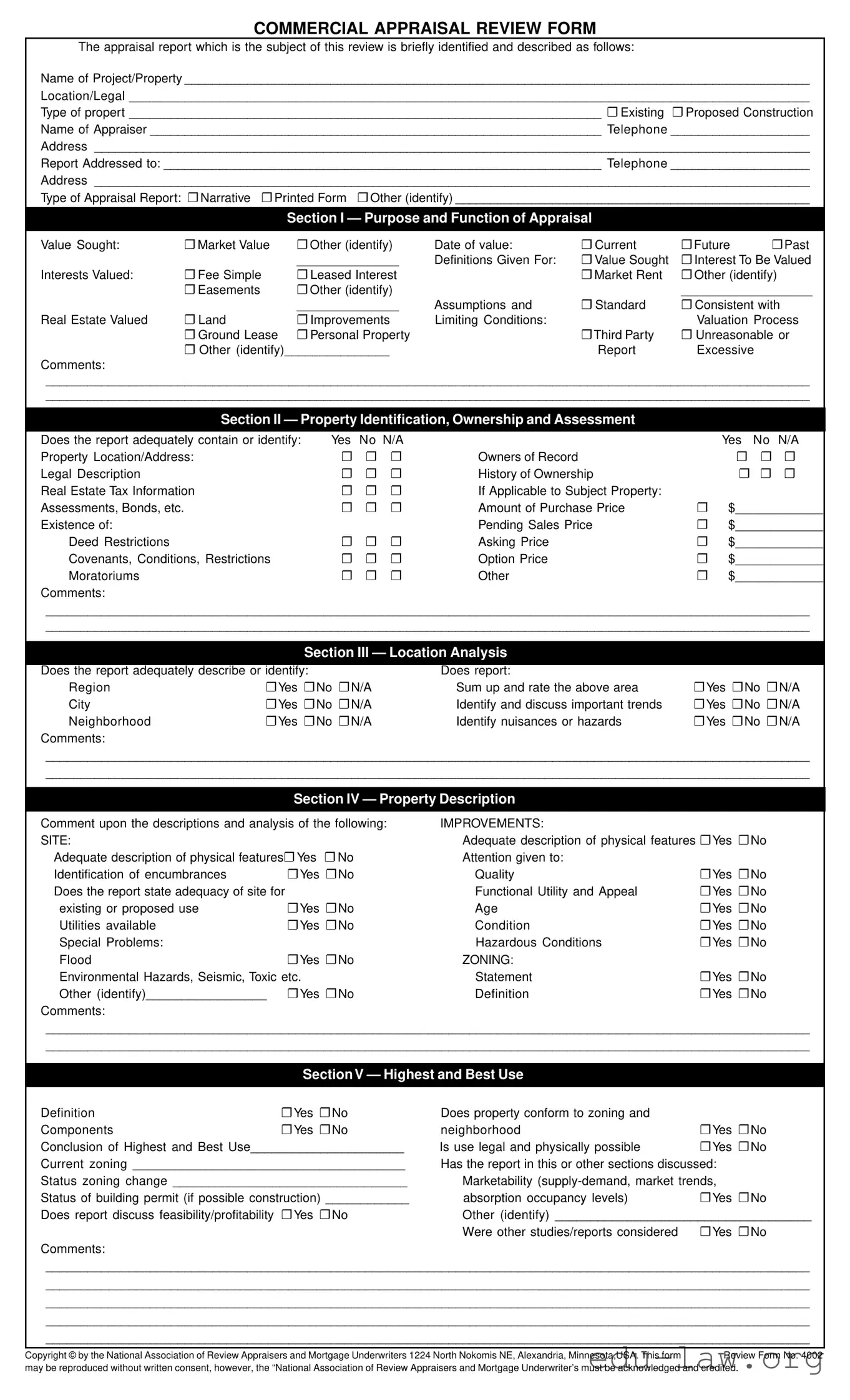
The Review Commercial Appraisal form serves as a comprehensive tool designed to evaluate the quality and accuracy of appraisal reports related to commercial properties. It encompasses various sections that guide the reviewer through critical aspects of the appraisal process. Initially, the form captures essential details about the property, including its name, location, and the type of appraisal report being assessed, whether it be a narrative, printed form, or another format. The reviewer is prompted to consider the purpose of the appraisal, the value sought—such as market value—and the date of that value. Furthermore, the form addresses property identification, ownership, and assessment, ensuring that the report adequately describes the property’s legal status and any pertinent financial information, such as purchase prices and existing restrictions. The location analysis section encourages a thorough examination of the property's surroundings, including regional trends and potential hazards. Additionally, the form evaluates the property description, focusing on improvements and site characteristics, while also addressing zoning and highest and best use considerations. The valuation section allows the reviewer to assess various approaches to value, including cost, sales comparison, and income capitalization methods. Finally, the form concludes with a section for the reviewer’s recommendations, ensuring that all aspects of the appraisal report are systematically analyzed and rated. This structured approach facilitates a clearer understanding of the appraisal's soundness and reliability.

COMMERCIAL APPRAISAL REVIEW FORM
The appraisal report which is the subject of this review is briefly identified and described as follows:
Name of Project/Property __________________________________________________________________________________________
Location/Legal __________________________________________________________________________________________________
Type of propert ____________________________________________________________________ ❐ Existing ❐ Proposed Construction
Name of Appraiser _________________________________________________________________ Telephone ____________________
Address |
_______________________________________________________________________________________________________ |
Report Addressed to: _______________________________________________________________ Telephone ____________________ |
|
Address |
_______________________________________________________________________________________________________ |
Type of Appraisal Report: ❐ Narrative ❐ Printed Form ❐ Other (identify) ___________________________________________________ |
|
Section I — Purpose and Function of Appraisal
Value Sought: |
❐ Market Value |
❐ Other (identify) |
Date of value: |
❐ Current |
❐ Future |
❐ Past |
|
|
______________ |
Definitions Given For: |
❐ Value Sought |
❐ Interest To Be Valued |
|
Interests Valued: |
❐ Fee Simple |
❐ Leased Interest |
|
❐ Market Rent |
❐ Other (identify) |
|
|
❐ Easements |
❐ Other (identify) |
|
|
__________________ |
|
|
|
______________ |
Assumptions and |
❐ Standard |
❐ Consistent with |
|
Real Estate Valued |
❐ Land |
❐ Improvements |
Limiting Conditions: |
|
Valuation Process |
|
|
❐ Ground Lease |
❐ Personal Property |
|
❐ Third Party |
❐ Unreasonable or |
|
|
❐ Other (identify)_______________ |
|
Report |
Excessive |
|
|
Comments: |
|
|
|
|
|
|
______________________________________________________________________________________________________________
______________________________________________________________________________________________________________
Section II — Property Identification, Ownership and Assessment
Does the report adequately contain or identify: |
Yes |
No |
N/A |
|
|
Yes |
No N/A |
|
Property Location/Address: |
❐ |
❐ |
❐ |
Owners of Record |
|
❐ |
❐ |
❐ |
Legal Description |
❐ |
❐ |
❐ |
History of Ownership |
|
|
|
|
Real Estate Tax Information |
❐ |
❐ |
❐ |
If Applicable to Subject Property: |
|
|
|
|
Assessments, Bonds, etc. |
❐ |
❐ |
❐ |
Amount of Purchase Price |
❐ |
$____________ |
||
Existence of: |
|
|
|
Pending Sales Price |
❐ |
$____________ |
||
Deed Restrictions |
❐ |
❐ |
❐ |
Asking Price |
❐ |
$____________ |
||
Covenants, Conditions, Restrictions |
❐ |
❐ |
❐ |
Option Price |
❐ |
$____________ |
||
Moratoriums |
❐ |
❐ |
❐ |
Other |
❐ |
$____________ |
||
Comments: |
|
|
|
|
|
|
|
|
______________________________________________________________________________________________________________
______________________________________________________________________________________________________________
Section III — Location Analysis
Does the report adequately describe or identify: |
Does report: |
|
|
Region |
❐ Yes ❐ No ❐ N/A |
Sum up and rate the above area |
❐ Yes ❐ No ❐ N/A |
City |
❐ Yes ❐ No ❐ N/A |
Identify and discuss important trends |
❐ Yes ❐ No ❐ N/A |
Neighborhood |
❐ Yes ❐ No ❐ N/A |
Identify nuisances or hazards |
❐ Yes ❐ No ❐ N/A |
Comments: |
|
|
|
______________________________________________________________________________________________________________
______________________________________________________________________________________________________________
Section IV — Property Description
Comment upon the descriptions and analysis of the following: |
IMPROVEMENTS: |
|
|
SITE: |
|
Adequate description of physical features ❐ Yes ❐ No |
|
Adequate description of physical features❐ Yes ❐ No |
Attention given to: |
|
|
Identification of encumbrances |
❐Yes ❐ No |
Quality |
❐ Yes ❐ No |
Does the report state adequacy of site for |
|
Functional Utility and Appeal |
❐ Yes ❐ No |
existing or proposed use |
❐Yes ❐ No |
Age |
❐ Yes ❐ No |
Utilities available |
❐Yes ❐ No |
Condition |
❐ Yes ❐ No |
Special Problems: |
|
Hazardous Conditions |
❐ Yes ❐ No |
Flood |
❐Yes ❐ No |
ZONING: |
|
Environmental Hazards, Seismic, Toxic etc. |
Statement |
❐ Yes ❐ No |
|
Other (identify)_________________ |
❐Yes ❐ No |
Definition |
❐ Yes ❐ No |
Comments: |
|
|
|
______________________________________________________________________________________________________________
______________________________________________________________________________________________________________
Section V — Highest and Best Use
Definition |
❐ Yes ❐ No |
Does property conform to zoning and |
|
Components |
❐ Yes ❐ No |
neighborhood |
❐ Yes ❐ No |
Conclusion of Highest and Best Use______________________ |
Is use legal and physically possible |
❐ Yes ❐ No |
|
Current zoning ______________________________________ |
Has the report in this or other sections discussed: |
||
Status zoning change _________________________________ |
Marketability |
||
Status of building permit (if possible construction) ____________ |
absorption occupancy levels) |
❐ Yes ❐ No |
|
Does report discuss feasibility/profitability |
❐ Yes ❐ No |
Other (identify) ____________________________________ |
|
|
|
Were other studies/reports considered |
❐ Yes ❐No |
Comments: |
|
|
|
______________________________________________________________________________________________________________
______________________________________________________________________________________________________________
______________________________________________________________________________________________________________
______________________________________________________________________________________________________________
______________________________________________________________________________________________________________
Copyright © by the National Association of Review Appraisers and Mortgage Underwriters 1224 North Nokomis NE, Alexandria, Minnesota,USA. This formReview Form No. 4002 may be reproduced without written consent, however, the “National Association of Review Appraisers and Mortgage Underwriter’s must be acknowledged and credited.

SECTION VI — Property Valuation
Comment and rate the approaches to value: |
|
|
|
|
||
COST APPROACH: |
Satisfactory |
Unsatisfactory |
DISCOUNTED CASH FLOW ANALYSIS (DCF) |
|
||
Format |
|
❐ |
❐ |
|
Satisfactory |
Unsatisfactory |
Adequacy of data |
|
❐ |
❐ |
Format |
❐ |
❐ |
Source of costs |
|
❐ |
❐ |
Adequacy of data and support for: |
|
|
Land value estimate |
|
❐ |
❐ |
Holding Period |
❐ |
❐ |
Estimated cost new |
|
❐ |
❐ |
Growth Rates |
❐ |
❐ |
Depreciation estimate |
|
❐ |
❐ |
Discount Rate |
❐ |
❐ |
SALES COMPARISON APPROACH: |
|
Development of Cash Flow Estimates ❐ |
❐ |
|||
Format |
|
❐ |
❐ |
Reversionary Value |
❐ |
❐ |
Adequacy of data |
|
❐ |
❐ |
Other Methods of Processing Income |
|
|
Sources of data |
|
❐ |
❐ |
Stream (Mortgage Equity, Band of |
|
|
Summary of sales table |
|
❐ |
❐ |
Investments, etc.) |
❐ |
❐ |
Use of adjustment grid table |
❐ |
❐ |
RECONCILIATION: |
|
|
|
Comparative analysis of sales |
❐ |
❐ |
Indicated values are: |
|
|
|
INCOME CAPITALIZATION APPROACH: |
|
Cost Approach |
$ __________ |
|
||
Format |
|
❐ |
❐ |
Sales Comparison Approach |
$ __________ |
|
Selection of proper capitalization |
|
Income Approach |
$ __________ |
|
||
method |
|
❐ |
❐ |
DCF Analysis |
$ __________ |
|
Adequacy of data and support for: |
|
|
Other (Pending Sale, etc.) |
|
|
|
Comparable Rentals |
|
❐ |
❐ |
Value Conclusion |
|
$ ________ |
Vacancy and Loss Factor |
|
❐ |
❐ |
Allocation as Follows: |
|
|
Operating History |
|
❐ |
❐ |
Land |
$ __________ |
|
Rent Roll |
|
❐ |
❐ |
Improvements |
$ __________ |
|
Income Estimate |
|
❐ |
❐ |
Personal Property |
$ __________ |
|
Expense Estimate |
|
❐ |
❐ |
Other |
$ __________ |
|
Net Operating Income |
|
❐ |
❐ |
Total Value |
|
$ ________ |
Capitalization Rate |
|
❐ |
❐ |
|
|
|
Comments:
______________________________________________________________________________________________________________
______________________________________________________________________________________________________________
______________________________________________________________________________________________________________
______________________________________________________________________________________________________________
Section VII — Other Report Requirements
Does the report contain a certification ❐ Yes |
❐ No |
Does the principal appraiser make |
|
|
|
Is the report |
❐ Yes |
❐ No |
statement of concurrence with value |
|
|
Did the principal appraiser sign the |
|
conclusion |
❐ Yes |
❐ No |
|
report |
❐ Yes |
❐ No |
Does the report contain appraiser(s) |
|
|
Did the principal appraiser personally |
|
qualifications |
❐ Yes |
❐ No |
|
inspect subject property |
❐ Yes |
❐ No |
|
|
|
|
|
|
|
||
|
Section VIII — Final Rating of Appraisal |
|
|
||
|
|
|
|
|
|
|
Acceptable |
Unacceptable |
|
Acceptable |
Unacceptable |
Report Format |
|
|
Property Valuation: |
|
|
Readability and neatness |
❐ |
❐ |
Feasibility/Profitability |
❐ |
❐ |
Mathematical accuracy |
❐ |
❐ |
Market Trends |
❐ |
❐ |
Exhibits (Photos, Maps, etc.) |
❐ |
❐ |
Cost Approach |
❐ |
❐ |
Appraiser’s analytical ability |
❐ |
❐ |
Sales Comparison Approach |
❐ |
❐ |
Purpose and function of appraisal ❐ |
❐ |
Income Approach |
❐ |
❐ |
|
Property identification |
❐ |
❐ |
DCF |
❐ |
❐ |
Locational analysis |
❐ |
❐ |
Reconciliation |
❐ |
❐ |
Property Description |
❐ |
❐ |
Date of Appraisal |
❐ |
❐ |
Site |
❐ |
❐ |
Overall Rating of Appraisal |
|
|
Improvements |
❐ |
❐ |
|
|
|
Highest and Best Use |
❐ |
❐ |
|
|
|
Brief Comments on Unacceptable Ratings:
______________________________________________________________________________________________________________
______________________________________________________________________________________________________________
______________________________________________________________________________________________________________
______________________________________________________________________________________________________________
Section IX — Reviewer’s Conclusions — Recommendations
Scope of Review: |
|
|
If reviewer does not concur with the soundness if conclusion, then |
Read report |
❐ Yes |
❐ No |
what is the recommended action: |
Interviewed appraiser |
❐ Yes |
❐ No |
❐ Totally reject appraisal |
Field Review |
❐ Yes |
❐ No |
❐ Have appraiser rework, revise, update the appraisal |
Does the Reviewer concur with |
|
|
❐ Have another appraisal prepared by someone else |
the soundness of conclusion: |
❐ Yes |
❐ No |
❐ Other |
Concluding Comments:
______________________________________________________________________________________________________________
______________________________________________________________________________________________________________
______________________________________________________________________________________________________________
______________________________________________________________________________________________________________
______________________________________________________________________________________________________________
______________________________________________________________________________________________________________
Reviewer’s Signature _____________________________________________________________________________________________
Name of Reviewer __________________________________________________________________ Date ________________________
Position ___________________________________________________________________________ Department __________________
Address __________________________________________________________________________ Telephone ___________________
City, State, Zip __________________________________________________________________________________________________
Copyright © by the National Association of Review Appraisers and Mortgage Underwriters P.O. Box 879, Palm Springs, California, 92263 USA. This form |
Review Form No. 4002 |
may be reproduced without written consent, however, the “National Association of Review Appraisers and Mortgage Underwriter’s must be acknowledged and credited. |
|
| Fact Name | Description |
|---|---|
| Purpose of the Form | The Review Commercial Appraisal form is designed to evaluate the quality and accuracy of an appraisal report for commercial properties. |
| Key Sections | This form includes sections that address property identification, location analysis, property description, and valuation approaches. |
| Legal Compliance | The form adheres to the regulations set forth by the National Association of Review Appraisers and Mortgage Underwriters. |
| Use of the Form | It is utilized by appraisers, lenders, and reviewers to ensure appraisals meet industry standards and provide reliable value assessments. |
Completing the Review Commercial Appraisal form requires careful attention to detail. Each section must be filled out accurately to ensure a comprehensive review of the appraisal report. Follow these steps closely to ensure all necessary information is provided.
What is the purpose of the Review Commercial Appraisal form?
The Review Commercial Appraisal form serves as a tool for assessing the quality and accuracy of a commercial appraisal report. It allows reviewers to evaluate various aspects of the appraisal, including property identification, valuation methods, and compliance with relevant standards. This form helps ensure that the appraisal meets the necessary requirements for financial decision-making, risk assessment, and property valuation in real estate transactions.
What information is required to complete the Review Commercial Appraisal form?
To complete the form, several key pieces of information must be provided. This includes the name and location of the property being appraised, the appraiser’s details, and the type of appraisal report being reviewed. Additionally, the form requires information about the purpose of the appraisal, the value sought, and various property characteristics such as ownership history, zoning, and any encumbrances. Specific sections also ask for ratings and comments on valuation approaches, property descriptions, and overall report quality.
How does the form assess the valuation methods used in the appraisal?
The form includes a dedicated section that evaluates different valuation approaches, such as the Cost Approach, Sales Comparison Approach, and Income Capitalization Approach. Reviewers are asked to rate the adequacy of data, the format of the analysis, and the selection of appropriate methods. By providing comments on these aspects, the reviewer can highlight strengths or weaknesses in the appraisal's valuation process, ensuring that the conclusions drawn are well-supported and reliable.
What actions can a reviewer recommend if they do not agree with the appraisal conclusion?
If a reviewer finds that they do not concur with the appraisal's conclusions, they have several options for recommended actions. These may include rejecting the appraisal entirely, suggesting that the appraiser revise or update their work, or recommending that a new appraisal be conducted by a different appraiser. The form provides space for the reviewer to detail their reasoning and any additional comments, ensuring that the appraisal process remains transparent and accountable.
Incomplete Information: Failing to provide all necessary details, such as the name of the project or property, can lead to confusion. Each section should be fully completed to ensure clarity.
Incorrect Property Type Selection: Selecting the wrong type of property, whether it is existing or proposed construction, can significantly impact the appraisal process. Accuracy in this selection is crucial.
Neglecting to Specify Value Type: Not indicating the value sought, such as market value or other types, can hinder the appraisal's purpose. Clearly stating this helps guide the review process.
Omitting Relevant Comments: Failing to provide comments in sections where opinions or additional information is requested can result in an incomplete review. Comments often clarify the appraisal's context.
Ignoring Property History: Not including the history of ownership or relevant tax information may lead to misunderstandings about the property's value and marketability. This information is vital for a comprehensive appraisal.
Inadequate Analysis of Location: Overlooking the analysis of location and neighborhood trends can skew the appraisal's findings. A thorough understanding of the area is essential for accurate valuation.
The Review Commercial Appraisal form is often accompanied by several other essential documents that provide a comprehensive understanding of the appraisal process. Below is a list of commonly used forms and documents, along with brief descriptions of their purposes.
These documents collectively support the appraisal process, ensuring that all relevant factors are considered when determining a property's value. Understanding each document's role is crucial for a thorough appraisal review.
The Review Commercial Appraisal form is similar to the Appraisal Report form. Both documents serve the purpose of providing a detailed assessment of a property's value. They include sections that identify the property, describe its characteristics, and outline the valuation methods used. The Appraisal Report form typically presents the appraiser's findings, while the Review Commercial Appraisal form focuses on evaluating those findings and ensuring they meet industry standards.
Another similar document is the Property Condition Assessment (PCA). The PCA evaluates the physical condition of a property, assessing its structural integrity and maintenance needs. Like the Review Commercial Appraisal form, the PCA includes a detailed analysis of the property, including its location, improvements, and any potential issues. Both documents aim to provide a comprehensive understanding of a property’s value and condition, but the PCA emphasizes physical attributes more than financial metrics.
The Commercial Lease Agreement is also akin to the Review Commercial Appraisal form. This document outlines the terms under which a property is leased, including rental rates and responsibilities of both parties. While the Review Commercial Appraisal form focuses on valuation, it indirectly supports lease agreements by providing an understanding of market value, which can influence rental rates. Both documents require a clear presentation of property details and terms.
The Comparative Market Analysis (CMA) shares similarities with the Review Commercial Appraisal form as well. The CMA evaluates property values based on recent sales of similar properties in the area. Both documents involve an analysis of market trends and property characteristics. The Review Commercial Appraisal form takes this further by focusing on the appraisal process and ensuring that the valuation meets specific standards.
The Due Diligence Checklist is another related document. This checklist is used during the purchase or investment process to ensure all necessary evaluations are completed. It often includes assessments of property value, condition, and compliance with regulations. Like the Review Commercial Appraisal form, the Due Diligence Checklist aims to minimize risk by providing a thorough examination of the property in question.
The Environmental Assessment Report (EAR) is also comparable. This report evaluates potential environmental hazards associated with a property, such as contamination or zoning issues. Both the EAR and the Review Commercial Appraisal form require a detailed analysis of the property’s characteristics and how they affect its value. While the EAR focuses on environmental factors, the Review Commercial Appraisal form looks at overall property valuation.
Lastly, the Financial Feasibility Study is similar in its objective to evaluate a property’s potential for investment. This study analyzes costs, revenues, and market conditions to determine if a project is viable. Both documents require a thorough understanding of the property and market conditions. The Review Commercial Appraisal form provides the necessary valuation to support the conclusions drawn in a Financial Feasibility Study.
When filling out the Review Commercial Appraisal form, attention to detail is crucial. Here are some important guidelines to keep in mind:
This is not true. The form can also be used for proposed construction projects. It allows for a comprehensive evaluation regardless of whether the property is already built or still in the planning stages.
While the form contains technical elements, it is designed to be user-friendly. Clear sections guide users through the necessary information, making it accessible for anyone involved in property appraisal.
In reality, the review process considers various factors, including market trends, zoning, and highest and best use. This holistic approach ensures a well-rounded assessment.
While the form helps structure the review, the accuracy of the appraisal ultimately depends on the quality of the data and the appraiser's expertise. The form is a tool, not a guarantee.
Although it is tailored for commercial appraisals, the principles and processes outlined can be applicable to various types of properties. Understanding these concepts can benefit anyone involved in real estate.
The review can be an ongoing process, especially if market conditions change or new information arises. Regular updates can provide a more accurate and current assessment of the property's value.
When filling out and using the Review Commercial Appraisal form, consider the following key takeaways:
By following these guidelines, you can ensure a thorough and effective appraisal review process.