When faced with a cease and desist letter, individuals and businesses often find themselves in a complex situation that requires careful consideration and a thoughtful response. The Response to a Cease and Desist Letter form serves as a crucial tool in navigating these circumstances. This form typically includes sections for identifying the sender and recipient, detailing the specific allegations made in the original letter, and providing a space for the recipient to articulate their position. Additionally, it may outline any counterarguments or defenses that the recipient wishes to present. The form can also include options for negotiating terms or seeking clarification on the issues raised. Understanding how to effectively utilize this form can significantly impact the outcome of the dispute, whether it leads to resolution or further legal action. By addressing the concerns raised in the cease and desist letter, the recipient can assert their rights while attempting to mitigate potential conflicts.
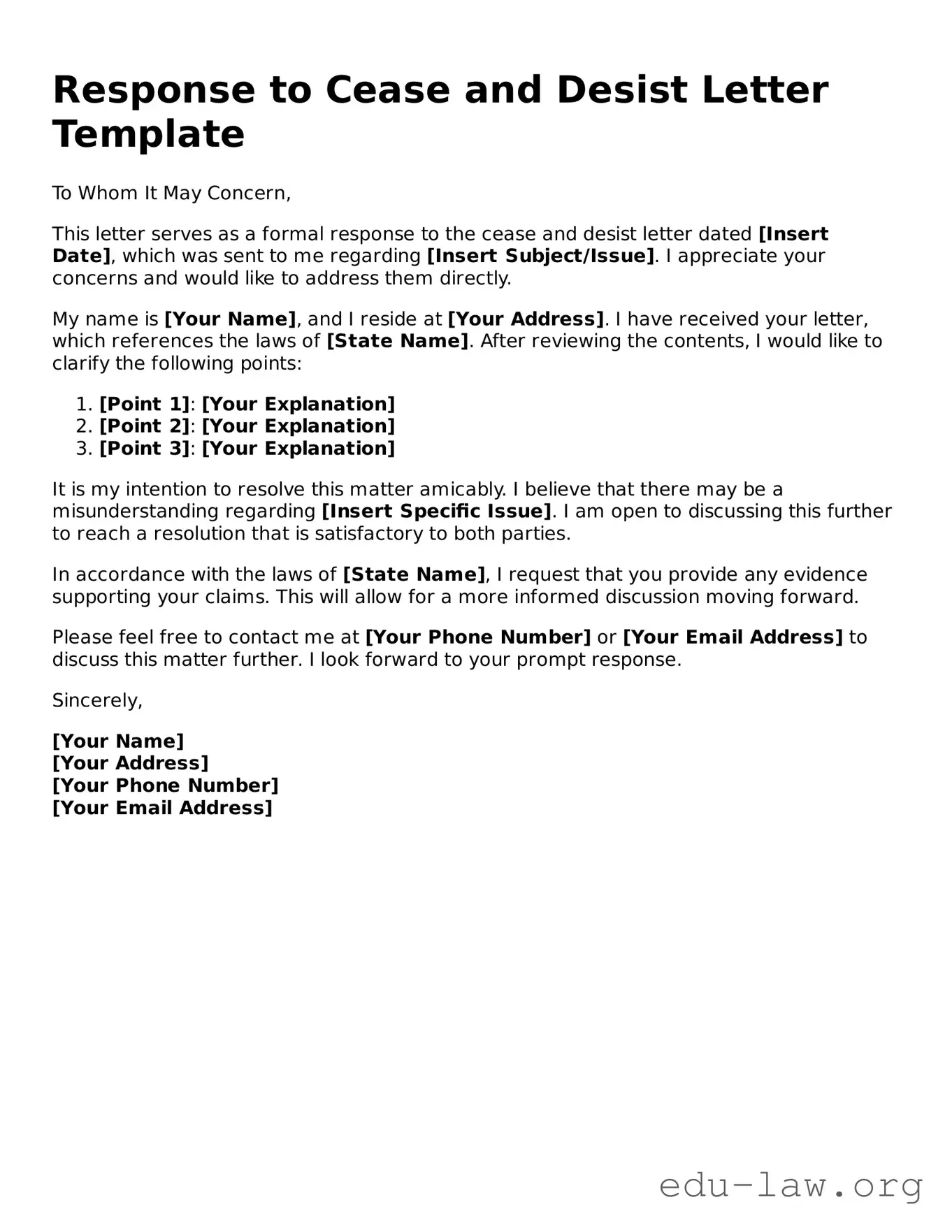
Response to Cease and Desist Letter Template
To Whom It May Concern,
This letter serves as a formal response to the cease and desist letter dated [Insert Date], which was sent to me regarding [Insert Subject/Issue]. I appreciate your concerns and would like to address them directly.
My name is [Your Name], and I reside at [Your Address]. I have received your letter, which references the laws of [State Name]. After reviewing the contents, I would like to clarify the following points:
It is my intention to resolve this matter amicably. I believe that there may be a misunderstanding regarding [Insert Specific Issue]. I am open to discussing this further to reach a resolution that is satisfactory to both parties.
In accordance with the laws of [State Name], I request that you provide any evidence supporting your claims. This will allow for a more informed discussion moving forward.
Please feel free to contact me at [Your Phone Number] or [Your Email Address] to discuss this matter further. I look forward to your prompt response.
Sincerely,
[Your Name]
[Your Address]
[Your Phone Number]
[Your Email Address]
| Fact Name | Description |
|---|---|
| Purpose | The Response to a Cease and Desist Letter is used to formally address claims made in the letter. |
| State-Specific Forms | Some states may have specific forms or requirements for responding to such letters. |
| Governing Laws | Each state has its own laws governing cease and desist letters, which can affect how responses are handled. |
| Content Requirements | The response should clearly state whether the claims are accepted or disputed. |
| Timeliness | Responding promptly is crucial to avoid escalation of the issue. |
| Documentation | Keep a copy of the response and any related correspondence for your records. |
| Legal Advice | Consulting with an attorney before responding is often recommended to ensure proper handling. |
| Potential Outcomes | A well-crafted response may lead to resolution without further legal action. |
After you receive a cease and desist letter, responding appropriately is crucial. Your response can help clarify your position and potentially resolve the issue at hand. Follow these steps to fill out the Response to a Cease and Desist Letter form effectively.
What is a cease and desist letter?
A cease and desist letter is a formal request for an individual or organization to stop engaging in a specific activity that is believed to infringe on rights or cause harm. These letters are often used in cases involving intellectual property, harassment, or contractual disputes. They serve as a warning before legal action is taken.
Why might I receive a cease and desist letter?
You may receive a cease and desist letter for various reasons, including allegations of copyright infringement, trademark violations, defamation, or breach of contract. The sender believes that your actions are unlawful or harmful, and they want you to stop those actions immediately.
What should I do if I receive a cease and desist letter?
First, take the letter seriously. Review its contents carefully to understand the claims being made against you. It's advisable to consult with a legal professional who can help you assess the situation and determine the best course of action. Ignoring the letter could lead to further legal complications.
Can I respond to a cease and desist letter?
Yes, you can respond to a cease and desist letter. In fact, it's often a good idea to do so. Your response can clarify your position, dispute the claims made against you, or outline your intentions moving forward. A well-crafted response can sometimes lead to a resolution without the need for further legal action.
What information should I include in my response?
Your response should include a clear acknowledgment of the cease and desist letter, a detailed explanation of your position, and any relevant evidence that supports your case. If you disagree with the claims, articulate your reasons clearly. Additionally, you may want to propose a resolution or request more information if needed.
Is it necessary to hire a lawyer to respond?
While it's not strictly necessary to hire a lawyer, doing so can be beneficial. A legal professional can help you navigate the complexities of the situation, ensure that your response is appropriate, and protect your rights. They can also provide you with insight into the potential consequences of your actions.
What happens if I ignore the cease and desist letter?
Ignoring a cease and desist letter can have serious consequences. The sender may escalate the situation by pursuing legal action against you. This could lead to costly litigation and potential damages. It's important to take the letter seriously and respond appropriately.
Can a cease and desist letter be challenged?
Yes, a cease and desist letter can be challenged. If you believe the claims are unfounded or that you have a legal right to continue your actions, you can dispute the allegations. This may involve providing evidence or legal arguments to support your position. Consulting with a lawyer can help you determine the best approach.
What if I agree with the cease and desist letter?
If you agree with the claims made in the cease and desist letter, it's important to acknowledge that in your response. You should outline the steps you will take to comply with the request. This might involve ceasing the disputed activity or reaching a settlement with the sender to resolve the issue amicably.
How can I prevent future cease and desist letters?
To prevent future cease and desist letters, it's crucial to understand your legal rights and obligations. Conduct thorough research before engaging in activities that may infringe on others' rights. Consider seeking legal advice when starting new projects, especially those involving intellectual property or contractual agreements. Being proactive can save you time and resources in the long run.
Failing to read the cease and desist letter thoroughly. Understanding the claims made is essential for an effective response.
Not addressing the specific allegations. Each point raised in the letter should be acknowledged and responded to directly.
Using emotional language instead of factual statements. Sticking to the facts helps maintain a professional tone.
Ignoring deadlines. Timely responses are crucial, as delays can negatively impact the situation.
Neglecting to include contact information. Providing clear contact details ensures that communication can continue smoothly.
Not seeking legal advice when needed. Consulting with a legal professional can provide guidance tailored to the specific situation.
Overlooking the importance of documentation. Keeping records of all correspondence can be beneficial for future reference.
Responding with threats or hostility. Maintaining a respectful tone can help de-escalate potential conflicts.
Failing to consider alternative resolutions. Exploring options for compromise can sometimes lead to a more favorable outcome.
When responding to a cease and desist letter, it is essential to consider additional documents that may support your position or clarify your intentions. These documents can help articulate your stance and ensure that all parties understand the context of the situation.
Incorporating these documents into your response strategy can enhance your position and clarify your intentions. Each serves a distinct purpose, and together they can provide a comprehensive view of the situation at hand.
The Response to a Cease and Desist Letter form is similar to a Demand Letter. A Demand Letter is a formal request for action or compensation that one party sends to another. Both documents serve as a means of communication regarding a dispute. While a Demand Letter typically requests a specific action, the Response to a Cease and Desist Letter addresses the claims made in the original letter, providing a counterargument or defense.
Another document that shares similarities is the Legal Complaint. A Legal Complaint initiates a lawsuit and outlines the plaintiff's claims against the defendant. Like the Response to a Cease and Desist Letter, it is a formal document that articulates a party's position. However, the Response focuses on addressing the allegations, while the Legal Complaint seeks to establish the basis for legal action.
The Settlement Agreement is also comparable. This document outlines the terms under which parties agree to resolve a dispute outside of court. Both the Response to a Cease and Desist Letter and the Settlement Agreement aim to clarify positions and may lead to an amicable resolution. However, the Response is reactive, while the Settlement Agreement is proactive in nature.
A Letter of Intent shares some characteristics with the Response to a Cease and Desist Letter. It expresses a party's intention to enter into a formal agreement or negotiation. Both documents convey important information and intentions. However, a Letter of Intent is generally more about future actions, while the Response addresses past actions and claims.
The Memorandum of Understanding (MOU) is another document that bears resemblance. An MOU outlines an agreement between parties, often in a non-binding format. Similar to the Response, it clarifies the understanding between parties. However, the MOU typically focuses on collaboration rather than dispute resolution.
The Notice of Claim is also akin to the Response to a Cease and Desist Letter. A Notice of Claim is often used to inform a party of a potential legal action. Both documents serve as formal notifications regarding disputes. However, the Notice of Claim is usually a precursor to litigation, while the Response directly addresses an existing claim.
The Arbitration Demand is another related document. This form initiates the arbitration process to resolve a dispute outside of court. Similar to the Response, it is a formal communication regarding a disagreement. The key difference lies in the fact that the Arbitration Demand seeks to engage a neutral third party for resolution, while the Response aims to counter the claims made in the cease and desist letter.
A Counterclaim can also be compared to the Response to a Cease and Desist Letter. A Counterclaim is a claim made by a defendant against a plaintiff in response to a lawsuit. Both documents serve to assert a party's position and provide a defense. However, a Counterclaim is filed in the context of ongoing litigation, whereas the Response addresses a pre-litigation communication.
The Release of Claims is another document that bears similarity. A Release of Claims is used to relinquish any future claims against another party. Both the Response and the Release clarify positions regarding disputes. However, the Response focuses on addressing specific allegations, while the Release seeks to finalize a resolution by preventing future claims.
Lastly, a Non-Disclosure Agreement (NDA) can be seen as related. An NDA protects confidential information shared between parties. While the Response to a Cease and Desist Letter addresses claims of infringement or wrongdoing, an NDA serves to safeguard proprietary information. Both documents are important in managing relationships and expectations between parties.
Receiving a cease and desist letter can be alarming, but responding appropriately is crucial. Here’s a list of essential dos and don’ts to guide you through filling out the Response to a Cease and Desist Letter form.
Following these guidelines can help you navigate this situation more effectively. Remember, a calm and measured approach is often the best strategy.
Misconceptions about the Response to a Cease and Desist Letter can lead to confusion and missteps. Here are eight common misunderstandings:
Some believe that they can simply ignore a cease and desist letter. This can escalate the situation and lead to legal action.
Many think that if they disagree with the claims, they do not need to respond. A response can clarify your position and potentially resolve the issue.
Not all letters have legal weight. Some may be sent as a precautionary measure without any legal basis.
Some individuals feel justified in responding aggressively. A calm and professional tone is more effective in these situations.
While legal advice can be beneficial, not every situation requires a lawyer. Assess the complexity of your case first.
These letters can address various issues, including trademark disputes, harassment, or contract violations.
Responding does not eliminate the possibility of negotiation. In fact, it can open the door to a constructive dialogue.
While a professional tone is important, responses can also be straightforward and concise. Clarity is key.
Understanding these misconceptions can help individuals navigate the response process more effectively. Take action promptly and consider your options carefully.
Responding to a cease and desist letter can feel daunting, but understanding the process is essential. Here are some key takeaways to keep in mind:
By following these steps, you can navigate the response process more effectively and protect your interests.