The Residency Letter of Intent form is a crucial document for medical residency applicants, serving as a personal statement that outlines their intentions and motivations for pursuing a specific residency program. This form allows candidates to express their unique experiences, professional goals, and reasons for choosing a particular institution. It typically includes sections where applicants can highlight their clinical experiences, research interests, and personal attributes that make them a suitable fit for the program. Additionally, the form often requires candidates to articulate how their values align with the mission of the residency program. Submitting a well-crafted Letter of Intent can significantly enhance an applicant's chances of standing out in a competitive selection process, making it essential to approach this task with care and consideration.
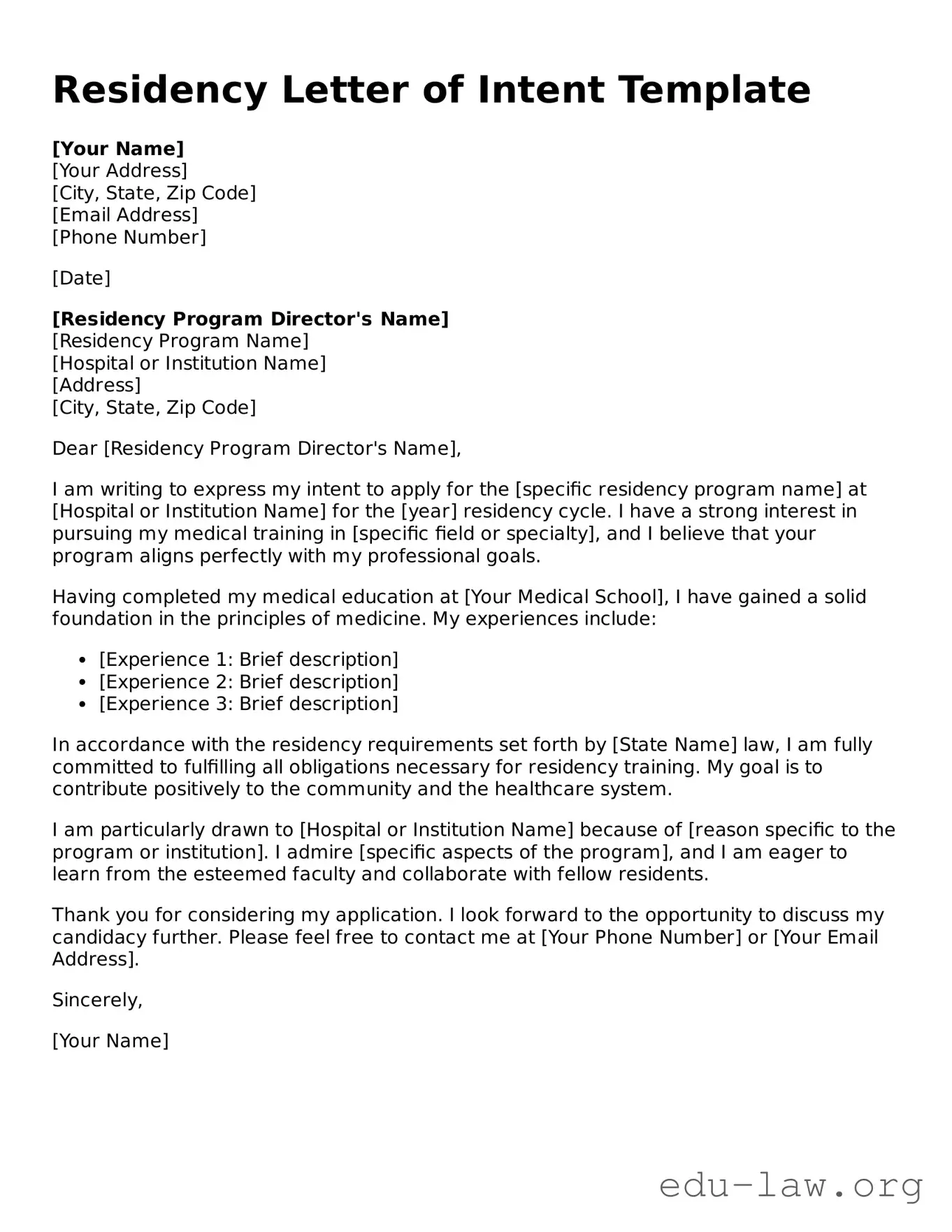
Residency Letter of Intent Template
[Your Name]
[Your Address]
[City, State, Zip Code]
[Email Address]
[Phone Number]
[Date]
[Residency Program Director's Name]
[Residency Program Name]
[Hospital or Institution Name]
[Address]
[City, State, Zip Code]
Dear [Residency Program Director's Name],
I am writing to express my intent to apply for the [specific residency program name] at [Hospital or Institution Name] for the [year] residency cycle. I have a strong interest in pursuing my medical training in [specific field or specialty], and I believe that your program aligns perfectly with my professional goals.
Having completed my medical education at [Your Medical School], I have gained a solid foundation in the principles of medicine. My experiences include:
In accordance with the residency requirements set forth by [State Name] law, I am fully committed to fulfilling all obligations necessary for residency training. My goal is to contribute positively to the community and the healthcare system.
I am particularly drawn to [Hospital or Institution Name] because of [reason specific to the program or institution]. I admire [specific aspects of the program], and I am eager to learn from the esteemed faculty and collaborate with fellow residents.
Thank you for considering my application. I look forward to the opportunity to discuss my candidacy further. Please feel free to contact me at [Your Phone Number] or [Your Email Address].
Sincerely,
[Your Name]
| Fact Name | Description |
|---|---|
| Purpose | The Residency Letter of Intent form is used to declare a person's intent to establish residency in a specific state. |
| Eligibility | Individuals must meet certain criteria to be eligible to submit this form, which may include duration of stay and proof of residency. |
| Governing Laws | Each state has its own laws governing residency, which may include statutes related to domicile and residency requirements. |
| Submission Process | The form typically needs to be submitted to a designated state agency or department, such as the Department of Motor Vehicles. |
| Required Information | Applicants must provide personal information, including name, address, and the date of residency establishment. |
| Supporting Documents | Often, supporting documents are required, such as utility bills or lease agreements, to verify residency claims. |
| Deadlines | There may be specific deadlines for submission, which can vary by state and the purpose of the residency declaration. |
| Consequences of Misrepresentation | Falsifying information on the form can lead to legal penalties, including fines or denial of residency status. |
| Renewal Requirements | Some states may require periodic renewal of residency declarations, depending on the specific laws governing residency. |
Completing the Residency Letter of Intent form is an important step in your application process. After filling out this form, you will be able to submit it along with your other application materials. Ensure that all information is accurate and reflects your intentions clearly.
What is a Residency Letter of Intent?
A Residency Letter of Intent is a formal document that expresses your interest in a specific residency program. It allows you to communicate your motivations, goals, and what you hope to contribute to the program. This letter helps residency directors understand why you are a good fit and what makes you stand out as a candidate.
Why is the Residency Letter of Intent important?
This letter is crucial because it provides an opportunity for you to showcase your personality and passion beyond your application. It can highlight your unique experiences, skills, and aspirations. A well-crafted letter can set you apart from other candidates and strengthen your application by demonstrating your commitment to the program.
What should I include in my Residency Letter of Intent?
Your letter should include several key elements. Start with a brief introduction about yourself and your background. Explain why you are interested in the specific residency program and how it aligns with your career goals. Include any relevant experiences that have prepared you for this residency. Finally, express your enthusiasm for the program and your eagerness to contribute to its community.
How long should the Residency Letter of Intent be?
A Residency Letter of Intent should typically be one page long. Aim for clear and concise writing. Use this space wisely to convey your message without overwhelming the reader. Keeping it to a single page ensures that your letter is easy to read and respects the time of those reviewing your application.
When should I submit my Residency Letter of Intent?
Timing is key when submitting your letter. Ideally, you should send it shortly after your interview or when you feel ready to express your interest in the program. Make sure to check the specific guidelines of the residency program, as some may have particular deadlines for submitting this letter. Sending it at the right time can reinforce your enthusiasm and commitment to the program.
Incomplete Information: Many applicants forget to fill out all required fields. Missing information can delay the review process.
Incorrect Contact Information: Providing outdated or incorrect contact details can lead to missed communications. Always double-check phone numbers and email addresses.
Neglecting to Proofread: Spelling and grammatical errors can create a negative impression. Take the time to review the document for clarity and professionalism.
Failure to Follow Instructions: Each program may have specific guidelines. Ignoring these can result in disqualification or rejection of your application.
Overly Generic Statements: Using vague language can make your intent unclear. Personalize your letter to reflect your unique experiences and motivations.
Missing Signature: Forgetting to sign the form can render it invalid. Ensure that you sign and date the document before submission.
Submitting After the Deadline: Late submissions are often not accepted. Keep track of deadlines to ensure timely delivery of your application.
Ignoring Word Count Limits: Some forms have specific word count requirements. Adhering to these limits is crucial for compliance.
When applying for residency programs, several documents complement the Residency Letter of Intent form. Each of these documents serves a specific purpose and provides additional context to the application. Below is a list of commonly used forms and documents in this process.
Each of these documents plays a vital role in presenting a complete picture of the applicant to residency program directors. Together, they contribute to the overall evaluation process and help determine the best fit for both the applicant and the program.
The Residency Letter of Intent form bears similarities to the Personal Statement often required in residency applications. Both documents serve as platforms for applicants to convey their motivations, aspirations, and personal experiences related to their chosen field. Each document allows candidates to present their unique narratives, emphasizing qualities that make them suitable for residency programs. The Personal Statement, however, tends to focus more on the applicant's journey and reflections, while the Letter of Intent is more directed toward expressing a specific interest in a particular program.
Another document that shares characteristics with the Residency Letter of Intent is the Curriculum Vitae (CV). The CV provides a comprehensive overview of an applicant's academic background, work experience, and achievements. While the CV is fact-based and lists qualifications, the Letter of Intent complements it by adding a personal touch. It allows candidates to articulate their passion for the specialty and the reasons behind their application to a specific residency program, creating a more holistic view of the applicant.
The Statement of Purpose is another document that aligns closely with the Residency Letter of Intent. Both documents aim to clarify the applicant's goals and intentions. The Statement of Purpose typically outlines long-term career objectives and how a particular program fits into those plans. In contrast, the Residency Letter of Intent focuses on immediate intentions for a specific residency, emphasizing the applicant's commitment to that program and their readiness to contribute to its community.
Letters of Recommendation are also relevant to the discussion. While they differ in format and purpose, both the Letter of Intent and Letters of Recommendation aim to support an applicant's candidacy. The Letter of Intent provides a personal narrative from the applicant, while Letters of Recommendation offer insights from mentors or supervisors. Together, they create a fuller picture of the applicant’s capabilities and potential fit within a residency program.
The Statement of Interest is another document that closely resembles the Residency Letter of Intent. Both documents articulate the applicant's enthusiasm for a specific program or opportunity. The Statement of Interest may be more general, while the Letter of Intent is typically more focused on a particular residency program. Both documents serve to communicate the applicant's dedication and interest, aiming to persuade the selection committee of their suitability.
Application Essays often parallel the Residency Letter of Intent in that both require applicants to reflect on their experiences and articulate their motivations. Application Essays may cover broader themes or specific prompts, while the Letter of Intent hones in on the applicant's reasons for choosing a particular residency program. Both documents aim to showcase the applicant's personality, commitment, and readiness for the next step in their career.
The Interview Preparation Document can also be compared to the Residency Letter of Intent. While the former focuses on preparing candidates for interviews by outlining potential questions and answers, the Letter of Intent serves as a prelude to those discussions. Both documents require candidates to think critically about their motivations and experiences, ultimately helping them present themselves effectively during the interview process.
Lastly, the Follow-Up Letter is similar to the Residency Letter of Intent in that it expresses continued interest in a residency program after an initial application. Both documents serve to reinforce the applicant's enthusiasm and commitment. The Follow-Up Letter often addresses specific points of interest discussed during interviews or interactions with program representatives, while the Letter of Intent is more proactive, asserting the applicant's desire to be part of a specific residency program from the outset.
When filling out the Residency Letter of Intent form, it's important to keep certain guidelines in mind. Here are nine things to do and not to do:
Understanding the Residency Letter of Intent can be challenging, and several misconceptions often arise. Here are eight common misunderstandings about this important document:
Filling out the Residency Letter of Intent form is an important step in the application process for residency programs. Here are some key takeaways to keep in mind:
By keeping these points in mind, you can craft a compelling Residency Letter of Intent that stands out to program directors and enhances your application. Good luck!