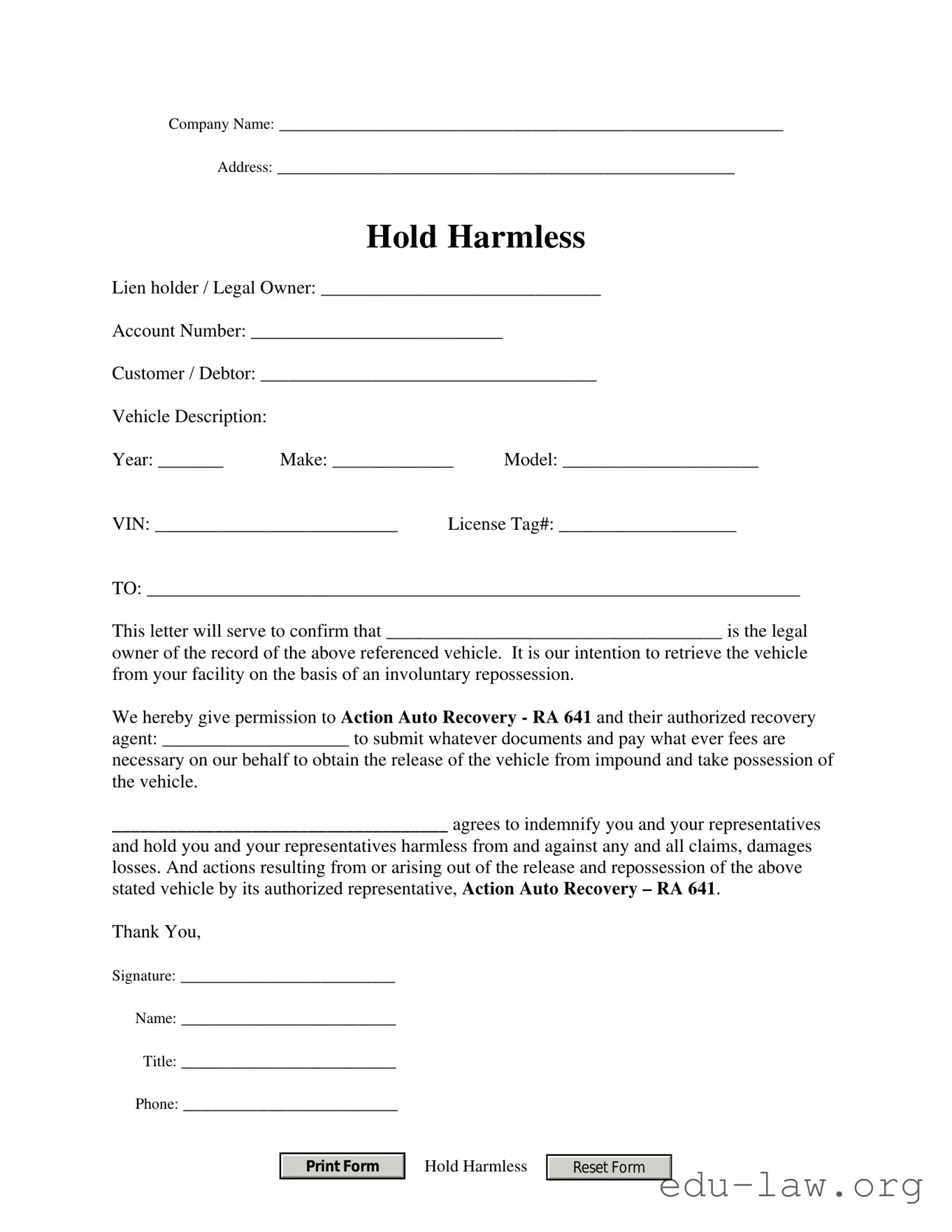
The Repo Order form is a crucial document used in the process of vehicle repossession, particularly when retrieving a vehicle from an impound facility. This form requires specific information, including the company name, address, and details about the lien holder or legal owner. It also captures the account number, customer or debtor information, and a thorough description of the vehicle, including its year, make, model, VIN, and license tag number. The form serves as a confirmation that the listed individual or entity is the legal owner of the vehicle in question. It grants permission to Action Auto Recovery and their authorized recovery agent to act on behalf of the owner in retrieving the vehicle through involuntary repossession. Additionally, the form includes an indemnification clause, where the owner agrees to hold the recovery agent harmless from any claims or damages arising from the repossession process. To ensure compliance with impound regulations, it is important to note that two Hold Harmless forms may be necessary—one for the police department and another for the tow yard. Completing the form accurately and submitting it alongside the required documents, such as the title and contract, is essential for a smooth repossession process. For any inquiries or assistance, the Impound Department can be reached directly.

Company Name: ______________________________________________________
Address: _________________________________________________
Hold Harmless
Lien holder / Legal Owner: ______________________________
Account Number: ___________________________
Customer / Debtor: ____________________________________
Vehicle Description:
Year: _______ |
Make: _____________ |
Model: _____________________ |
|
VIN: __________________________ |
License Tag#: ___________________ |
||
TO: ______________________________________________________________________
This letter will serve to confirm that ____________________________________ is the legal
owner of the record of the above referenced vehicle. It is our intention to retrieve the vehicle from your facility on the basis of an involuntary repossession.
We hereby give permission to Action Auto Recovery - RA 641 and their authorized recovery agent: ____________________ to submit whatever documents and pay what ever fees are
necessary on our behalf to obtain the release of the vehicle from impound and take possession of the vehicle.
____________________________________ agrees to indemnify you and your representatives
and hold you and your representatives harmless from and against any and all claims, damages losses. And actions resulting from or arising out of the release and repossession of the above stated vehicle by its authorized representative, Action Auto Recovery – RA 641.
Thank You,
Signature: _______________________
Name: _______________________
Title: _______________________
Phone: _______________________
Print Form
Hold Harmless
Reset Form
Most Impound vehicles require two Hold Harmless. One for the impounding police agency (police department) and one for the impounding agency (tow yard): ___
Once you complete the form above to the tow yard and print, just scroll up and change the “To:” filed to the police department and print. This will help from re- typing the entire form all over again.
There are two fields you can not enter on the form online. The first field is the name of our repossessor and your signature. Make sure you sign the form and we will enter the name of the recovery agent once we receive the completed forms.
Make sure you Sign both forms and fax them to us along with: the copy of the Title and Contract.
Our Fax number is (562)
If you have any questions please contact our Impound Dept at: (800)
Thank you,
Action Auto Recovery – RA 641
Southern California’s Repossession & Skip Tracing Experts – Since 1967
Serving all of Los Angeles, Orange, Riverside and San Diego Counties Daily
Hold Harmless
| Fact Name | Description |
|---|---|
| Company Information | The form requires the company name and address of the legal owner of the vehicle being repossessed. |
| Legal Owner Confirmation | This document serves to confirm the legal ownership of the vehicle, allowing for involuntary repossession. |
| Indemnification Clause | The form includes a hold harmless clause, indemnifying the recovery agent and representatives from claims related to the repossession. |
| Required Signatures | Both the legal owner and the recovery agent must sign the form to authorize the repossession process. |
| State-Specific Laws | In California, the governing law for repossession is the California Commercial Code, Sections 9600-9615. |
| Contact Information | For inquiries, the form provides a contact number for the Impound Department, ensuring assistance is readily available. |
Completing the Repo Order form is essential for the process of vehicle repossession. After filling out the form, it must be signed and submitted along with necessary documentation. This ensures that the recovery agent can retrieve the vehicle efficiently.
Once completed, remember that two Hold Harmless forms are typically required: one for the tow yard and another for the police department. Modify the “To:” field for the police department before printing the second form. Ensure both forms are signed and faxed along with a copy of the Title and Contract to the specified fax number.
What is the purpose of the Repo Order form?
The Repo Order form is used to authorize the repossession of a vehicle. It confirms that the listed individual or company is the legal owner of the vehicle and allows a recovery agent to retrieve it from an impound facility. This form ensures that all parties involved understand their responsibilities and protects them from potential claims related to the repossession process.
Who needs to sign the Repo Order form?
The Repo Order form must be signed by the legal owner of the vehicle. This is usually the individual or entity listed as the "Hold Harmless Lien holder / Legal Owner." The signature indicates consent for the recovery agent to act on their behalf during the repossession process.
What information is required on the Repo Order form?
You need to provide several details on the form. This includes the company name, address, account number, customer or debtor information, vehicle description (year, make, model, VIN, and license tag number), and the name of the recovery agent. Completing this information accurately is essential for a smooth repossession process.
How do I submit the Repo Order form?
After filling out the Repo Order form, you should print it and sign it. You will need to fax the signed form, along with a copy of the vehicle title and contract, to the designated fax number: (562) 633-9768. Make sure to follow these steps carefully to avoid delays.
Do I need to fill out two forms?
Yes, in most cases, you will need to complete two Hold Harmless forms. One is for the impounding police agency and the other is for the impounding agency, such as a tow yard. You can easily modify the first form for the police department by changing the "To:" field and reprinting it, saving you time.
What should I do if I have questions about the Repo Order form?
If you have any questions or need assistance, you can contact the Impound Department at (800) 421-5528, extension 221. They are available to help you with any concerns you may have regarding the Repo Order form or the repossession process.
Incomplete Information: One common mistake is failing to fill out all required fields. Each section, such as the Company Name, Address, and Vehicle Description, must be fully completed to avoid delays in processing.
Incorrect Vehicle Information: Providing inaccurate details about the vehicle, such as the Year, Make, Model, or VIN, can lead to complications. Always double-check these entries for accuracy.
Neglecting to Sign: Forgetting to sign the form is a frequent oversight. The signature is crucial for validating the order and allowing the recovery agent to act on your behalf.
Failing to Include Hold Harmless Agreements: Many people overlook the requirement for two Hold Harmless agreements. It is essential to prepare one for both the police department and the tow yard.
Not Providing Supporting Documents: Along with the completed form, it is necessary to send copies of the Title and Contract. Omitting these documents can hinder the repossession process.
Ignoring Contact Information: Some individuals forget to include their contact details, such as a phone number. This information is vital for any follow-up communication regarding the repossession.
Submitting the Form to the Wrong Agency: It's important to ensure that the form is sent to the correct entity. Using the wrong "To:" field can result in delays or the form being rejected entirely.
When dealing with vehicle repossession, several forms and documents accompany the Repo Order form. Each of these documents plays a crucial role in ensuring a smooth process. Below is a list of commonly used documents.
Gathering these documents will streamline the repossession process and help avoid potential delays. Ensure that all forms are completed accurately and submitted promptly to facilitate a smooth recovery of the vehicle.
The Repo Order form shares similarities with a Power of Attorney (POA) document. Both serve to authorize another party to act on behalf of the principal. In the case of a Repo Order, the vehicle owner allows a recovery agent to retrieve their vehicle. Similarly, a POA grants an agent the authority to make decisions or take actions regarding legal or financial matters for the principal. Each document requires clear identification of the parties involved and often necessitates a signature to validate the authority granted.
Another document akin to the Repo Order form is a Vehicle Release Authorization. This form allows a vehicle owner to authorize a specific individual or entity to pick up their vehicle from an impound lot or repair shop. Like the Repo Order, it includes vital details such as the vehicle description and the owner's information. Both documents ensure that the recovery or release process is conducted legally and that the vehicle is returned to the rightful owner or their representative.
The Repo Order form is also similar to a Waiver of Liability. This document releases one party from legal claims or liability arising from certain actions. In the Repo Order, the vehicle owner agrees to indemnify the recovery agent against any claims related to the repossession. Both documents are designed to protect the parties involved by clearly outlining responsibilities and limiting liability in specific situations.
A lien release form is another document that shares characteristics with the Repo Order. This form is used to remove a lien from a vehicle once the debt has been satisfied. Like the Repo Order, it identifies the vehicle and the parties involved. Both documents play a crucial role in the ownership transfer process, ensuring that the rightful owner has clear title to the vehicle without encumbrances.
The Repo Order form is also comparable to a Consent to Tow form. This document grants permission for a vehicle to be towed from a specific location, often due to parking violations or other infractions. Similar to the Repo Order, it requires the vehicle owner's consent and includes details about the vehicle. Both forms are essential for ensuring that the towing process is conducted legally and with the owner's knowledge.
Additionally, a Bill of Sale is akin to the Repo Order form in that it facilitates the transfer of ownership of a vehicle. While the Repo Order focuses on the recovery of a vehicle, a Bill of Sale confirms the sale and transfer of ownership from one party to another. Both documents require specific information about the vehicle and the parties involved, serving as legal proof of the transaction.
A Release of Claims form is another document that resembles the Repo Order. This form is used to formally relinquish any claims against a party following a specific event or transaction. In the Repo Order, the vehicle owner agrees to hold the recovery agent harmless from claims arising from the repossession. Both forms are designed to protect parties from future legal disputes and clarify the terms of their agreement.
The Repo Order form is also similar to an Authorization for Release of Information. This document allows one party to access personal or confidential information held by another party. In the context of a Repo Order, the vehicle owner authorizes the recovery agent to retrieve the vehicle, which may involve accessing information from impound facilities. Both documents require clear consent and specify the scope of the authorization granted.
Another related document is a Security Agreement, which outlines the terms under which a borrower grants a lender a security interest in a vehicle. Like the Repo Order, it details the rights and responsibilities of both parties regarding the vehicle. Both documents are crucial in the context of vehicle financing and repossession, ensuring that all parties understand their rights and obligations.
Lastly, a Notification of Repossession form is similar to the Repo Order form. This document is sent to inform the vehicle owner that their vehicle is being repossessed due to non-payment or other breaches of the loan agreement. Like the Repo Order, it includes essential details about the vehicle and the reasons for repossession. Both documents are vital in the repossession process, providing transparency and clarity to the parties involved.
When filling out the Repo Order form, it’s important to be careful and thorough. Here’s a list of things you should and shouldn’t do:
Following these guidelines can help ensure a smoother process for your vehicle's repossession. Take your time and make sure everything is in order before you send it off.
Understanding the Repo Order form is essential for anyone involved in the vehicle repossession process. However, several misconceptions can lead to confusion. Below are ten common misconceptions about the Repo Order form, along with clarifications for each.
By understanding these misconceptions, you can navigate the Repo Order form process more effectively and ensure a smoother experience in vehicle recovery.
Filling out the Repo Order form is a crucial step in the vehicle repossession process. Understanding how to complete this form accurately can make a significant difference in ensuring a smooth recovery. Here are some key takeaways to keep in mind:
By following these guidelines, you can navigate the Repo Order form with confidence and ensure that your vehicle recovery proceeds as smoothly as possible.