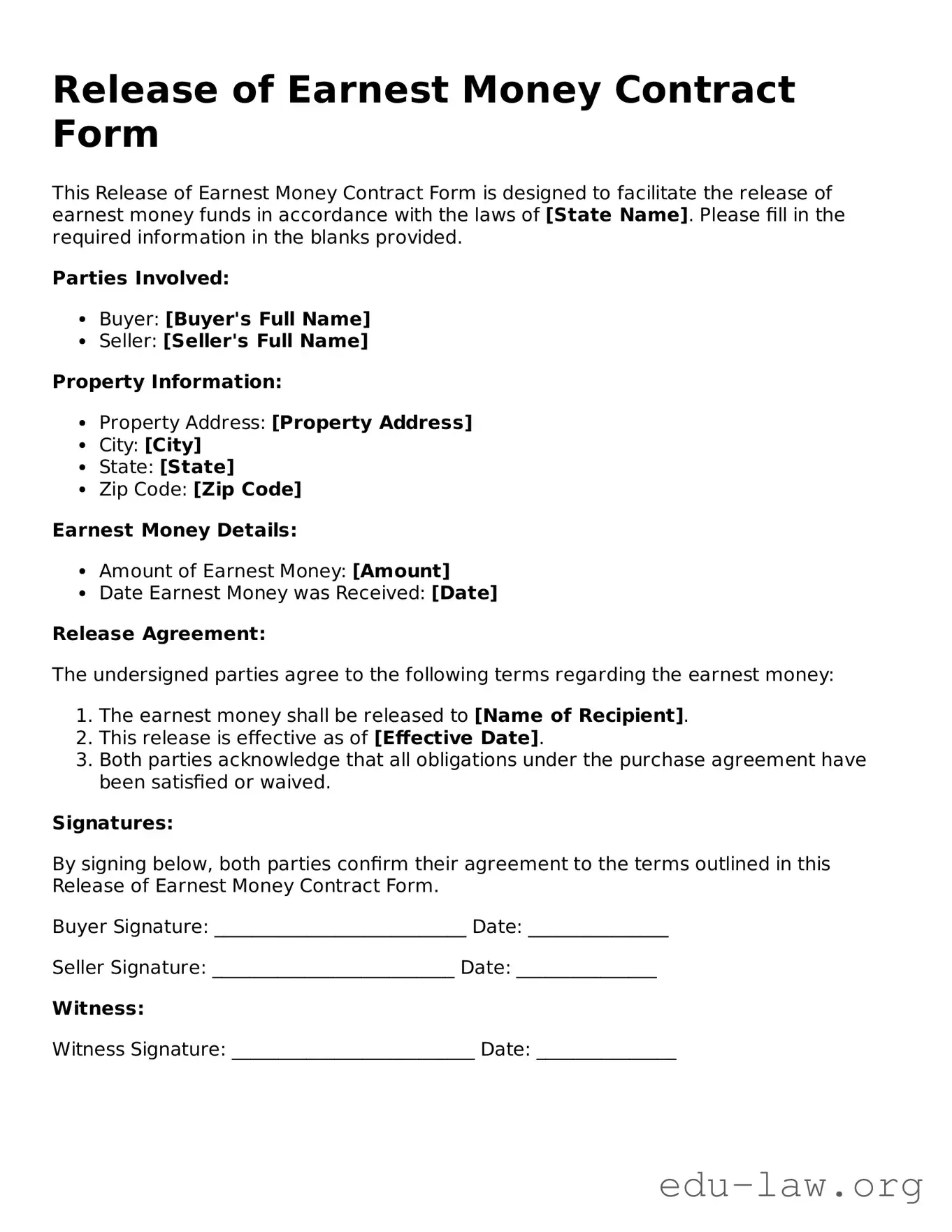
The Release of Earnest Money Contract Form is an essential document in real estate transactions, serving as a formal agreement between parties involved in a property sale. This form primarily addresses the handling of earnest money, which is a deposit made by a buyer to demonstrate their serious intent to purchase a property. In the event of a canceled transaction, the form outlines the conditions under which the earnest money will be released back to the buyer or forfeited to the seller. Key aspects include the identification of the buyer and seller, the property details, and the specific reasons for the release of funds. Additionally, it may include signatures from both parties, ensuring mutual agreement on the terms. Understanding this form can help buyers and sellers navigate the complexities of real estate deals with clarity and confidence.
Release of Earnest Money Contract Form
This Release of Earnest Money Contract Form is designed to facilitate the release of earnest money funds in accordance with the laws of [State Name]. Please fill in the required information in the blanks provided.
Parties Involved:
Property Information:
Earnest Money Details:
Release Agreement:
The undersigned parties agree to the following terms regarding the earnest money:
Signatures:
By signing below, both parties confirm their agreement to the terms outlined in this Release of Earnest Money Contract Form.
Buyer Signature: ___________________________ Date: _______________
Seller Signature: __________________________ Date: _______________
Witness:
Witness Signature: __________________________ Date: _______________
| Fact Name | Description |
|---|---|
| Definition | The Release of Earnest Money Contract Form is a document used to outline the terms under which earnest money is returned to the buyer or forfeited to the seller. |
| Purpose | This form serves to clarify the conditions that must be met for the release of earnest money, preventing disputes between parties. |
| Governing Law | In many states, the release of earnest money is governed by real estate laws, which may vary by jurisdiction. For example, in California, it falls under the California Civil Code. |
| Parties Involved | The form typically involves the buyer, seller, and sometimes the real estate broker, ensuring all parties agree on the terms of the release. |
| Signature Requirement | All parties must sign the form to validate the release of earnest money, making it a legally binding agreement. |
| Time Sensitivity | There may be specific timelines within which the form must be executed, often stipulated in the purchase agreement or state laws. |
After obtaining the Release of Earnest Money Contract Form, you’ll need to complete it accurately to ensure a smooth process. This form is essential for documenting the release of earnest money in a real estate transaction. Follow these steps carefully to fill it out correctly.
What is the Release of Earnest Money Contract Form?
The Release of Earnest Money Contract Form is a legal document used to formally release earnest money from a real estate transaction. This form is typically utilized when a transaction does not proceed to closing, allowing the parties involved to agree on the distribution of the earnest money deposit.
When should I use this form?
This form should be used when a real estate transaction falls through, and the parties need to determine how the earnest money should be handled. Common scenarios include the buyer backing out of the sale, or if the seller fails to meet contractual obligations.
Who needs to sign the Release of Earnest Money Contract Form?
Typically, both the buyer and seller must sign the form. Their signatures indicate mutual agreement on the release of the earnest money. In some cases, if there are additional parties involved, such as real estate agents or attorneys, their signatures may also be required.
What happens if one party refuses to sign?
If one party refuses to sign the Release of Earnest Money Contract Form, it can lead to disputes regarding the earnest money. In such cases, it may be necessary to seek legal advice or mediation to resolve the issue. The funds may remain in escrow until an agreement is reached or a court order is obtained.
Is there a deadline for submitting this form?
While there is no universal deadline, it is advisable to submit the form as soon as possible after the decision to terminate the contract is made. Delays may complicate the release process and could lead to disputes over the earnest money.
Can I modify the Release of Earnest Money Contract Form?
What if the earnest money is disputed?
In the event of a dispute over the earnest money, the parties may need to negotiate a resolution or seek legal intervention. It may involve mediation or arbitration, depending on the terms of the original contract. Legal advice is recommended to navigate these disputes effectively.
Where can I obtain the Release of Earnest Money Contract Form?
The form can typically be obtained from real estate agents, brokers, or legal professionals. Additionally, many online legal services provide templates that can be customized to fit your specific situation.
Failing to include all parties' names: It's crucial to list the names of everyone involved in the transaction. Missing a name can lead to complications later.
Not specifying the reason for the release: Clearly stating why the earnest money is being released helps avoid misunderstandings and provides clarity to all parties.
Using incorrect dates: Ensure that all dates are accurate. Mistakes in dates can lead to disputes about timelines and obligations.
Omitting signatures: Every party involved must sign the form. Without signatures, the document may not be considered valid.
Leaving out the amount of earnest money: Clearly state the exact amount being released. This detail is essential for financial clarity.
Not providing contact information: Including contact details for all parties ensures that communication remains open and accessible.
Failing to date the signatures: Each signature should be accompanied by the date it was signed. This provides a timeline for the agreement.
Using unclear language: Avoid vague terms. Clear and precise language prevents confusion and misinterpretation.
Not reviewing the form before submission: Always double-check the completed form for errors. A quick review can save time and prevent issues later.
Ignoring local laws and regulations: Different states may have specific requirements for such forms. Familiarize yourself with local laws to ensure compliance.
The Release of Earnest Money Contract Form is an important document in real estate transactions. It helps clarify the terms regarding the return of earnest money, which is a deposit made by a buyer to show their commitment to purchasing a property. Alongside this form, several other documents are often used to ensure a smooth transaction. Below is a list of commonly associated forms and documents.
Each of these documents plays a vital role in the real estate transaction process. They help protect the interests of all parties involved and ensure that the transaction proceeds smoothly. Proper attention to these forms can prevent misunderstandings and disputes down the line.
The Release of Earnest Money Contract Form is closely related to the Purchase Agreement. This document outlines the terms of the sale, including the purchase price, contingencies, and the timeline for closing. When a buyer and seller enter into a Purchase Agreement, earnest money is typically deposited to show good faith. If the deal falls through, the Release of Earnest Money Contract Form is used to determine how the earnest money will be handled, ensuring that both parties agree on the next steps.
Another document that bears similarity is the Earnest Money Receipt. This receipt serves as proof that the buyer has submitted earnest money to the seller or their agent. It details the amount paid and the terms under which the money is held. If a transaction does not proceed as planned, the Release of Earnest Money Contract Form will reference the Earnest Money Receipt to clarify the amount in question and the conditions for its return or forfeiture.
The Buyer’s Agency Agreement is also relevant. This document establishes a formal relationship between a buyer and a real estate agent, outlining the agent's duties and the buyer's obligations. If a buyer decides to back out of a deal, the Release of Earnest Money Contract Form can come into play to address how the earnest money is affected by the terms set forth in the Buyer’s Agency Agreement.
Similarly, the Seller’s Disclosure Statement is important in this context. This document provides potential buyers with information about the property's condition and any known issues. If a buyer finds undisclosed problems and opts to withdraw from the transaction, the Release of Earnest Money Contract Form will help facilitate the return of earnest money, depending on the circumstances outlined in the Seller’s Disclosure Statement.
The Cancellation of Contract form is another document that aligns with the Release of Earnest Money Contract Form. When a contract is canceled, this form officially terminates the agreement between the buyer and seller. The Release of Earnest Money Contract Form is often used in conjunction with this cancellation to ensure that any earnest money is handled appropriately, based on the reasons for the cancellation.
The Addendum to Purchase Agreement can also be connected to the Release of Earnest Money Contract Form. An addendum may modify specific terms of the original Purchase Agreement. If changes lead to a buyer withdrawing from the deal, the Release of Earnest Money Contract Form will clarify how the earnest money is affected by those modifications.
Another related document is the Closing Statement. This statement outlines all financial transactions that occur at the closing of a real estate deal. If a buyer does not complete the purchase, the Release of Earnest Money Contract Form may reference the Closing Statement to determine how the earnest money fits into the overall financial picture of the transaction.
The Termination Agreement is also similar. This document is used when both parties agree to end a contract without proceeding to closing. The Release of Earnest Money Contract Form will be necessary to address the earnest money and ensure that both parties understand their rights and obligations regarding the funds.
Lastly, the Letter of Intent is relevant in this discussion. While not a binding contract, it expresses a buyer’s interest in purchasing a property and may include terms for earnest money. If negotiations fall through after a Letter of Intent is submitted, the Release of Earnest Money Contract Form may be needed to clarify the status of the earnest money, ensuring that both parties are on the same page regarding the next steps.
When filling out the Release of Earnest Money Contract Form, it’s essential to approach the process with care. Here are some key do's and don'ts to keep in mind:
Understanding the Release of Earnest Money Contract Form is essential for anyone involved in real estate transactions. However, several misconceptions can lead to confusion. Here are five common myths explained:
This is not true. The Release of Earnest Money Contract Form can be used in various situations, including when both parties agree to terminate the contract amicably.
In reality, either party can initiate the request. Sellers can also seek the release if they believe the buyer has not fulfilled their obligations.
Filling out the form does not automatically ensure that the earnest money will be returned. The decision depends on the terms outlined in the purchase agreement and the circumstances surrounding the transaction.
While it is wise to consult an attorney for legal advice, the form itself is straightforward and can often be filled out by the parties involved without legal assistance.
This is incorrect. The Release of Earnest Money Contract Form is applicable in both residential and commercial real estate transactions.
When dealing with the Release of Earnest Money Contract Form, it’s essential to understand its purpose and the correct way to fill it out. Here are some key takeaways to keep in mind: